
Dryer Vent Cleaning Cost: What You Should Pay in 2026
Dryer vent cleaning is one of the few home services where the price should be simple. There is one vent, one run, one job. Yet quotes across the Philadelphia suburbs swing from suspiciously cheap coupons to inflated "emergency" rates. This guide breaks down what the work actually costs in 2026, why vent location changes the price, when a deep cleaning is genuinely necessary, and how to pay a fair rate the first time.
How Much Does Dryer Vent Cleaning Cost in 2026?
Across the industry, a standard residential dryer vent cleaning runs roughly $100 to $200 — that is the range national cost guides like Angi and HomeGuide report for a typical home. Where a specific quote lands inside that range usually depends on three things: where the dryer sits in the house, how long the vent run is, and whether the company charges a flat rate or bills by the foot and by the "finding."
At E Cleaning, we removed the guesswork a different way. Every job starts with a free video inspection inside the vent line, so the quote is based on what your vent actually needs — not a phone estimate that grows once the truck arrives. You get one flat, written number before any work begins, and it covers the whole job: no trip fee, no per-foot surcharge, no upsell at the door. The quote you approve is the invoice you pay.
| Job type | How it's priced | What it covers |
|---|---|---|
| Typical market range (standard cleaning) | $100–$200, per Angi and HomeGuide | Varies by company; watch for per-foot billing and trip fees |
| E Cleaning — routine cleaning | Flat written quote after a free video inspection | Full run cleaned from dryer connection to exterior termination, video inspection included |
| E Cleaning — deep cleaning | Scoped honestly as its own service; flat written quote before work begins | Nest removal, severely packed lines, very long or roof-terminated runs, years of neglect |
| Air duct cleaning (add dryer vent the same visit) | One combined written quote for the whole visit | One crew, one appointment — ask about combined-visit pricing when you book |
Why Does an Upper-Floor Dryer Cost More to Service?
The difference between a basement job and an upper-floor job is not arbitrary — it reflects real labor, which is why upstairs laundry rooms are quoted higher across the industry. A basement or first-floor dryer usually has a short, direct run to an exterior wall. An upper-floor laundry room is a different animal: the vent often travels down through a wall cavity, turns through two or three elbows, and exits high on the siding or through the roof.
Every elbow in that run is a lint trap. Airflow slows at each turn, lint drops out of the airstream, and buildup starts exactly where a homeowner's brush kit can't reach. Reaching the exterior termination on a second-story wall also means ladder work, and cleaning the full run — not just the first few feet behind the dryer — takes more time and longer rods. That is exactly what the free video inspection settles before you commit: you see the layout and the buildup for yourself, and the flat written quote covers the entire run, however many elbows your builder installed.
What Does a Deep Cleaning Cost, and When Do You Actually Need One?
A deep cleaning is a genuinely bigger job than routine maintenance, so we scope and quote it as its own service — and most homes never need one if the vent gets routine annual service. Deep cleanings exist for the situations a standard cleaning can't handle in one pass:
- Bird or rodent nests in the line. Birds love the warm, sheltered opening of a dryer vent. Nest material has to be extracted carefully, section by section, and the termination fitted with a proper guard afterward.
- Very long runs. Vents that travel 25 feet or more, especially with multiple elbows, hold far more lint and take substantially longer to clear end to end.
- Years of neglect. When a vent hasn't been touched in five or ten years, lint compacts into dense plugs that a quick brush pass won't move. These lines need repeated agitation and vacuum extraction.
- Roof-terminated vents. Vertical runs that exit through the roof combine height, gravity working against you, and terminations that clog faster than wall caps.

What "years of neglect" looks like
This is the kind of lint volume we pull out of lines that were never professionally cleaned. When a vent is this far gone, the dryer has usually been limping for months — clothes taking two cycles, the laundry room getting hot and humid, a faint burning smell on long loads. A standard cleaning gets most vents back to full airflow; a line packed like this is deep-cleaning territory.
We confirm which one you need before we quote it. Every job starts with a free video inspection inside the duct, so you see the actual condition of your line — and you're never paying for a deep cleaning your vent doesn't require.
Why Are Roof Vents More Complicated?
Roof-terminated dryer vents are the hardest configuration in the trade, and they're common in townhomes and newer two-story construction around Montgomery and Chester counties where the laundry moved upstairs. Three things make them tougher. First, the run is vertical, so the dryer's blower has to push moist, lint-heavy air straight up against gravity — any weakness in airflow and lint starts settling in the pipe. Second, roof caps and their screens clog faster than wall terminations, and a blocked cap chokes the whole system. Third, servicing one safely means roof access, fall protection, and often working around a steep pitch.
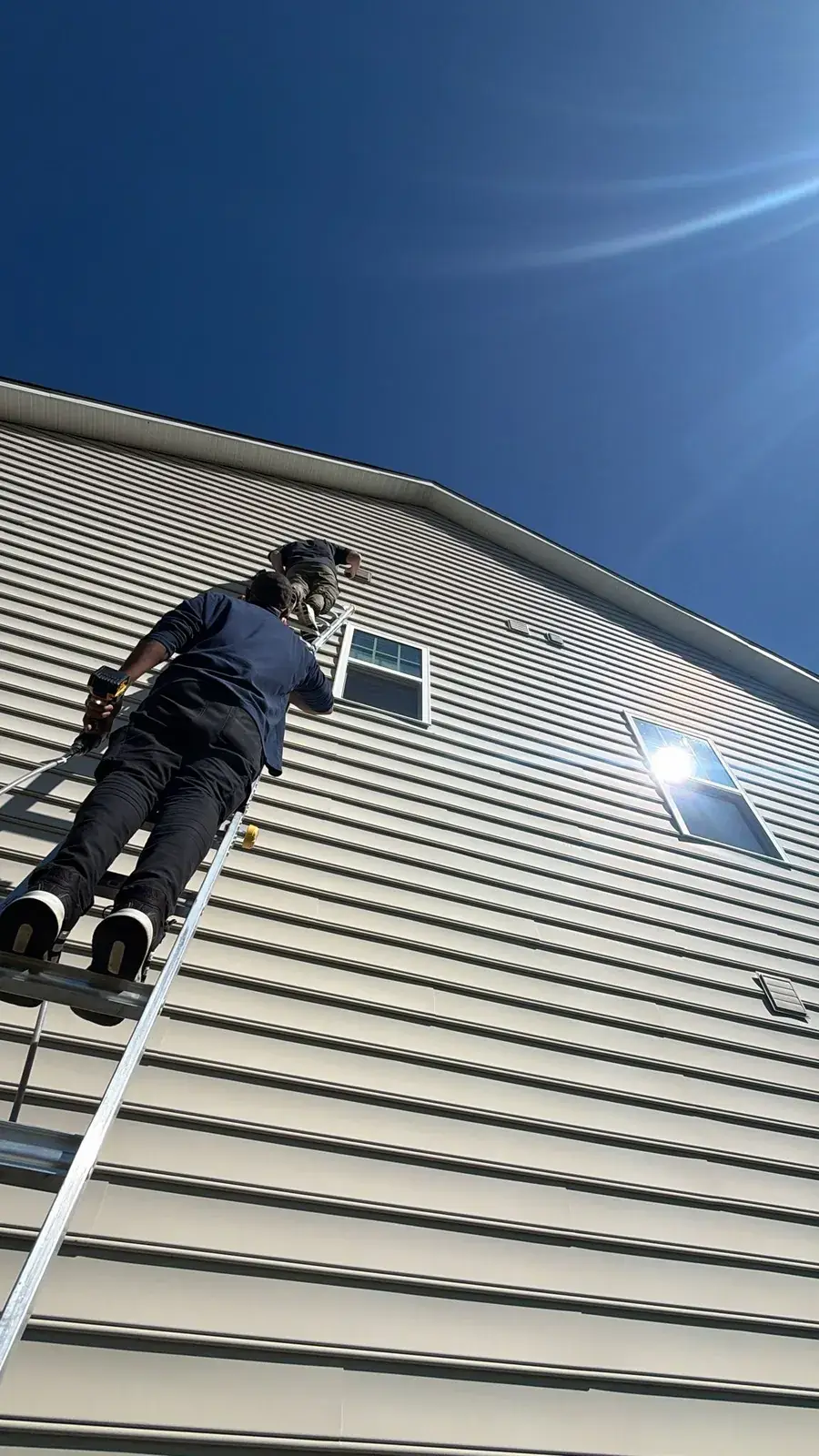
What roof work means for the price
A roof-vented dryer in reasonable shape is scoped as a routine cleaning. If the vertical line is packed solid or the cap is fully blocked with matted lint, it is honestly a deep cleaning — a different job, and we quote it as one. Either way, we tell you which it is after the free video inspection: one flat, written number, before any work starts, and before you owe anything.
If your dryer vents through the roof, don't skip years between cleanings. These lines fail faster than any wall-vented setup, and they fail out of sight.
What's Actually Included in the Quote?
A fair comparison between quotes only works if you know what each company includes. Some low quotes cover just the four feet of flex duct behind the dryer — which is like changing one tire and calling it a rotation. Here's what every E Cleaning dryer vent job includes in the flat written quote:
- Free video inspection inside the vent line before any work, so you see the real condition
- Cleaning of the entire run — from the dryer connection through every elbow to the exterior termination
- Rotary agitation plus vacuum extraction, so loosened lint leaves the line instead of resettling
- Exterior termination cleared and the flap or cap checked for free movement
- After-photos when the job is done, plus an airflow check at the dryer
- A PA-licensed contractor (PA 187935), insured up to $2 million, backed by Google Guaranteed money-back protection up to $2,000 on qualifying jobs
You can read a step-by-step walkthrough of how we work on our process page. The short version: we prove the problem before we touch it, and we prove the result before we leave.
Does Bundling With Air Duct Cleaning Save Money?
Yes — bundling is the most reliable way to lower your total cost per service. When the crew is already at your home for air duct cleaning with the truck, the negative-pressure equipment, and the ladders set up, adding the dryer vent to the same visit is dramatically more efficient than booking two separate appointments.
That efficiency is worth real money to you in three ways. You make one appointment instead of two, so you're not burning a second morning waiting on an arrival window. The setup and travel cost is spread across both services instead of billed against each one. And both systems get inspected on the same video walkthrough, so nothing gets missed between visits. When you call to schedule, ask about combined-visit pricing — you'll get one written quote covering both services before any work begins, and bundling duct and dryer vent service is the single most common way our customers bring the per-service cost down.
What Does It Cost to Skip the Cleaning?
The honest answer: more than the cleaning itself, paid in worse ways. A clogged vent forces the dryer to run longer cycles, which shows up on your electric bill month after month. It also cooks the dryer's heating element and thermal fuses, shortening the life of an appliance that costs far more to replace than to maintain. And then there's the risk that has nothing to do with money.
Lint is engineered kindling — dry, fibrous, and packed into a tube attached to a heat source. That's why fire marshals and appliance manufacturers alike recommend regular vent cleaning, and why we treat this as safety work, not just maintenance. If you want the full picture of warning signs and prevention, read our guide to dryer vent fire safety.
How Do You Book — and What Should You Ask Any Company First?
Whoever you hire, ask four questions before you book: Is the price flat and in writing before work begins? Does it cover the entire run to the exterior termination? Are you licensed and insured? Will I see proof — camera footage or photos — of the before and after? Any reputable company answers all four without hesitation. And if a quote sounds too cheap to cover a truck, a technician, and an hour of real work — the $49–$99 "whole-house special" coupons are the classic example — it usually is. Those teaser numbers exist to get a foot in the door, and the difference tends to reappear at your door as add-ons.
Our answers are simple: a free video inspection first, one flat written quote before any work begins, the entire run covered, no trip fees anywhere in our service area, license PA 187935, insured to $2 million, and video proof on every job. Financing is available through Wisetack if you'd rather split the cost. We serve Montgomery, Chester, Bucks, Delaware, Berks, and Philadelphia counties from our King of Prussia base, around the clock, Sunday through Friday.
