
Our Process: How We Actually Clean Your Air Ducts
Every E Cleaning job follows the same six steps: a free video inspection inside your ducts, full home protection, a Nikro negative-pressure connection at the trunk line, agitation of every single supply run, cleaning of the returns, trunks, and blower compartment, and after-photos with an airflow check. Plan on 2-3 hours per HVAC system.

What is source-removal duct cleaning? It is the method where the entire duct system is placed under negative pressure by a powerful HEPA-filtered vacuum while agitation tools physically dislodge dust and debris from every duct run, so contamination is pulled out of the system and collected — not blown around or left behind. It is the approach NADCA sets as the industry standard, and it is the only method E Cleaning uses — scoped with a free video inspection and a flat, written quote before any work begins.
There is no mystery to a proper duct cleaning — just a sequence that has to happen in the right order, with the right equipment, on every run of duct in the house. This page walks through exactly what our technicians do from the moment they arrive to the moment you review the after-photos, so you know what you are paying for before you book.
The reason the order matters: ducts collect a real amount of material. Industry sources such as Stanley Steemer estimate the average six-room home can accumulate 40 pounds of dust in a year, and a system that has never been cleaned holds years of it — drywall dust from the last renovation, pet hair, construction debris, sometimes nesting material. If a crew brushes that loose without the system under suction, it does not disappear. It resettles in the ducts or blows into your rooms. Negative pressure first, agitation second. Always.
What happens during a source-removal duct cleaning?
Six steps, in a fixed order, on every job. Nothing gets skipped because a run is hard to reach, and nothing gets added to the bill after the inspection — your flat, written quote is locked in before step two begins.
Free video inspection
Before any work, the technician runs a camera into your ductwork and shows you the footage — the actual dust load, debris, and any surprises like pest evidence or disconnected runs. You see what is in there, we confirm the scope and hand you a flat, written quote, and only then does work begin. If the ducts genuinely do not need cleaning, we say so and leave you the footage.
We protect your home
Drop cloths go down along the work path, technicians wear shoe covers, and floors and furniture near registers are covered before a single vent comes off. Register and grille covers are removed carefully and set aside for cleaning. The goal is simple: when we leave, the only difference you can see is inside the ducts and on the after-photos.
Negative-pressure connection
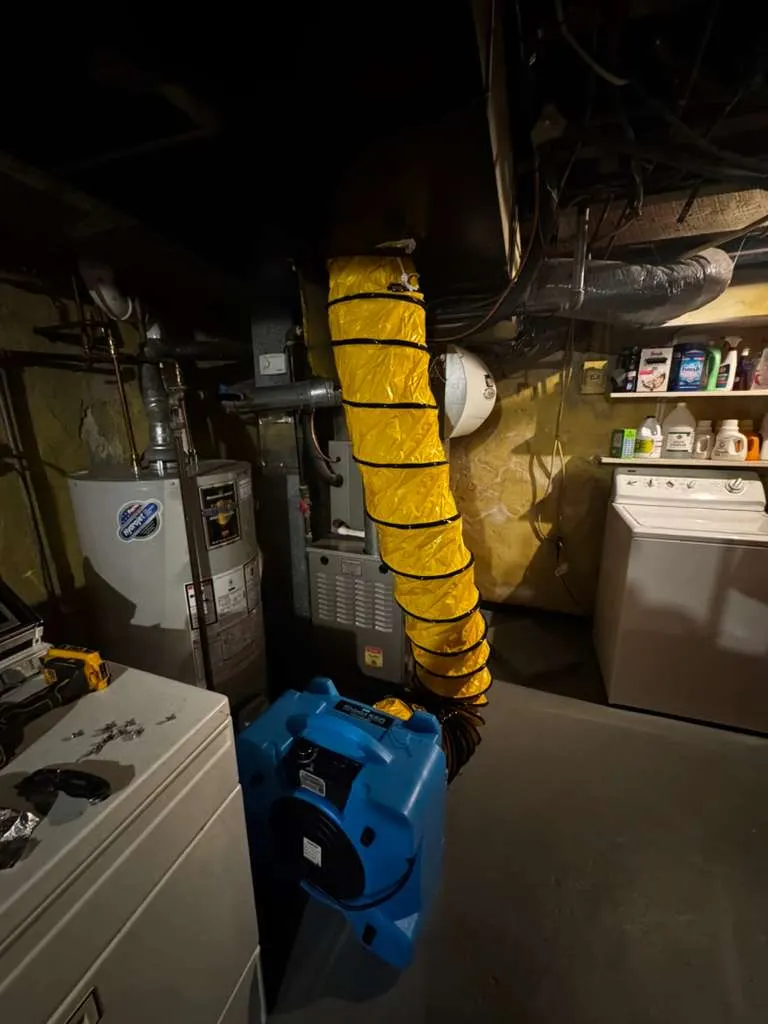
We open an access point at the main trunk line near the furnace or air handler and connect our Nikro negative-pressure machine, then seal the registers so the vacuum pulls through the whole system. From this point on, the entire duct network is under continuous HEPA-filtered suction — every particle we knock loose has exactly one way out, and it leads into the collection unit, not your living room.
Agitation of every run
With the system under suction, we work each supply run one at a time with air whips and agitation tools, from the register boot all the way back to the trunk. This is the step the cheap crews skip: the vacuum alone cannot break years of caked dust off duct walls. Physical agitation dislodges it; negative pressure carries it to the machine. Every run gets this treatment — not just the ones that are easy to reach.
Returns, trunk lines, and blower compartment
Supply ducts are only half the system. The return runs pull dusty household air toward the furnace, so they are usually the dirtiest ducts in the house — and the ones coupon crews never touch. We agitate and extract the returns, clean the main supply and return trunks, and clean the accessible blower compartment area so the freshly cleaned ducts are not fed by a dirty air handler.
After-photos and airflow verification
Access points are sealed, register covers are cleaned and reinstalled, and we photograph the duct interiors so you can compare against the inspection footage from step one. Then we run the system and check airflow at the registers before walking you through what we found and what we removed. You keep the photos.
Why does source removal beat the "blow-and-go" coupon crews?
You have seen the ads: whole-house duct cleaning for $49 to $99. Here is what that money actually buys — a shop vacuum held up to each register for a minute or two, maybe a quick blast of compressed air into the boot, no trunk access, no returns, no agitation. The visible first foot of duct looks better; the other 95% of the system is untouched. That is if the low price is even real: more often it is bait, and the number balloons once the tech is in your basement inventing problems.
Source removal is a different job entirely. The whole system goes under negative pressure, every run is physically agitated, and the debris ends up in a HEPA-filtered collection unit you can see. That is why it takes 2-3 hours per system instead of 30 minutes, and why no honest company can do it at a coupon price — one of them removes the contamination, the other relocates it.
- Whole system under HEPA-filtered negative pressure — not a shop vac at the register
- Every supply and return run agitated, boot to trunk
- Trunk lines and blower compartment cleaned, not skipped
- Video before, photos after — proof instead of promises
- Flat, written quote confirmed before work starts — no surprise invoice
What equipment do we use?
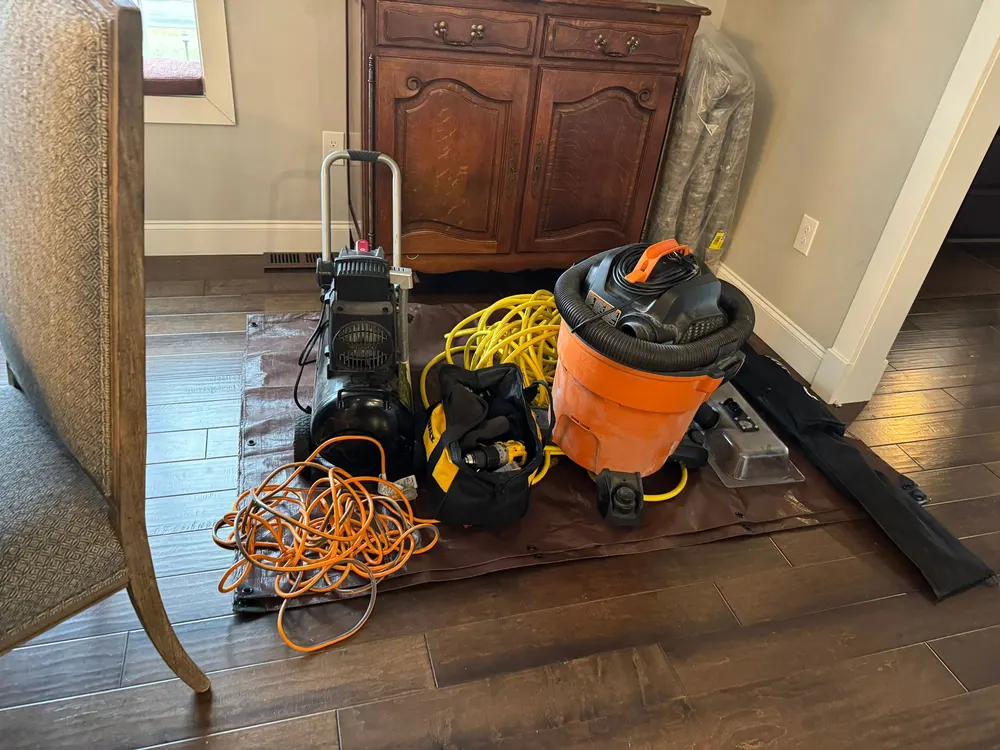
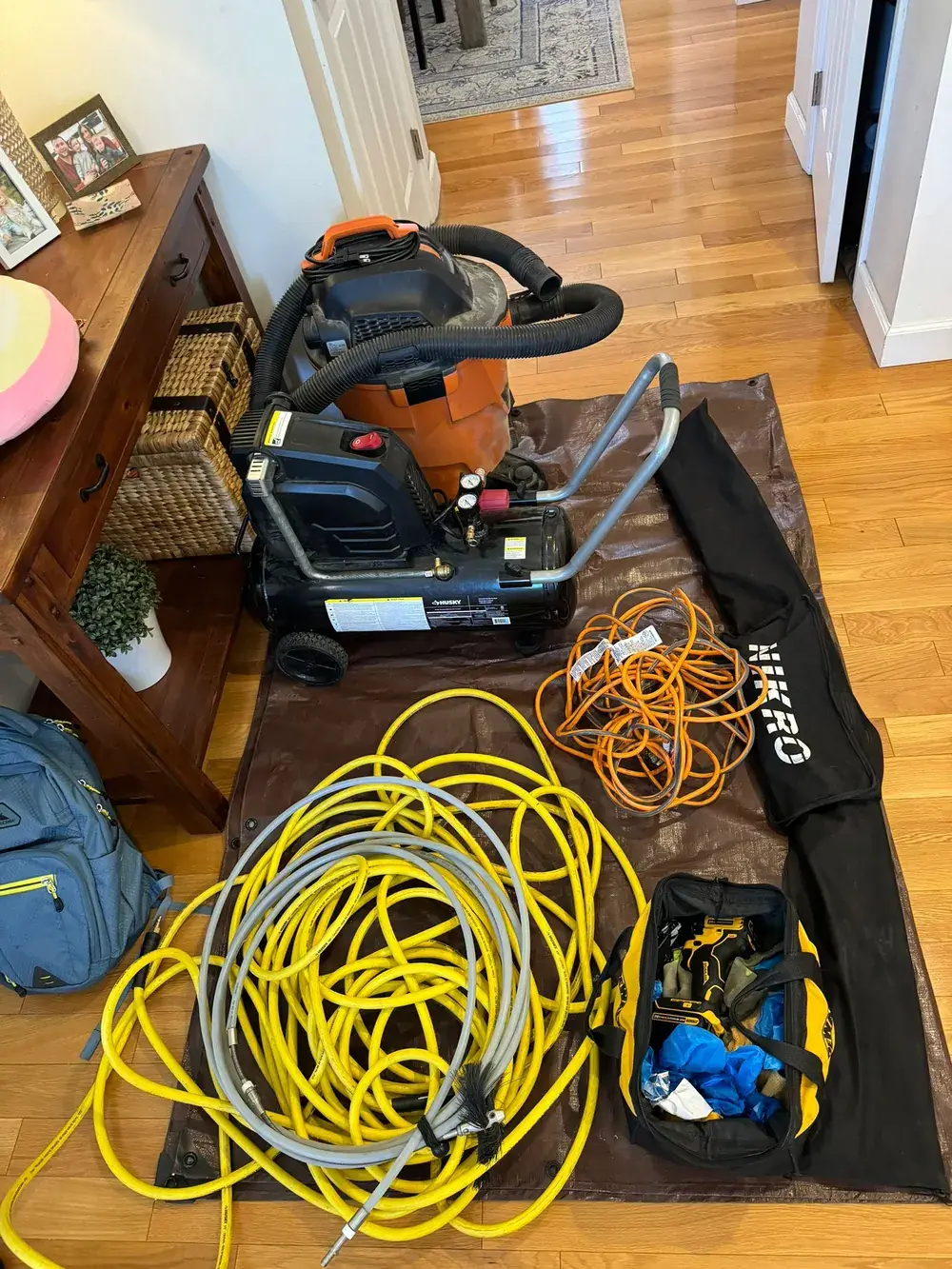
Professional Nikro negative-pressure machines, air whips and agitation tools, HEPA filtration, and inspection cameras. The equipment is the difference between removing debris and rearranging it — a truck full of the right gear is why the job takes hours and works.
Nikro negative-pressure machines
The heart of source removal. Connected at the trunk line, the machine pulls continuous suction across the entire duct network so dislodged debris travels one direction — into the collection unit. Without this, agitation would just stir dust into your rooms.
Air whips and agitation tools
Compressed-air whips and mechanical agitation tools travel down each duct run and physically break caked dust, pet hair, and construction debris off the duct walls. Suction alone cannot remove buildup that has compacted for years — this is the step that earns the name source removal.
HEPA filtration and cameras
Collection is HEPA-filtered, so fine particles captured from your ducts stay captured instead of exhausting back into the house. Inspection cameras document the ducts before and after — the same footage we show you at the free inspection and in your after-photos.
How long does duct cleaning take, hour by hour?
A single HVAC system takes 2-3 hours from arrival to walkthrough. Here is roughly where that time goes — the exact split shifts with duct layout, number of vents, and how much material is in the system.
| Time on site | What is happening |
|---|---|
| First 15-20 minutes | Walkthrough and free video inspection. You see the camera footage, we confirm scope, and you get a flat, written quote before any work starts. |
| Next 20-30 minutes | Home protection and setup: drop cloths, register removal, trunk access opened, Nikro machine connected, system sealed and placed under negative pressure. |
| Roughly the next hour | Supply runs agitated one at a time with air whips, register boot to trunk, while the vacuum extracts everything that comes loose. |
| Next 30-45 minutes | Return runs, main supply and return trunk lines, and the accessible blower compartment — typically the dirtiest parts of the system. |
| Final 20-30 minutes | Access sealed, cleaned register covers reinstalled, after-photos taken, system run for an airflow check, and a plain-English walkthrough of what we found. |
Homes with more than one HVAC system should plan on roughly the same window per additional system — and the written quote from the inspection covers every system up front, so nothing gets renegotiated mid-job. You do not need to follow the crew around, but most homeowners like to be there for the inspection at the start and the photo walkthrough at the end.
What our process will and will not do
A source-removal cleaning removes the dust, debris, and contamination sitting in your ductwork — that is what the after-photos show. We keep the health claims measured, because honesty is the whole brand: the U.S. EPA does not endorse routine duct cleaning as a proven fix for indoor air quality, and we will not tell you a cleaning cures allergies. What the EPA does say is that indoor levels of some pollutants may be 2 to 5 times — occasionally more than 100 times — higher than outdoor levels, and people spend about 90% of their time indoors. Cleaning is clearly warranted when there is visible mold on duct surfaces, heavy debris, pest activity, or renovation dust — and many homeowners notice less dusting and fresher-smelling air afterward.
The process is backed the way a real contractor backs work: E Cleaning is a PA licensed contractor (PA 187935), insured up to $2 million, and Google Guaranteed — money-back protection up to $2,000 on qualifying jobs. Financing is available through Wisetack, and we work around the clock, Sunday through Friday — we're closed Saturdays. Family-owned and based in King of Prussia since 2016.
Process Questions, Answered
How long does air duct cleaning take?
Plan on 2-3 hours per HVAC system. A real source-removal cleaning has to put the system under negative pressure, agitate every supply and return run individually, and clean the trunk lines and blower compartment — that physically cannot happen in 30 minutes. Homes with multiple systems take roughly 2-3 hours per system, and the written quote from the inspection covers the full scope before work begins.
Do I need to be home during the cleaning?
You need to be there at the start for the free video inspection — that is where you see inside your ducts and get your flat, written quote before work begins — and most homeowners want to be there at the end for the after-photo walkthrough. In between, you do not need to supervise. The crew protects floors and furniture, wears shoe covers, and works register to register on a fixed sequence.
Will duct cleaning make a mess in my house?
Not when it is done under negative pressure. Before any agitation starts, the entire duct system is connected to a HEPA-filtered Nikro vacuum and sealed, so debris knocked loose travels into the collection unit — not into your rooms. We also lay drop cloths along the work path and cover nearby floors and furniture before removing a single register. A crew that brushes ducts without suction running is the one that makes a mess.
What is the difference between source removal and what the $49 coupon companies do?
Source removal puts the whole duct system under HEPA-filtered negative pressure and physically agitates every run so debris is extracted and collected. The $49-99 crews typically hold a shop vacuum at each register for a minute or two — no trunk access, no returns, no agitation — which cleans the visible first foot of duct and leaves the rest untouched. Or the low price is bait and the bill multiplies on site. That price cannot buy a real cleaning — which is why every E Cleaning job starts with a free video inspection and a flat, written quote before any work begins.
Do you clean the return ducts and trunk lines, or just the supply vents?
Both sides, every job. Return ducts pull dusty household air toward the furnace, which usually makes them the dirtiest ductwork in the house — and the part low-cost crews never open. Our process covers every supply run, every return run, the main supply and return trunk lines, and the accessible blower compartment, all while the system is under negative pressure.
How do I know the ducts were actually cleaned?
You see it twice. Before work starts, the free video inspection shows you the inside of your ducts — the actual dust load, not a stock photo. When the job is done, you get after-photos of the same ductwork to compare, plus an airflow check at the registers with the system running. If a company cannot show you before and after evidence from your own house, you have no way to know what you paid for.
How should I prepare my home before the crew arrives?
Very little is required. Clear a few feet of space around the furnace or air handler and around floor and wall registers so the crew can reach them, and put pets somewhere calm — the equipment is loud while the vacuum runs. We handle the rest: drop cloths, register removal, protection of nearby floors and furniture, and full reassembly before we leave.
Can the agitation tools damage my ductwork or flex duct?
Not when the right tool is matched to the right duct. Rigid metal trunks and runs take standard air whips and agitation heads; flexible and fiberboard duct gets gentler attachments and lower air pressure so the liner is cleaned without being torn. This is one more reason the inspection comes first — the camera tells us what every run is made of before anything goes down it. E Cleaning is a PA licensed contractor (PA 187935) insured up to $2 million, and qualifying jobs carry Google Guaranteed protection up to $2,000.
See Inside Your Ducts Before You Spend a Dollar.
Free video inspection first, after-photos when we are done, and a flat, written quote in between. Call (484) 367-5944 or book online — 2-3 hours per system, every step on this page.
