
Indoor Air Quality: A Practical Home Guide
Indoor air is often more polluted than the air outside — the EPA reports indoor levels of some pollutants can run 2 to 5 times, occasionally more than 100 times, higher than outdoor levels, and people spend about 90% of their time indoors. This guide explains what is actually in your home’s air, which fixes move the needle, and the honest, narrow role duct cleaning plays. No scare tactics, no miracle cures.
Why does indoor air quality matter?
Indoor air quality matters because you breathe indoor air far more than outdoor air. The U.S. EPA reports that indoor levels of some pollutants may be 2 to 5 times — occasionally more than 100 times — higher than outdoor levels, and that people spend about 90% of their time indoors. In a sealed, energy-efficient modern home, the things you cook, clean, track in, and shed simply build up.
This page is a guide, not a sales pitch. We clean ducts for a living, but the biggest wins for most Greater Philadelphia homes are cheaper and simpler than a duct cleaning: a better filter, the right humidity, and a little more fresh air. We will lay out all of it plainly so you can decide what your house actually needs.
The reason indoor air concentrates pollutants is basic physics. Outdoors, contaminants disperse into a nearly infinite volume of air. Indoors, they collect in a few thousand cubic feet, get recirculated by your HVAC system, and settle onto surfaces only to be stirred up again. Newer homes are built tighter to save energy, which is good for heating bills and worse for natural air exchange. That trade-off is exactly why deliberate filtration and ventilation matter more than they did in a draftier house from decades ago.
What are the most common indoor air pollutants?
The most common indoor pollutants in a typical home are particles you can’t see: dust mites and their waste, pet dander, mold spores, and pollen tracked in from outside. These are the everyday irritants behind sneezing, itchy eyes, and stuffiness. They accumulate on surfaces, get pulled into the return side of your HVAC system, and recirculate every time the blower runs.
Understanding what you are dealing with tells you which fix helps. A filter catches airborne particles. A dehumidifier starves mold and dust mites of the moisture they need. Ventilation dilutes gases a filter can’t trap. Here are the usual culprits and where they come from.
Dust mites
Microscopic creatures that live in bedding, upholstery, and carpet, feeding on shed skin. Their droppings are a leading indoor allergen. They thrive in humidity above roughly 50%, which is why controlling moisture matters as much as cleaning.
Pet dander
Tiny flecks of skin shed by cats, dogs, and other animals — not the hair itself. Dander is light, stays airborne for hours, and settles into ducts, filters, and soft furnishings throughout the house even in rooms the pet never enters.
Mold spores
Always present in the air at low levels, but a moisture problem — a damp basement, a leak, high humidity — lets them multiply. Mold is the one pollutant that can actively grow inside ductwork and on HVAC components when conditions are wet.
Pollen
Seasonal, but relentless in the tree-and-grass-heavy suburbs of Montgomery, Chester, and Bucks counties. It rides in on clothing, pets, and open windows, then recirculates indoors long after the outdoor count drops.
Beyond these four, homes also carry combustion byproducts from stoves and fireplaces, volatile organic compounds (VOCs) off-gassing from paint, new furniture, and cleaning products, and plain settled dust. The average six-room home can accumulate 40 pounds of dust in a year, according to Stanley Steemer and other industry sources — and a share of that ends up cycling through your air handler.
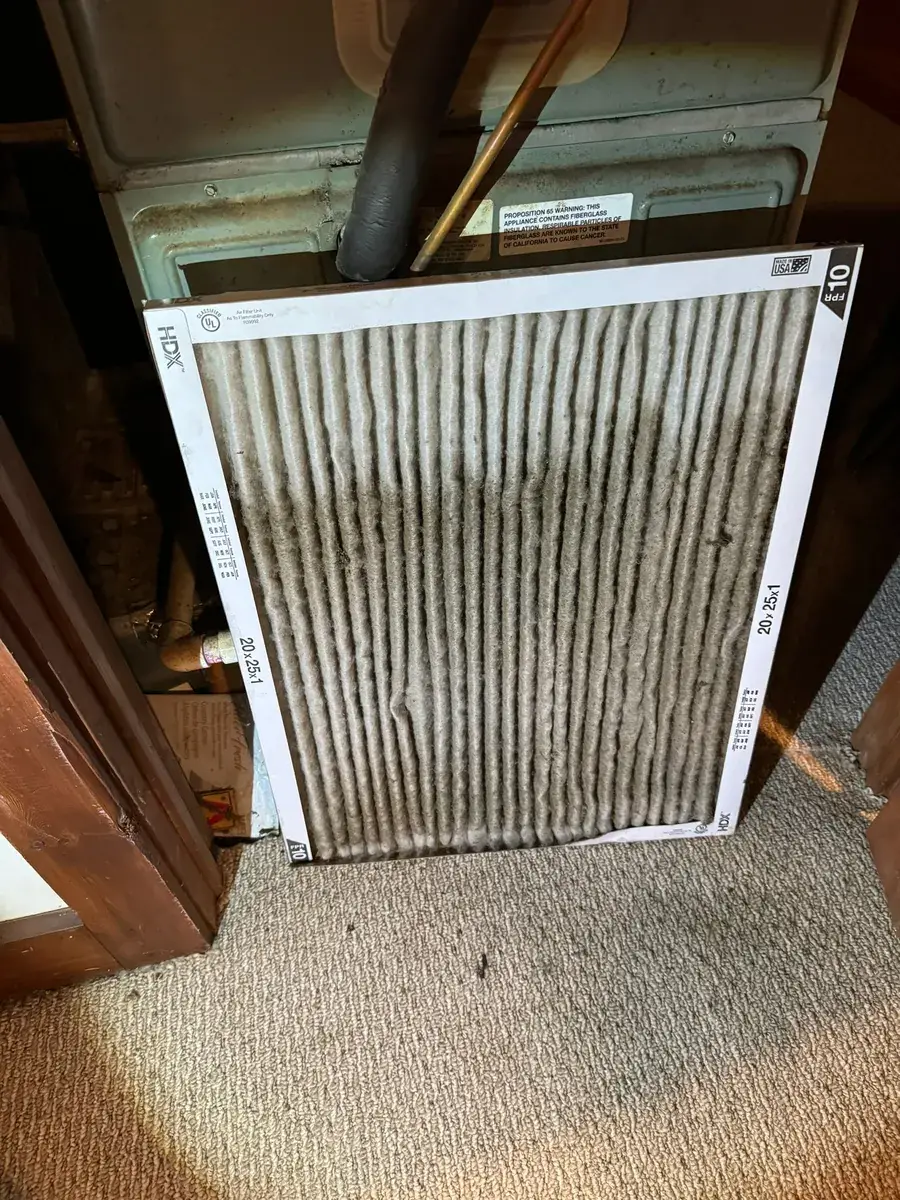
Your filter is the evidence
Want to know what is in your air? Pull your HVAC filter. The gray mat of dust, hair, and dander it collects is a physical record of what would otherwise be circulating through your rooms. A filter this loaded is also past its job — once it clogs, it restricts airflow and stops catching much of anything.
That is the cheapest, highest-leverage indoor-air habit there is: check the filter monthly, change it on schedule, and match it to your system. More on how to choose one below.
Does air duct cleaning improve indoor air quality?
Sometimes — but the EPA does not endorse routine duct cleaning as a proven way to improve indoor air quality. Cleaning is clearly worth doing when there is visible mold inside the ducts, an infestation of rodents or insects, or ducts clogged with heavy debris. For a system with only light, normal dust, the health benefit is unproven, and your money is usually better spent on filtration and humidity control.
We are a duct cleaning company telling you that duct cleaning is not always the answer. That is deliberate. The EPA’s guidance is measured, and so is ours: cleaning helps in specific, verifiable situations, and we would rather you trust us on the jobs that matter than oversell you on the ones that don’t.
Cleaning is clearly warranted when…
- There is visible mold growth inside hard-surface ducts or on HVAC components
- Ducts are infested with rodents, birds, or insects — droppings and nesting material belong in no air stream
- Ducts are clogged with so much debris that particles visibly release from the registers into the room
- You just finished a renovation and drywall dust or sawdust went straight into open ductwork
- You bought an older home with no record the system was ever cleaned
Cleaning is not the fix when…
- A video inspection shows only light, normal dust and the system was cleaned recently
- Someone promises it will cure allergies, asthma, or illness — evidence does not support claims that strong
- The real problem is a cheap filter, high humidity, or poor ventilation — fix those first
- The pitch started with a $49 whole-house coupon and escalated to a "mold emergency"
When cleaning is warranted, it should be done right: a free video inspection so you see the actual condition first, the source-removal method that keeps the whole system under negative pressure with professional Nikro equipment and HEPA filtration, and before-and-after photos so the proof is the inside of your own ducts. That is our approach on every air duct cleaning job — and if the camera shows your ducts are fine, we will tell you.
Call (484) 367-5944How do I choose the right air filter? Understanding MERV
The single most effective indoor-air move for most homes is a good filter, changed on time. Filters are rated by MERV (Minimum Efficiency Reporting Value) from 1 to 16 — higher numbers trap smaller particles. For a typical home, a MERV 8 to 13 filter catches dust, pollen, and dander well without choking your system. Change it every 1 to 3 months.
Your filter is the one part of your air system working every minute the blower runs. Getting it right does more for the air you breathe than almost anything else, and it costs a few dollars a month.
| MERV rating | What it captures | Best for |
|---|---|---|
| MERV 1–4 | Large particles: lint, big dust | Bare-minimum equipment protection — poor for air quality |
| MERV 5–8 | Dust, pollen, mold spores, pet dander | Most homes; the practical starting point |
| MERV 9–13 | Finer dust, smoke particles, some bacteria-sized particles | Homes with allergy sufferers or pets |
| MERV 14–16 | Very fine particles | Specialized needs; can restrict airflow on residential systems |
- Check monthly, change every 1–3 months — sooner with pets, allergies, or heavy use
- Match the size and MERV to your system, not just the cheapest box on the shelf
- Seal the fit — a filter that leaves gaps around the frame lets unfiltered air slip right past it
- A portable HEPA air purifier in a bedroom or main room adds room-level filtration on top of the whole-house filter
How does humidity affect indoor air quality?
Keeping indoor humidity between roughly 30% and 50% is one of the most underrated air-quality levers. Too much moisture feeds mold and dust mites; too little dries out airways and increases dust. The middle band starves the two biggest biological allergens while keeping the air comfortable to breathe.
Humidity is the hidden variable behind a lot of "bad air" complaints. Mold spores are always floating around at low levels — what turns them into a problem is moisture. Control the moisture and you remove the fuel.
Too humid (above 50%)
Mold grows on surfaces and inside ductwork, dust mites multiply, and the air feels heavy and musty. Common in basements and during humid Pennsylvania summers. A dehumidifier or properly sized AC is the answer.
The 30–50% sweet spot
Mold and dust mites struggle, static and dryness stay down, and the air is comfortable. A cheap hygrometer lets you actually see where your home sits instead of guessing.
Too dry (below 30%)
Common in winter with the heat running. Dries out sinuses and skin, and low humidity keeps fine dust airborne longer. A humidifier helps, but do not overshoot into mold territory.
Practical moves: run bathroom and kitchen exhaust fans when showering or cooking, address any basement dampness or leaks quickly, and use a dehumidifier in humid months. If you already have visible mold inside your ducts from a past moisture problem, that is one of the cases where duct cleaning — and sometimes sanitization — is genuinely warranted, but the moisture source has to be fixed first or the growth simply returns.
How does ventilation improve the air I breathe?
Ventilation dilutes indoor pollutants by replacing stale inside air with fresh outside air. A filter traps particles but does nothing for gases, odors, and VOCs — only bringing in fresh air removes those. In tight modern homes especially, deliberate ventilation is what keeps the concentration of everything from cooking fumes to off-gassing furniture from climbing.
Filtration and humidity control handle particles and moisture. Ventilation handles the rest — the gases and odors no filter can catch. It is the third leg of the stool, and the one most homeowners overlook.
- Use exhaust fans — kitchen range hood while cooking, bathroom fans while showering — to pull combustion byproducts and moisture straight outside
- Open windows when outdoor air is clean and pollen is low, especially after painting, cleaning with strong products, or bringing in new furniture
- Do not block return vents with furniture — your HVAC system needs to pull air freely to filter and circulate it
- Consider mechanical ventilation (an ERV or HRV) if your home is very tightly sealed and feels stuffy — it brings in fresh air without wasting the energy you spent heating or cooling
Ventilation also keeps humidity in check and clears the combustion byproducts a gas stove or fireplace produces. If you use a fireplace, keeping the chimney clean and drawing properly is part of the same picture — a poorly venting flue pushes those byproducts back into the room.
What is the priority order for better indoor air?
If you do these in order, most homes see the biggest improvement for the least money. Start at the top and only move down as far as your home actually needs.
Fix the filter
Match a MERV 8–13 filter to your system, seal the fit, and change it every 1–3 months. This is the cheapest, most effective single step, and it works every minute the blower runs.
Control humidity
Get a hygrometer, target 30–50%, and add a dehumidifier or humidifier as your season demands. This starves mold and dust mites of the moisture they need.
Ventilate
Run exhaust fans, open windows when outside air is clean, and keep return vents clear. This clears the gases and odors filters can’t catch.
Reduce the sources
Vacuum with a HEPA machine, wash bedding in hot water, keep pets off soft furniture where you can, and choose low-VOC products. Less coming in means less to filter.
Clean the ducts — when warranted
If there is visible mold, pests, heavy debris, or post-renovation dust in the system, this is the step that matters. Start with a free video inspection so you clean based on evidence, not a sales pitch.
What's hiding in your ducts?
Tap each hotspot to see what builds up where — and why it matters.
See what accumulates in each part of your system — from the blower wheel to the dryer run.
Indoor Air Quality Questions, Answered
Is indoor air really worse than outdoor air?
Often, yes. The U.S. EPA reports that indoor levels of some pollutants may be 2 to 5 times — and occasionally more than 100 times — higher than outdoor levels. Because people spend about 90% of their time indoors, the air inside your home has an outsized effect on what you breathe day to day. Tightly sealed, energy-efficient homes concentrate pollutants further because there is less natural air exchange to dilute them.
What is the single most effective thing I can do for indoor air quality?
Change your HVAC filter on time and use one that matches your system. A MERV 8 to 13 filter catches dust, pollen, and pet dander for a few dollars, and it filters air every minute your blower runs. Check it monthly and replace it every 1 to 3 months — sooner with pets or allergies. It is cheaper and more consistently effective than most other single upgrades, including duct cleaning for a system that only has light, normal dust.
Does duct cleaning improve indoor air quality?
It can, but the EPA does not endorse routine duct cleaning as a proven way to improve indoor air quality. Cleaning is clearly worth doing when there is visible mold inside the ducts, an infestation of rodents or insects, ducts clogged with heavy debris, or leftover dust from a renovation. For a system with only light dust, the health benefit is unproven and your money is usually better spent on a better filter and humidity control. Our free video inspection exists so you can decide based on what is actually inside your ducts.
What MERV rating should I use?
For most homes, MERV 8 to 13 is the sweet spot — high enough to capture dust, pollen, mold spores, and pet dander, low enough not to choke airflow. Higher is not automatically better: a filter that is too dense for your system restricts airflow, strains the blower, and can reduce the amount of air actually being filtered. Homes with allergy sufferers often benefit from the MERV 11 to 13 range. If you are unsure what your equipment can handle, check the unit documentation or ask your HVAC technician before installing a very high-MERV filter.
What humidity level is best for indoor air?
Aim for roughly 30% to 50% relative humidity. Above 50%, mold grows and dust mites multiply — the two biggest biological allergens in most homes. Below 30%, air gets dry, sinuses and skin suffer, and fine dust stays airborne longer. A cheap hygrometer lets you see where your home sits. In humid Pennsylvania summers a dehumidifier helps, especially in basements; in winter with the heat running, a humidifier can bring dry air back up without overshooting into mold territory.
What are the most common indoor air pollutants in a home?
The everyday ones are particles you cannot see: dust mites and their droppings, pet dander, mold spores, and pollen tracked in from outside. On top of those, homes carry settled dust, combustion byproducts from stoves and fireplaces, and VOCs off-gassing from paint, new furniture, and cleaning products. Filtration handles the airborne particles, humidity control starves mold and dust mites, and ventilation clears the gases and odors a filter cannot trap.
Can I improve my air without spending much money?
Yes. The highest-leverage steps are the cheapest: change your filter on schedule with the right MERV, run your kitchen and bathroom exhaust fans, keep humidity in the 30–50% band, vacuum with a HEPA machine, wash bedding in hot water, and open windows when outdoor air is clean. Those habits cost little and address the biggest pollutant sources directly. Save the larger investments — duct cleaning, air purifiers, mechanical ventilation — for situations where a specific problem calls for them.
When is duct cleaning genuinely worth the money for air quality?
When there is a clear, physical reason: visible mold growth inside the ductwork, a rodent or insect infestation, ducts clogged with enough debris that particles blow out of the registers, or construction dust that entered the system during a renovation. In those cases cleaning removes contamination a filter cannot reach. Outside those situations — for a system with light, normal dust — the air-quality benefit is unproven, which is exactly why we lead every job with a free video inspection instead of a pitch. Call (484) 367-5944 and we will look before we recommend anything.
Not sure what your home’s air actually needs?
Start with a free video inspection inside your ducts — you see the real condition and we tell you honestly whether cleaning is warranted. Call (484) 367-5944 or book online, Open 24 hours · Sun–Fri.
