
Duct Sanitization & Disinfection
Duct sanitization applies an EPA-registered antimicrobial product to the interior of your ductwork after a full source-removal cleaning. We never sell sanitizer as a substitute for cleaning: fogging over dirt does nothing. Clean first, then treat when it is actually warranted — with a flat, written quote in hand before any work begins.

What is duct sanitization? It is the application of an EPA-registered antimicrobial product to the inside surfaces of your air ducts, plenum, and vent covers immediately after they have been mechanically cleaned. It targets the bacteria, mold spores, and odor sources that brushing and vacuuming alone cannot neutralize. It is offered strictly as an add-on to a standard cleaning, and it is spelled out in your flat, written quote before any work begins.
Here is the part most duct companies will not tell you: sanitization only works on clean ductwork. Antimicrobial products are surface treatments — if a duct is coated in dust, lint, and debris, the product lands on the dirt layer, not the duct itself. That is why E Cleaning offers sanitization strictly as an add-on to our source-removal air duct cleaning, never as a stand-alone shortcut.
We use professional Nikro negative-pressure equipment and agitation tools to physically remove the contamination first, show you the results on camera, and only then apply the treatment where it makes sense. If your ducts do not need sanitizing, we will tell you that too — plenty of homes only need the cleaning.
When does duct sanitization actually make sense?
Sanitization is not for every home. It earns its cost in four specific situations: visible microbial growth, persistent odors, cleanup after a pest problem, and households with occupants who are especially sensitive to what is in the air.
Visible mold or microbial growth
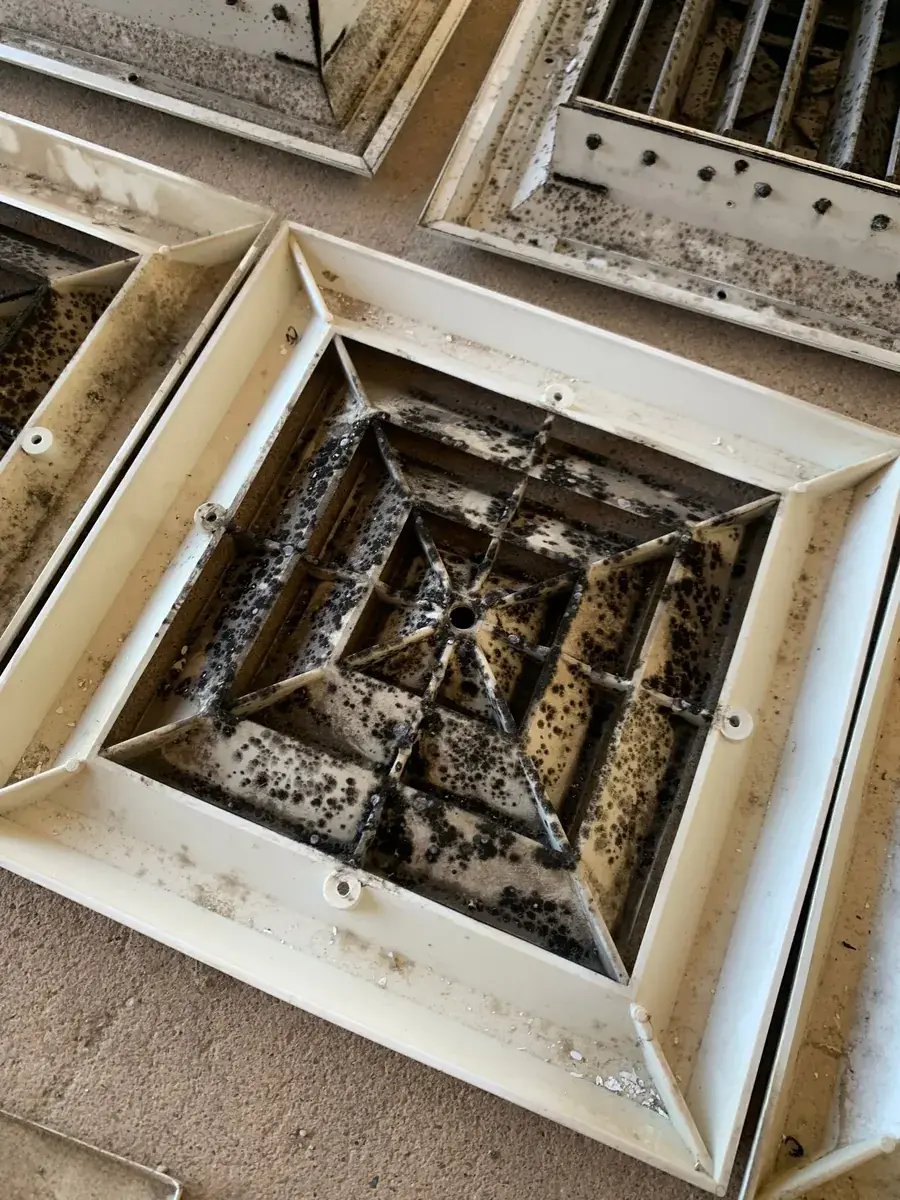
Dark spotting on diffusers, registers, or the visible interior of a duct is the clearest sign. Cleaning removes the growth; an EPA-registered antimicrobial treats the surface afterward to address what agitation alone leaves behind. If growth is extensive or tied to an active moisture problem, we will say so — the moisture source has to be fixed or the growth returns.
Musty or stale odors from the vents
A "dirty sock" or musty smell every time the system kicks on usually means bacteria or mold metabolites on duct surfaces or the coil area. Removing the debris cuts the source; sanitizing helps neutralize what remains so the smell does not simply restart with the next cooling cycle.
After rodents, insects, or nesting
Mice, birds, and insects leave droppings, nesting material, and biological residue in ductwork. We physically extract the material first, then sanitize the affected runs. This is one situation where we recommend the add-on almost every time — mechanical cleaning removes the debris, but treatment addresses the residue it leaves on the metal.
Sensitive occupants in the home
Newborns, elderly family members, people with asthma or allergies, or anyone recovering from illness. Sanitization is not a medical treatment and we will never claim it cures anything — but after a full cleaning, many families with sensitive occupants want the extra step, and it is a reasonable one.
Why we never sanitize without cleaning first
Some companies sell "duct fogging" or "sanitizing" as a cheap stand-alone service — spray a mist into dirty ducts, charge for it, drive away. That is the sanitization version of the $49 whole-house special, and it does close to nothing. The product settles on top of dust and debris instead of the duct surface, and every contaminant that was in the system is still there.
Our order of operations is fixed and non-negotiable: video inspection, full source-removal cleaning with negative-pressure equipment and HEPA filtration, after-photos so you can see the bare duct interior, and only then the antimicrobial application. The treatment touches clean metal, which is the only way it can do its job.
We are also straightforward about limits. The U.S. EPA does not endorse routine duct cleaning as a proven fix for indoor air quality, and no sanitizer is a substitute for fixing a leak, drainage problem, or humidity issue that is feeding mold. We treat symptoms honestly and point you at causes.
- EPA-registered antimicrobial products only — applied per label directions
- Never applied over dirt; always after full source removal
- Before/after video and photos of your actual ducts
- We tell you when you do not need it
How does the sanitization process work?
Sanitization adds roughly 20–30 minutes to a standard duct cleaning visit. Every step of the base cleaning happens first — the treatment is the final stage, not a replacement for any of it.
Free video inspection
Before any work, we run a camera through your ductwork and show you what is inside — dust load, debris, any visible growth or pest evidence. This is how we decide together whether sanitization is warranted or whether cleaning alone will do.
Full source-removal cleaning
We connect our Nikro negative-pressure machine to the trunk line, then work every supply and return run with air whips and agitation tools. Dislodged debris is pulled into HEPA-filtered collection — out of your ducts and out of your air.
Component cleaning
Registers, diffusers, and accessible plenum surfaces are cleaned by hand. Anything with visible growth gets extra attention, because the treatment in the next step only works on surfaces we have already cleaned down to bare material.
EPA-registered antimicrobial application
We apply the product evenly through the supply and return sides so it reaches interior duct surfaces, following the manufacturer's EPA label for dilution, coverage, and dwell time. The products we use are registered for use in HVAC systems.
After-photos and walkthrough
You get after-photos of the cleaned ductwork and a plain-English rundown of what we found, what we treated, and anything — like a moisture source — that needs attention from another trade to keep the problem from coming back.
How much does duct sanitization cost?
Every job starts with a free video inspection, and you get one flat, written quote — cleaning, sanitization add-on, everything — before we touch a single vent. The number you approve is the number on the invoice, no on-site upsell games.
- Free video inspection first. We scope your ductwork on camera and show you exactly what is inside before quoting anything.
- Flat, written quote before work begins. Cleaning and the sanitization add-on are itemized per HVAC system, in writing, up front.
- Routine and deep cleaning scoped honestly. Heavy buildup, post-renovation dust, or pest cleanup is a different job than routine maintenance — we quote it as what it is, not as a surprise later.
- No trip fees anywhere in our service area, no surprise invoice, no door-step upsell.
Financing is available through Wisetack, and qualifying jobs are backed by Google Guaranteed money-back protection up to $2,000. E Cleaning is a PA licensed contractor (PA 187935) insured up to $2 million.
What can sanitization realistically do for your air?
It can help reduce the bacteria, mold spores, and odor-causing residue left on duct surfaces after cleaning, and many homeowners notice that lingering musty smells fade once the source is removed and the surfaces are treated. What it cannot do is purify your whole house, cure allergies, or compensate for an unresolved moisture problem — and we will not tell you otherwise.
Context matters here. According to the U.S. EPA, indoor levels of some pollutants may be 2 to 5 times — occasionally more than 100 times — higher than outdoor levels, and people spend about 90% of their time indoors. Your ductwork moves that indoor air through the house many times a day, so keeping the duct surfaces clean — and treated, when growth or contamination has been present — is a sensible part of the picture. It is one part, though: filtration, humidity control, and ventilation matter just as much. Our indoor air quality guide covers how these pieces fit together.
If our camera inspection finds ongoing moisture — a leaking coil pan, condensation in an unconditioned crawlspace run, a humid basement — we will show you the footage and recommend fixing that first or alongside the treatment. Sanitizing a duct that stays wet is a temporary fix by definition, and we would rather lose the add-on sale than have you pay for something that will not hold.
Skip the phone tree. We call you.
Drop your number and a real person from our King of Prussia office calls you back — usually within minutes, day or night (we run 24 hours, Sunday–Friday).
No robocalls, no spam — one call from us about your ducts, that's it.
Sanitization & deodorizing prices
| Service | Starting price |
|---|---|
| Sanitize & disinfect (EPA-registered) — per HVAC unit | $200–$550 |
| Deodorizer treatment for ductwork | $200–$400 |
| Exhaust fan cleaning | $150 |
| Always performed AFTER source-removal cleaning | Never instead of it |
Prefer monthly payments? Bigger jobs like deep cleaning can be paid over time with Wisetack — check your options in about a minute with no impact to your credit score.*
Three promises. In writing. On every job.
Price Match Guarantee
Bring a competitor's written quote for the same scope of work — we'll match it. You never overpay for doing it right.
6-Month Warranty
Every job carries a 6-month workmanship warranty. If a problem traced to our work shows up, we come back and make it right — free.
Google Guaranteed
Booked through Google Local Services, qualifying jobs carry Google's own money-back protection up to $2,000, administered by Google.
Backed by a real license and $1M/$2M insurance — see the actual documents
Don't put off air you breathe — finance it with Wisetack
Check your options in about a minute with no impact to your credit score, choose terms that fit your budget, and pay over time instead of all at once.
*All financing is subject to credit approval. Your terms may vary. Wisetack loans are issued by Hatch Bank. See additional terms at wisetack.com/faqs.
Duct Sanitization Questions, Answered
Can I get sanitization without a duct cleaning?
No — and that is deliberate. Antimicrobial products are surface treatments, so applying them over dusty, debris-lined ducts means the product sits on the dirt instead of the duct. Companies that sell stand-alone "fogging" are charging for something that does close to nothing. We apply sanitizer only after full source-removal cleaning, when it can actually reach the duct surface.
What products do you use, and are they safe for my family and pets?
We use only EPA-registered antimicrobial products, applied according to their EPA-approved label directions for dilution, coverage, and dwell time. Registration means the EPA has reviewed the product for its stated use. We will tell you the specific product used on your job, and your technician will let you know if the label calls for any short re-entry interval for the treated area.
How much does the sanitization add-on cost?
The honest answer: it depends on what the camera finds, so we never quote blind. Every job starts with a free video inspection; then you get one flat, written quote — per HVAC system, cleaning and add-on itemized — before any work begins. Larger systems or extensive contamination (for example, after a significant pest problem) change the scope, but the number you approve is the number you pay. No trip fees anywhere in our service area, and no surprises at the end.
Will sanitizing my ducts get rid of mold permanently?
Only if the moisture feeding the mold is also fixed. Cleaning removes the growth and the treatment addresses what remains on the surface, but mold needs moisture to return — a leaking coil pan, condensation on uninsulated runs, or a damp basement will regrow it regardless of any product. If we find an active moisture source on camera, we will show you and recommend addressing it; otherwise you are paying for a temporary result.
Does duct sanitization help with allergies or asthma?
We keep this claim honest: it is not a medical treatment and we will not promise health outcomes. What it does is reduce bacteria, mold spores, and odor residue on duct surfaces after cleaning, and many homeowners — especially in households with sensitive occupants — notice fresher-smelling air. If someone in your home has a diagnosed respiratory condition, cleaning plus sanitization is a reasonable supporting step, not a cure.
How do I know if my ducts actually need sanitizing?
The free video inspection answers this before you spend anything. Clear signs include visible dark growth on registers or duct interiors, a musty smell when the system runs, or evidence of rodents, birds, or insects in the ductwork. If the camera shows ordinary dust with no growth, odor source, or pest residue, we will tell you the standard cleaning is enough — we skip the add-on on plenty of jobs.
How long does the treatment take and how long does it last?
The application adds about 20–30 minutes to a standard cleaning visit. How long the result lasts depends on the cause: after a one-time event like a pest cleanup, the benefit is lasting because the source is gone. If growth came from ongoing humidity or a leak, the treatment holds only until moisture returns — which is why we always flag moisture problems rather than reselling you the same fix.
Do you sanitize after rodent or bird infestations?
Yes, and this is the situation where we recommend it most strongly. We first physically remove droppings, nesting material, and debris using negative-pressure extraction with HEPA filtration, then apply the EPA-registered antimicrobial to the affected runs to address the biological residue that remains on duct surfaces. You get before-and-after photos of the affected sections.
Clean First. Sanitize When It Counts.
Free video inspection shows you exactly what is in your ducts — then we recommend only what your system actually needs. Call (484) 367-5944 or book online.
