
Why Duct Cleaning After a Renovation Is Non-Negotiable
Renovation dust does not stay in the work area. Drywall dust, sawdust, and insulation fibers get pulled into your return ducts and settle in every run, where the HVAC system recirculates them for months. Post-renovation duct cleaning removes that debris at the source, protecting your new finishes, your equipment, and the air your family breathes.
Ask anyone who has lived through a remodel: the dust gets everywhere. It coats the tops of door frames, sneaks into closed cabinets, and shows up on windowsills three rooms away from the work. What most homeowners never see is where a large share of it ends up — inside the ductwork. Every time the furnace or air handler kicked on during the project, it inhaled construction dust through the returns and pushed it through the supply runs. That debris does not leave on its own, and no amount of surface cleaning will touch it.
At E Cleaning we scope every job with a free video inspection inside the ducts before we quote or clean anything, and post-renovation systems produce some of the most dramatic footage we capture. Here is what we find after remodels across Montgomery, Chester, Bucks, and Delaware counties, why it matters for your home and your equipment, and exactly when to schedule the cleaning so you only pay for it once.
What does a renovation actually leave inside your ducts?
A typical remodel leaves a fine layer of drywall dust through every duct run in the house, plus heavier debris — sawdust, insulation fibers, and outright construction scraps — concentrated near the work zone and on the return side of the system. The finer the dust, the farther it travels: gypsum dust from sanded joint compound is light enough to ride the airstream through the entire supply network and settle in runs two floors away from the renovation.
Here is what we routinely pull out of ductwork after a construction project:
- Drywall and joint-compound dust — the single biggest offender. It is fine enough to slip past basic filters and coat every interior duct surface in the house.
- Sawdust and MDF dust from framing, trim carpentry, and cabinet installation.
- Insulation fibers disturbed during demolition or blown loose while new insulation went in.
- Tile, plaster, and concrete dust from bathroom and basement work — heavy, abrasive, and rough on blower motors.
- Screws, wrappers, and offcuts dropped straight into open floor registers while the covers were off.
- Nesting material — when duct runs sit open or disconnected for weeks, pests treat them as an entrance.
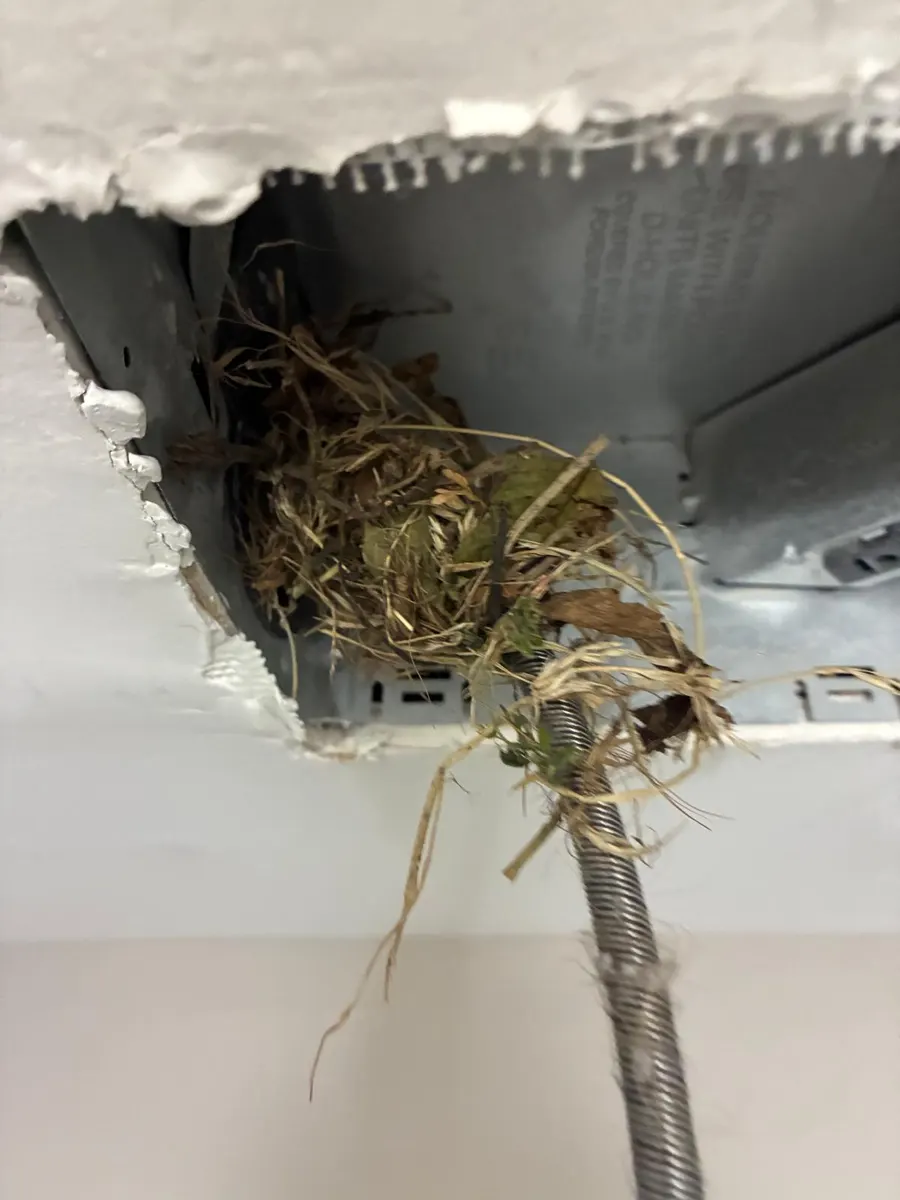
Open ducts are an open door
That last item on the list surprises people. During a longer project, supply boots and return chases can sit exposed for weeks while walls are open. Birds, mice, and insects find those openings quickly, and the nesting material they haul in stays behind long after the drywall goes back up. We have pulled piles of debris like this one out of systems where the homeowner had no idea anything was in there — the only symptom was a faint odor and weak airflow from one room. A camera inspection before cleaning is how we catch it.
Why doesn't the contractor's final cleanup handle the ducts?
Because ductwork is outside the scope of a standard construction cleanup. A good crew will wipe every surface, HEPA-vacuum the floors, and leave the space looking finished — the industry standard is "broom clean" or a step above. But the inside of your duct system is not a surface anyone on that crew can reach, and it is almost never in the contract.
Careful contractors tape plastic over registers during demolition, and that helps. In practice, the covers often come off early — someone gets cold, someone gets hot, the system gets switched on to dry joint compound faster — and the returns start pulling dust the moment the blower spins up. Even when supply registers stay sealed for the whole project, the return side of the system is much harder to protect, and the return is exactly where airborne dust gets concentrated. The result is a system that looks untouched from the outside and is coated on the inside.
How does construction dust threaten a new HVAC system?
If your renovation included a new furnace, heat pump, or central air system — as many larger projects do — this is the part to read twice. Construction dust loads a filter in days instead of months, and whatever gets past the filter settles on the two components that matter most: the blower wheel and the evaporator coil. Dust caked on blower blades cuts airflow and makes the motor work harder. A film of fine dust on the coil acts like a blanket, forcing longer run times to move the same amount of heat — which shows up on your utility bill and shortens the life of equipment you just paid for.
Abrasive dust from tile, plaster, and concrete is a separate problem: it does not just settle, it scours. Running a brand-new system as the construction vacuum for your remodel is an expensive habit, and it is completely avoidable with the right timing.
Worth being clear about: the EPA does not endorse duct cleaning as a routine, every-year service, and neither do we. But heavy debris is one of the situations where cleaning is plainly warranted, and a post-renovation system is the textbook example. This is not a maybe-it-helps scenario — the debris is visibly there, our camera shows it to you before we touch anything, and removing it can help reduce the dust your system recirculates into rooms you just finished paying to make beautiful.
When is the right time to schedule duct cleaning after a renovation?
After the last dust-producing trade is finished, and before you move furniture in. That window — final construction cleanup done, house still empty — is the ideal moment. Clean too early and the remaining sanding or cutting refills the ducts; wait until after move-in and the system blows leftover drywall dust across your new rugs, upholstery, and window treatments for weeks.
| Project stage | What to do about your ducts |
|---|---|
| Demolition and framing | Seal supply and return registers in the work zone; run the HVAC system as little as possible |
| Drywall hanging and sanding | Keep registers sealed and swap the filter — sanding week puts the finest dust in the air |
| Painting and finish work | Leave registers covered until every dust-producing task is done |
| Final construction cleanup | Book duct cleaning now — after the contractor's cleanup, before rugs and furniture arrive |
| Move-in | Install a fresh filter after the duct cleaning and enjoy the new space |
The same logic applies to newly built homes, by the way. New construction ducts routinely hold sawdust, drywall crumbs, and fast-food wrappers from the framing crew — being brand new does not mean being clean. If you are moving into new construction, a cleaning before move-in starts the system at genuinely zero.
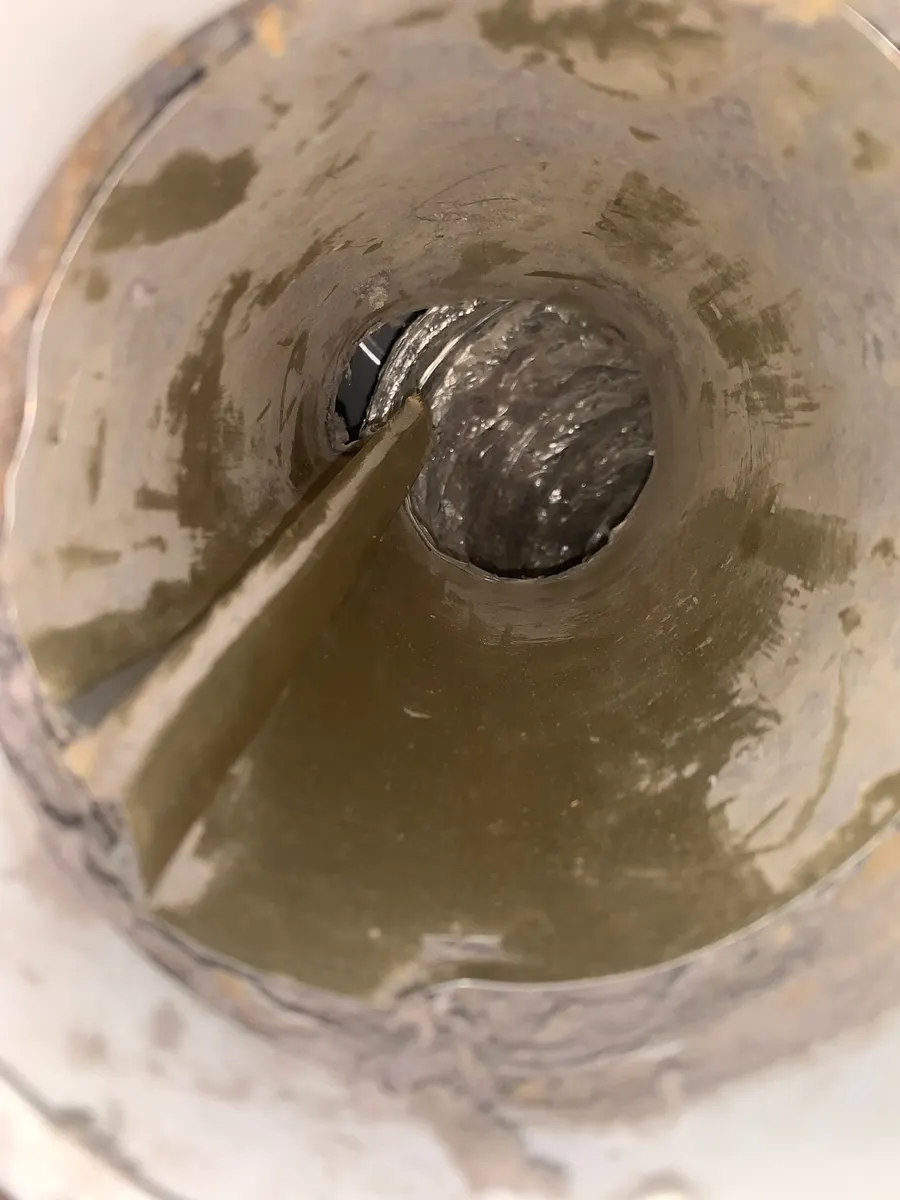
What "caked" actually looks like
This is the inside of a round supply duct before cleaning — the kind of buildup that fine renovation dust accelerates dramatically. Dust bonds to the slight oil film and humidity inside ductwork and builds in layers. Once drywall dust joins the mix, the layer thickens fast, narrows the effective duct diameter, and gives every later particle something to stick to. Removing it takes negative pressure and mechanical agitation, not a shop vac held up to the register.
What does post-renovation duct cleaning actually involve?
We use source removal — the method NADCA sets as the industry standard — which means the debris physically leaves your system instead of getting blown around inside it. The visit starts with a free video inspection so you see the construction dust with your own eyes before we quote anything. Then we connect a professional Nikro negative-pressure machine to the trunk line, put the entire duct system under vacuum, and run air whips and agitation tools through every supply and return to knock debris loose. Everything travels to a HEPA-filtered collection unit, not into your freshly painted rooms. When we finish, you get after-photos of the same runs the camera showed you at the start. You can read the step-by-step breakdown on our process page.
Pricing works the same way on a post-renovation job as on any other air duct cleaning: the free video inspection comes first, and you receive a flat, written quote before any work begins. If the buildup calls for deep cleaning rather than a routine service, we tell you that up front and scope it honestly as its own job — not as a doorstep surprise. No inflated "post-construction surcharge," no trip fees anywhere in our service area, and none of the $49-to-$99 coupon bait-and-switch that plagues this industry; how we quote is spelled out on our pricing page, and financing is available through Wisetack. E Cleaning is a PA licensed contractor (PA 187935), insured up to $2 million, and Google Guaranteed with money-back protection up to $2,000 on qualifying jobs.
What about the dryer vent and everything else?
If your renovation touched the laundry area — a relocated laundry room, a basement finished into living space, a new upper-floor laundry closet — the dryer vent deserves the same attention. New vent routes are often longer, with more elbows for lint to catch on, and construction debris has a way of ending up in exterior vent hoods. A dryer vent cleaning is easy to pair with the duct work while we are already on site — we scope it during the same visit and fold it into the same flat, written quote before anything starts. Lint buildup is a genuine fire hazard, not just a drying-time nuisance — we cover the full picture on our dryer vent fire safety page.
One more post-renovation add-on worth knowing about: if the project involved water exposure or lingering odors, we offer sanitization with EPA-registered products, applied after the physical cleaning so it treats clean metal instead of sitting on top of dust.
The bottom line
A renovation is one of the few times duct cleaning is not a judgment call. The debris is real, it is sitting in every run, and your HVAC system will keep redistributing it until someone physically removes it. Schedule it after the final cleanup and before move-in, and your new space starts life with clean air instead of a slow drizzle of drywall dust.
We serve Montgomery, Chester, Bucks, Delaware, Berks, and Philadelphia counties from our King of Prussia base, around the clock, Sunday through Friday. Tell us your move-in date and we will work the cleaning into that window.
