
How Often Should Air Ducts Be Cleaned? An Honest Schedule
"How often should air ducts be cleaned?" is the question we hear most, and it is also the one the duct cleaning industry answers least honestly. Some companies will tell you every year, every six months, even every season. That schedule is built for their revenue, not your house. Here is the honest version: a realistic baseline, the specific situations that shorten it, the situations where you should not bother at all, and a five-minute check you can do yourself before you spend a dollar.
Why Is 3 to 5 Years the Right Baseline?
Dust builds up in ductwork slowly. Your HVAC filter catches most of what circulates, and the rest settles gradually along duct walls, in return drops, and around supply boots. In a typical home with a decent filter that gets changed on schedule, it takes years — not months — for that settled layer to become thick enough that cleaning accomplishes anything meaningful.
The 3-to-5-year window is wide on purpose. A one-person household with hard floors, no pets, and a well-maintained system can comfortably ride the far end of it. A busy family home with carpet, kids, and a filter that gets changed "whenever someone remembers" will drift toward the near end. Neither of those homes needs a truck in the driveway every spring.
There is also a practical reason we like this window: it lines up with what we actually see on camera inspections. We run a video inspection inside the ductwork before any cleaning, and homes that were properly cleaned three or four years earlier usually show light, even dust — the kind a filter handles fine. Homes that have never been cleaned, or that hit one of the risk factors below, look very different.
What Shortens the 3-to-5-Year Schedule?
Certain households load their ductwork faster than others. If any of the following describes your home, move your schedule toward the shorter end — or in a few cases, act now regardless of when the ducts were last cleaned.
| Your situation | Suggested interval | Why it changes things |
|---|---|---|
| No pets, no allergies, filters changed on time | Every 4–5 years | Slow, even dust accumulation; the filter does most of the work |
| One shedding dog or cat | Every 3 years | Pet hair and dander bypass cheap filters and mat inside returns |
| Multiple pets | Every 2–3 years | Hair accumulates in return ducts and around the blower faster than filters can catch it |
| Allergy or asthma sufferers at home | Every 2–3 years | Lower tolerance for recirculated dander, dust, and pollen |
| Smoking indoors | Every 2–3 years | Residue coats duct walls and holds odor that recirculates |
| Renovation or remodeling just finished | Once, right after the work | Drywall and sanding dust is fine enough to pass filters and keeps recirculating |
| New-construction home | Once, after move-in | Construction debris — sawdust, drywall dust, scraps — often sits in brand-new ducts |
| Visible mold, pests, or rodent evidence | Immediately | These are the cases where cleaning is clearly warranted, whatever the calendar says |
Pets and allergies: the everyday accelerators
Pet hair is the single most common thing we pull out of return ducts. Returns are under negative pressure — they inhale whatever is floating near the grille, and floor-level returns in particular collect hair, dander, and carpet fibers in mats. If someone in the house takes allergy medication from spring through fall, a shorter cycle plus a better filter is a reasonable combination. We keep the claim measured on purpose: air duct cleaning can help reduce the dust and dander recirculating through the system, and many homeowners notice less dust settling after a cleaning — but it is one part of managing allergies, not a cure.
Renovation and new construction: the one-time resets
Renovation dust deserves its own mention because it behaves differently from household dust. Drywall dust is extremely fine, and a running HVAC system during a remodel pulls it into the returns and distributes it through the whole duct network. If you just finished a kitchen, a basement, or an addition, one thorough cleaning afterward is worth more than years of routine cleanings. The same logic applies to new builds: brand-new ducts are frequently not clean ducts. Builders rarely seal ductwork during construction, so sawdust, drywall dust, and stray debris end up inside before anyone has lived there a day. One cleaning after move-in, then reset the clock to the normal 3-to-5-year baseline.
When Should You NOT Bother With Duct Cleaning?
Here is the part most duct cleaning websites leave out. The U.S. EPA does not endorse routine duct cleaning as a proven fix for indoor air quality. Their position, in plain terms: clean ducts when there is a real reason — visible mold, heavy debris buildup, or vermin — and do not treat it as an automatic annual chore. We agree with that, and we say so even though we clean ducts for a living.
Skip the cleaning, or at least postpone it, if all of the following are true: your ducts were professionally cleaned within the last three years, you see only a light dust film when you look inside a register, nobody in the house has unexplained allergy flare-ups, and there are no musty odors or visible mold. Cleaning a clean duct does not make your air cleaner. It just makes your wallet lighter.
Indoor air quality still matters — the EPA reports that indoor levels of some pollutants may be 2 to 5 times, and occasionally more than 100 times, higher than outdoor levels, and that people spend about 90% of their time indoors. But if your ducts are already clean, the better investments are a higher-quality filter, humidity control, and source control like entry mats and regular vacuuming.
Be skeptical of anyone who pressures you onto an annual plan sight unseen, and be very skeptical of the $49–$99 "whole house special." That price does not cover the labor of a real source-removal cleaning; it is a door-opener designed to upsell you once a crew is standing in your basement. An honest company inspects first and tells you when you do not need the service. That is why we run a free camera inspection inside the ducts before quoting work — if the video shows clean ductwork, we will tell you to keep your money.
How Can You Check Your Own Ducts?
You do not need a technician to get a first read on your ductwork. Ten minutes and a phone flashlight will tell you most of what you need to know.
- Pull a floor or wall register. Most lift out or unscrew in seconds. Shine your phone light in and take a photo — the camera sees deeper into the duct than your eye does.
- Inspect the return grille. Matted, felt-like dust on the return grille or just inside it is the most reliable visual sign the system is due.
- Watch your filter. A filter that loads up gray within a few weeks of being changed means the system is moving a lot of dust.
- Do the white-cloth wipe. Wipe just inside a supply boot with a white cloth. Light gray dust is normal; black, greasy, or thick buildup is not.
- Watch the startup puff. Visible dust blowing from supply vents when the blower kicks on means loose debris is sitting in the duct runs.
- Trust your nose. A musty smell that appears when the system runs and fades when it stops points to buildup or moisture in the ducts, and moisture is worth investigating promptly.
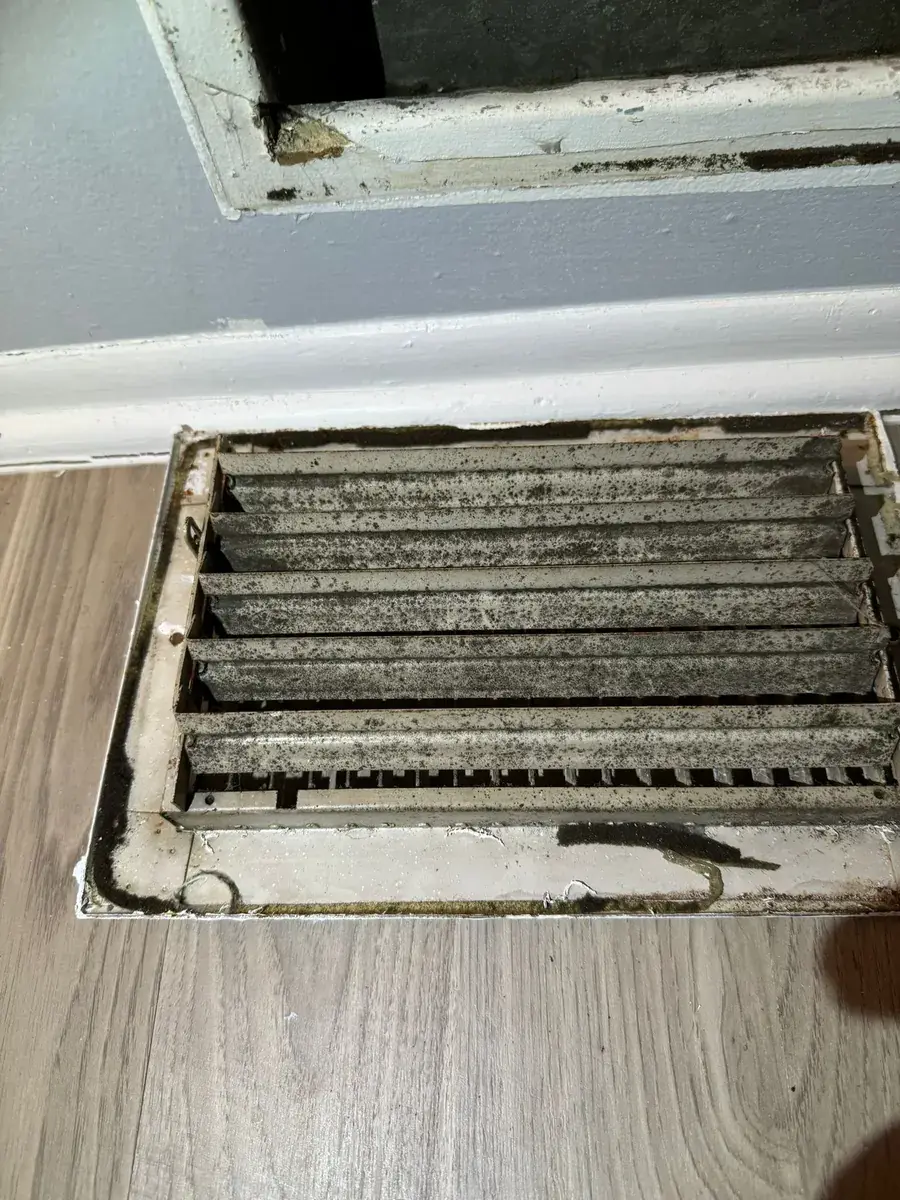
If your photos look like the one above — visible debris, matted dust, anything you could pick up with your fingers — the ducts are past due. If you see bare sheet metal with a light film, put the money back in your pocket and check again next year.
Do Dryer Vents Follow the Same Schedule?
No, and this is the schedule most homeowners actually get wrong. Dryer vents need cleaning every year — not every 3 to 5 — because the failure mode is different. A dusty air duct is an air-quality nuisance; a lint-packed dryer vent is a fire hazard. According to the U.S. Fire Administration (FEMA), an estimated 2,900 home clothes dryer fires are reported each year, and lint buildup is the classic cause. Longer drying times, a hot dryer top, and a burning smell are the warning signs. If it has been more than a year — or you cannot remember your last one — start with our dryer vent cleaning page, and read our dryer vent fire safety guide for the full warning-sign list.
What Should It Cost When the Time Comes?
When your ducts genuinely need cleaning, the honest market rate for a real source-removal job runs a few hundred dollars per HVAC system — not $49. We handle it the transparent way: every job starts with a free video inspection inside the ductwork, and you get a flat, written quote before any work begins. Routine cleaning and deep cleaning are scoped honestly as the different services they are, so you are quoted for what your system actually needs — never a one-size package with surprises attached. There are no trip fees anywhere in our service area, no surprise invoice, and no door-step upsell. Every job includes after-photos when we are done, performed with professional Nikro negative-pressure equipment, financing is available through Wisetack, and as a Google Guaranteed company, qualifying jobs carry Google's money-back protection up to $2,000. How the quote process works, including optional sanitization with EPA-registered products, is explained on our pricing page.

Not sure where your home falls on the schedule?
Tell us about your house — pets, allergies, last cleaning date, any renovation — and we will give you a straight answer, including "you don't need us yet" when that is the truth. E Cleaning is a family-owned company serving Montgomery, Chester, Bucks, and Delaware counties since 2016, PA licensed (PA 187935), insured up to $2 million, and Google Guaranteed.
