
Air Duct Cleaning in Yeadon, PA
Air duct cleaning in Yeadon, PA starts with a free video inspection — a camera travels inside your ductwork and shows you its true condition on screen before you approve a flat, written quote. E Cleaning is family-owned, PA-licensed (PA 187935), insured up to $2 million and Google Guaranteed, and has served Delaware County's rowhouse boroughs from King of Prussia since 2016.
A borough on the Philadelphia line, finished growing generations ago
Yeadon sits at the eastern edge of Delaware County, pressed right against the Philadelphia city line — Cobbs Creek and its wooded parkland form the borough's eastern boundary, and on the far bank the rowhouse grid of Southwest Philadelphia picks up without missing a beat. Lansdowne lies to the northwest, East Lansdowne and Upper Darby to the north, and Darby and Colwyn to the south and southwest. The borough was set off from Darby Township when it incorporated in the 1890s, and it grew the way the whole inner ring grew: streetcar lines and rail service turned farmland into tight residential blocks, and by the middle of the twentieth century there was essentially nothing left to build on.
Church Lane is the borough's working spine, cutting diagonally through town and carrying its main commercial strip, with Baltimore Avenue running along the northern reaches toward Lansdowne. One of SEPTA's West Philadelphia trolley lines still runs into the borough, and the Fernwood–Yeadon stop on the Media/Wawa Regional Rail line sits at the Lansdowne edge — transit that has kept these blocks continuously occupied and worked on for a century. Holy Cross Cemetery's green acreage takes up a sizable share of the borough's roughly one and a half square miles, which makes the residential blocks that remain even denser than the map suggests. For ductwork, all of this history points one direction: no home in Yeadon is new, so every duct system in town is either a mid-century original that has been running for seventy years or a retrofit threaded into a house that predates forced air entirely.
Getting to you is a run we already make constantly. From our headquarters at 555 S Goddard Blvd in King of Prussia, the crew takes I-476 south and comes across on the Baltimore Pike corridor — the same approach we use for Lansdowne, Darby and the rest of the inner boroughs. We schedule 24 hours a day, Sunday through Friday — closed Saturdays — and Yeadon gets the same terms as every town we serve: the video inspection is free, the flat quote is in writing before any work begins, and there is no trip fee for the drive.
Brick rows and twins that heating technology caught up to later
Yeadon's housing stock is remarkably consistent: block after block of brick rowhouses and twins, most of them built between the 1920s and the early 1950s, with a band of larger apartment buildings along the main corridors. The earlier houses in that range went up when coal heat was standard — radiators fed by a basement boiler, or a gravity warm-air furnace with big octopus ducts that moved air by convection alone. The later blocks, finished after the war, were often built with true forced-air heating from day one. That split matters, because it produces two very different duct situations sitting side by side on the same street.
In the pre-war rows, forced air arrived as a retrofit. The typical conversion put a compact furnace in the basement, ran a single supply trunk down the spine of the house — a rowhome is long and narrow, so one trunk with short branch runs reaches everything — and solved the return side cheaply by panning: nailing sheet metal over open joist bays so the house's own floor framing became the return duct. Panned returns pull air through century-old framing gaps, which means they inhale whatever the structure sheds — plaster grit, crumbling insulation, dust from under the floorboards — and store it in cavities no filter ever touches. In the post-war blocks, the ducts are original, which sounds better until you count the years: a system installed around 1950 has been breathing the same house for seven decades, and a large share of them have never once been opened and cleaned.
The retrofit story didn't stop at heating. Plenty of Yeadon twins and rows have had central air added in the decades since, sometimes sharing the heating trunk, sometimes as a separate attic system with flexible duct dropped to ceiling registers. Flex duct's ridged interior slows airflow and holds onto dust, and attic runs pick up loose insulation fibers wherever a joint has shifted. The apartment buildings along Church Lane and the avenues add their own variety — individual air handlers serving stacked units, with short but heavily used duct runs. Different systems, same rule: the camera looks first, and you see exactly what your ducts are carrying before anyone quotes anything.
Where the dust in a Yeadon duct system comes from
Dense, older housing generates dust from the inside out. Plaster walls shed fine grit into wall cavities for decades; early insulation breaks down into fibers; gaps in old floors feed panned returns directly; and a house that has stood since the 1930s has had ninety years to accumulate what its ductwork now stores. Yeadon adds an urban layer on top: the borough sits against the city line with busy corridors on several sides, and fine traffic dust works indoors year-round through windows and door traffic, then rides the return air into the system. According to the U.S. EPA, indoor levels of some pollutants may be 2 to 5 times — occasionally more than 100 times — higher than outdoor levels, and people spend about 90% of their time indoors. Industry sources such as Stanley Steemer estimate the average six-room home can accumulate 40 pounds of dust in a year.
The blocks closest to Cobbs Creek carry one more thing worth checking: moisture. Low-lying basements near the creek can run damp in wet seasons, and dampness around return ducting is exactly the condition that deserves a camera, because moist buildup inside a duct is one of the clear-cut cases where cleaning is plainly warranted — alongside heavy debris, renovation dust and evidence of pests or nesting. Yeadon's steady housing turnover matters here too: rows and twins change hands, get renovated, get floors sanded and kitchens opened up, and whenever a forced-air system runs during or soon after that work, the renovation dust ends up distributed through every run in the system.
Signs a Yeadon home is due for a look inside its ducts:
- Dust films the furniture again within a day or two of wiping it down
- Registers or return grilles show dark streaks or matted buildup around the edges
- A musty or stale smell when the heat or air conditioning first kicks on
- You just bought the house, or a renovation recently wrapped up
- Allergy or asthma symptoms that flare indoors, especially overnight
- No record that the ducts have ever been opened and cleaned
Source removal in a Yeadon home, from camera to after-photos
The method we use is source removal — the approach NADCA sets as the industry standard. Its defining rule is sequence: the entire duct system goes under continuous negative pressure before anything agitates the buildup. A professional Nikro negative-pressure machine connects to the trunk line, the registers are sealed, and HEPA filtration captures everything that moves. Only then do air whips and brushes travel each run, loosening buildup so the suction carries it out of the house instead of deeper into it. Agitating first and vacuuming second — the shortcut behind most cheap duct jobs — doesn't clean a system; it redistributes its contents into your rooms.
Rowhouse geometry actually works in our favor here. A single trunk with short branches means the equipment stages once in the basement and reaches the whole system, and a typical Yeadon row or twin is a compact, efficient job. What changes house to house is the return side: panned joist-bay returns get opened, agitated and extracted rather than skipped, because that's where a retrofit system hides most of what it has collected. Attic flex-duct runs from later AC additions get gentler agitation matched to the liner so the duct is cleared without damage. Every job covers the same full scope:
- Every supply run, from register back to the trunk
- Every return, including panned joist bays in retrofit systems
- The main supply and return trunks, cleaned last so loosened debris exits the system
- Registers and grilles removed, cleaned and reinstalled
- The system run before we leave, and after-photos of the cleaned ductwork for your records
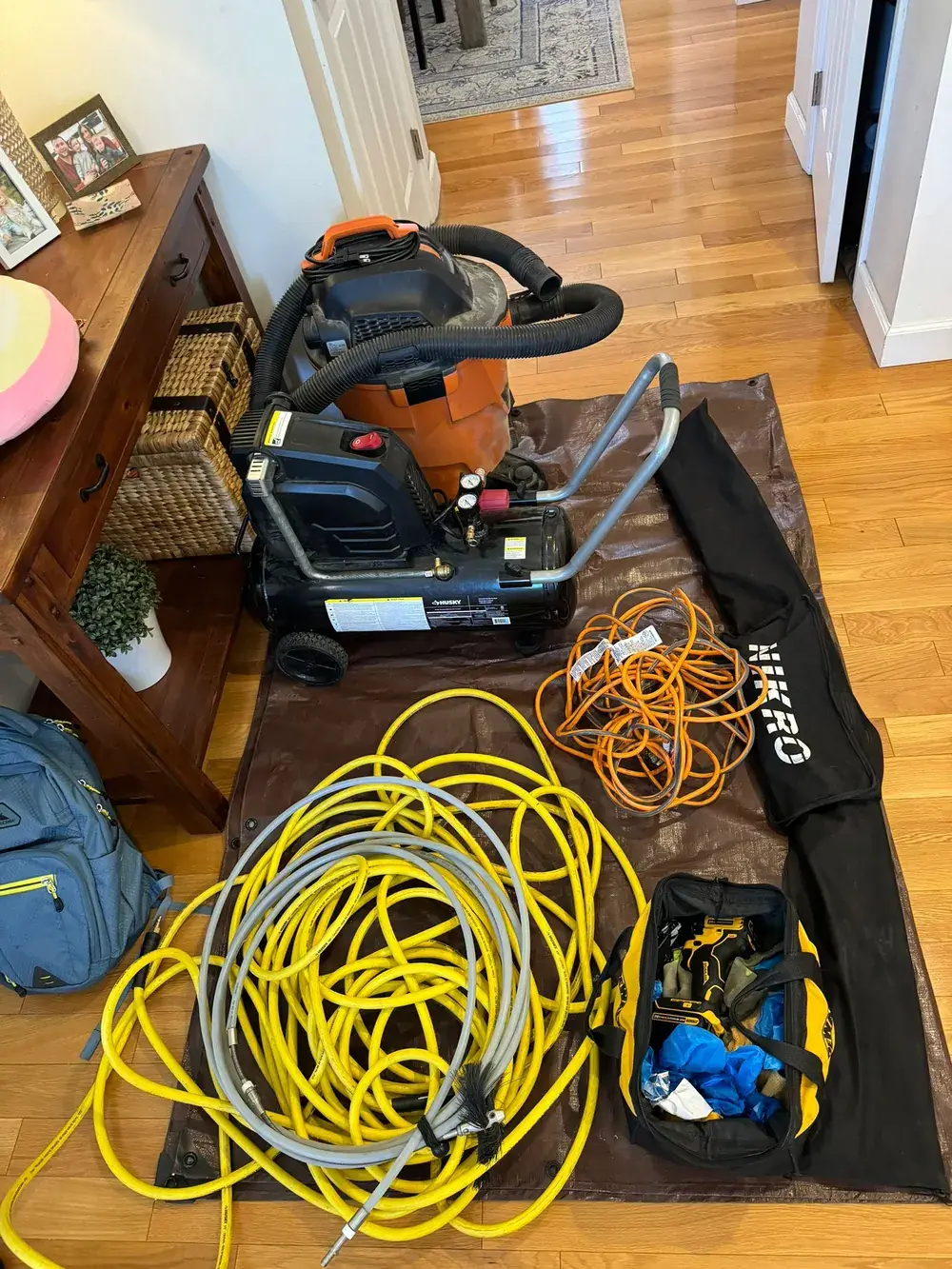
Built for tight basements
The same commercial equipment that handles a large single stages just as well in a narrow Yeadon rowhome basement. Original chases, plaster ceilings and finished basement walls are worked around, not through — the house goes back exactly as we found it, minus what was in the ducts.
Routine or deep — the camera decides, not a salesperson
Routine cleaning and deep cleaning are genuinely different services, and we don't blur the line to sell the bigger one. The free video inspection is what sorts a Yeadon system into one or the other — you watch the footage with the technician, and the honest answer goes into a flat written quote before anything is staged.
| Routine cleaning | Deep cleaning | |
|---|---|---|
| Typical system | Cleaned within the last few years and maintained since | Never opened, or not cleaned in 3+ years — most first-time jobs in pre-war housing |
| What the camera shows | Light, loose dust film along the runs | Compacted buildup, caked duct walls, debris in panned returns |
| The work | Lighter agitation, fewer passes per run | More aggressive tooling, repeated passes, more time under vacuum |
| Typical visit | A few hours for a single-system home | Longer — and because the quote came first, the price doesn't change |
Whichever service applies, nothing is priced per vent and nothing gets invented at the door. Optional extras exist only if you choose them: sanitizing with EPA-registered products after the cleaning — worth considering where the camera found damp buildup, common in the low blocks near Cobbs Creek — and a deodorizer treatment where smoke, pet or long-vacancy odors linger. Both go on the same written quote, never on a surprise invoice. If the camera reveals heavy mold or construction debris, that gets scoped and quoted honestly in writing too, not discovered halfway through and renegotiated in your basement.
Every job carries our 6-month workmanship warranty: if a problem traced to our work shows up within six months, we come back and make it right free. Wisetack financing is available if you'd rather split the cost into payments, and if a competitor hands you a written quote for the same scope of work, our Price Match Guarantee means we match it.
A flat written quote against the coupon-flyer playbook
Yeadon's mailboxes and neighborhood feeds see the same "$49–$99 whole-house duct cleaning" offers as the rest of inner Delaware County. Read those numbers as a warning label, not a price: they can't cover a truck, a trained technician and hours of commercial equipment time, and they exist to get a stranger into your basement, where the total swells through per-vent charges, invented mold findings and doorstep upsells. Our answer is structural. The video inspection is free, the quote is flat and in writing before any work begins, and there is never a moment where you're negotiating with someone standing inside your house.
The rest is built so you never have to take our word for anything. We are a PA-licensed contractor — PA 187935, with the license and insurance certificates viewable on our licensed & insured page — insured up to $2 million and rated 4.8 stars across 144 Google reviews. Qualifying jobs are additionally backed by Google Guaranteed, Google's program providing money-back protection up to $2,000, administered by Google.
The neighboring boroughs sit on the same routes for us: we clean air ducts next door in Lansdowne, across the northern line in Upper Darby and just south in Darby — the full town list lives on our Delaware County service page. And since the crew is already at your door, many Yeadon customers add dryer vent cleaning in Yeadon to the same visit — one crew, one written quote covering both.
How much does air duct cleaning cost?
Routine and deep cleaning are different services — the free inspection determines which one your system actually needs. Prices vary house to house; your exact price comes as a flat written quote before any work begins.
| Air duct routine cleaning (per HVAC unit) | $299.99 |
| Air duct deep cleaning (per HVAC unit) | $650 |
| Multi-unit homes | Discount available |
| Dryer vent routine add-on | from $129.99 |
Three promises. In writing. On every job.
Price Match Guarantee
Bring a competitor's written quote for the same scope of work — we'll match it. You never overpay for doing it right.
6-Month Warranty
Every job carries a 6-month workmanship warranty. If a problem traced to our work shows up, we come back and make it right — free.
Google Guaranteed
Booked through Google Local Services, qualifying jobs carry Google's own money-back protection up to $2,000, administered by Google.
Backed by a real license and $1M/$2M insurance — see the actual documents
Don't put off air you breathe — finance it with Wisetack
Check your options in about a minute with no impact to your credit score, choose terms that fit your budget, and pay over time instead of all at once.
*All financing is subject to credit approval. Your terms may vary. Wisetack loans are issued by Hatch Bank. See additional terms at wisetack.com/faqs.
4.8 stars from 144 Google reviews — and easy to find
E Cleaning Duct & Vent Cleaning is based at 555 S Goddard Blvd, King of Prussia, and serves Yeadon and all of Delaware County from right here. Check our Google profile: real jobs, real photos, and a rating our crew protects on every visit.
- Google Guaranteed business — screened, licensed and insured (see the documents)
- Read every review on our Google profile — we don't cherry-pick what you can verify
Air Duct Cleaning questions from Yeadon homeowners
Do you charge a trip fee to come out to Yeadon?
No. Yeadon is a straightforward run from our King of Prussia headquarters — I-476 south, then in on the Baltimore Pike corridor — and there are no trip fees, fuel surcharges or per-vent add-ons anywhere we work. Every job starts with a free video inspection, and the flat written quote you approve before work begins is the whole price.
Can you clean the ducts in a rowhome without opening up walls or ceilings?
Yes. Source removal works through the system's existing openings — the registers come off, access is made at the trunk line, and the whips and brushes travel inside the ducts themselves. A rowhome's single-trunk layout actually makes this efficient: the equipment stages once in the basement and reaches every run. Plaster, finished walls and original chases are worked around, never cut through.
My return vents seem to be built into the floor framing. Can those be cleaned?
Those are panned returns — sheet metal fastened over open joist bays, the standard shortcut when Yeadon's pre-war rows and twins were converted to forced air. They can absolutely be cleaned, and they usually need it most, because they pull air through the house's own framing and store what it sheds. The bays are opened, agitated and extracted under vacuum rather than skipped.
Our basement runs damp near Cobbs Creek. What happens if the camera finds mold in the ducts?
You see exactly what the camera sees, on screen, and the response is scoped honestly in writing. Visible mold is one of the clear-cut cases where cleaning is warranted; after the physical cleaning, sanitizing with EPA-registered products can be added — but only if you choose it, on the same written quote. Heavy mold situations are assessed and quoted before any work begins, never turned into a bigger invoice mid-job.
Our house was built in the early 1950s and the ducts might be original. Is that a problem?
It's common in Yeadon's post-war blocks, and it's exactly what the free inspection is for. A system installed around 1950 has been breathing the same house for seventy years, and many have never been opened. If the camera shows heavy, compacted buildup, the honest answer is usually a deep cleaning — a genuinely different service from routine maintenance, scoped in writing before you commit to anything.
How often should air ducts be cleaned in housing this age?
Every three to five years is a sensible rhythm — sooner after a renovation, when you buy a home, with shedding pets, or when allergies flare indoors. Because much of Yeadon's housing predates forced air or runs on mid-century original ducts, first-ever cleanings are common here, and that first one typically makes the biggest visible difference.
Ready for honest air duct cleaning in Yeadon?
Free video inspection, a flat written quote before any work, and real before/after proof — call (484) 367-5944 or book online now.
