
Dryer Vent Cleaning in Charlestown, PA
E Cleaning cleans dryer vents across Charlestown Township — second-floor laundry rooms in the newer colonials, basement hookups in old stone farmhouses, and the carriage homes near Devault. The inspection is free, the quote is flat and in writing before we touch anything, and there is no trip fee to reach any corner of the township.
Where your dryer sits decides what the job looks like
Charlestown is a detached-home township in northeastern Chester County — no borough-style row blocks, and very few of the short, straight-through-the-wall dryer vents that make laundry rooms in denser towns easy to service. Here, long vent runs are the norm, and the floor your laundry sits on largely determines how that run behaves.
Charlestown is one of the more rural, low-density corners of Chester County, and it has stayed that way on purpose — the township has a long land-preservation tradition, so preserved farmland and large-lot properties still define most of it. That history shows up in the housing stock, which spans more than two centuries: 18th- and 19th-century stone farmhouses, ranch and colonial homes from the mid-to-late 1900s, and newer large-lot subdivisions that filled in from the 1990s onward. A township this varied has no single typical house — and, as a result, no single typical dryer-vent run. Where the laundry ended up in each of these homes is what sets the job.
Second-floor laundry rooms are standard in the colonials built here from the 1990s onward, and they usually vent vertically to a roof termination. Warm, moisture-heavy exhaust cools as it climbs, so lint sticks at every elbow on the way up, and the roof cap itself — often fitted with a cage or screen — collects a mat of lint that chokes airflow from the top down. Cleaning these runs properly requires roof access, which is exactly why they are the runs most often skipped or half-done.
Basement laundry is what you find in the township's older stone farmhouses. The dryer often sits far from an exterior wall, so the vent travels a long horizontal path across the joists before exiting above grade through a foundation that can be a foot or more thick. Long horizontal runs with multiple elbows collect lint along their entire length, and many of these older setups still use ribbed foil transition hose behind the dryer — the single worst material for lint accumulation.
First-floor mudroom laundry in newer builds looks simpler, but the vent frequently makes several 90-degree turns inside walls to reach an exterior face the builder preferred. And in the townhomes and carriage homes near the Route 29 and Devault corridor — the closest thing Charlestown has to attached-housing density — builders route vents to keep terminations away from neighboring units, which often produces the longest and most concealed runs in the township.
One more local reality: Charlestown households on larger properties tend to run heavy laundry — work clothes, yard and barn gear, pet bedding, bulky comforters. More loads and heavier fabrics mean more lint per month than the same dryer would produce in a small apartment, on a vent run that is already longer than average.
Run length is not just a cleaning inconvenience — it is a design limit. Dryer manufacturers publish a maximum allowable vent length, and every elbow in the run subtracts several feet from that allowance. Plenty of Charlestown runs — a farmhouse basement crossing to a far wall, or a second-floor laundry climbing to the roof with two or three turns — sit close to that limit even when perfectly clean. A run near its limit has little margin: a modest lint layer that a short vent would shrug off is enough to push airflow below what the dryer needs to work safely. That is why the free inspection matters more here than in towns full of short, straight vents.
A clogged dryer vent is a fire risk you can remove
The numbers here are not marketing. U.S. fire departments respond to an estimated 15,970 home fires involving clothes dryers or washing machines each year, and failure to clean is the leading factor, contributing to one-third (33%) of dryer fires, according to NFPA data from 2010–2014. The U.S. Fire Administration (FEMA) separately estimates 2,900 home clothes dryer fires are reported each year.
The risk peaks exactly when Charlestown dryers work hardest: winter, when the house is sealed up, guests bring extra bedding, and everything from snow gear to muddy work clothes runs through the machine. Watch for the warning signs:
- Towels or jeans need two cycles to dry — the clearest sign airflow is restricted
- The top of the dryer or the laundry room itself gets noticeably hot mid-cycle
- A burning or scorched smell while the dryer runs
- The exterior flap barely moves — or doesn't open at all — while the dryer is on
- Lint collecting around the dryer door, behind the machine, or at the outside hood
- The moisture sensor ends cycles early or the dryer shuts down on its thermal limit
Any one of these in a Charlestown home — especially with a roof-terminated or long basement run — is reason to have the vent inspected. The inspection costs nothing, so there is no reason to guess.
Fire is the headline risk, but a restricted vent costs you every week before anything dramatic happens. When exhaust cannot leave, every load runs longer — heating element cycling, drum turning, electricity metering the whole time — and the extra heat wears out the element, the thermostat, and the moisture sensor years ahead of schedule. In newer, tightly built Charlestown homes, a struggling vent also pushes warm, moist air back into the laundry room, where it condenses on cool surfaces and feeds mildew around the machine. Clearing the run is the cheapest fix on that entire list of consequences.
Routine cleaning or a deep clean? The inspection decides
Dryer vent work comes in two honestly different forms, and we never guess which one you need — the free inspection settles it before you see a number. A routine cleaning keeps a vent that is already in reasonable shape flowing freely: an annual or every-other-year clearing of ordinary lint from the run and the termination. A deep clean is the heavier job for a vent that has gone years without service, or that we find packed with hardened lint, a bird nest, or a section that has collapsed or pulled apart — more time, more disassembly, and sometimes a transition-hose replacement. They are scoped as two separate services because they are genuinely different amounts of work, and pretending a badly clogged forty-foot roof run is the same job as a short annual touch-up is exactly the bait-and-switch we refuse to do.
What makes that scoping honest is that we can put a camera into the vent and show you what we see, instead of asking you to take our word for it. The video inspection shows how far the lint really extends, whether an elbow or the roof cap is matted shut, whether the transition hose behind the dryer is crushed or the wrong ribbed-foil type, and — the failure homeowners almost never catch from outside — whether a joint has separated inside a wall or ceiling and is quietly shedding lint and damp air into the framing. You watch the same screen we do, before any work and again after, so the flat written quote reflects the real condition of your vent rather than a sales script.
Timing matters here too. The smart window in Charlestown is late summer or early fall, before heating season seals the house up and the dryer takes on holiday bedding, guest laundry, and months of heavy cold-weather loads. That stretch is when a marginal, near-its-limit run is most likely to tip from merely slow to won't-dry, and when a lint-choked vent is working its hardest right as fire risk peaks. Clearing it ahead of the cold means the run is ready when you lean on it most — and we answer Sunday through Friday, around the clock, to get it scheduled.
What a full-run dryer vent cleaning includes
We clean the entire run — from the connection behind the dryer to the termination on the wall or roof — not just the few feet a hardware-store brush can reach from one end. It starts with a free inspection: we check the run, the transition hose, and the termination, and you get a flat written quote before any work begins. The number in writing is the number you pay, whether your vent turns out to be a short mudroom run or forty feet of duct ending on a second-story roof.
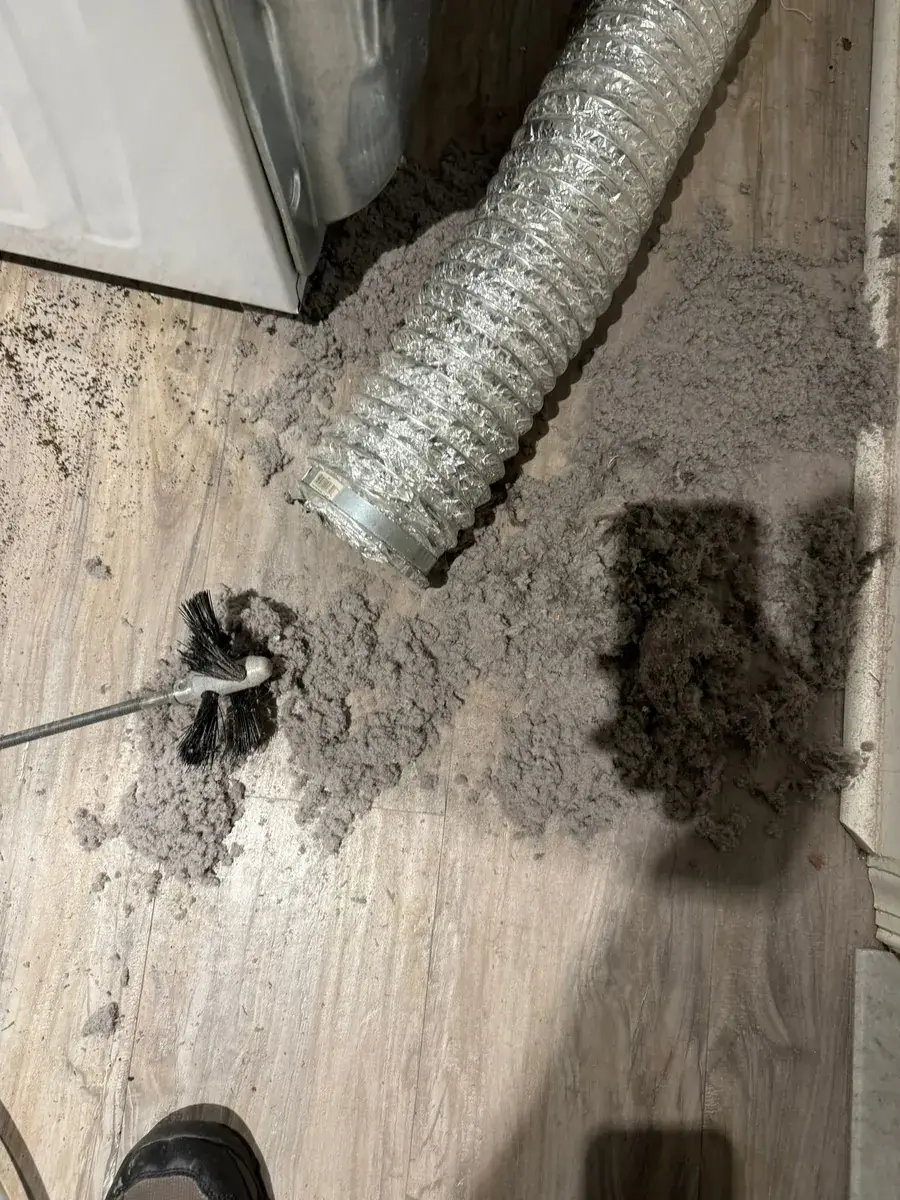
The cleaning itself pairs rotary brushes with HEPA-filtered vacuum extraction, so the lint we dislodge ends up in the machine — not floating around your laundry room. Every elbow gets worked through, because elbows are where roof-run and farmhouse-run clogs actually live.
- Rotary brush and vacuum extraction along the full length of the run
- Exterior hood or roof cap cleared — including lint mats, stuck flaps, screens, and bird nests
- Roof terminations handled with proper access equipment — common in Charlestown's two-story homes
- Transition hose behind the dryer checked; crushed or ribbed-foil hose flagged with a replacement option in your written quote
- Airflow verified at the termination before and after, so you see the difference
- After-photos of the cleared run and termination for your records
Every job carries our 6-month workmanship warranty — if a problem traced to our work appears within six months, we return and fix it free — plus a Price Match Guarantee against any competitor's written quote for the same scope, and Google Guaranteed protection on qualifying jobs. We are a PA licensed contractor (PA 187935) and insured; the actual documents are viewable on our license and insurance page.
A word on the do-it-yourself route, since we get asked: hardware-store brush kits top out well short of what a Charlestown roof run or farmhouse basement run measures, and pushing a short brush into a long duct tends to compact lint into the elbows rather than remove it — the clog gets denser and moves out of reach. Working blind from one end also misses the failures that matter most: a transition hose crushed behind the dryer, a joint that has pulled apart inside a wall or ceiling chase, or a duct quietly dumping lint and moist air into a joist bay. Our inspection catches those; if we find a disconnected or damaged section, we show you and scope the repair as its own clearly defined line in the written quote — never as a surprise added mid-job.
One visit, one flat quote, anywhere in the township
We come to Charlestown from our King of Prussia base — a straight shot down the Turnpike or Route 29 — so there is no trip fee and no minimum. Regular hours are Sunday through Friday, 24 hours a day, we answer around the clock for emergencies, and financing is available through Wisetack if you are bundling larger work. Whether the appointment is a quick first-floor run or a roof termination that needs ladder work, the visit ends the same way: airflow verified, after-photos in hand, and a dryer that dries in one cycle again.
Many Charlestown homeowners pair the dryer vent with a duct cleaning in the same visit, since the equipment and the technician are already on site; you can read how we handle the township's farmhouse retrofits and multi-zone systems on our Charlestown air duct cleaning page. We also serve the neighboring townships day in and day out — Schuylkill Township toward Valley Forge, East Pikeland across Pickering Creek, and Tredyffrin to the east — and the full list of Chester County towns is on our Chester County service page.
We are rated 4.8 stars across 144 Google reviews. The process never changes: free inspection, flat written quote before any work, honest scoping, after-photos when we are done.
How much does dryer vent cleaning cost?
Routine and deep cleaning are different services — the free inspection determines which one your system actually needs. Prices vary house to house; your exact price comes as a flat written quote before any work begins.
| Dryer vent routine — basement / 1st floor | $129.99 |
| Dryer vent routine — 2nd floor & up | $149.99 |
| Dryer vent deep cleaning | $299.99 |
| Nest removal · bird guard installation | from $250 · from $150 |
Three promises. In writing. On every job.
Price Match Guarantee
Bring a competitor's written quote for the same scope of work — we'll match it. You never overpay for doing it right.
6-Month Warranty
Every job carries a 6-month workmanship warranty. If a problem traced to our work shows up, we come back and make it right — free.
Google Guaranteed
Booked through Google Local Services, qualifying jobs carry Google's own money-back protection up to $2,000, administered by Google.
Backed by a real license and $1M/$2M insurance — see the actual documents
Don't put off air you breathe — finance it with Wisetack
Check your options in about a minute with no impact to your credit score, choose terms that fit your budget, and pay over time instead of all at once.
*All financing is subject to credit approval. Your terms may vary. Wisetack loans are issued by Hatch Bank. See additional terms at wisetack.com/faqs.
4.8 stars from 144 Google reviews — and easy to find
E Cleaning Duct & Vent Cleaning is based at 555 S Goddard Blvd, King of Prussia, and serves Charlestown and all of Chester County from right here. Check our Google profile: real jobs, real photos, and a rating our crew protects on every visit.
- Google Guaranteed business — screened, licensed and insured (see the documents)
- Read every review on our Google profile — we don't cherry-pick what you can verify
Dryer Vent Cleaning questions from Charlestown homeowners
Is there a travel fee for dryer vent service in Charlestown?
No. The inspection is free, the quote is flat and in writing before any work begins, and there are no travel or fuel surcharges anywhere in Charlestown Township — the same process we follow across all of Chester County.
Our laundry room is upstairs and the vent goes to the roof. Can you clean it?
Yes — roof terminations are routine for us in Charlestown's two-story homes. We bring proper roof access equipment, clean the full vertical run including every elbow, clear the cap or cage where lint mats form, and verify airflow at the termination before and after so you can see the result.
How often should a Charlestown dryer vent be cleaned?
Once a year works for most households. Homes that run heavy laundry — big families, pets, bulky bedding, work and barn clothes — often need attention every six to twelve months, especially on long roof-terminated or basement runs. NFPA data identifies failure to clean as the leading factor in dryer fires, so the schedule is worth keeping.
What are the signs my vent is clogged right now?
Loads needing two cycles to dry, a hot dryer top or hot laundry room, a burning smell mid-cycle, an exterior flap that barely opens while the dryer runs, and lint gathering around the door or behind the machine. Any one of these is enough reason to book the free inspection.
Do you clean vents in the townhomes and carriage homes near Devault?
Yes. Attached homes near the Route 29 corridor often have the longest and most concealed vent runs in the township, because builders route terminations away from neighboring units. We inspect the full run first and give you a flat written quote before any work — long run or short, the number does not change afterward.
Can you replace the flexible hose behind the dryer?
Yes. If the inspection shows a crushed, kinked, or ribbed-foil transition hose — common behind older basement setups in Charlestown farmhouses — we show it to you and include a semi-rigid replacement as a clearly defined option in the written quote before any work begins.
Ready for honest dryer vent cleaning in Charlestown?
Free video inspection, a flat written quote before any work, and real before/after proof — call (484) 367-5944 or book online now.
