
Dryer Vent Cleaning in Cheltenham, PA
E Cleaning cleans dryer vents across Cheltenham Township the transparent way: every job starts with a free video inspection, and you approve a flat, written quote before any work begins. We are family-owned, a licensed Pennsylvania contractor (PA 187935), insured up to $2 million, and Google Guaranteed — and every job ends with the airflow verified at the termination and the extracted lint documented in photos.
Basement, first floor, or upstairs? In Cheltenham, that question decides a lot
The floor your dryer sits on usually predicts how hard the vent has to work — and how big the cleaning job really is. Cheltenham packs an unusually wide range of laundry setups into one township, from rowhouse basements at the Philadelphia line to laundry rooms perched high in tall Victorian houses, which is exactly why we scope every job with a free video inspection before we quote it.
Cheltenham Township sits in the southeastern corner of Montgomery County, directly across Cheltenham Avenue from Philadelphia, with Springfield Township to the west, Jenkintown and Abington to the north, and Rockledge to the northeast. Its communities each bring their own laundry patterns. In the brick twins and rowhome blocks of La Mott, Melrose Park, and Cheltenham Village near the city line, the dryer almost always lives in the basement — the shortest, most straightforward runs we see. They usually exit a rear or side wall not far above grade, which sounds easy. The catch is the termination: low exits collect yard debris, flaps get painted shut or bent, screens mat over with lint, and a short run clogs at the exit just as effectively as a long run clogs in the middle.
The old Victorian and early-1900s homes of Wyncote and Elkins Park tell a different story. In houses that tall, renovations have steadily moved the laundry up — second floor, sometimes third — to be near the bedrooms. That produces some of the longest vent runs we see anywhere: vertical climbs inside walls, multiple elbows, and a termination through the roof or a high gable that nobody has looked at in years. That is a genuinely bigger job — more length, more turns, ladder or roof access — and it is why we put the scope in writing before we start. Your quote reflects the actual run, not a teaser number that grows once a crew is at the door.
Along the Old York Road corridor, Cheltenham also has a substantial stock of apartments and condominiums. Stacked washer-dryer units in closets are common there, and the crushed or kinked transition hose hiding behind a stacked unit is one of the most frequent lint traps we open up. Renters and condo owners get the same free video inspection and the same flat written quote as everyone else.
The township's postwar pockets and its Glenside edge add a third pattern: first-floor laundry closets and mudroom hookups, converted from pantries or back porches over the years. Those look like simple jobs, but a dryer parked mid-house often pushes its exhaust a surprising horizontal distance through the floor framing before it finds an outside wall — and unlike a vertical rise, where moving air helps carry lint up and out, every level foot is a shelf where lint settles and stays.
One more Cheltenham-specific point: this is a township full of attached housing. Twins and rowhomes share walls, and a dryer fire in attached housing never stays one household's problem. Winter sharpens the math — cold months are when Cheltenham dryers run their heaviest loads of towels, blankets, and layered clothing, right when a year of accumulated lint has already narrowed the line. An annual cleaning is the cheap way out of that equation.
Gas or electric changes nothing about how we scope and quote the job, but gas adds one more reason to keep the vent clear: combustion byproducts leave through the same duct as the lint. When the line chokes, moisture and exhaust back up into the laundry area instead of leaving the building.
Lint fires are boring to prevent and expensive to have
Nearly every dryer fire traces back to the same simple failure: the vent stopped moving air, and the heat had nowhere to go. Lint is fine, dry, and sits directly in the path of a heating appliance — it is about as close to tinder as anything in your house.
The U.S. Fire Administration (FEMA) separately estimates 2,900 home clothes dryer fires are reported each year. And well before anything ignites, a restricted vent quietly costs you money: cycles run longer, the heating element works harder, electricity bills creep up, and the dryer wears out years early. In a shared-wall township like Cheltenham, the fire risk is not just yours — it belongs to the neighbors on the other side of the party wall too.
Six signs your Cheltenham dryer vent is struggling
- Loads that used to finish in one cycle now need two
- The laundry area turns warm and muggy while the dryer runs
- A hot, scorched, or burnt-dust smell mid-cycle
- The outside flap stays shut or barely flutters with the dryer on
- Lint dusting the floor behind the machine or around the door seal
- Clothes come out damp at the seams and smelling musty
It is worth understanding why the lint screen does not save you. The screen catches most of the lint, but a portion of every load slips past it — carried by moist exhaust air into the duct, where it sticks to the walls as the moisture condenses. That is why a vent clogs slowly and invisibly over a year or two of normal use, even in a household that cleans the screen after every single load. The screen is maintenance you do; the duct is maintenance we do.
Any single sign is worth a cleaning. If you are seeing several at once, stop running the dryer while you are asleep or out of the house until the line is cleared — we offer 24-hour emergency response (closed Saturdays) for exactly this situation.
What happens during the visit
We clean the entire line, from the connection behind the dryer to the outdoor termination, then prove it worked: airflow checked at the exit, extracted lint photographed. Every job starts with a free video inspection and a flat, written quote you approve before any work begins — and that number is the whole bill.
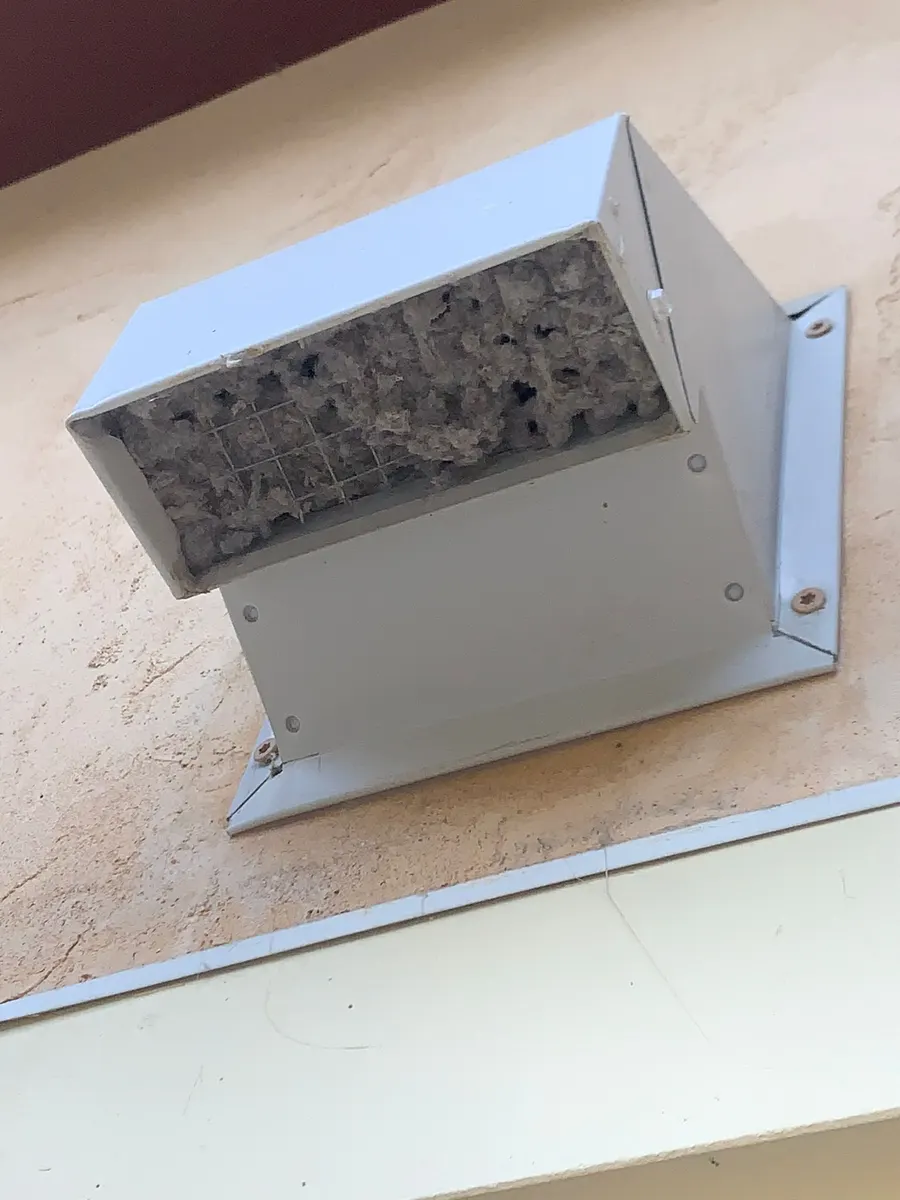
The clog is never where you can see it
Quick-visit outfits vacuum the two visible ends of the vent and leave. But lint packs up at the elbows, the vertical rises, and the long horizontal stretches in between — the parts you cannot reach from either end with a shop vac. Cleaning that misses the middle is not cleaning.
Trace and test
We locate the vent's true termination — wall, gable, or roof — check baseline airflow, and inspect the transition hose behind the dryer, a frequent failure point in stacked and closet setups.
Brush the full run
A rotary brush travels every foot of the duct, working through elbows and vertical climbs, scouring packed lint off the walls of the line — not just the ends.
Extract and clear the exit
Vacuum extraction captures what the brush frees, and the exterior hood, flap, or roof cap gets cleared of matted lint so the line can actually breathe.
Verify and document
Airflow is re-checked at the termination and compared against the starting reading, and you get photos of the lint that came out and the cleared line.
Most Cheltenham jobs take 45 to 75 minutes. Short basement runs in the rowhome blocks finish fast; a tall Wyncote or Elkins Park house with a roof termination uses the full window, and the ladder and roof work are scoped into your written quote up front — there is no separate access charge.
If the brush hits a hard obstruction — a bird nest at the cap, a crushed duct section, a joint that has come apart inside a wall — we stop, show you exactly what we found, and lay out the options. Nothing beyond the quoted cleaning happens without your approval.
Dryer vent cleaning cost in Cheltenham
The honest answer: it depends on the run, which is exactly why every visit starts with a free video inspection and a flat, written quote you approve before any work begins. That quote is final — no per-foot pricing, no trip charge anywhere in our service area, no add-ons invented at the door.
| What shapes your quote | Why it matters |
|---|---|
| Laundry location (basement vs. upper floors) | Longer lines, more elbows, and higher terminations mean more work |
| Termination type (wall, gable, or roof) | Ladder or roof access is scoped in up front — never a surprise line item |
| Routine cleaning vs. deep cleaning | They are honestly scoped as different services, and we tell you which one your vent actually needs |
A basement run is shorter and reachable from the ground; an upper-floor run is longer, turns more corners, and usually ends somewhere that needs a ladder. Both get the identical scope — full-length brushing, vacuum extraction, termination clearing, airflow verification, and photos — and both are quoted in writing before we touch the machine.
You have probably seen the $49–$99 “whole-house special” coupons that circulate around Montgomery County. That is a teaser, not a price — the number exists to get a crew in the door so it can grow once they are standing in your basement. Our answer to that industry habit is simple: the written quote you approve before work begins is the invoice you get when it ends. No surprise invoice, no door-step upsell.
E Cleaning is family-owned, licensed in Pennsylvania (PA 187935), insured up to $2 million, and Google Guaranteed, which adds money-back protection up to $2,000 on qualifying jobs. Wisetack financing is available, and we schedule around the clock, Sunday through Friday — we're closed Saturdays.
Because the crew is already on site, many customers pair the dryer vent with air duct cleaning in Cheltenham in the same visit — one inspection, one written quote covering both. We also handle the neighboring communities — Elkins Park, Wyncote, and Jenkintown — and the rest of the Montgomery County service area.
How much does dryer vent cleaning cost?
Routine and deep cleaning are different services — the free inspection determines which one your system actually needs. Prices vary house to house; your exact price comes as a flat written quote before any work begins.
| Dryer vent routine — basement / 1st floor | $129.99 |
| Dryer vent routine — 2nd floor & up | $149.99 |
| Dryer vent deep cleaning | $299.99 |
| Nest removal · bird guard installation | from $250 · from $150 |
Three promises. In writing. On every job.
Price Match Guarantee
Bring a competitor's written quote for the same scope of work — we'll match it. You never overpay for doing it right.
6-Month Warranty
Every job carries a 6-month workmanship warranty. If a problem traced to our work shows up, we come back and make it right — free.
Google Guaranteed
Booked through Google Local Services, qualifying jobs carry Google's own money-back protection up to $2,000, administered by Google.
Backed by a real license and $1M/$2M insurance — see the actual documents
Don't put off air you breathe — finance it with Wisetack
Check your options in about a minute with no impact to your credit score, choose terms that fit your budget, and pay over time instead of all at once.
*All financing is subject to credit approval. Your terms may vary. Wisetack loans are issued by Hatch Bank. See additional terms at wisetack.com/faqs.
4.8 stars from 144 Google reviews — and easy to find
E Cleaning Duct & Vent Cleaning is based at 555 S Goddard Blvd, King of Prussia, and serves Cheltenham and all of Montgomery County from right here. Check our Google profile: real jobs, real photos, and a rating our crew protects on every visit.
- Google Guaranteed business — screened, licensed and insured (see the documents)
- Read every review on our Google profile — we don't cherry-pick what you can verify
Dryer Vent Cleaning questions from Cheltenham homeowners
Why does upstairs laundry cost more to clean in Cheltenham?
Because the vent run is genuinely more work. Upper-floor laundry — common in Cheltenham's taller older homes — means longer lines, more elbows, and a termination through the roof or a high gable that requires ladder or roof access. All of that is scoped during the free video inspection and covered by the flat written quote you approve before we start, with no separate access fee.
Is there a travel charge to come to Cheltenham?
No. The flat, written quote you approve after the free video inspection is the complete price everywhere we work. We are based in King of Prussia and serve eastern Montgomery County constantly, so there is no trip fee, fuel surcharge, or minimum.
I live in a rowhome near Cheltenham Avenue. Does a shared wall change anything?
The cleaning is the same, but the verification matters more. In attached housing we trace the line to its true termination and confirm it actually exhausts outdoors rather than into a wall cavity or crawl space — a real risk in older homes where past renovations rerouted things. The fire stakes in shared-wall housing make the annual cleaning worth taking seriously.
My vent exits through the roof of a tall three-story house. Can you reach it?
Yes. Roof terminations are routine in Cheltenham's older two- and three-story homes with upstairs laundry, and lint matting against the roof cap is one of the most common blockages we clear. The ladder and roof work are part of the written quote for an upper-floor job — never a surprise line item.
How often should a dryer vent be cleaned?
Annually for most households. Big families running daily loads, homes with long or roof-terminating runs, and pet owners whose animals add hair to the lint stream should consider every six to nine months. If drying times are already stretching, book now rather than waiting for the calendar.
Can you do the dryer vent and the air ducts in one appointment?
Yes, and it is the most popular combination in Cheltenham. We scope the dryer vent and the air duct cleaning in Cheltenham during the same free video inspection and put both on one flat written quote. One visit, both lines cleared.
Ready for honest dryer vent cleaning in Cheltenham?
Free video inspection, a flat written quote before any work, and real before/after proof — call (484) 367-5944 or book online now.
