
Dryer Vent Cleaning in Eagleville, PA
E Cleaning clears dryer vents across Eagleville, PA the straightforward way: a free video inspection first, then a flat, written quote before any work begins. Licensed Pennsylvania contractor PA 187935, insured up to $2 million, Google Guaranteed — and every job ends with after-photos of the cleared line.
Where the dryer sits in an Eagleville home shapes the job
Dryer vent cleaning in Eagleville starts with one question: which floor is the laundry on? The answer tells us most of what the visit involves — which is why every job begins with a free video inspection and a flat, written quote before any work starts. The number you approve is the number on the invoice; nothing we find mid-job changes it.
In Eagleville, the answer usually tracks the age of the house. Lower Providence Township's older stock — the ranches, capes and split-levels put up through the 1950s, 60s and 70s as the suburbs spread out from Norristown — almost always keeps the washer and dryer in the basement. A basement dryer typically vents through a short, mostly straight run out a rim joist or a side wall a few feet away. Those are the quickest jobs on our schedule, and the quote reflects that.
The newer half of Eagleville tells a different story. The townhome communities and two-story singles built from the 1990s onward, as the township filled in between Norristown and Collegeville, mostly moved the laundry upstairs next to the bedrooms. Convenient for hampers — complicated for exhaust. A second-floor dryer cannot vent out the nearest wall; its duct usually climbs a wall cavity, crosses unconditioned attic space, and exits through the roof or a high gable. Longer run, more elbows, ladder work at the far end. That extra time is real work, and we scope it honestly in the written quote up front — the ladder never appears as a surprise line item.
Townhome density raises the stakes further. Interior townhouse units have no free side wall at all, so their vents almost always rise straight through the roof — twenty to thirty feet of duct with several elbows is normal, and every elbow is a ledge where lint packs in. Roof terminations are routine work for us in Eagleville's attached-home communities, and there is no separate roof or height fee.
Season matters here too. The heaviest laundry months — comforters, blankets, coats and wet winter gear from November through February — are exactly the months when an attic duct run is coldest, and cold duct walls are where damp lint sticks fastest. Humid Pennsylvania summers push from the other side: damp air stretches drying cycles, and longer cycles shed more lint per load. Add the weekend-batch laundry rhythm of commuter households along the Route 363 corridor — five days of clothes run back-to-back on a Saturday — and a vent that seemed fine in spring can be seriously restricted by January. If you are picking a time to book, fall is the smart season.
The fire math on a clogged dryer vent
Lint is fine, dry, highly flammable fiber, and a dryer vent's whole job is to move it past a heating element and out of the house. Narrow the vent, and two things climb at once: the temperature inside the machine and the amount of fuel sitting in the duct. The numbers behind that risk are public and specific.
How the clog forms is plain physics. Your lint screen catches only part of what a load sheds; the rest travels with warm, moist exhaust into the duct. Wherever that exhaust cools — above all in an uninsulated attic run during an Eagleville winter — moisture condenses on the duct wall, damp lint sticks to it, and the layer thickens a little with every load. The long vertical runs behind upstairs laundry rooms cool the most, which means the homes most likely to be carrying a packed vent are the township's newer ones, not the old basements.
Long before ignition, a restricted vent quietly bills you. Towels and jeans start needing a second cycle, which doubles the energy per load. The machine runs hotter, so the heating element and thermostat age early. Customers regularly tell us drying time fell by a third after a cleaning — the dryer was never broken; it just could not exhale.
The warning signs are easy to check without tools. If loads routinely need a second cycle, if the top of the dryer or the laundry room itself feels hot mid-run, if there is a faint scorched smell while the machine works, if barely any air moves at the exterior hood, or if moisture beads on the laundry-room window — the vent is talking to you. One sign means book a cleaning soon. Two or more means stop running the dryer until the line is cleared; the fix is a quick, routine service call, and the alternative can cost the house.
What the visit looks like, minute by minute
An Eagleville dryer vent cleaning covers the complete exhaust path — the transition hose behind the machine, the full duct run, and the termination outside — and typically takes 45 minutes to an hour. The work runs in four stages:
Trace the run
We locate the exit point, count the elbows and measure the run, so we know exactly what we are cleaning — a free inspection, on camera where the duct allows it. You get a flat, written quote before any cleaning starts, and nothing we find afterward changes it.
Brush and capture
Rotary brushes sized to your duct scrub the full length of the line while a HEPA-filtered vacuum captures everything the brush frees. The lint travels back toward the machine — never deeper into the duct, never loose around your laundry room.
Clear the termination
Matted lint, jammed damper flaps and the nesting debris that shows up in exterior hoods every spring all come out, and we confirm the flap swings freely.
Verify and document
We reconnect the dryer, confirm strong airflow at the exit, and photograph the cleared line before we leave.
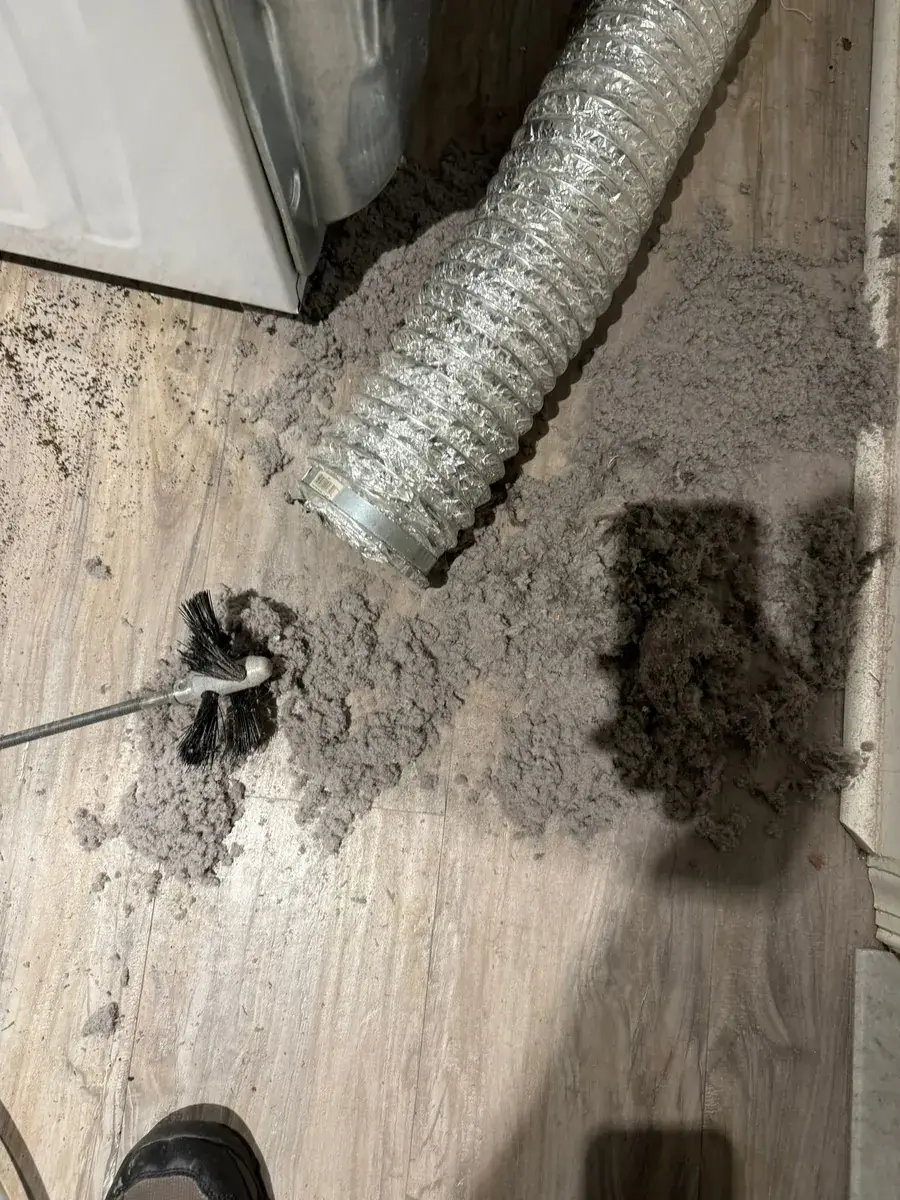
The lint comes out, not further in
A leaf blower or a hardware-store brush kit tends to compact lint at the elbows instead of removing it — which can leave a vent more dangerous than before. Rotary agitation working against HEPA suction pulls the whole accumulation out of the system, and the after-photo proves it.
- Transition hose behind the dryer inspected for kinks, crush damage and foil accordion material
- Full duct run brushed from the laundry wall to the termination
- Exterior hood or roof cap cleared completely — nesting debris included, at no extra charge
- Damper flap freed and tested so it seals when the dryer is off
- Airflow verified at the exit with the dryer running
- Dated after-photos of the cleared line for your records
Two lines we do not cross. We do not open up the dryer itself — internal appliance repair belongs to an appliance technician, and we will say so rather than tinker. And we do not manufacture repair work: sound rigid metal duct gets cleaned and left alone. If we find crushed flex, a separated joint in the attic, or the plastic or foil hose that codes and manufacturers warn against, we photograph it, show you, and lay out the options — your decision, zero pressure.
On rhythm: once a year suits a typical household. Move to every six months if the dryer runs daily, if the house is full of kids or shedding pets, or if tenants share the machine. Given what NFPA attributes to failure to clean, a yearly visit is about the cheapest insurance a homeowner can buy.
A flat written quote, no trip fee, and a local address
Every Eagleville job runs the same way: a free video inspection first, then one flat quote in writing before we touch the vent. There are no per-elbow charges, no ladder fee, no roof surcharge, no nest-removal add-on, and no trip fee anywhere in our service area — no surprise invoice, no door-step upsell, and the quote you approve is the invoice you receive.
E Cleaning is family-owned and has served Montgomery County since 2016 from 555 S Goddard Blvd in King of Prussia, a short run up the Route 363 corridor to Eagleville. The work is backed by Pennsylvania contractor license PA 187935, insurance up to $2 million, and Google Guaranteed money-back protection up to $2,000 on qualifying jobs. We schedule around the clock, Sunday through Friday — we're closed Saturdays, and Wisetack financing is available.
Booking takes one phone call or a minute online: tell us which floor the dryer sits on and roughly where the vent exits, and we can set a two-hour arrival window on the spot — the flat written quote follows the free inspection, before any work begins. Evening and overnight slots exist precisely because that is when Eagleville does its laundry — and because we run around the clock Sunday through Friday, you rarely have to wait long.
The most popular pairing in Eagleville is a same-visit air duct cleaning — one appointment, one crew, one written quote covering both services, and before-and-after evidence for both systems. We cover the neighboring towns as well: browse the Montgomery County service hub, or go straight to dryer vent cleaning in East Norriton, Norristown or Collegeville.
How much does dryer vent cleaning cost?
Routine and deep cleaning are different services — the free inspection determines which one your system actually needs. Prices vary house to house; your exact price comes as a flat written quote before any work begins.
| Dryer vent routine — basement / 1st floor | $129.99 |
| Dryer vent routine — 2nd floor & up | $149.99 |
| Dryer vent deep cleaning | $299.99 |
| Nest removal · bird guard installation | from $250 · from $150 |
Three promises. In writing. On every job.
Price Match Guarantee
Bring a competitor's written quote for the same scope of work — we'll match it. You never overpay for doing it right.
6-Month Warranty
Every job carries a 6-month workmanship warranty. If a problem traced to our work shows up, we come back and make it right — free.
Google Guaranteed
Booked through Google Local Services, qualifying jobs carry Google's own money-back protection up to $2,000, administered by Google.
Backed by a real license and $1M/$2M insurance — see the actual documents
Don't put off air you breathe — finance it with Wisetack
Check your options in about a minute with no impact to your credit score, choose terms that fit your budget, and pay over time instead of all at once.
*All financing is subject to credit approval. Your terms may vary. Wisetack loans are issued by Hatch Bank. See additional terms at wisetack.com/faqs.
4.8 stars from 144 Google reviews — and easy to find
E Cleaning Duct & Vent Cleaning is based at 555 S Goddard Blvd, King of Prussia, and serves Eagleville and all of Montgomery County from right here. Check our Google profile: real jobs, real photos, and a rating our crew protects on every visit.
- Google Guaranteed business — screened, licensed and insured (see the documents)
- Read every review on our Google profile — we don't cherry-pick what you can verify
Dryer Vent Cleaning questions from Eagleville homeowners
How much does dryer vent cleaning cost in Eagleville, PA?
Every job starts with a free video inspection, and you receive a flat, written quote before any work begins. The quote depends on the scope — mainly which floor the laundry is on and where the vent exits — and it covers the entire line from the dryer to the outside termination, with after-photos of the cleared vent included. The number you approve is the number on the invoice.
Does an upstairs laundry room cost more to clean?
It can, because the run is genuinely more work. Upstairs laundries in Eagleville's newer homes typically vent up a wall cavity, across the attic, and out the roof or a high gable — more duct, more elbows, and ladder time at the termination. Whatever the layout, it is all scoped honestly in your flat written quote before we start, with no height or roof charge added later.
My townhouse is an interior unit and the vent goes through the roof. Does that cost extra?
No. Interior units in Eagleville's townhome communities almost always vent through the roof, and those runs are everyday work for us. Length, elbow count and roof access are all inside the flat written quote you approve before we start — there is no separate roof or height fee.
My dryer takes two cycles to dry towels. Is the vent really the cause?
Very often, yes. A restricted vent traps heat and moisture in the drum, so the dryer works longer and hotter without drying better. Customers frequently see drying times drop by about a third after a cleaning. If two cycles has become normal in your house, have the vent checked before blaming the machine.
Do you clean vents for both gas and electric dryers?
Yes, and the gas case is the more urgent one: a blocked vent on a gas dryer can push combustion byproducts, including carbon monoxide, back into the laundry area. The cleaning process is identical for both types, and so is how we price it: a free inspection, then one flat written quote before any work begins.
How often should an Eagleville household have the dryer vent cleaned?
Once a year for typical use. Go to every six months if the dryer runs daily, if you have a large family or shedding pets, or if the machine serves a rental with rotating tenants. NFPA data ties about one-third of home dryer fires to failure to clean, so an annual visit is inexpensive protection.
Ready for honest dryer vent cleaning in Eagleville?
Free video inspection, a flat written quote before any work, and real before/after proof — call (484) 367-5944 or book online now.
