
Dryer Vent Cleaning in Highland, PA
E Cleaning provides professional dryer vent cleaning across Highland Township in southwestern Chester County — full-run lint extraction from the transition hose behind the dryer to the exterior hood. Every job starts with a free inspection, you approve a flat written quote before any work begins, and there is no trip fee for the drive out. Family-owned since 2016, licensed PA contractor (PA 187935), insured to $2 million, and rated 4.8 stars across 144 Google reviews.
Why dryer vent cleaning matters more in a spread-out township
In a township like Highland, dryer vent cleaning is fire prevention before it is anything else. Highland occupies a rural corner of southwestern Chester County — bordered by East Fallowfield to the north, West Marlborough to the east, Londonderry to the south, and West Fallowfield to the west — where homes sit far apart along township roads and long private lanes off the Route 41 corridor. Out here, fire protection comes from volunteer companies based in the surrounding communities, and a truck simply has farther to travel than it would in a borough with a station down the street. That doesn't make Highland unsafe; it makes prevention worth more.
The U.S. Fire Administration (FEMA) puts reported home clothes dryer fires at an estimated 2,900 per year. The mechanism is not mysterious: lint is fabric fiber, fabric fiber is fuel, and a vent that cannot exhaust freely traps hot, moist air exactly where that fuel accumulates. Cleaning the full run removes the fuel and restores the airflow — which is also why a freshly cleaned vent dries laundry faster and runs the dryer cooler and cheaper.
We drive out from our King of Prussia base and serve every corner of Chester County with no trip fee, no mileage charge, and no minimum — Highland's back roads included. The free inspection and the flat written quote before any work apply on every single visit. The full county list is on our Chester County service page.
Where your laundry room sits decides what the vent run looks like
Highland's homes put their laundry in three places, and each one produces a different vent run — which is exactly why we inspect before we quote.
In the township's older farmhouses, the washer and dryer usually live in the basement. That means a vent that exits through a thick fieldstone foundation or the rim joist above it, often after a long horizontal run beneath the first floor. Basement runs in old houses also tend to be the ones assembled decades ago from whatever was on hand — flexible foil hose, screwed joints that snag lint, sections that sag between supports. Every one of those details slows airflow and packs lint deeper into the duct.
Newer construction moved the laundry upstairs. Main-floor laundry and mudroom setups — common in the single-family homes built on subdivided acreage here through the 1990s and 2000s — often send the vent up through the wall and across the ceiling framing, and some terminate through the roof. Roof terminations work, but they clog quietly: nobody walks past a roof cap the way they walk past a wall hood, so lint builds unseen until dry times stretch and the laundry room turns humid.
Second-floor laundry rooms, a signature of the newest homes, produce the longest concealed runs of all — routed through framing with multiple elbows, and every elbow is a lint trap. One thing Highland largely does not have is the attached housing you find in boroughs like Parkesburg or Oxford: no shared party walls, few stacked units, almost none of the short shared runs of denser neighborhoods. The local pattern is the opposite — detached homes with long, private vent runs. Long runs are exactly where lint compacts hardest, and they are the reason "we cleaned what we could reach from outside" is not a real cleaning in this township. The whole run has to be done, end to end.
Farm-country laundry is hard on a dryer vent
Households in Highland simply run their dryers harder than the average suburban home. Work clothes, barn and garden gear, towels, pet bedding, and mud-season laundry produce heavy, lint-rich loads — thick cotton work fabric sheds far more fiber per load than office wear ever will. Families out here also tend to dry everything indoors through the winter, so the vent works hardest in exactly the months when moist exhaust meets freezing outside air.
That combination matters on long runs. Where a vent passes through unconditioned space — a crawlspace, an attic, an uninsulated chase — winter cold condenses the moisture in the exhaust, damp lint sticks to the duct wall, and every later load presses more lint onto it. That is how a run "suddenly" clogs in February: it was packing slowly all season, and the cold snap finished the job.
Rural exterior hoods also attract tenants. Birds nest in uncovered dryer vent terminations every spring, and small animals find them in the fall — it is one of the most common discoveries on our inspections of homes surrounded by fields and hedgerows. We remove nests as part of the scoped work when we find them, and we can install a bird guard so the vent stays protected without choking airflow. Everything gets named in the written quote before work begins, so finding a nest never turns into a doorstep negotiation.
We handle the same conditions all through the neighboring townships — see our pages for dryer vent cleaning in Londonderry, West Fallowfield, and Parkesburg.
What happens during a full-run lint extraction?
We clean the entire vent — transition hose, wall or floor duct, every elbow, and the exterior termination — using rotary agitation and vacuum extraction, then verify airflow before we leave. Here is the sequence:
Free inspection
We examine the full run from the dryer connection to the exterior hood and show you what we find. If the vent is genuinely clear, we say so — you owe nothing for the look.
Honest scoping, in writing
A maintained vent needs a routine cleaning. A run that has never been cleaned, or is packed solid, is a deep cleaning — a genuinely different job with more agitation and more time. The inspection decides which applies, and you approve a flat written quote before any work starts.
Transition hose off, dryer outlet cleared
We disconnect and clean the transition hose behind the dryer and clear the lint that accumulates at the dryer's own exhaust outlet — the first place airflow chokes. If the hose is foil or damaged, we tell you; we don't upsell it.
Rotary agitation with vacuum extraction
A rotary brush runs the full length of the duct while vacuum extraction captures the dislodged lint, so it leaves your house instead of resettling in the run — the same end-to-end approach whether your vent exits a stone foundation or a roof cap.
Exterior hood and termination
We clear the hood, free the flap so it opens and closes properly, remove nest material if present, and fit a bird guard if you want one.
Reconnect and verify
Everything goes back together, we run the dryer, and we confirm strong airflow at the termination. You get after-photos of the run and the lint that came out of it.
Most single-family vents take under an hour once work begins; long second-floor runs, roof terminations, and deep cleanings take longer, and the written quote sets that expectation up front.
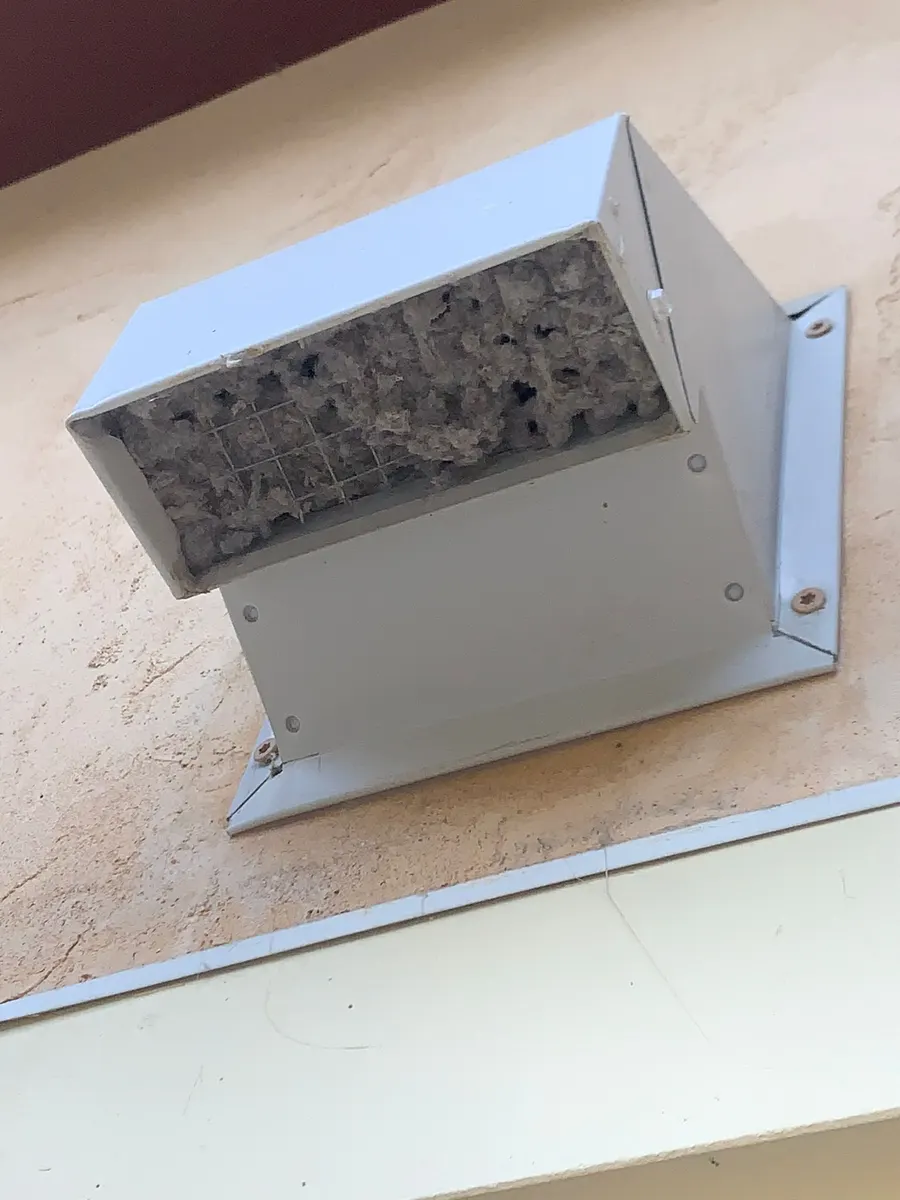
How do you know it's time? The warning signs
A clogging dryer vent announces itself — quietly at first. Catch the signs early and the fix is a routine cleaning; ignore them for a few years and you are into a deep cleaning of a compacted run. Watch for these:
- Towels or jeans need a second cycle to dry
- The top of the dryer — or the laundry room itself — feels hot and humid mid-cycle
- A faint burning smell while the dryer runs
- The exterior flap barely moves, or doesn't move at all, while the dryer is on
- Lint collecting around the exterior hood or on the ground below it
- Clothes come out hotter than usual, or smelling musty
- The dryer's moisture sensor keeps ending cycles early while loads are still damp
Any one of these is reason to have the run looked at, and the look costs nothing. The free inspection covers the full run — not just the visible ends — and whatever it finds goes into a flat written quote you approve before we start. No trip fee for the visit, no charge if you decide to wait, and no number that changes once work begins. That structure exists on purpose: this industry's teaser-coupon habits taught homeowners to expect a doorstep upsell, and the written quote is our answer to it.
Guarantees, scheduling, and pairing it with a duct cleaning
Dryer vent work in Highland carries the same four-way backing as every job we do. A Price Match Guarantee: bring a competitor's written quote for the same scope of work and we match it. A 6-month workmanship warranty: if a problem traced to our work shows up within six months, we return and fix it free. And Google Guaranteed money-back protection up to $2,000 on qualifying jobs. We are a licensed Pennsylvania contractor (PA 187935), insured to $2 million — the actual documents are posted on our licensed and insured page.
We schedule around the clock, Sunday through Friday — we're closed Saturdays when a dryer problem cannot wait, and Wisetack financing is available if you would rather spread payments out.
Because Highland addresses sit a real drive from anywhere, it pays to combine services in one visit. If your home's air ducts have not been looked at in years — and in this township's farmhouses, they often have never been looked at — our air duct cleaning in Highland pairs naturally with the dryer vent: one truck, one written quote, both systems handled the same afternoon. The full list of towns we serve is on the Chester County page.
How much does dryer vent cleaning cost?
Routine and deep cleaning are different services — the free inspection determines which one your system actually needs. Prices vary house to house; your exact price comes as a flat written quote before any work begins.
| Dryer vent routine — basement / 1st floor | $129.99 |
| Dryer vent routine — 2nd floor & up | $149.99 |
| Dryer vent deep cleaning | $299.99 |
| Nest removal · bird guard installation | from $250 · from $150 |
Three promises. In writing. On every job.
Price Match Guarantee
Bring a competitor's written quote for the same scope of work — we'll match it. You never overpay for doing it right.
6-Month Warranty
Every job carries a 6-month workmanship warranty. If a problem traced to our work shows up, we come back and make it right — free.
Google Guaranteed
Booked through Google Local Services, qualifying jobs carry Google's own money-back protection up to $2,000, administered by Google.
Backed by a real license and $1M/$2M insurance — see the actual documents
Don't put off air you breathe — finance it with Wisetack
Check your options in about a minute with no impact to your credit score, choose terms that fit your budget, and pay over time instead of all at once.
*All financing is subject to credit approval. Your terms may vary. Wisetack loans are issued by Hatch Bank. See additional terms at wisetack.com/faqs.
4.8 stars from 144 Google reviews — and easy to find
E Cleaning Duct & Vent Cleaning is based at 555 S Goddard Blvd, King of Prussia, and serves Highland and all of Chester County from right here. Check our Google profile: real jobs, real photos, and a rating our crew protects on every visit.
- Google Guaranteed business — screened, licensed and insured (see the documents)
- Read every review on our Google profile — we don't cherry-pick what you can verify
Dryer Vent Cleaning questions from Highland homeowners
How often should a dryer vent be cleaned in Highland?
Once a year is the standard recommendation, and it fits most households. Homes that run heavy, lint-rich loads — work clothes, barn gear, big families, lots of towels and pet bedding — often benefit from more frequent attention. NFPA data shows failure to clean is the leading factor in dryer fires, so if you can't remember your last cleaning, that is your answer.
Can you clean a dryer vent that exits through a stone foundation?
Yes. Basement laundry in an old farmhouse is one of the most common setups we see in this part of Chester County. The rotary-brush-and-extraction method works the full length of the duct from the inside, so a thick fieldstone wall at the termination doesn't limit the cleaning — we clear the run end to end and confirm airflow at the hood before we leave.
There's a bird nest in my dryer vent — can you handle it?
Yes. Nesting in exterior vent hoods is routine on rural properties like Highland's, especially in spring. We remove the nest material, clean the full run behind it, and can install a bird guard so it doesn't happen again. Everything appears on the flat written quote before we start — finding a nest never turns into a surprise charge halfway through the job.
Do you charge extra to drive out to Highland Township?
No. There is no trip fee, mileage charge, or minimum anywhere in Chester County, and that includes Highland's back roads and long private lanes. The inspection is free, and the flat written quote you approve before work begins is the complete price.
My laundry room is on the second floor — does that change the job?
It changes the run, not the promise. Second-floor laundry usually means the longest concealed duct in the house, with more elbows and sometimes a roof termination — the places lint compacts hardest. The free inspection maps what your run actually needs, routine or deep, and the written quote covers the full scope before any work starts.
Do you also clean air ducts in Highland?
Yes — air duct cleaning is our core service, and many Highland customers book both in one visit since we are already making the drive. The same rules apply: free video inspection inside the ducts first, then a flat written quote before any work. See our air duct cleaning in Highland page for how that service works.
Ready for honest dryer vent cleaning in Highland?
Free video inspection, a flat written quote before any work, and real before/after proof — call (484) 367-5944 or book online now.
