
Dryer Vent Cleaning in Lionville, PA
E Cleaning provides full-run dryer vent cleaning across Lionville and Uwchlan Township — from the connection behind your dryer all the way to the exterior hood — with a free camera inspection first and a flat written quote before any work begins. Family-owned since 2016, PA-licensed (PA 187935), insured, rated 4.8 stars across 144 Google reviews, and there is never a trip fee anywhere in the township.
Lionville laundry rooms, floor by floor
Where your laundry room sits determines almost everything about your dryer vent — how long the run is, where it terminates, and how much lint it traps along the way. Lionville's housing mix means we see every configuration here in the same week.
In the older split-levels and ranches near the Route 113 village core, laundry usually lives in the basement or a lower-level utility room. These are often the shortest vent runs in town — a few feet out through the rim joist — but they are also the oldest. Forty or fifty years of service means decades of lint compacted in the duct, exterior hoods with broken or stuck flaps, and in many cases an original vinyl or foil transition hose behind the dryer that no longer meets today's standards and should be replaced.
The colonial subdivisions built through the 1980s and 1990s tend to put laundry in a first-floor mudroom off the garage or kitchen. That convenience comes with a longer vent run — often routed through the garage ceiling or a soffit before it reaches an exterior wall — and with elbows along the way. Every elbow is a lint trap; a run with three or four bends clogs far faster than a straight shot out of a basement.
The townhomes, carriage homes, and newer single-family builds from the 1990s onward frequently feature second-floor laundry closets, placed near the bedrooms where the laundry actually is. Smart design — but it produces the longest and least accessible vent runs in Lionville: vertical chases to a roof termination, or long horizontal runs through ceilings. Roof-terminated vents are out of sight and out of mind; most owners have never seen theirs, let alone checked whether the cap is packed with lint. When we clean a second-floor or roof-terminated run, the ladder work and the roof cap are part of the written scope — not a surprise add-on at the door.
Townhomes, shared walls, and why the stakes are higher here
A large share of Lionville's growth over the past few decades came in the form of attached housing — townhome and carriage-home communities along the Route 100 and Route 113 corridors. Attached housing changes the dryer vent conversation in two ways.
First, the runs themselves. Builders of attached homes route dryer vents wherever the floor plan allows: up through chases between units, across garage ceilings, through attic spaces to the roof. These long, hidden runs move air more weakly than short ones, which means lint drops out of the airstream and accumulates instead of being carried outside. A vent the homeowner cannot see and cannot reach is a vent that quietly fills up year after year.
Second, the neighbors. In a detached house, a dryer fire is a tragedy for one family; behind a shared wall, it endangers the family next door too. The numbers deserve respect.
Lionville's commuter rhythm adds one more factor. With the Turnpike interchange minutes away on Route 100, plenty of households start a load in the dryer on the way out the door. A restricted vent forces the dryer to run hotter and longer — exactly the conditions you do not want in an empty house. HOA-managed exteriors compound the issue: when the association handles the outside of the building, many owners assume someone else is watching the vent hood. In our experience, nobody is.
Seasons, birds, and the warning signs Lionville homeowners should know
Dryer vents in this part of Chester County live on a seasonal cycle. Winter is the heavy season: more loads, heavier fabrics, and long runs passing through cold attics and chases, where warm, moist dryer air condenses and turns loose lint into a damp mat that clings to the duct wall. Spring brings a different problem — birds. An exterior dryer hood is warm, sheltered, and elevated: ideal nesting real estate. Every spring we pull nests out of vents across this area, and a nest does not just restrict airflow — it can block it completely while adding highly flammable material directly in front of a heat source. If your vent has hosted a nest once, a bird guard on the hood prevents the repeat. Fall adds windblown leaves and debris at ground-level terminations.
The warning signs are consistent regardless of season. Clothes taking two cycles to dry is the classic one — and the most expensive, since every extra cycle is wasted energy and wear on the machine. Others: the top of the dryer or the laundry room feeling unusually hot mid-cycle, a faint burning smell, lint collecting behind or beneath the dryer, visible lint around the exterior hood, or an exterior flap that no longer opens when the dryer runs. Any one of these is your vent asking for attention. Two or more means stop using the dryer until the run has been inspected — a precaution the fire statistics above more than justify.
Because our shop is in King of Prussia and the Turnpike connects us straight to the Route 100 interchange, Lionville sits squarely inside our fast-response zone. Most appointments here are scheduled within days, not weeks — and the inspection that starts the visit costs nothing either way.
What full-run dryer vent cleaning actually includes
The phrase "dryer vent cleaning" covers a lot of sins in this industry, so here is precisely what we mean by it: cleaning the entire run, from the connection behind your dryer to the exterior termination, with the lint physically removed from the system — not blasted deeper into it.
Our technicians disconnect and inspect the transition hose — the short flexible section behind the machine, and the most common failure point — then work the full duct with rotary brushes that scrub the duct wall while a vacuum extracts what the brush frees. The exterior hood is opened and cleared, the flap checked for free movement, and the run is reassembled with airflow verified at the termination. You can feel the difference at the hood before we leave, and we photograph the results so you have evidence, not assurances.
We scope this work honestly, because routine and deep cleaning are genuinely different services. A vent that gets cleaned regularly is a routine job: brush, extract, verify, done. A vent that has gone years without attention — or one hosting a bird's nest, crushed flat behind the dryer, or terminating in a clogged roof cap — is a different job that takes different time and different work, and pretending otherwise is how this industry earned its reputation for doorstep surprises. The free inspection tells us which situation you have, and you get a flat written quote before any work begins. No trip fee to come look, and the written number is the number you pay.
If the inspection turns up a problem beyond cleaning — a transition hose that should be replaced, a nest that needs removal, a hood that should get a bird guard — you hear about it at quote time, in writing, and you decide. Nothing gets "discovered" halfway through the job.
Our dryer vent process, step by step
Every Lionville dryer vent appointment follows the same sequence, whether the run is six feet out of a split-level basement or thirty feet up through a townhome chase to the roof:
- Free inspection of the full run — transition hose, duct, and exterior termination, with photos of what we find.
- Flat written quote — scoped to your actual vent configuration and approved by you before work starts.
- Dryer moved and protected — floors covered and the machine disconnected safely.
- Full-run cleaning — rotary brush agitation through the entire duct with vacuum extraction, worked from both ends where the run allows.
- Exterior hood serviced — lint cleared, flap movement checked, nesting debris removed if present.
- Reassembly and airflow test — transition hose reconnected properly and airflow verified at the termination.
- After-photos and walkthrough — you see the clean run and feel the airflow before we leave.
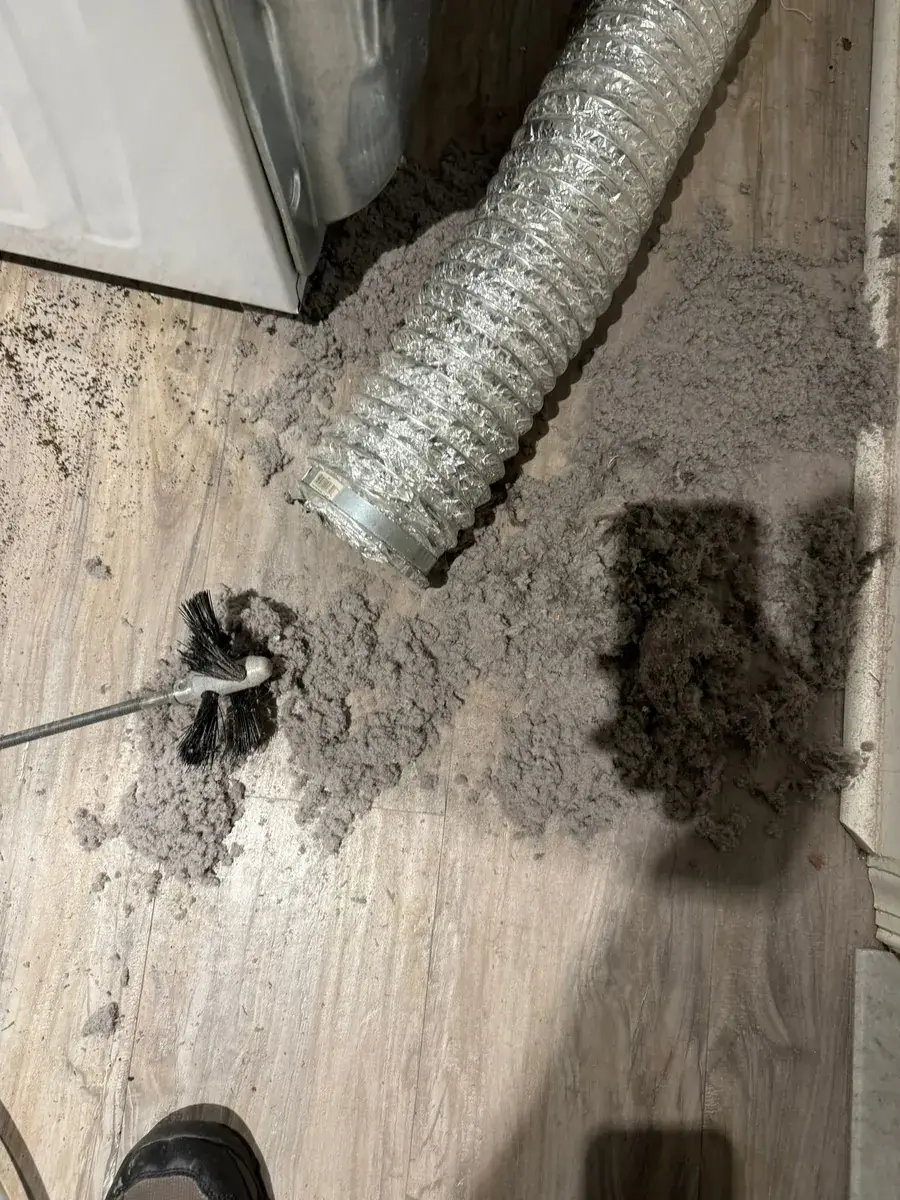
A straightforward basement or first-floor run usually takes under an hour. Second-floor and roof-terminated runs take longer — the ladder or roof work is written into the scope, and your quote reflects it up front rather than as a doorstep revision. If you would also like your air ducts inspected while we are on site, mention it when you book; pairing the two services in one visit is common in Lionville and saves scheduling a second appointment.
Guarantees, financing, and nearby towns we serve
Every dryer vent job in Lionville carries our full guarantee stack: a Price Match Guarantee — bring a competitor's written quote for the same scope of work and we match it; a 6-month workmanship warranty on every job — if a problem traced to our work shows up within six months, we come back and make it right free; and Google Guaranteed protection on qualifying jobs. We are a PA-licensed contractor (PA 187935) and insured — the license and insurance documents are viewable on our licensed & insured page. Financing is available through Wisetack, and we schedule 24 hours a day, Sunday through Friday (we're closed Saturdays) for vent problems that cannot wait.
Lionville homeowners often pair this service with air duct cleaning in Lionville — one visit, one crew, both systems handled. We also serve the surrounding communities, including Exton, West Whiteland, and Upper Uwchlan, plus every town on our Chester County service page.
How much does dryer vent cleaning cost?
Routine and deep cleaning are different services — the free inspection determines which one your system actually needs. Prices vary house to house; your exact price comes as a flat written quote before any work begins.
| Dryer vent routine — basement / 1st floor | $129.99 |
| Dryer vent routine — 2nd floor & up | $149.99 |
| Dryer vent deep cleaning | $299.99 |
| Nest removal · bird guard installation | from $250 · from $150 |
Three promises. In writing. On every job.
Price Match Guarantee
Bring a competitor's written quote for the same scope of work — we'll match it. You never overpay for doing it right.
6-Month Warranty
Every job carries a 6-month workmanship warranty. If a problem traced to our work shows up, we come back and make it right — free.
Google Guaranteed
Booked through Google Local Services, qualifying jobs carry Google's own money-back protection up to $2,000, administered by Google.
Backed by a real license and $1M/$2M insurance — see the actual documents
Don't put off air you breathe — finance it with Wisetack
Check your options in about a minute with no impact to your credit score, choose terms that fit your budget, and pay over time instead of all at once.
*All financing is subject to credit approval. Your terms may vary. Wisetack loans are issued by Hatch Bank. See additional terms at wisetack.com/faqs.
4.8 stars from 144 Google reviews — and easy to find
E Cleaning Duct & Vent Cleaning is based at 555 S Goddard Blvd, King of Prussia, and serves Lionville and all of Chester County from right here. Check our Google profile: real jobs, real photos, and a rating our crew protects on every visit.
- Google Guaranteed business — screened, licensed and insured (see the documents)
- Read every review on our Google profile — we don't cherry-pick what you can verify
Dryer Vent Cleaning questions from Lionville homeowners
How often should a dryer vent be cleaned in Lionville?
Once a year is the right rhythm for most households, and it matches what dryer manufacturers generally recommend. Clean more often if you have a large family doing daily loads, pets whose hair rides in with the laundry, or a long run — second-floor laundry closets and roof-terminated townhome vents restrict airflow sooner than a short basement run does. If you cannot remember the last time yours was cleaned, that is the answer: book the free inspection and find out what is actually in there.
My laundry room is on the second floor — does that change the job?
Yes, and we scope it honestly up front. Second-floor laundry, common in Lionville's newer townhomes and single-family builds, usually means a long vertical run to a roof termination or a long ceiling run to a side wall. Longer runs trap more lint, and roof terminations require ladder work to clean and verify. All of that is written into your flat quote before we start — never added at the door.
Do townhomes really need dryer vent cleaning more often?
Often, yes. Attached homes tend to have the longest, most hidden vent runs — through chases, garage ceilings, or attics to the roof — and weak airflow in a long run drops lint out of the airstream faster. Shared walls also raise the stakes: NFPA data attributes about one-third of dryer fires to failure to clean. If you have never seen where your vent terminates, it is worth finding out where it is and what condition it is in.
There is a bird's nest in my dryer vent — can you remove it?
Yes. Nest removal is something we handle regularly each spring across the Lionville area — exterior hoods are warm and sheltered, which makes them prime nesting spots. We remove the nesting material, clean the full run behind it, verify airflow, and can install a bird guard on the hood so it does not happen again. As with everything we do, you get a flat written quote for the full scope before any work begins.
Can you tell me the price over the phone?
No — and we would be guessing if we did. The honest cost of the job depends on the run itself: its length, how many elbows it has, where it terminates, whether it has been maintained or is packed solid, and whether anything beyond cleaning turns up, like a failing transition hose or a nest. The inspection is free, there is no trip fee, and the flat written quote you approve before work is the number you pay.
What are the warning signs of a clogged dryer vent?
Clothes needing a second cycle to dry is the classic sign, and the most expensive one to ignore. Also watch for a dryer or laundry room that feels unusually hot mid-cycle, a faint burning smell, lint gathering behind the machine or around the exterior hood, and an exterior flap that stays shut while the dryer runs. Two or more of these together means stop using the dryer until the run has been inspected.
Ready for honest dryer vent cleaning in Lionville?
Free video inspection, a flat written quote before any work, and real before/after proof — call (484) 367-5944 or book online now.
