
Dryer Vent Cleaning in London Grove, PA
E Cleaning cleans dryer vents across London Grove Township — full-run lint extraction from the dryer connection to the exterior hood, whether your laundry sits in a farmhouse basement or a second-floor laundry room venting through the roof. A free inspection comes first, and you get a flat written quote before any work begins. Family-owned, PA-licensed, rated 4.8 stars across 144 Google reviews.
Dryer Vent Service for a Township Where Prevention Does the Heavy Lifting
London Grove Township covers a broad stretch of southern Chester County, and most of its homes sit well apart from one another — down long driveways off Route 41, along the back roads around the village of Chatham, or in subdivisions spread across former farmland near the US 1 corridor. That spread-out settlement pattern is a big part of the township's appeal. It also changes the math on fire safety. Like most rural townships in this corner of the county, London Grove relies largely on volunteer fire companies based in the nearby boroughs, and a home at the end of a half-mile lane is simply farther from help than a rowhome in town. None of that is a reason for alarm; it is a reason to take prevention seriously — and a clogged dryer vent is one of the most preventable fire hazards in any house.
We bring the same service to every corner of the township: the lanes west of Chatham, the homes around the edges of West Grove and Avondale boroughs, and the newer developments toward Toughkenamon and New Garden. E Cleaning is family-owned, based in King of Prussia, and has served Chester County since 2016. There is no trip fee to reach a rural address here — the inspection is free, the quote is flat and in writing before we start, and the invoice matches the quote.
Where the Laundry Is — and Why That Decides How Your Vent Clogs
In London Grove, where your washer and dryer sit is usually a function of when your house was built, and it determines almost everything about your vent run. The township's old farmhouses typically keep laundry in the basement, which sounds simple until you trace the vent: a basement dryer often needs a long horizontal run to reach daylight, sometimes snaking past a foundation wall and out through a rim joist. Every foot of that run, and every elbow in it, slows airflow and gives lint a place to settle. In houses where the laundry migrated over the years — into a converted porch, a mudroom addition, or a first-floor closet — the vent path is frequently an afterthought, with more bends than any installer would choose on purpose.
The subdivisions built here from the 1990s onward flipped the layout: second-floor laundry rooms, put up near the bedrooms for convenience. Those dryers usually vent vertically through the attic and out the roof, or take a long concealed run through framing to a sidewall. Vertical runs work against lint — it has to be carried upward the whole way — and a roof termination adds a cap that can mat over with lint where no one ever looks. We clean roof-terminated vents routinely, and they are among the most neglected in the township precisely because they are out of sight.
There are also pockets of attached and closer-set housing near the borough edges and along the US 1 corridor — townhomes and duplexes where dryer runs thread through shared framing and where one household's neglected vent sits a wall away from the neighbors. Attached homes raise the stakes and shrink the margin for error. Whatever your setup — basement, upper floor, garage-side mudroom, or townhome — the run length, the number of elbows, and the termination type are what we inspect first, because they tell us exactly where your lint is hiding.
Dryer Fires Are a Prevention Problem — Especially Out Here
The national numbers are blunt. U.S. fire departments respond to an estimated 15,970 home fires involving clothes dryers or washing machines each year, and failure to clean is the leading factor, contributing to one-third (33%) of dryer fires, according to NFPA data from 2010–2014. The U.S. Fire Administration (FEMA) puts reported home clothes dryer fires at an estimated 2,900 per year. Behind those statistics is a simple mechanism: lint is fuel, a restricted vent traps heat, and the two meet inside a metal box that runs unattended in your house several times a week.
London Grove's laundry habits add load, too. Rural and farm-adjacent households wash heavier, dirtier textiles — work clothes, barn layers, dog towels, muddy kids' gear — and heavy fabrics shed more lint per load than office wear. Winters push everything into the dryer for months, since line-drying is a three-season option here at best. If your dryer has started taking two cycles to dry a load, if the laundry room gets noticeably humid while it runs, or if you cannot remember the vent ever being cleaned, the run is telling you it is restricted. Those symptoms are also the honest signal that it is time to look — which, with us, costs nothing: the inspection is free, and the flat quote arrives in writing before any work begins.
Full-Run Lint Extraction, From the Drum to the Outside Hood
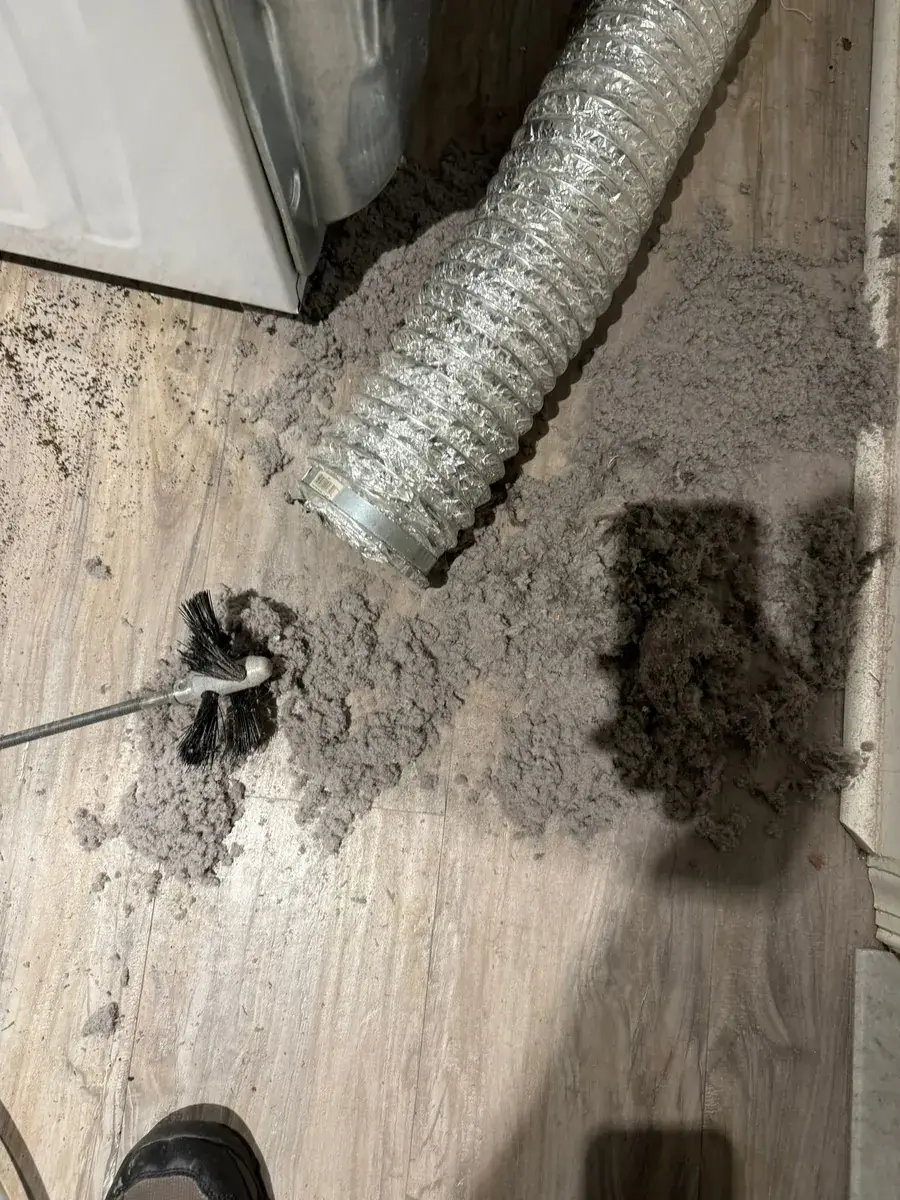
A dryer vent is only clean if the entire run is clean — from the connection behind the dryer to the hood or roof cap where it exits the house. Cleaning the first few feet and calling it done just leaves the blockage deeper in the line, which is arguably worse, because the dryer keeps pushing hot air at it. Our method works the full run: we disconnect the dryer, inspect the transition hose, then drive a rotary brush through the entire duct while a HEPA-filtered vacuum pulls the loosened lint out under negative pressure.
We finish at the termination — the piece most homeowners never see. Exterior hoods get checked for matted lint and stuck flappers; roof caps, common on London Grove's second-floor laundry homes, get the same treatment. If we find a bird's nest in the line — a regular discovery in a township with this much open land and tree cover — we will show it to you on camera and scope the removal honestly in your written quote, along with a bird guard if you want the problem prevented rather than repeated.
The same honesty applies to the level of service. A vent maintained on a regular schedule needs routine cleaning. A vent that is packed solid, has never been serviced, or is hiding a nest needs deep work — a genuinely different job with different effort. The free inspection determines which one your home actually needs, and the flat written quote names it before we start. No upgrade speech in your laundry room halfway through.
What Every London Grove Dryer Vent Visit Includes
Most visits take under an hour and a half, start to finish — a small window of time against what a restricted vent costs you in energy, dryer wear, and risk. Here is what happens on every job, whether the run is six feet out of a basement wall or thirty feet up through a subdivision roof:
- Free inspection of the full vent run first — you get a flat written quote for the right service before any work begins
- Dryer pulled and the transition hose behind it inspected — crushed or foil hoses are flagged, since they choke airflow no matter how clean the duct is
- Rotary brush driven through the entire run, breaking packed lint free at every elbow and joint
- Negative-pressure extraction with HEPA filtration, so the lint leaves your house instead of your laundry room air
- Exterior hood or roof cap cleared, and the flapper checked so it opens under airflow and closes against pests
- Nest and obstruction check along the run, scoped honestly in writing if anything is found
- Airflow verified at the termination after cleaning — you see the difference, not just hear about it
- After-photos of the cleared run and the lint that came out, delivered before we leave
Flat Written Quotes, Real Guarantees, No Trip Fees
Dryer vent cleaning is a small-ticket service, which is exactly where bait-and-switch operators do their best work — a teaser price on the phone, then a very different number once the dryer is pulled out. We built our process to make that impossible: the inspection is free, the quote is flat and written before work begins, and the invoice matches the quote. Driving out to a rural London Grove address costs you nothing extra; there are no trip fees anywhere in the township.
The guarantees are the same ones we stake the whole business on. Bring us a competitor's written quote for the same scope of work and we match it. Every job carries a 6-month workmanship warranty — if a problem traced to our work appears within six months, we return and fix it free. We are Google Guaranteed, so qualifying jobs carry Google's money-back protection as well. We are a PA-licensed contractor (PA 187935), insured up to $2 million, and the actual documents are viewable on our licensed & insured page. Wisetack financing is available, and we answer the phone for emergencies 24-hour.
One more practical note: if we are already at your home, it is worth knowing what your air ducts look like inside too — the free video inspection covers that as well. See air duct cleaning in London Grove; plenty of neighbors have us handle both systems in a single visit and skip a second appointment entirely.
How much does dryer vent cleaning cost?
Routine and deep cleaning are different services — the free inspection determines which one your system actually needs. Prices vary house to house; your exact price comes as a flat written quote before any work begins.
| Dryer vent routine — basement / 1st floor | $129.99 |
| Dryer vent routine — 2nd floor & up | $149.99 |
| Dryer vent deep cleaning | $299.99 |
| Nest removal · bird guard installation | from $250 · from $150 |
Three promises. In writing. On every job.
Price Match Guarantee
Bring a competitor's written quote for the same scope of work — we'll match it. You never overpay for doing it right.
6-Month Warranty
Every job carries a 6-month workmanship warranty. If a problem traced to our work shows up, we come back and make it right — free.
Google Guaranteed
Booked through Google Local Services, qualifying jobs carry Google's own money-back protection up to $2,000, administered by Google.
Backed by a real license and $1M/$2M insurance — see the actual documents
Don't put off air you breathe — finance it with Wisetack
Check your options in about a minute with no impact to your credit score, choose terms that fit your budget, and pay over time instead of all at once.
*All financing is subject to credit approval. Your terms may vary. Wisetack loans are issued by Hatch Bank. See additional terms at wisetack.com/faqs.
4.8 stars from 144 Google reviews — and easy to find
E Cleaning Duct & Vent Cleaning is based at 555 S Goddard Blvd, King of Prussia, and serves London Grove and all of Chester County from right here. Check our Google profile: real jobs, real photos, and a rating our crew protects on every visit.
- Google Guaranteed business — screened, licensed and insured (see the documents)
- Read every review on our Google profile — we don't cherry-pick what you can verify
Dryer Vent Cleaning questions from London Grove homeowners
How often should a London Grove home have its dryer vent cleaned?
Once a year is the standard recommendation, and it fits most households here. Families running heavy loads — farm and work clothes, pet bedding, sports gear, big winter laundry volumes — should hold to that schedule firmly, since heavier fabrics shed more lint. If the vent has never been cleaned, or your dryer already needs two cycles per load, do not wait for the calendar: the inspection is free and the quote comes in writing before any work.
My laundry room is on the second floor and vents through the roof. Can you clean that?
Yes — roof-terminated vents are routine work for us, and they are common in London Grove's 1990s and 2000s subdivision homes with upstairs laundry rooms. Vertical runs collect lint differently than horizontal ones, and the roof cap itself often mats over where nobody ever looks. We clean the full run from the dryer connection to the cap and verify airflow at the top when we are done.
Do birds really nest in dryer vents around here?
Regularly. A township with this much open land, tree cover, and farmland is full of birds looking for warm, sheltered cavities, and an exterior vent hood with a damaged or missing flapper is exactly that. A nest blocks airflow almost completely and is a serious fire risk. If we find one, we show it to you, scope the removal honestly in your written quote, and can install a bird guard so it does not happen again.
How long does dryer vent cleaning take?
Most London Grove jobs are done in under an hour and a half. A short basement run out a rim joist goes quickly; a long vertical run through the attic and roof, or a vent hiding a nest, takes longer. The free inspection tells us which situation you have, so the time window we give with your written quote is realistic rather than optimistic.
We live down a long lane outside Chatham — do you charge extra to come out?
No. There are no trip fees anywhere in London Grove Township — not on the rural roads off Route 41, not near the US 1 corridor, not at the borough edges. The inspection is free, the quote is flat and written before work begins, and the invoice matches the quote. That policy is the whole point of how we operate.
What are the warning signs my dryer vent is clogged?
Loads taking two cycles to dry, the dryer or the laundry itself coming out unusually hot, a humid or lint-smelling laundry room while the machine runs, visible lint around the exterior hood, or a flapper that no longer moves when the dryer is on. Any one of those means airflow is restricted. Restricted airflow traps heat, and trapped heat plus lint is how the NFPA's dryer-fire statistics get written — it is worth a free inspection.
Ready for honest dryer vent cleaning in London Grove?
Free video inspection, a flat written quote before any work, and real before/after proof — call (484) 367-5944 or book online now.
