
Dryer Vent Cleaning in Lower Moreland, PA
E Cleaning cleans dryer vents across Lower Moreland Township — the postwar ranches around Bethayres, the big colonials on the wooded lots above the Pennypack, and the split-levels in between. The inspection is free, you approve a flat written quote before any work begins, and we clear the full line from the dryer connection to the outside termination. Family-owned since 2016, PA licensed contractor 187935, insured to $2 million, and rated 4.8 stars across 144 Google reviews.
Where Lower Moreland Sits, and How Its Households Do Laundry
Lower Moreland Township sits in the far southeastern corner of Montgomery County, hard against the Philadelphia city line to the south and the Bucks County border to the east, with Upper Moreland to the northwest, Abington to the west, and the small borough of Bryn Athyn folded almost entirely inside its boundaries. Huntingdon Pike — Route 232 — runs the length of the township through the old village center of Bethayres, Welsh Road and Philmont Avenue carry the cross traffic, and SEPTA's West Trenton Line has made this a rail-commuter township for generations, with station stops at Bethayres and Philmont. Most of the community carries the Huntingdon Valley postal name, and the streets between the Pike and the Pennypack hold exactly the kind of homes people picture when they picture this township: large single-family houses on generous, wooded lots.
That housing character is the starting point for any honest conversation about dryer vents here, because it decides where the laundry lives and how far its exhaust has to travel. Lower Moreland is a low-turnover township — families buy for the schools and the quiet streets and stay for decades — and it is overwhelmingly detached single-family housing rather than the dense townhome-and-apartment mix you find closer to Willow Grove or along the busier corridors. Big detached homes on half-acre and larger lots mean two things for a dryer. First, the run is long by the simple geometry of the house: a basement laundry can sit near the center of a wide foundation, twenty feet or more of horizontal duct threading through the joist bays before it reaches an outside wall, and an upstairs laundry in a roomy colonial often has no closer exit than the roof. Second, the household doing that laundry tends to be a full one — the family that raised its children in the house is running heavy, frequent loads for years on end.
The Vent That Has Never Been Cleaned
The single most common thing we find on a Lower Moreland dryer vent is simple neglect — not because anyone was careless, but because the vent is invisible and the township's long tenures give it years to fill. When a family owns a home here for fifteen, twenty, or twenty-five years, the dryer vent installed the month they moved in often runs that entire stretch without a single cleaning. It does not fail all at once. It loses a little airflow each season as lint packs onto the horizontal shelves and builds up at every elbow, and the household quietly compensates without noticing — a second cycle here, a slightly longer setting there — until the run is three-quarters full and the dryer is working against a nearly closed pipe.
Volume accelerates it. A settled family township runs a lot of laundry: kids' sports uniforms and practice gear, bath towels through the summer, flannel sheets and heavy bedding through the winter, work clothes year round. Every one of those loads sheds lint, and the heavier cold-weather fabrics shed the most, which is why a vent that limped through the warm months so often starts leaving loads damp the first cold week of the year. The long runs common in these big homes simply cannot absorb decades of that without help — the compacted lint has nowhere to go but tighter.
The exterior end of the run takes its own kind of abuse in Lower Moreland. This is one of the greenest corners of eastern Montgomery County: a broad band of preserved woodland and meadow follows the Pennypack Creek through the township, and mature tree canopy shades most residential streets. That open space is a genuine reason to live here, but it also fills the neighborhood with starlings and sparrows, and every spring we clear vent hoods where a bird pushed past a broken or missing flapper and built a nest inside the duct. A nest is not a partial clog — it is a plug, and the dryer behind it is exhausting into a sealed pipe. Where we find one, we clear the run and can fit a bird guard on the hood so the next season's visitors stay out. Falling leaves, seed, and organic debris from that same canopy collect at ground-level and low wall terminations too, matting over a screen most homeowners never think to check.
A Blocked Vent Is a Fire Question, Not Just a Laundry One
In a township of big, occupied family homes, a restricted dryer vent is a safety issue before it is an inconvenience. The national numbers make the case plainly: U.S. fire departments respond to an estimated 15,970 home fires involving clothes dryers or washing machines each year, and failure to clean is the leading factor, contributing to one-third (33%) of dryer fires, according to NFPA data from 2010–2014. The U.S. Fire Administration (FEMA) separately estimates that 2,900 home clothes dryer fires are reported each year. Lint is fine, dry, and packed into a heated airstream — almost purpose-built tinder sitting in a tube behind the wall.
Lower Moreland's rhythms raise the odds in a quiet way. This is a commuter township — the West Trenton Line and the road network see to that — and commuter households do their laundry when they are home: weeknight evenings, weekends, and overnight while the family sleeps. A dryer running unattended against a packed vent is exactly the scenario fire officials warn about. The good news is that a failing vent almost always warns you first, and the signs are easy to check this week:
- Loads that need a second cycle, or towels still damp after a full one
- The dryer top, the laundry room, or the clothes themselves running unusually hot
- A burning or scorched smell while the dryer is on
- An exterior flapper that barely lifts — or never opens — while the machine runs
- Lint collecting around the door seal, behind the dryer, or on the outside hood
- The dryer shutting itself off mid-cycle on its thermal safety switch
Any one of these is reason to have the line looked at; two or more usually mean the vent is substantially blocked. Humidity is the quiet tell — if the laundry area steams up or nearby windows fog while the dryer runs, exhaust that should be leaving the house is staying inside it, and on the gas dryers common in these basements that exhaust carries combustion byproducts along with the moisture. A restricted vent also costs money long before it becomes dangerous, because every extra cycle burns energy you did not need to spend and wears out heating elements and bearings — plenty of homeowners have replaced a dryer that was never actually broken. We clean dryer vents on every street in the township, and right next door as well: see Huntingdon Valley, Bryn Athyn, and Upper Moreland, or browse every community we cover on the Montgomery County hub.
What a Full Dryer Vent Cleaning Includes in Lower Moreland
A proper dryer vent cleaning clears the entire run — from the transition hose behind the dryer, through every elbow and every foot of concealed duct, to the exterior termination — and then verifies the airflow so you can see the result rather than take it on faith. That completeness is the whole point here, where the long basement runs, upstairs-laundry roof runs, and split-level routes common in these homes put the heaviest buildup exactly where a shop vac or a hardware-store brush can never reach from either end. Every job starts the same way, with a free inspection and a flat written quote — there is no trip fee anywhere in Montgomery County, and nothing is touched until you approve the number:
- Pull the dryer, then detach and inspect the transition hose and the space behind the machine — where crushed ducting and hidden lint piles usually hide
- Drive a rotary brush through the full length of the duct while a professional HEPA-filtered vacuum captures the lint the brush frees, so debris ends up in the machine, not in your wall cavities
- Give particular attention to elbows and vertical rises — the shelves where lint actually compacts and clogs form
- Clear the exterior hood or roof cap and check its flapper so it opens under airflow and closes against weather and nesting birds
- Handle roof terminations with proper roof access, common on the upstairs laundries in the township's larger colonials
- Reconnect the dryer, run it, and verify strong airflow at the termination
- Photograph the cleared run, so you have a record of what came out
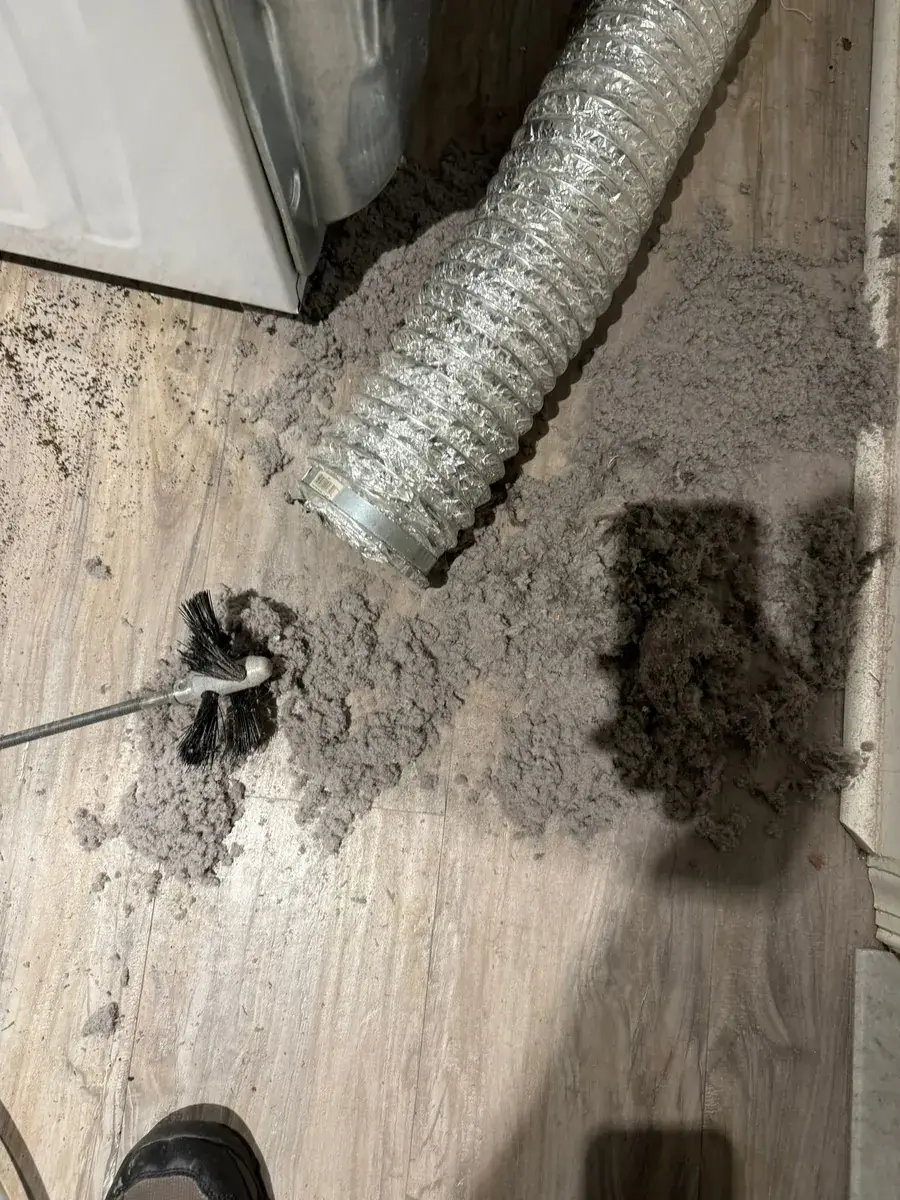
If the transition hose behind your dryer is the ribbed foil or vinyl kind, we will show it to you and explain why a smooth, semi-rigid metal transition is the safer replacement — foil and vinyl sag, trap lint in their ridges, and are far more combustible than metal. And if the inspection shows the vent is genuinely clear and your slow drying traces back to the machine itself, we will tell you exactly that, and you will have spent nothing to find out. The inspection is there to give you the truth about your own vent, not to manufacture a sale.
Roof Runs, Gas Dryers, and Why a DIY Kit Falls Short Here
Lower Moreland's housing throws a few specific challenges at a dryer vent, and each one is a reason the full-run approach matters. In the big detached colonials, the upstairs laundry frequently has no shorter path to the outside than straight up through the roof, so the run is both long and vertical — moist, lint-heavy air has to climb, and lint drops back down as it cools, building the duct up from the inside. We handle those roof terminations with proper roof access, clear the cap itself, and clean the full vertical run down to the dryer. In the postwar basements, the challenge is the opposite: a short-looking hookup that actually threads twenty feet or more horizontally through the joists to reach a far wall, collecting lint on every shelf. And on the gas dryers common in those basements, a restricted vent does not just trap moisture — it lets combustion byproducts back up into the house, which is a reason not to let a slow vent slide.
This is also why a hardware-store brush kit rarely solves the problem here. A consumer kit can clear the first few feet, and emptying the lint screen and vacuuming behind the machine are genuinely worth doing between professional visits. What a kit cannot do is reach the full length of a long run, pull compacted lint out of elbows and vertical rises, or clear a roof cap — and pushing a short brush into a packed duct often compresses the clog tighter instead of removing it. Our rotary system drives a brush the entire length while the vacuum pulls the freed lint back out of the system, which is the only way to actually empty a long run rather than rearrange it. When we are done, the airflow test at the hood tells the honest story, and the after-photos give you a record you can keep.
Honest Scope, Flat Quotes, and the Guarantees Behind the Work
We scope two honestly different services, because they are different jobs. A vent that has been maintained on a regular schedule and needs a routine pass is one thing; a run that has never been serviced across a long ownership, is packed solid, or has a nest in it is a genuinely deeper job that takes more time and more work at the elbows and the termination. The free inspection is what determines which one your home actually needs — we do not guess from the driveway, and we do not quote the small job and hand you an invoice for the big one.
That structure is also our answer to the oldest trick in this trade. You have probably seen the "$49 to $99 whole-house special" coupons that circulate around eastern Montgomery County. The truck shows up, the special turns out to cover almost nothing, and the pressure starts at your door. We make that impossible by doing it in order: the inspection comes first, the flat written quote goes on paper second, and the work happens third. What you approve is what you pay — no teaser price that doubles at the door, no surprise line items.
Most Lower Moreland homes take somewhere between under an hour and about ninety minutes; long roof-terminated runs and packed, never-cleaned lines take longer, and the written quote states that scope before we begin, so the time on site never changes the price you agreed to. Behind every job stands the same set of real commitments: a Price Match Guarantee if you bring a competitor's written quote for the same scope of work, a 6-month workmanship warranty — if a problem traced to our work shows up within six months, we come back and make it right free — and, because E Cleaning is Google Guaranteed, money-back protection of up to $2,000 on qualifying jobs through Google's own program. We are a Pennsylvania licensed contractor (PA 187935) insured to $2 million, with the documents viewable on our licensed and insured page, and we are rated 4.8 stars across 144 Google reviews. Financing is available through Wisetack, and we run around the clock, Sunday through Friday — closed Saturdays — which matters when the dryer quits mid-week and the laundry will not wait.
Most households here handle both systems at once: the dryer usually sits a short walk from the furnace, so pairing this with air duct cleaning in Lower Moreland means one appointment, one crew, and both systems documented with after-photos.
How much does dryer vent cleaning cost?
Routine and deep cleaning are different services — the free inspection determines which one your system actually needs. Prices vary house to house; your exact price comes as a flat written quote before any work begins.
| Dryer vent routine — basement / 1st floor | $129.99 |
| Dryer vent routine — 2nd floor & up | $149.99 |
| Dryer vent deep cleaning | $299.99 |
| Nest removal · bird guard installation | from $250 · from $150 |
Three promises. In writing. On every job.
Price Match Guarantee
Bring a competitor's written quote for the same scope of work — we'll match it. You never overpay for doing it right.
6-Month Warranty
Every job carries a 6-month workmanship warranty. If a problem traced to our work shows up, we come back and make it right — free.
Google Guaranteed
Booked through Google Local Services, qualifying jobs carry Google's own money-back protection up to $2,000, administered by Google.
Backed by a real license and $1M/$2M insurance — see the actual documents
Don't put off air you breathe — finance it with Wisetack
Check your options in about a minute with no impact to your credit score, choose terms that fit your budget, and pay over time instead of all at once.
*All financing is subject to credit approval. Your terms may vary. Wisetack loans are issued by Hatch Bank. See additional terms at wisetack.com/faqs.
4.8 stars from 144 Google reviews — and easy to find
E Cleaning Duct & Vent Cleaning is based at 555 S Goddard Blvd, King of Prussia, and serves Lower Moreland and all of Montgomery County from right here. Check our Google profile: real jobs, real photos, and a rating our crew protects on every visit.
- Google Guaranteed business — screened, licensed and insured (see the documents)
- Read every review on our Google profile — we don't cherry-pick what you can verify
Dryer Vent Cleaning questions from Lower Moreland homeowners
Do you charge a trip fee to come out to Lower Moreland?
No. There are no trip fees or travel charges anywhere in Montgomery County. The dryer vent inspection is free whether you are in Bethayres, off Huntingdon Pike, or on a wooded lot above the Pennypack, and the flat written quote you approve before work begins is the full price you pay.
Our laundry is upstairs and the vent goes out through the roof — can you clean it?
Yes. Roof-terminated runs are one of the most common setups in Lower Moreland's larger colonials, and one of the most neglected because nobody ever sees the cap. We access the roof safely, clear the termination, clean the full vertical run down to the dryer, and verify airflow afterward. The free inspection and flat written quote cover the roof work up front.
We have owned our home more than 20 years and never cleaned the vent. Is that a problem?
It is the most common situation we find here, and yes, it is worth addressing. A vent that has run an entire long ownership without cleaning is usually a deep job rather than a routine one — packed at the elbows and the termination. The inspection is free and shows you exactly what is in the line, and the written quote reflects the real scope before we start.
How often should a Lower Moreland household clean the dryer vent?
Once a year is the right baseline for most homes here. Go more often if you have a long basement run, a roof-terminated upstairs laundry, or a large household doing daily loads — all common in the township. If the dryer already needs two cycles to dry a load, do not wait for the anniversary; book the free inspection now.
A bird nested in our dryer vent. What should we do?
Stop running the dryer and have the run cleared — a nest is a full blockage, and hot, moist air has nowhere to go. This is a spring regular on Lower Moreland's wooded lots: starlings and sparrows push past a broken or missing flapper and build inside the duct. We remove the nest, clean the full run, and can install a bird guard on the hood so it does not happen again next season.
Can you clean our air ducts during the same visit?
Yes, and most Lower Moreland customers who book both do exactly that — one appointment, one crew, both systems documented with after-photos. See our Lower Moreland air duct cleaning page for how that service works, starting with the same kind of free inspection.
Ready for honest dryer vent cleaning in Lower Moreland?
Free video inspection, a flat written quote before any work, and real before/after proof — call (484) 367-5944 or book online now.
