
Dryer Vent Cleaning in New Britain, PA
E Cleaning cleans dryer vents across New Britain Borough and New Britain Township — from short basement runs in older borough homes to second-floor laundry rooms venting through the roof in newer townhome communities. The inspection is free, you get a flat written quote before any work begins, and there are no trip fees anywhere in Bucks County.
Where your laundry room is decides what your vent run looks like
In New Britain, the age and layout of a home usually predicts its dryer vent: short basement runs in the older borough houses, mid-length runs in the postwar ranches and split-levels, and long multi-elbow or roof-terminated runs in the second-floor laundry layouts that became standard in the township's newer construction. Each setup fails differently, and each one is a different cleaning job.
Basement laundries in the older borough homes
In the older houses in and around the borough, the washer and dryer usually live in the basement, and the vent exits through the rim joist a few feet away. A short run sounds like the easy case, and often it is — but these are also the vents most likely to have been retrofitted decades ago with sagging foil flex duct that crushes behind the machine and traps lint at every ripple, or an exterior hood whose flap broke off years ago and now lets cold air, rain, and the occasional bird straight into the line. Short does not mean clean.
Ranches, split-levels, and ground-floor utility rooms
The mid-century homes common on the older township streets tend to put laundry in a basement corner or a ground-level utility room, with a vent run of moderate length and an elbow or two. These runs clog on a predictable schedule: a little more lint left behind after every load until, several years in, drying times quietly double and nobody remembers when towels started taking two cycles.
Second-floor laundries in the newer township communities
From the 1990s on, builders across New Britain Township moved the laundry upstairs next to the bedrooms — a genuine convenience with a hidden cost. A second-floor laundry vents either straight up through the attic and out the roof, or sideways through the floor system in a long horizontal run with multiple elbows. Every vertical foot and every bend slows the airflow, and slower airflow drops lint inside the duct instead of pushing it outside. Roof terminations add one more problem: the cap can mat over with lint completely, and you cannot see it from the ground. These are the runs where we most often find serious blockages in otherwise nearly-new homes.
Some of the longest horizontal runs in these newer layouts were built with an inline booster fan to keep the air moving. Boosters help, but they are also lint collectors themselves: the blades and housing cake up over time, the fan loses effectiveness, and homeowners rarely know it is there until we point it out. If your run has one, it gets cleaned along with the rest of the duct — a boosted run that has never been serviced is often dirtier than a plain one.
Because the runs vary this much, we do not quote dryer vent work sight unseen. We inspect the actual run — length, routing, termination, condition — and put a flat number in writing before touching anything.
New Britain’s housing eras — and what your vent is actually made of
New Britain sits in central Bucks County — a small borough paired with a much larger township of the same name — with Doylestown, the county seat, just to the north, Warrington to the south, and the Route 202 corridor tying the area together. That span of old and new construction means two homes a mile apart can hide completely different vent systems behind the dryer.
The material behind the machine is the real tell, and in New Britain it tracks with the era. The oldest homes were often retrofitted with ribbed foil or, worse, vinyl flex duct — flammable, quick to sag, and no longer accepted for a run of any real length. Postwar ranches and split-levels tend to hide thin foil or several mismatched sections spliced together over the years. The newer township subdivisions were generally built with rigid or semi-rigid metal, which is the right choice — but the short transition hose from the dryer to the wall is still usually the flexible type, and it is the first thing to crush and pack when the machine gets pushed back into place.
Knowing what you have changes the work. A crushed metal transition can be reshaped or swapped; a vinyl run buried in a wall is a fire and code concern we flag on the written quote rather than quietly clean around. Either way, you learn what is behind your machine before we start — most homeowners have never seen their own vent run, and the camera usually surprises them.
In attached homes, a clogged dryer vent is a shared-wall problem
A meaningful share of New Britain Township's newer housing is attached — townhomes with shared walls, where a dryer fire is never just one household's emergency. That density is exactly why dryer vent cleaning here is a fire-safety task first and an appliance-performance task second.
The U.S. Fire Administration (FEMA) puts it in similar terms: an estimated 2,900 home clothes dryer fires are reported each year. The mechanism is simple. Lint is fine, dry, and highly flammable; a restricted vent traps hot air in the drum and the duct; and a clogged run gives any spark a fuel supply that stretches from the laundry room to the outside wall or roof. In a detached house that is dangerous. In a townhome row, it puts the neighbors' homes on the line too.
Central Bucks winters concentrate the risk. The cold months are when dryers work hardest — flannel sheets, comforters, kids' sports laundry, and no option to line-dry anything — so lint production peaks at exactly the time of year the vent is most likely to already be restricted. If your dryer has been running hot or slow going into or coming out of a heavy laundry season, that is the moment to have the vent inspected rather than pushed through another few months.
We cover the neighboring towns on the same routes — see dryer vent cleaning in Chalfont, Doylestown, and Warrington, or the whole service area on our Bucks County page.
Is your dryer telling you the vent is clogged?
A restricted vent almost always announces itself before it becomes dangerous. If any of these sound familiar in your New Britain home, the vent is the first thing to check:
- Towels and jeans need a second cycle to dry
- The top of the dryer or the laundry room itself gets hot and humid mid-cycle
- A burning or scorched smell while the dryer runs
- The exterior flap barely moves when the dryer is on, or lint is packed around the hood
- Newer dryers throw airflow or vent-blockage error codes
- You cannot remember the vent ever being cleaned
What the free inspection actually shows
Before any work or any price, we run the inspection. We check airflow at the dryer and at the outside termination, trace how the run is routed, and — where the run allows — send a camera into the duct so you see exactly what we see: how far the lint buildup reaches, whether the flex duct is crushed or sagging, whether the roof cap or exterior hood has matted over, and whether anything has started nesting in the line. That is the difference between guessing and knowing, and it is what lets the written quote stay a flat number instead of an estimate that drifts once the work starts.
Routine cleaning vs. a deep clog — two honestly different jobs
Not every vent needs the same work, and we will not pretend it does. A routine cleaning is annual maintenance on a vent that has been kept up — a rotary brush and vacuum pass through a run that is still doing its job, done to keep it that way. A deep cleaning is a genuinely different service: a run that has gone years without attention, packed solid, matted over at the roof cap, or blocked by a nest is slow, heavy work that sometimes means opening the line at more than one point. The inspection is how we tell which one your home actually needs — and if yours only calls for the routine version, that is what goes on the quote.
How the cleaning works, start to finish
First we inspect: we check airflow at the machine and at the termination, look at the routing and the condition of the run, and use a camera where the situation calls for it. Then you get a flat written quote — the same no-surprises quote we give for every service, and the price does not change once the work starts.
The cleaning itself is mechanical, not cosmetic. A rotary brush works through the full length of the run while a vacuum extracts the loosened lint, working from both ends where access allows. We clear the exterior hood or roof cap — including roof terminations on the township's second-floor laundry homes — remove bird nests and other blockages, check the transition hose behind the dryer for crushing or damage, and take after-photos so you can see the open, clear run before we leave.
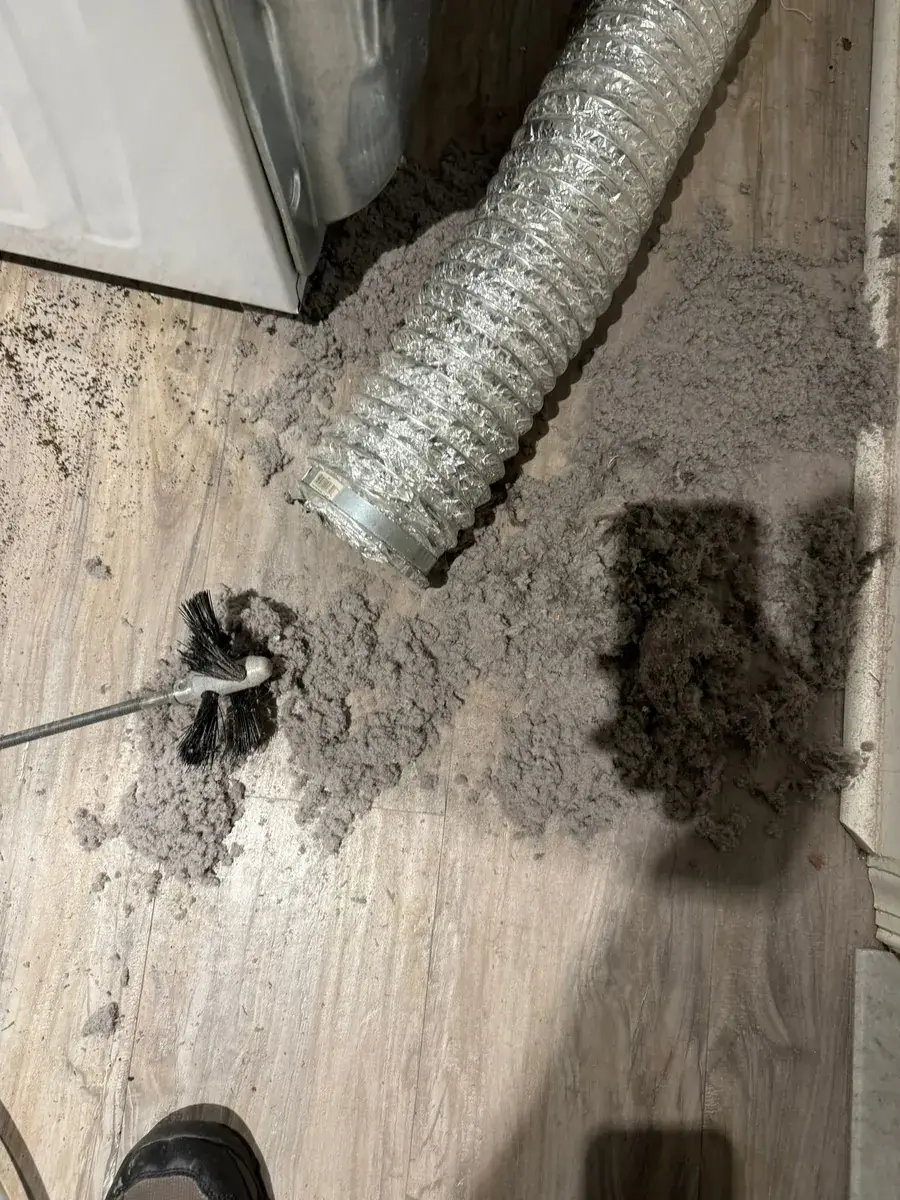
If we find something the cleaning cannot fix — a crushed section, an illegal plastic run, a missing termination cap — we document it on camera and put the fix on the written quote so you can decide with the facts in front of you.
What a clear vent gives you back
The payoff is immediate and easy to notice. Loads dry in one cycle again, the machine and the laundry room stop overheating, and the dryer's heating element and moisture sensors stop working against a blocked exhaust — which is real wear you avoid, since a dryer that runs two cycles per load is doing double duty on every part inside it. Clothes stop coming out with that faintly damp, musty edge, and on newer machines the airflow error codes go away. Many New Britain homeowners tell us the difference in drying time is obvious on the very first load.
Free inspection, flat written quote, guarantees that hold
Dryer vent work in New Britain starts the same way all our work does: a free inspection, then a flat written quote before anything is cleaned. No trip fees to the borough or the township, no door-step price changes, no discovering the real number after the truck is already in your driveway.
We also scope honestly and never push a bigger job than the run needs — you will know which service your vent calls for, and why, before any work begins, not after.
Every job is backed by our guarantee stack: a Price Match Guarantee if you bring a competitor's written quote for the same scope of work, a 6-month workmanship warranty, and Google Guaranteed protection on qualifying jobs. E Cleaning is family-owned, serving Bucks County since 2016, PA licensed contractor 187935, insured, and rated 4.8 stars across 144 Google reviews. We work around the clock, Sunday through Friday, and if you are smelling something burning when the dryer runs, we answer emergency calls 24-hour.
Since the crew is already at your house, it is worth knowing we also do air duct cleaning in New Britain — many homeowners book both in one visit and get the whole airflow side of the house handled at once. Details on the service itself are on our main dryer vent cleaning page.
How much does dryer vent cleaning cost?
Routine and deep cleaning are different services — the free inspection determines which one your system actually needs. Prices vary house to house; your exact price comes as a flat written quote before any work begins.
| Dryer vent routine — basement / 1st floor | $129.99 |
| Dryer vent routine — 2nd floor & up | $149.99 |
| Dryer vent deep cleaning | $299.99 |
| Nest removal · bird guard installation | from $250 · from $150 |
Three promises. In writing. On every job.
Price Match Guarantee
Bring a competitor's written quote for the same scope of work — we'll match it. You never overpay for doing it right.
6-Month Warranty
Every job carries a 6-month workmanship warranty. If a problem traced to our work shows up, we come back and make it right — free.
Google Guaranteed
Booked through Google Local Services, qualifying jobs carry Google's own money-back protection up to $2,000, administered by Google.
Backed by a real license and $1M/$2M insurance — see the actual documents
Don't put off air you breathe — finance it with Wisetack
Check your options in about a minute with no impact to your credit score, choose terms that fit your budget, and pay over time instead of all at once.
*All financing is subject to credit approval. Your terms may vary. Wisetack loans are issued by Hatch Bank. See additional terms at wisetack.com/faqs.
4.8 stars from 144 Google reviews — and easy to find
E Cleaning Duct & Vent Cleaning is based at 555 S Goddard Blvd, King of Prussia, and serves New Britain and all of Bucks County from right here. Check our Google profile: real jobs, real photos, and a rating our crew protects on every visit.
- Google Guaranteed business — screened, licensed and insured (see the documents)
- Read every review on our Google profile — we don't cherry-pick what you can verify
Dryer Vent Cleaning questions from New Britain homeowners
Do you charge extra to come out to New Britain?
No. There are no trip or travel fees anywhere in our Bucks County service area, the inspection is free, and the flat written quote you receive before work begins is the same whether you are in New Britain Borough, the township, or any neighboring town.
Our laundry is on the second floor and the vent goes through the roof. Can you clean that?
Yes. Roof-terminated vents are common in New Britain Township's newer homes, and they are among the most clog-prone runs because of the vertical rise and the lint that mats over the roof cap where nobody can see it. We clean the full run and clear the roof termination as part of the job.
I live in a townhome with shared walls. Is anything different about the job?
The cleaning itself is the same, but the stakes are higher — NFPA data shows failure to clean is the leading factor in dryer fires, and in attached housing a dryer fire threatens the neighbors too. We inspect the full run and termination, and we document the condition with photos before and after.
How often should a dryer vent be cleaned?
Once a year is the standard recommendation for most households, and more often with heavy laundry loads, long or roof-terminated runs, or pets in the house. If our inspection shows your vent is still clear, we tell you that at the free inspection rather than selling a cleaning you do not need.
There is a bird nest in our exterior vent. Do you remove it?
Yes. Nests behind exterior hoods are common, especially where the flap is broken or missing. We remove the nest and cleared debris, clean the full run behind it, and can address the damaged hood on the same written quote so the vent does not become a nesting spot again.
How long does a dryer vent cleaning take?
A typical basement-laundry run in New Britain takes about an hour. Longer runs — second-floor laundries, roof terminations, or a vent with a serious blockage or nest — can take longer, and we give you a realistic time window along with the flat written quote after the free inspection.
Ready for honest dryer vent cleaning in New Britain?
Free video inspection, a flat written quote before any work, and real before/after proof — call (484) 367-5944 or book online now.
