
Dryer Vent Cleaning in New Hanover, PA
E Cleaning cleans dryer vents throughout New Hanover Township, PA — basement hookups in the old farmhouses, first-floor laundry in the ranches, and the long second-floor and roof-terminated runs in the newer colonial and townhome developments around Gilbertsville. Free inspection first, flat written quote before any work begins. Family-owned since 2016, PA licensed (PA 187935), insured up to $2 million, rated 4.8 stars across 144 Google reviews.
Where New Hanover does laundry — and why the vent run is longer than you think
New Hanover built its housing in waves — eighteenth- and nineteenth-century farmhouses, postwar ranches and split-levels on big lots, then decades of colonial and townhome development filling the fields around the Gilbertsville crossroads in far western Montgomery County. Each wave put the laundry in a different place, and where the laundry sits decides how long, how hidden, and how hazardous the dryer vent run turns out to be.
In the older farmhouses, laundry almost always lives in the basement. The run itself is usually short — out a rim joist to a wall cap — but these are also the homes where we find the oldest materials: vinyl or thin foil transition hoses that predate current standards, crushed flat behind the dryer, or duct pieced together with sheet-metal screws that snag lint at every joint. Short does not mean safe when the duct itself is the problem.
The postwar ranches and split-levels keep laundry on the first floor or a lower level, with moderate runs and reachable terminations. The trouble era is what came next. The colonial developments of the 1990s and 2000s — the housing that defines modern New Hanover — moved the laundry room upstairs, next to the bedrooms, for convenience. Convenience for the household is distance for the vent: a second-floor laundry can put twenty to thirty-plus feet of duct between the dryer and the outside wall, routed down through wall cavities or across the attic with several elbows along the way. Every foot and every elbow slows the airflow, and slower airflow drops lint. These are the runs we find packed solid years before the owner suspects a thing.
Then there are the townhome and twin pockets near the corridor. Attached homes have fewer exterior walls to exit through, so builders route dryer vents wherever the geometry allows — long horizontal runs to the rear wall, or straight up through the roof. Roof terminations are the ones nobody ever looks at: the homeowner cannot see the cap from the ground, lint mats against the screen, and the first symptom is a dryer that suddenly needs two cycles to finish a load of towels. The one-line version for New Hanover: the newer and nicer the house, the longer and more hidden the dryer vent run tends to be — the opposite of what most homeowners assume, which is why we inspect and measure the actual run before quoting anything.
Packed lint, long runs, and shared walls: the fire math out here
Lint is one of the most flammable materials in any home, and a clogged vent holds pounds of it against a heat source that runs an hour at a time. The risk is not abstract, and in New Hanover's townhome and twin communities it is not private either — an attached home shares its fire risk with the neighbors on both sides of the wall.
The U.S. Fire Administration (FEMA) frames it another way: an estimated 2,900 home clothes dryer fires are reported each year. What the numbers do not show is how ordinary the failure looks from inside the house. The dryer still runs. Clothes still dry — just slower. The machine works harder against a blocked duct, the heat has nowhere to go, and lint sits in the run right where the temperature climbs. Most owners read the symptoms as a tired dryer, not a blocked vent, and some replace the machine only to hand the same clogged duct to a new one.
Warning signs worth acting on this week rather than this year:
- Towels or jeans need a second cycle to finish drying
- The dryer's top panel or the laundry room itself feels hot mid-cycle
- A burning or musty smell when the dryer runs
- Little or no airflow at the outside cap while drying — or a flap that never opens
- Lint collecting behind or beneath the machine
- You cannot remember the vent ever being cleaned
Seasons matter out here too. Winter is the heavy-laundry stretch — sports uniforms, blankets, extra layers — and it is also when the vent's job is hardest, pushing warm, moist air through a cold duct where condensation can turn loose lint into a damp mat. Spring brings a different problem: New Hanover is rural enough that birds are everywhere, and an uncapped or broken dryer termination is exactly the warm, sheltered cavity a nesting bird wants. We pull nests out of vent caps around the township every spring, and a nest blocks a duct faster than years of lint ever could. For anyone in an attached home, one more point stands: your vent's condition is part of your neighbors' safety, and theirs is part of yours.
Big families, daily loads, and the runs that clog first
Busy households compress the timeline on any dryer vent, and New Hanover is a family township — larger homes on larger lots, often with kids, pets, and the steady laundry that comes with both.
A family of five can run eight to twelve dryer loads a week. At that pace, a vent that would take four years to clog in a two-person home can close up in eighteen months — and if that household happens to be in one of the newer colonials with an upstairs laundry and a thirty-foot concealed run, the clog arrives even sooner and hides even better. Add the mud, grass, and field dust that come with rural and semi-rural living, and the lint load is heavier than a tidy in-town house of the same size.
The people who call us out here are the ones who noticed the symptoms and connected them: the second-cycle towels, the hot laundry room, the faint burning smell. Some are new owners who just closed on a resale and have no idea when — or whether — the vent was last cleaned. Some are long-time residents finally acting on a dryer that has been slow for a year. Whatever brought you to it, the drive out to the far western county costs you nothing extra: New Hanover is a normal run for us, the same free inspection and flat written quote as every town we serve, no trip fee tacked on for the miles.
Full-run lint extraction — from the drum connection to the outside cap
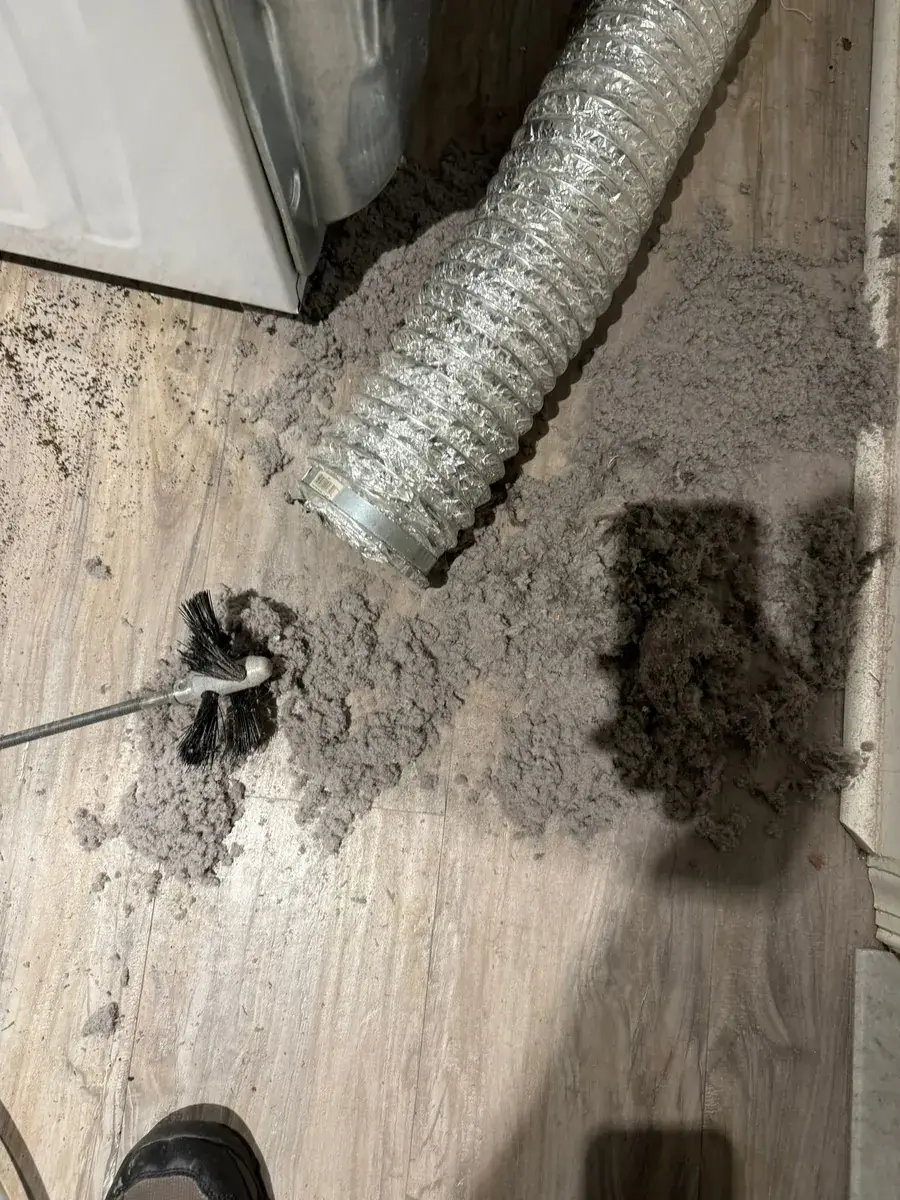
A proper dryer vent cleaning covers the entire run — transition hose, wall or ceiling duct, every elbow, and the exterior termination — with the lint physically pulled out, not blown around. Plan on about an hour for most New Hanover homes; long second-floor and roof-terminated runs take somewhat more.
Why we work the whole run
Lint does not clog evenly. It packs at elbows, at joints, at the termination screen, and anywhere the duct sags — which is why a quick pass from one end misses the exact spots most likely to burn. We work the full length mechanically and verify airflow at the end, so you are not paying for a guess.
Every dryer vent cleaning includes:
- A free inspection that traces the full route — where it exits, how many elbows, what the transition hose is made of
- The dryer pulled out and the transition hose disconnected, with the work area covered so lint ends up in our equipment
- A rotary brush run the entire length of the duct while a HEPA-filtered vacuum captures everything it breaks loose
- The exterior wall cap or roof termination cleared and its flap checked
- The dryer reconnected, run, and airflow confirmed at the cap
- After photos before we leave
If the inspection turns up a crushed, torn, or foil-type transition hose behind your dryer — common in New Hanover's older farmhouses — we will tell you and can replace it on the spot with proper rigid or semi-rigid material, flagged in the written quote first, like everything else. The point of working the full run is simple: the danger lives at the spots a shortcut skips, so we do not take the shortcut. What sets the time on site is the route, not the town — a short basement run to a wall cap is quick, while an upstairs laundry feeding a thirty-foot concealed run with four elbows, or a cap up on the roof, takes longer to brush and verify. We measure that route during the free inspection, so the hour estimate and the flat written quote are based on your actual vent, not an average.
Routine, deep, nests, and guards — every one quoted before we start
A vent kept on a regular cycle and a run that has not been touched in fifteen years are different jobs, and we scope them honestly as different services. The inspection determines which one your home needs, and the answer goes onto a flat written quote before any tool comes off the truck.
The same goes for the extras this township's setting produces. Spring bird nests in wall caps come out as a nest removal service, and if birds have found your vent once, a bird guard installation keeps them from moving back in — both scoped in writing before the work, never sprung on you afterward. Second-floor and roof-terminated runs in the newer developments take more time than a basement wall-cap run, and the quote reflects the actual route we measured, not a teaser number designed to grow on your doorstep. The "$49 to $99 whole-house special" flyers work the other way — a low number to get in the door, then a four-figure invoice once the truck is in your driveway. Whatever is on our written quote is what appears on the invoice: no trip fee for the drive out to New Hanover, no surprise line items.
Three real commitments stand behind the work. A Price Match Guarantee: bring us a competitor's written quote for the same scope of work and we match it. A 6-month workmanship warranty on every job: if a problem traced to our work shows up within six months, we come back and fix it free. And we are Google Guaranteed — Google's program, administered by Google, providing money-back protection up to $2,000 on qualifying jobs. E Cleaning is family-owned, working since 2016, a PA licensed contractor (PA 187935) insured up to $2 million — the documents are viewable on our licensed and insured page — and rated 4.8 stars across 144 Google reviews. Wisetack financing is available if you would rather spread the cost out. Most New Hanover households land on a once-a-year cleaning cycle — heavy-laundry families and long upstairs runs sometimes twice a year — and many pair it with air duct cleaning on the same visit, since the crew, the vacuum, and the written quote are already on site.
Serving New Hanover and its neighbors, Sunday through Friday
One crew, one process, no trip fees: free inspection first, flat written quote before work, after photos when we finish. That covers New Hanover and the towns around it in western Montgomery County.
We clean dryer vents throughout the Gilbertsville village on the township's western edge, down toward Limerick to the south, and in Upper Frederick next door to the east. The complete town list is on our Montgomery County service area page.
Property managers and HOA boards for the townhome and twin communities around Gilbertsville can also book multiple units in one visit — one schedule, one written quote per unit, after photos for every run. Long and roof-terminated vents are exactly the ones worth putting on a regular cycle, because they are the hardest for a resident to see and the quickest to clog.
We are open 24 hours a day, Sunday through Friday — closed Saturdays. That matters more for dryer vents than for most services: if your dryer smells hot tonight, do not run it again — call, and we can usually reach New Hanover fast.
How much does dryer vent cleaning cost?
Routine and deep cleaning are different services — the free inspection determines which one your system actually needs. Prices vary house to house; your exact price comes as a flat written quote before any work begins.
| Dryer vent routine — basement / 1st floor | $129.99 |
| Dryer vent routine — 2nd floor & up | $149.99 |
| Dryer vent deep cleaning | $299.99 |
| Nest removal · bird guard installation | from $250 · from $150 |
Three promises. In writing. On every job.
Price Match Guarantee
Bring a competitor's written quote for the same scope of work — we'll match it. You never overpay for doing it right.
6-Month Warranty
Every job carries a 6-month workmanship warranty. If a problem traced to our work shows up, we come back and make it right — free.
Google Guaranteed
Booked through Google Local Services, qualifying jobs carry Google's own money-back protection up to $2,000, administered by Google.
Backed by a real license and $1M/$2M insurance — see the actual documents
Don't put off air you breathe — finance it with Wisetack
Check your options in about a minute with no impact to your credit score, choose terms that fit your budget, and pay over time instead of all at once.
*All financing is subject to credit approval. Your terms may vary. Wisetack loans are issued by Hatch Bank. See additional terms at wisetack.com/faqs.
4.8 stars from 144 Google reviews — and easy to find
E Cleaning Duct & Vent Cleaning is based at 555 S Goddard Blvd, King of Prussia, and serves New Hanover and all of Montgomery County from right here. Check our Google profile: real jobs, real photos, and a rating our crew protects on every visit.
- Google Guaranteed business — screened, licensed and insured (see the documents)
- Read every review on our Google profile — we don't cherry-pick what you can verify
Dryer Vent Cleaning questions from New Hanover homeowners
How long does dryer vent cleaning take in a New Hanover home?
About an hour for a typical basement or first-floor hookup with a short run to a wall cap. Second-floor laundry rooms in the newer developments and roof-terminated townhome runs take longer, because there is simply more duct and more elbows to work through. We confirm the time and the flat written quote after inspecting the actual route, before any work begins.
Our laundry room is on the second floor. Does that change the job?
Yes, and it is one of the most common setups in New Hanover's 1990s and 2000s colonials. An upstairs laundry usually means a much longer concealed run — down through wall cavities or across the attic, with several elbows — and long runs clog sooner and hide it better. We clean the full length mechanically, verify airflow at the termination, and the written quote reflects the run we actually measured.
We're out near the fields and keep finding a bird nest in the vent cap. Can you handle that?
Yes — nest removal is standard work for us every spring around New Hanover, and we can install a bird guard afterward so the cavity never gets re-nested. Do not run the dryer until the nest is out: a nest blocks the duct far more completely than lint, and heat builds fast behind it. It all gets scoped into the flat written quote before the work starts.
How often should a dryer vent be cleaned out here?
Once a year is the right cycle for most New Hanover households. Big families running daily loads, homes with long upstairs runs, and anyone whose dryer already shows slow-dry symptoms should not wait the full year. Per NFPA data, failure to clean is the leading factor in home dryer fires, contributing to about one-third of them — an annual cleaning targets exactly that factor.
Do you charge extra to drive out to western Montgomery County?
No. New Hanover is a normal run for us from our King of Prussia base, and there is no trip fee, fuel surcharge, or distance markup. You get the same free inspection, the same full-run lint extraction, and the same flat written quote before any work begins as every other town we serve.
Can you clean the air ducts on the same visit?
Yes, and many New Hanover customers combine the two. Both services go on one flat written quote after a free inspection, one crew handles both, and the duct cleaning adds two to four hours depending on the system. Details are on our New Hanover air duct cleaning page.
Ready for honest dryer vent cleaning in New Hanover?
Free video inspection, a flat written quote before any work, and real before/after proof — call (484) 367-5944 or book online now.
