
Dryer Vent Cleaning in Newtown, PA
E Cleaning clears clogged dryer vents across Newtown, PA — from borough basements to second-floor laundry rooms and roof-vented townhomes. The inspection is free, and you approve a flat written quote before any work begins. Family-owned since 2016, PA licensed contractor 187935, insured to $2 million, and rated 4.8 stars across 144 Google reviews.
Where Newtown Does Its Laundry — and Why It Matters
The floor your laundry sits on decides how long your dryer vent runs, how many elbows it turns, and how much lint it can hide. Newtown has the full range under one zip-code family: a historic borough with basement hookups and constant renovation, and a township full of late-20th-century homes where the laundry moved upstairs.
In the borough — one of Bucks County's oldest communities, with a walkable core of homes dating to the 1700s and 1800s — laundry traditionally lives in the basement, and the vent exits through a rim joist or a stone foundation wall near grade. A short run sounds like the safe case, but these low exits collect leaves and snow, get painted shut or screened over by well-meaning owners, and the flapper outside is easy to forget entirely. And when borough owners renovate — which they do constantly — the washer and dryer often move up to a first- or second-floor closet, leaving a brand-new, much longer vent path concealed inside finished walls where nobody ever sees it again.
In Newtown Township, where most neighborhoods went up between the 1970s and the 1990s, the story is the second-floor laundry room. Later builds of that era put the washer and dryer upstairs next to the bedrooms — convenient for the household, demanding for the vent. The exhaust has to drop through a wall cavity and travel across a ceiling bay, or climb through the attic to a roof cap. Every added foot and every added elbow slows the airflow, and slower airflow drops lint out of suspension and onto the duct wall, where it builds season after season.
The physics is blunt: lint is nearly ideal fire fuel, and the vent is the only escape path for the hot, moist air your dryer produces. When the path chokes, heat builds exactly where the fuel is packed. That is why dryer vent cleaning is a fire-safety service first and an efficiency service second — and why we treat a blocked vent in a Newtown home as something to fix now, not at the next convenient appointment. We answer emergencies 24-hour for exactly this reason.
Townhomes, Condos, and the Long-Run Problem
The attached-home communities that came with Newtown Township's growth decades are exactly where dryer vents need the most attention. In a townhome, the laundry usually sits somewhere inside the footprint rather than against an outside wall, so the vent has to travel — through floor systems, around framing, up through the roof, or out high on a rear wall. Dryer manufacturers publish a maximum equivalent vent length for a reason, and an elbow-heavy attached-home run pushes hard against it: the longer and more bent the path, the faster lint accumulates and the harder the dryer works on every single load.
Attached housing also raises the stakes. A party wall means a vent fire is not only your problem — it is your neighbor's too, which is why townhome and condo residents are often the most consistent about annual cleanings once they have seen what comes out of the line. Roof terminations add one more wrinkle: you cannot check a roof cap from the ground, so a bird's nest or a matted lint plug can sit up there for years unnoticed. We handle roof-vented systems routinely, with the right safety setup, and photograph the termination so you can see its condition without leaving the kitchen.
Exterior hoods at ground level have their own calendar. Spring brings nesting birds that find a warm, sheltered vent hood irresistible; winter brings lint mats stiffened with frozen moisture that hold flappers shut. And laundry itself is seasonal in a family town like Newtown — colder months mean heavier fabrics, more loads, and holiday houseguests, so a vent that limped through summer often gives up in December.
There is a quieter cost to a slow vent, too. A dryer fighting a restricted line runs longer on every load, which means more electricity or gas per basket, more heat stress on the machine's heating element and blower, and more tumbling wear on your clothes. Households often absorb the decline gradually — the sixty-minute cycle becomes seventy-five, then ninety — until the appliance gets blamed and replaced when the real problem was fifteen feet of packed lint. Clearing the run restores the dryer the household actually paid for, and in an attached home it removes a genuine fire risk at the same time.
We cover the surrounding towns on the same no-trip-fee terms — see Yardley, Northampton, and Upper Makefield, or the full Bucks County service area. Many Newtown homeowners also pair the visit with air duct cleaning in Newtown, since the truck, the technician, and the airflow logic are already at your door.
Newtown's Geography, Older Housing, and Hidden Vent Paths
Newtown sits in the lower-central part of Bucks County, a small borough of just a few streets wrapped almost entirely by the larger Newtown Township, with Yardley and the Delaware River corridor to the south, Upper Makefield and the Washington Crossing area to the east, Wrightstown and open farmland to the north, and Northampton and Middletown to the west. The Newtown Bypass — PA Route 332 — and Durham Road (Route 413) carry most of the through traffic, while Sycamore Street anchors the historic commercial core and Tyler State Park forms a green edge on the township's side. It is a genuinely old place: the borough was first laid out in the 1680s during William Penn's earliest settlement of Bucks County, which is why its housing stock spans three centuries within a short walk.
That range is why no two Newtown dryer vents are quite alike. In the oldest borough homes, exterior walls are stone or brick with plaster-and-lath interiors, and a dryer added generations after the house was built often vents through an improvised path — a hole cut through a foundation wall, a run threaded along a joist bay, or an exhaust snaked up through a former chimney chase. Additions layered on over the decades can leave a vent crossing from a newer wing back into the original structure, adding length and turns no appliance manual ever anticipated. None of it is visible once the drywall or paneling goes back, which is exactly why an inspection matters more in an old house than a new one.
The township's neighborhoods tell a newer story. Most of Newtown Township filled in between the 1960s and the 1990s, with brick-and-frame colonials, split-levels, and later subdivisions built around drywall interiors and forced-air heat. In those homes the dryer vent is usually a dedicated duct run inside a wall chase or across the attic — cleaner in concept, but easy to forget, and prone to sagging or pulling apart at a joint where lint then piles up out of sight. Newer still are the townhome and condo clusters that came with the township's later growth, where the vent path is the longest and most concealed of all. Whatever the era, the pattern holds: the harder a vent is to see, the more it needs a camera and a brush rather than a guess.
What a Full Dryer Vent Cleaning Includes
A real dryer vent cleaning covers the entire line — from the drum connection behind the machine to the termination hood outside — not just the few feet you can reach with a shop vac or a dryer-lint kit from the hardware store. Partial cleanings push lint deeper into the run; full-run cleanings remove it. Here is the scope we quote in writing before we start:
- Free inspection and airflow check before you approve anything
- Dryer pulled, transition hose cleaned — or flagged for replacement if it is the crushable foil type
- Rotary brush agitation with HEPA-filtered extraction along the full run, drum to termination
- Exterior hood cleared, flapper freed, bird nesting removed when present
- Roof terminations cleaned safely — common in Newtown's townhome communities
- Dryer reconnected, airflow verified after the work, with after-photos of what came out

Honest hardware advice, no upsell theater
Two things we tell Newtown customers straight. First, if your dryer connects to the wall with a foil accordion hose, it is worth swapping for semi-rigid metal — foil crushes behind the machine, kinks at the bend, and traps lint at every rib; we will show you yours and let the picture make the argument. Second, if the problem turns out to be the machine rather than the vent — a failing heating element, a worn blower — we say so and step aside. We clean vents; we do not invent work.
Routine vs Deep Cleaning — and What the Free Inspection Shows
Not every dryer vent needs the same job, and pretending otherwise is how homeowners end up overcharged or undercleaned. A routine dryer vent cleaning is for a line that has been kept up — cleaned within recent memory, moderate lint, no nesting, a reasonable length — and it restores full airflow quickly. A deep cleaning is a genuinely different service: it is for a vent that has never been cleaned, has gone many years untouched, runs long through an attic or an attached-home path, or has hardened lint mats, a crushed section, or a bird's nest packed into the hood. The two take different time, different tools, and different effort, so we scope them honestly instead of quoting one and hoping the other applies.
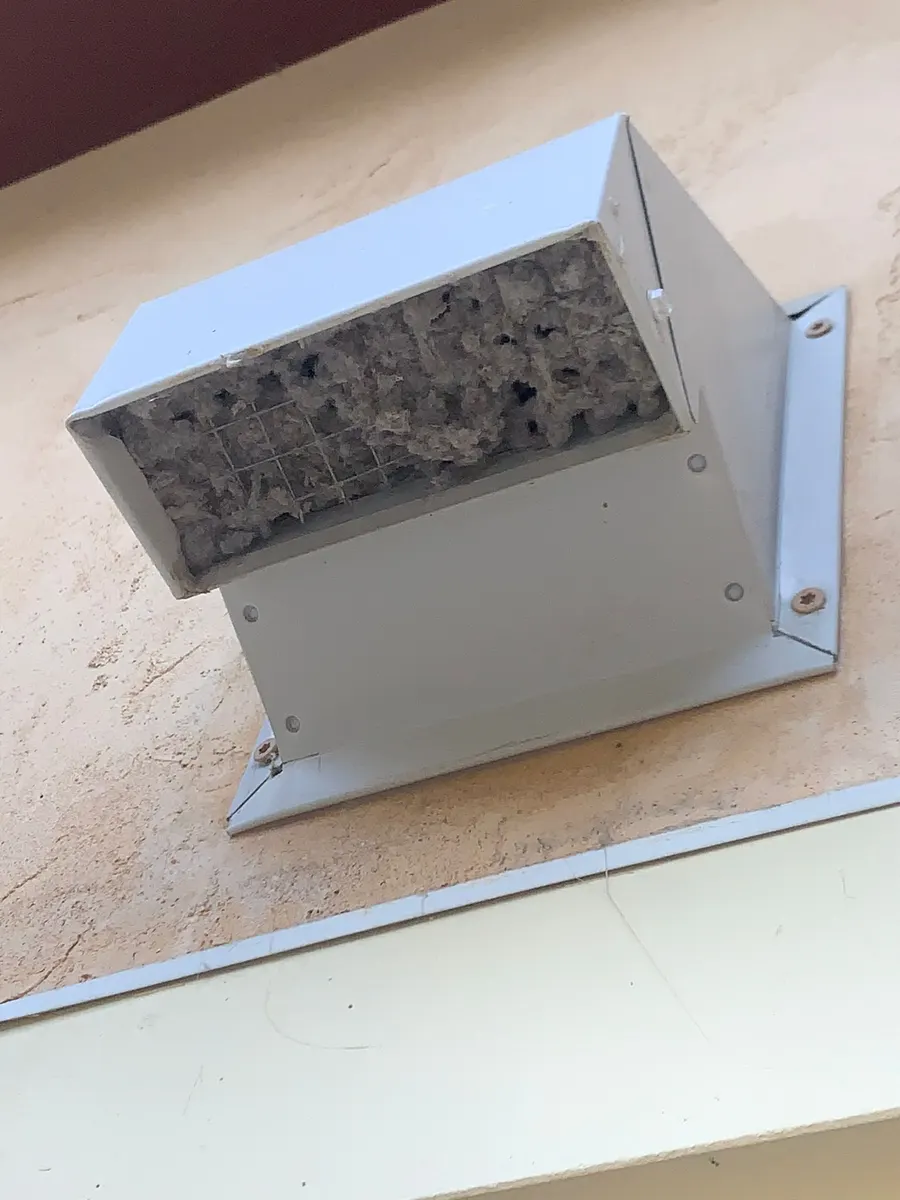
The inspection settles which one you need
The free inspection is what decides between routine and deep, and it is not a glance behind the machine. We read airflow at the hood while the dryer runs, check the transition hose and the exterior termination, and — where the run allows — send a camera into the line so you see exactly what we see: whether the duct is lightly dusted or packed solid, whether a joint has separated inside a wall, whether the flapper still opens. In an older borough home where the vent vanishes into stone or a former chase, that camera is often the only way to confirm where the line even goes.
What the inspection commonly finds in Newtown homes: a foil transition hose crushed flat behind a tight laundry closet, a second-floor run that lost half its airflow to a sagging attic duct, a townhome roof cap matted shut, or — in more homes than you would expect — a vent quietly disconnected inside a wall during a past renovation, dumping hot, moist lint into the cavity for years. Each of those is a different fix, and each goes into the flat written quote in plain language before a single brush turns.
Warning Signs, Honest Scope, and the Quote That Comes First
If your dryer needs two cycles to dry a normal load, the vent is the first suspect. The other tells: the top of the dryer or the laundry room itself runs hot, clothes come out hotter than usual but still damp, there is a faint burning smell mid-cycle, lint collects around the door seal or behind the machine, or the flapper on the outside hood never moves while the dryer runs. Any one of these is reason to book an inspection; two or more means stop using the dryer until the line is checked.
Scope honesty matters as much here as it does in ductwork. A straight eight-foot basement run in a borough twin and a three-story, roof-terminated townhome line are genuinely different jobs, and quoting them identically sight unseen is either guessing or setting up a hallway renegotiation. So we do it the same way every time: free inspection first, then one flat written quote for the actual line in your actual house, before any work begins. No trip fee to Newtown or anywhere else in Bucks County, no doorstep upsell, no surprise invoice.
For most households, once a year is the sensible cleaning rhythm — more often if you have a long attached-home run, a big family's laundry volume, or pets whose hair rides along with every load. Every job carries our 6-month workmanship warranty, backed by Google Guaranteed protection up to $2,000 on qualifying jobs, and we match any competitor's written quote for the same scope of work. Financing is available through Wisetack, we work 24 hours a day, Sunday through Friday, and emergency response is available 24-hour.
Between professional cleanings, two homeowner habits carry real weight: empty the lint screen before every load rather than after, and step outside once a season while the dryer runs to confirm the flapper opens and air actually moves. If either check fails — or if you cannot find where your vent terminates at all, which happens more often than you would think in renovated borough homes — that is exactly what the free inspection is for.
How much does dryer vent cleaning cost?
Routine and deep cleaning are different services — the free inspection determines which one your system actually needs. Prices vary house to house; your exact price comes as a flat written quote before any work begins.
| Dryer vent routine — basement / 1st floor | $129.99 |
| Dryer vent routine — 2nd floor & up | $149.99 |
| Dryer vent deep cleaning | $299.99 |
| Nest removal · bird guard installation | from $250 · from $150 |
Three promises. In writing. On every job.
Price Match Guarantee
Bring a competitor's written quote for the same scope of work — we'll match it. You never overpay for doing it right.
6-Month Warranty
Every job carries a 6-month workmanship warranty. If a problem traced to our work shows up, we come back and make it right — free.
Google Guaranteed
Booked through Google Local Services, qualifying jobs carry Google's own money-back protection up to $2,000, administered by Google.
Backed by a real license and $1M/$2M insurance — see the actual documents
Don't put off air you breathe — finance it with Wisetack
Check your options in about a minute with no impact to your credit score, choose terms that fit your budget, and pay over time instead of all at once.
*All financing is subject to credit approval. Your terms may vary. Wisetack loans are issued by Hatch Bank. See additional terms at wisetack.com/faqs.
4.8 stars from 144 Google reviews — and easy to find
E Cleaning Duct & Vent Cleaning is based at 555 S Goddard Blvd, King of Prussia, and serves Newtown and all of Bucks County from right here. Check our Google profile: real jobs, real photos, and a rating our crew protects on every visit.
- Google Guaranteed business — screened, licensed and insured (see the documents)
- Read every review on our Google profile — we don't cherry-pick what you can verify
Dryer Vent Cleaning questions from Newtown homeowners
Do you charge extra to come out to Newtown?
No. There are no trip fees anywhere in our Bucks County service area — Newtown Borough, Newtown Township, and every surrounding community pay nothing for the visit itself. The inspection is free, and the flat written quote you approve before work begins is the whole price.
My townhome's dryer vent exits through the roof — can you clean it?
Yes. Roof-terminated vents are common in Newtown Township's attached-home communities, and we clean them regularly — full run from the dryer to the roof cap, with the right safety setup and after-photos of the termination so you can see its condition without climbing anything.
How often should a dryer vent be cleaned in Newtown?
Once a year is the right rhythm for most households — NFPA data shows failure to clean contributes to one-third of dryer fires, so the habit matters more than the exact date. Long townhome runs, second-floor laundry rooms, big families, and pet owners should lean toward more frequent service; the free inspection will tell you honestly where your line stands.
My dryer takes two cycles to dry a load. Is that the vent?
Usually, yes — a restricted vent is the most common cause of long dry times. Sometimes the culprit is a crushed transition hose behind the machine, and occasionally it is the dryer itself. The free inspection identifies which one you have, and if the vent is not the problem, we tell you so instead of cleaning something that did not need it.
Can you clean the vent in an older borough home with a stone foundation?
Yes. Low, grade-level exits through stone or rim-joist walls are typical of older Newtown Borough basements, and we work them carefully — hood cleared, flapper freed, full run brushed and extracted, and everything reconnected properly. If a renovation relocated your laundry upstairs, we trace and clean the newer concealed run too.
What if something goes wrong after the cleaning?
Every job carries a 6-month workmanship warranty — if a problem traced to our work shows up within six months, we come back and make it right free. That sits on top of Google Guaranteed protection up to $2,000 on qualifying jobs. We are PA licensed (187935) and insured to $2 million.
Ready for honest dryer vent cleaning in Newtown?
Free video inspection, a flat written quote before any work, and real before/after proof — call (484) 367-5944 or book online now.
