
Dryer Vent Cleaning in Penndel, PA
E Cleaning cleans dryer vents throughout Penndel, PA — the full line, from the connection behind your dryer to the exterior hood — and shows you after-photos to prove the run is clear. Every job starts with a free inspection and a flat, written quote before any work begins, and there is no trip fee for Penndel. Failure to clean is the leading factor in home dryer fires, which makes this one of the most effective pieces of fire prevention available to any homeowner.
Why Dryer Vents Deserve More Attention in a Borough Like Penndel
Penndel is a small, densely built borough in Lower Bucks County — closely spaced homes, twins, and small multi-family buildings gathered along the US Route 1 corridor, with Middletown Township wrapping around nearly the entire boundary. In housing this tight, a dryer fire is never just one household's problem. The U.S. Fire Administration estimates 2,900 home clothes dryer fires are reported each year, and the mechanism behind most of them is mundane: lint — a highly flammable material — accumulating inside a vent line until airflow drops, drying times stretch, and heat has nowhere to go.
Where the laundry sits determines what the vent run looks like
In Penndel's older borough homes near Lincoln Highway, laundry usually lives in the basement. That typically means a vent line that has to climb out of the basement and travel to a sidewall — a run with several elbows, and every elbow is a place where lint slows down, settles, and starts building a mat. The postwar Capes and ranches that fill out the rest of the borough often keep laundry in the basement too, or in a first-floor utility corner with a shorter, more direct sidewall run. That short run is the easiest configuration to keep clear — and also the easiest to forget about for a decade, precisely because it never causes obvious trouble until it is badly blocked.
In remodeled and newer homes where the laundry has moved up to bedroom level, the story changes again. The vent usually runs concealed through walls, ceiling cavities, or attic space before it reaches a sidewall or roof termination. Those long hidden runs are the ones that clog silently, because no one ever sees any part of them, and they are the runs where a clog does the most damage to drying performance. Roof terminations deserve special mention: they clog faster than wall hoods, they are hard for a homeowner to check safely, and a screened or damaged roof cap can mat over with lint in a single heavy season. If your Penndel dryer vents through the roof and you cannot remember its last cleaning, treat it as overdue.
Shared Walls, Small Lots, and the Winter Laundry Season
Twins and small apartment buildings — common in a compact borough like Penndel — add wrinkles of their own. In multi-unit buildings, vent runs can be longer than anything a household dryer was designed to push, and some rely on booster fans that fail quietly and go unnoticed for years. In twins, the laundry hookup often sits toward the party wall, which means the vent has to travel farther than you would guess to reach an outside wall. None of this makes a vent uncleanable; it simply means the free inspection matters more, because the right scope of work depends entirely on the run your house actually has.
Season matters too. The cold months are peak laundry season — heavier fabrics, more loads, and a dryer pushing warm moist air against cold outdoor temperatures. Exterior flappers can stick or freeze shut, and moisture condensing inside a cold vent run turns dry, fluffy lint into a damp mat that no home lint brush will move. If your dryer suddenly needs two cycles in January, the vent is the first suspect, not the machine.
Gas dryers raise the stakes one notch further. A gas dryer's vent carries combustion byproducts out of the house along with the moisture and lint, so a badly restricted line does not just slow the drying — it can push moisture and exhaust back into the laundry area. Plenty of Penndel's older homes run gas appliances, and if yours is one of them, keeping the vent line clear is part of keeping the appliance venting the way it was designed to.
We clean dryer vents throughout Bucks County and are in Lower Bucks constantly — Penndel appointments slot in alongside our work in Langhorne Manor, Lower Southampton, and Bensalem, so scheduling is quick and there is never a trip fee. If we are already on your street for a neighbor, so much the better.
Added-On Laundries and Vent Runs That Grew Over Time
Many of Penndel's homes took shape before an indoor washer and dryer was standard equipment. When laundry moved indoors — sometimes decades after the house was built — the vent got routed along whatever path was available: around framing, over a finished ceiling, through a closet wall, out to the nearest exterior surface. The result, in house after house, is a run that is longer, more kinked, or more roundabout than a dryer was ever designed to push air through. Every extra foot and every added elbow is one more place lint slows down and settles.
Retrofit runs also tend to use the wrong materials. Ribbed foil or thin plastic transition duct, easy to snake through a tight space during a quick install, is exactly the surface lint grabs onto — and a length of it buried inside a wall or ceiling is a length no one ever inspects. When we open up an older Penndel laundry, a crushed transition hose pinned behind the dryer in a shallow closet is one of the most common things we find, along with joints that have pulled apart inside a cavity and quietly vented warm, lint-heavy air into the structure instead of outdoors.
Rentals and multi-family units deserve a specific word. Penndel's compact housing includes a real share of twins, converted homes, and small rental buildings, and in those the person who runs the dryer often is not the person who owns the vent — so cleaning falls through the gap for years. If you own a rental here, a clear line protects your building and your tenants; if you rent, it is worth asking your landlord when the vent was last serviced. Either way the inspection is free and the scope is settled in writing before anyone commits to work.
What a Complete Dryer Vent Cleaning Looks Like
A complete cleaning covers the entire path lint travels: the transition hose behind the dryer, the concealed duct running through the house, and the exterior termination. Skipping any one of the three leaves the fire risk in place. Here is how we work through a Penndel job from start to finish.
Free inspection, inside and out
We check airflow at the exterior hood, examine the termination, and assess the transition hose behind the dryer. You get a flat, written quote for the exact scope before any work begins — and if the line turns out to be genuinely clear, we tell you that and you owe nothing.
Disconnect and protect
The dryer comes away from the wall, the transition hose is disconnected, and the work area is protected. Foil accordion and plastic transition hoses get flagged at this stage — their ridges trap lint, and they are the weakest link in most laundry setups.
Clean the full run
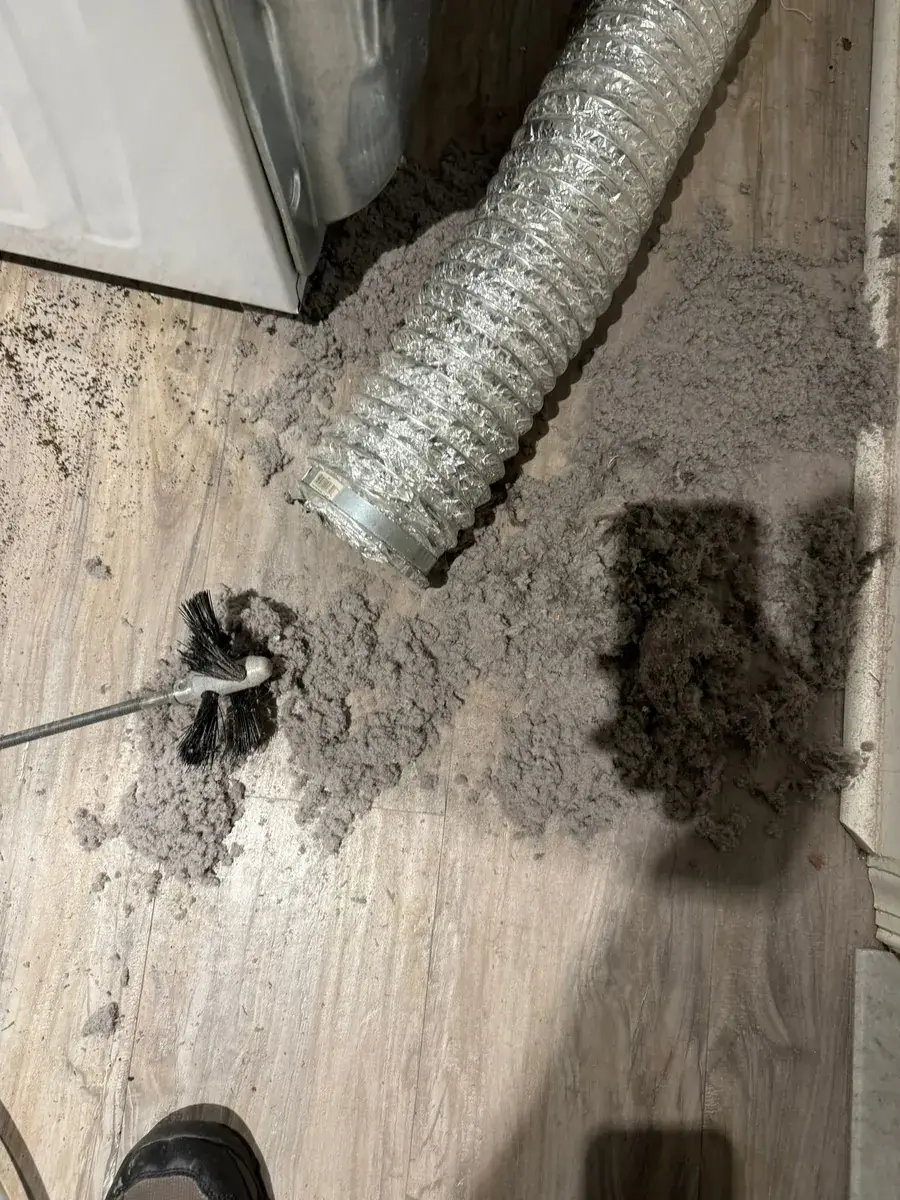
A rotary brush travels the entire duct while high-powered vacuum extraction captures the lint, working from both ends of the run where the layout allows. Elbows, vertical sections, and the sidewall or roof termination are all cleared — not just the first few feet behind the machine.
Verify and prove it
We reassemble the connection, confirm strong airflow at the termination, and show you after-photos of the cleared line. If we found damage along the way — a crushed section, a disconnected joint, a failed exterior hood — it goes in writing with its own quote, never as a surprise.
Every dryer vent cleaning includes
- Airflow check and inspection of the exterior termination
- Flat, written quote before any work starts
- Rotary brushing of the full run with vacuum extraction
- Transition hose check, with an honest recommendation if yours should be replaced
- After-photos of the cleared vent line
- 6-month workmanship warranty on the job
What the Free Video Inspection Shows Before You Approve Anything
The inspection is where the guesswork ends. Before we quote a Penndel dryer vent we take an airflow reading at the exterior hood, open and examine the termination, and check the transition hose behind the machine — and where the run allows, a camera goes into the line so you can see the real condition of the duct on screen instead of taking our word for it. That is the whole point of leading with a free video inspection: you approve a flat, written quote based on what the vent actually looks like, not on a guess made from the laundry-room doorway.
What we find sorts the job into a clear category, and it is the finding — not a flat rate off a menu — that sets the scope. An even, moderate coat of lint on a sound, reasonably short run points to a routine cleaning. A sharp drop in airflow while the first few feet read clear usually means the blockage sits deep, at an elbow or the termination, and that is heavier work. Buildup packed hard, moisture staining inside the duct, or a run far longer than the dryer can handle moves a job into deep-cleaning territory. Routine and deep cleaning are genuinely different services, and the inspection is what tells us — and you — which one applies before a single number is written down.
Timing feeds into it too. Spring is nesting season, when a bird can turn an open or weakly screened hood into a home in a matter of days; fall is the smart window to clear a line before the heavy winter laundry months load it back up. If you cannot remember the last time your vent was serviced, an inspection now tells you exactly where you stand — and costs nothing to find out.
How Do You Know a Penndel Dryer Vent Is Overdue?
The dryer usually tells you before anything dangerous happens, if you know what to listen for. Clothes needing a second cycle to dry is the classic sign — the vent cannot move moist air out fast enough. A dryer that is hot to the touch, a faint burning smell during a cycle, lint collecting around the door seal or under the exterior flap, a laundry room that feels more humid than the rest of the house, or an exterior flap that barely moves while the dryer runs all point the same direction. Any one of these is reason enough for an inspection, and ours is free.
Not every vent needs the same work, and we will not pretend otherwise. A routine annual cleaning on a short, healthy run is a straightforward job. Clearing a bird's nest from a termination, replacing a crushed or disconnected section, swapping a plastic transition hose for code-appropriate material, or dealing with a long roof run is a different scope — and the honest way to handle that difference is the way we handle everything: the free inspection establishes what your vent actually needs, and the flat, written quote spells it out before any work begins. Routine cleaning and deep cleaning are different services, and you will always know which one you are approving.
Between professional cleanings, the habits that help are simple: empty the lint screen every load, keep the area behind the dryer clear so the transition hose is never crushed, glance at the exterior flap now and then to confirm it opens when the dryer runs, and never run the dryer while everyone is asleep or out of the house if you already suspect a restriction. None of that replaces clearing the concealed run — a lint screen catches only a portion of what a load sheds — but it stretches the time between cleanings and gives you early warning when something changes.
E Cleaning is rated 4.8 stars across 144 Google reviews. Every job is backed by our 6-month workmanship warranty and a Price Match Guarantee against any competitor's written quote for the same scope of work. As a Google Guaranteed business, qualifying jobs also carry Google's money-back protection up to $2,000. We are PA licensed (PA 187935) and insured up to $2 million — the documents are viewable at our licensed and insured page.
Many Penndel homeowners pair this service with air duct cleaning in Penndel in a single visit — the technician is already there, and the whole HVAC-and-laundry side of the house gets handled at once.
How much does dryer vent cleaning cost?
Routine and deep cleaning are different services — the free inspection determines which one your system actually needs. Prices vary house to house; your exact price comes as a flat written quote before any work begins.
| Dryer vent routine — basement / 1st floor | $129.99 |
| Dryer vent routine — 2nd floor & up | $149.99 |
| Dryer vent deep cleaning | $299.99 |
| Nest removal · bird guard installation | from $250 · from $150 |
Three promises. In writing. On every job.
Price Match Guarantee
Bring a competitor's written quote for the same scope of work — we'll match it. You never overpay for doing it right.
6-Month Warranty
Every job carries a 6-month workmanship warranty. If a problem traced to our work shows up, we come back and make it right — free.
Google Guaranteed
Booked through Google Local Services, qualifying jobs carry Google's own money-back protection up to $2,000, administered by Google.
Backed by a real license and $1M/$2M insurance — see the actual documents
Don't put off air you breathe — finance it with Wisetack
Check your options in about a minute with no impact to your credit score, choose terms that fit your budget, and pay over time instead of all at once.
*All financing is subject to credit approval. Your terms may vary. Wisetack loans are issued by Hatch Bank. See additional terms at wisetack.com/faqs.
4.8 stars from 144 Google reviews — and easy to find
E Cleaning Duct & Vent Cleaning is based at 555 S Goddard Blvd, King of Prussia, and serves Penndel and all of Bucks County from right here. Check our Google profile: real jobs, real photos, and a rating our crew protects on every visit.
- Google Guaranteed business — screened, licensed and insured (see the documents)
- Read every review on our Google profile — we don't cherry-pick what you can verify
Dryer Vent Cleaning questions from Penndel homeowners
Is there a travel charge for dryer vent cleaning in Penndel?
No. We do not charge trip fees anywhere in Bucks County. A Penndel job starts with a free inspection of your vent line and exterior termination, and you get a flat, written quote before any work begins — the same process in every town we serve.
How often should a dryer vent be cleaned in Penndel?
Once a year is the right rhythm for most households. Clean more often if you run heavy laundry volume, have a long or concealed run to an upper-floor laundry, or vent through the roof — those setups collect lint faster and are harder to monitor yourself.
My dryer vents through the roof. Can you clean that?
Yes. Roof terminations are a normal part of the job for us — they clog faster than wall hoods and are the runs homeowners can least safely check themselves. We clear the full vertical run and the cap, verify airflow at the top, and show you after-photos.
Our laundry is on the second floor. Does that change the work?
It changes the run, so it changes the scope. Upper-floor laundries usually vent through concealed wall or attic runs with more elbows, which collect lint faster than a short basement-to-sidewall run. The free inspection maps what your line actually looks like, and the written quote reflects that exact run.
Can you clean the dryer vent and the air ducts in one visit?
Yes, and many Penndel customers book them together since the technician and equipment are already on site. Each service is inspected and quoted separately in writing, so you see exactly what each one involves. See our air duct cleaning in Penndel page for what that side of the visit covers.
There is a bird's nest in my exterior vent. What happens now?
Stop using the dryer until the line is cleared — a nest blocks airflow almost completely. We remove the nest and debris, deep-clean the full run behind it, verify airflow, and recommend a proper vent hood that keeps birds out without screening that traps lint. It is quoted in writing after the free inspection.
Ready for honest dryer vent cleaning in Penndel?
Free video inspection, a flat written quote before any work, and real before/after proof — call (484) 367-5944 or book online now.
