
Dryer Vent Cleaning in Richland, PA
E Cleaning clears clogged dryer vents throughout Richland Township, PA — townhome and apartment runs near the Route 309 corridor, second-floor laundries in the newer subdivisions, and basement hookups near the Quakertown line. Failure to clean is the leading factor in home dryer fires, so we treat this as safety work: free inspection first, flat written quote before anything else, no trip fees anywhere in upper Bucks.
Where Richland Does Its Laundry — and What That Means for the Vent
Richland Township grew in rings around Quakertown, and the laundry rooms grew with it. Because the township wraps entirely around the borough — and around little Richlandtown as well — one municipality ends up holding nearly every kind of laundry setup we see in upper Bucks County: dense attached housing near the Route 309 commercial corridor, big single-family subdivisions on former farmland, mid-century homes along the borough edges, and old farmhouses on the rural roads toward Haycock. Each setup changes where the dryer vent runs, how long it is, and where the lint hides.
One township wrapped around two boroughs. Richland is a township, and that shows up in the housing. The boroughs it surrounds — Quakertown and Richlandtown — are compact and close-built with older, often attached homes, while the township spreading around them runs to subdivisions, farm properties, and newer development clustered near the interchanges served by Route 309, the PA Turnpike Northeast Extension, and Route 313 toward Dublin. The road network that made Richland upper Bucks County's commercial anchor also pulled housing out to its edges, so a vent in a century-old borough-edge twin behaves nothing like one in a 2000s subdivision colonial a mile up the road.
Townhomes and apartments near the corridor. Decades of growth along Route 309 left Richland with a real share of attached housing, and attached housing is where dryer vents get complicated. The duct often travels through shared floor and wall framing for a surprising distance before it finds daylight, with elbows at every turn of the framing and no way to see any of it from the laundry closet. Many residents honestly do not know where their vent exits the building — which is a fair thing not to know, and exactly what our inspection is for. Longer concealed runs load up faster, and a clog deep in the framing is invisible until the dryer starts struggling.
Second-floor laundries in the newer subdivisions. The single-family homes built here from the 1990s onward increasingly put the laundry room upstairs near the bedrooms. Convenient — until you trace the vent. The run either climbs through the attic to a roof cap or travels a long hidden path through the floor system to a far wall. Roof terminations are out of sight and out of mind, and a cap screened against birds clogs with lint even faster than an open one.
Basements near the borough lines and on the farm roads. Richland's mid-century capes, ranches, and split-levels — and the farmhouses beyond them — mostly keep the dryer in the basement. The run itself is short, usually punching out through the band joist, but the hardware is old: sagging foil transition hoses that trap lint at every ridge, and exterior flaps sitting close to grade where matted lint, leaves, and the occasional mouse or bird nest pile up. On the wooded and field-edged roads toward the township's rural side, wildlife finding a warm, lint-lined pipe is not a rare event.
The prevention math matters in a township shaped like this one. Much of upper Bucks County relies on volunteer fire companies, and homes on Richland's outer roads sit well apart from their neighbors — so the cheapest minute of fire protection you can buy is the one that keeps the lint fire from starting at all. Winter stacks the odds further: heavy coats, blankets, and sports laundry mean more loads per week during exactly the months the dryer already works hardest.
Upper Bucks Weather and Newer Homes Fill a Vent Faster
Two things about Richland make dryer vents clog sooner than homeowners expect: the weather and the way the newer homes are built. Upper Bucks County winters are long and cold, and a cold season is a heavy-laundry season — coats, blankets, flannel sheets, and youth-sports gear mean more loads per week during exactly the months the dryer already runs longest against the chill. Each load pushes warm, moist, lint-carrying air into a vent whose far end the outdoor cold is chilling, so the exhaust cools and sheds its lint sooner along the run. Humid summers work their own version of the same problem, adding moisture that helps damp lint pack down instead of blowing clear.
Homes built here since the 1990s add a second factor. Tighter, more energy-efficient construction is easier on heating bills, but it also tends to place the laundry room deep inside the floor plan — an upstairs hall closet, an interior utility room — instead of against an outside wall. That buys a longer, more turned run to reach daylight or the roof, and a longer run with more elbows loads faster and hides its clog better. It is not a defect; it is simply how a modern layout trades a convenient laundry spot for a harder-to-service vent. We clean for every kind of Richland household on the same terms — owners in the subdivisions and on the farm roads, renters and landlords in the borough-edge twins and corridor apartments — and whoever holds the keys, the visit starts the same way, with a free inspection and a written quote before any work.
How a Dryer Vent Clogs — and How Yours Warns You
An estimated 2,900 home clothes dryer fires are reported each year, according to the U.S. Fire Administration — and the mechanism behind most of them is ordinary physics, not bad luck. The lint screen catches only part of what comes off your clothes. The rest rides hot, moist exhaust air into the vent, where it cools, condenses, and sticks — first at the elbows, then along sagging sections of hose, then anywhere airflow slows. Every particle that sticks slows the airflow a little more, which makes the next particle stick a little sooner. A vent does not clog all at once; it clogs on a curve, and the last stretch of that curve is fast.
Your dryer telegraphs the problem long before it becomes dangerous. Watch for these signals:
- Towels and jeans need a second cycle to dry
- The top of the dryer, or the laundry room itself, runs noticeably hot
- A burning or musty smell during or after a load
- Little or no lint at the outside flap while the lint trap fills fast
- Extra humidity or condensation around the laundry area
- The dryer shuts off mid-cycle on its thermal safety switch
Any one of these is reason enough to book the free inspection. Ignoring them costs you twice: a starved dryer runs longer and hotter on every load, wearing out its heating element and burning extra energy, all while the fire risk climbs.
A word on doing it yourself: the hardware-store brush kits and leaf-blower tricks can push loose lint out of a short, straight basement run, but they struggle exactly where Richland's vents get dangerous — long concealed runs through townhome framing, second-floor runs with multiple elbows, and roof terminations. Worse, a half-done job can compact a partial clog into a full one deeper in the pipe, where you cannot see it and your brush cannot reach it. If your run is short and simple, we will tell you so at the inspection. If it is not, rotary equipment that cleans the full length under vacuum is the difference between moving the lint and removing it.
What a Richland Dryer Vent Cleaning Looks Like
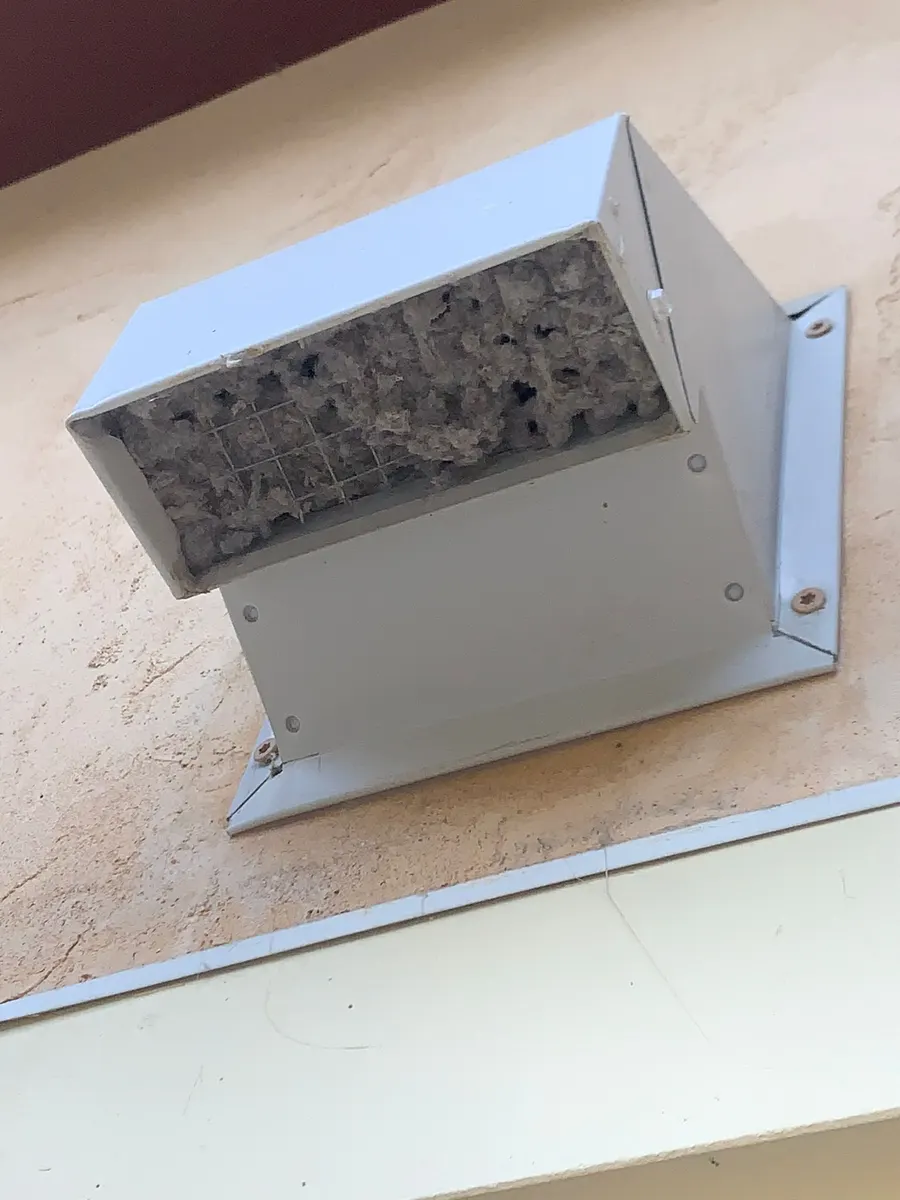
The termination — the flap or cap where the vent meets the outside world — is where problems show first and where coupon crews look last. We start at both ends: the transition hose behind the dryer and the exterior termination, then trace everything in between, whether that is three feet of pipe through a band joist or a long concealed run through townhome framing to a roof cap.
Inspect and show you
We examine the full run and show you exactly what we find. If your vent is genuinely fine, we say so and you owe nothing for the look.
Quote in writing first
A routine cleaning and a heavily clogged line that needs deep clearing are honestly scoped as different jobs. Whichever yours is, the flat quote goes on paper before any work starts — and it does not move.
Clear, verify, document
Rotary brushes and vacuum extraction work the entire run from the dryer connection to the termination. We clear the flap or roof cap of lint and nesting debris, confirm the exhaust is actually moving air, and hand you after-photos.
Routine and deep cleaning are two different jobs, and the inspection decides which is yours. A routine cleaning is maintenance — a vent cleared within the last few years that just needs its seasonal lint pulled from a run that is basically sound. A deep cleaning is for a line gone years without service, or one packed with compacted lint, a collapsed foil section, or a nest at the termination; it takes more time and more passes. We scope and quote them separately because they honestly are different services, and the free inspection is what tells us — and shows you — which one your vent needs. We will not quote a deep clean on a vent that only needs routine care.
Seeing it first is the whole point. We run a camera and a visual check through the accessible run so you watch the real condition inside — the elbows where lint packs, any crushed or sagging sections, the state of the flap or roof cap — instead of taking our word for it. The cleaning then drives a rotary brush on a flexible rod through the full length, paired with vacuum extraction and HEPA-filtered negative-pressure equipment that pulls the freed lint into our machine instead of scattering it into your laundry room. A short, straight basement run is often finished in under an hour; a long concealed or roof-terminated run takes longer — one more reason the quote is scoped to your actual vent and not a coupon rate.
Along the way we check the transition hose behind the dryer — the single most common failure point — and tell you plainly if it should be replaced rather than cleaned. The lint leaves with us, not into your yard or your basement. Every job carries our 6-month workmanship warranty, and our license and insurance documents are viewable here.
Once a Year Is the Baseline — Sooner for Some Richland Homes
Annual cleaning is the sound rule for most households. Move the schedule up if your laundry is on the second floor or the run is long and concealed — as it is in much of Richland's newer and attached housing — if your household runs daily loads, or if pets ride along on every cycle, because pet hair binds with lint and mats faster than lint alone. Basement setups with original foil hoses deserve a look even when the dryer seems happy, since that hose fails out of sight behind the machine.
Every Richland job is backed the same way: a flat written quote before work begins, a Price Match Guarantee against any competitor's written quote for the same scope, a 6-month workmanship warranty, and Google Guaranteed protection of up to $2,000 on qualifying jobs. We run around the clock, Sunday through Friday — we're closed Saturdays, and Wisetack financing is available.
The same crews cover the rest of upper Bucks with the identical inspection-first process — dryer vent cleaning in Quakertown at the township's center, Haycock Township to the northeast, and West Rockhill to the south — and the full map is on our Bucks County service page. If your furnace ducts are due as well, pairing this visit with air duct cleaning in Richland gets both systems inspected, quoted in writing, cleaned, and documented in one appointment.
How much does dryer vent cleaning cost?
Routine and deep cleaning are different services — the free inspection determines which one your system actually needs. Prices vary house to house; your exact price comes as a flat written quote before any work begins.
| Dryer vent routine — basement / 1st floor | $129.99 |
| Dryer vent routine — 2nd floor & up | $149.99 |
| Dryer vent deep cleaning | $299.99 |
| Nest removal · bird guard installation | from $250 · from $150 |
Three promises. In writing. On every job.
Price Match Guarantee
Bring a competitor's written quote for the same scope of work — we'll match it. You never overpay for doing it right.
6-Month Warranty
Every job carries a 6-month workmanship warranty. If a problem traced to our work shows up, we come back and make it right — free.
Google Guaranteed
Booked through Google Local Services, qualifying jobs carry Google's own money-back protection up to $2,000, administered by Google.
Backed by a real license and $1M/$2M insurance — see the actual documents
Don't put off air you breathe — finance it with Wisetack
Check your options in about a minute with no impact to your credit score, choose terms that fit your budget, and pay over time instead of all at once.
*All financing is subject to credit approval. Your terms may vary. Wisetack loans are issued by Hatch Bank. See additional terms at wisetack.com/faqs.
4.8 stars from 144 Google reviews — and easy to find
E Cleaning Duct & Vent Cleaning is based at 555 S Goddard Blvd, King of Prussia, and serves Richland and all of Bucks County from right here. Check our Google profile: real jobs, real photos, and a rating our crew protects on every visit.
- Google Guaranteed business — screened, licensed and insured (see the documents)
- Read every review on our Google profile — we don't cherry-pick what you can verify
Dryer Vent Cleaning questions from Richland homeowners
Do you charge extra to come out to Richland Township?
No. There are no trip fees or travel surcharges anywhere in our Bucks County service area — near the Route 309 corridor, along the borough lines, or out on the rural roads. The process is the same everywhere: free inspection, then a flat written quote before any work begins.
We live in a townhome and have no idea where our dryer vent exits the building. Can you find it?
Yes — that is a normal situation in Richland's attached housing, not an embarrassing one. Our inspection traces the full run from the dryer connection through the framing to the actual termination, wherever it turns out to be, and the written quote is based on that real route, not a guess.
Our laundry room is upstairs and the vent goes through the roof. Is that a problem?
Not for us. Second-floor laundries with roof terminations are standard in Richland's newer subdivisions, and we clean the entire run from the dryer to the roof cap, clearing the cap itself of lint and debris. Longer runs are scoped honestly in the written quote before we start.
Do you work with landlords and property managers on apartment units in Richland?
Yes. We regularly work with owners and property managers, and the format suits them: a free inspection, a flat written quote per unit before any work, and after-photos that document the cleared vent for their records.
The hose behind our dryer is the old foil kind. Should it be cleaned or replaced?
We will tell you plainly after looking at it. Sagging foil hoses trap lint at every ridge and are the most common failure point in the whole run — sometimes a cleaning is enough, and sometimes replacement is the honest answer. Either way it goes on the written quote first, not on a surprise invoice.
Can you clean our air ducts during the same visit?
Yes. Many Richland homeowners book both together — see our air duct cleaning in Richland page. Each system gets its own inspection and its own line on the flat written quote, so you see exactly what each service includes before we begin.
Ready for honest dryer vent cleaning in Richland?
Free video inspection, a flat written quote before any work, and real before/after proof — call (484) 367-5944 or book online now.
