
Dryer Vent Cleaning in Springfield, PA
Clogged dryer vents cause thousands of U.S. house fires every year, and failure to clean the vent is the leading factor. E Cleaning cleans the full vent run — from the dryer's transition hose to the exterior hood or roof cap — across Springfield Township, Montgomery County. The inspection is free, and you get a flat written quote before any work begins.
Where Springfield Homes Do Laundry — and Why It Matters for the Vent
Dryer vent risk is mostly a question of geometry: how far the exhaust has to travel, how many bends it takes, and where it terminates. In Springfield Township — the Montgomery County Springfield, tucked between Chestnut Hill and the Whitemarsh line — the local housing stock produces just about every difficult version of that geometry, which is why we treat this township as serious dryer vent territory.
Springfield Township sits in the southeastern corner of Montgomery County, pressed hard against the Philadelphia line, with Whitemarsh Township to the west, Upper Dublin to the north, and Cheltenham to the east. Bethlehem Pike runs through the heart of Flourtown and Erdenheim, and Stenton Avenue traces much of the boundary with the city. It is a mature, heavily wooded inner-ring suburb — the kind of place where the tree canopy is a selling point and also the reason roof caps and sidewall hoods fill with windblown debris and draw nesting birds every spring. Most of these homes went up before central laundry venting was ever a design consideration, so nearly every dryer here exhausts through a run that was added to the house rather than planned into it.
In the township's older stone twins and singles, especially around Wyndmoor near the Philadelphia line, laundry usually lives in the basement. Those houses predate clothes dryers entirely, so the vent was improvised whenever the first dryer arrived — often a run of flexible duct threaded through a joist bay to a rim-joist or sidewall exit, then repaired or extended piecemeal over the decades. Foil and plastic flex duct catches lint far faster than smooth metal, and old basement runs are exactly where we still find it.
The 1920s–1940s colonials and Cape Cods of Erdenheim and Flourtown were also built long before the appliances they now hold, and many have been renovated more than once. When a remodel moves the laundry up to the first or second floor — increasingly common here — the vent run gets longer and more complicated: up through wall cavities, around framing, sometimes all the way to a roof cap. Every added foot and every added elbow is another place lint collects, and none of it is visible from the laundry room.
Toward Oreland, the postwar ranches and split-levels bring a different pattern: laundry in an interior utility area, with a long, mostly horizontal vent run through a crawlspace or attic before it reaches an outside wall. Long horizontal runs are quiet lint traps — nothing about the dryer looks alarming until airflow is already badly choked.
One more local wrinkle worth naming: plenty of Springfield homes run gas dryers, and a blocked vent on a gas dryer is not just a fire concern. The same duct that carries lint and moisture also carries the burner's combustion byproducts, including carbon monoxide. When the run clogs, that exhaust has nowhere to go but backward. A working CO detector near the laundry is smart in any case — a clear vent is what keeps it quiet.
Twins, Party Walls, and Roof Caps: Local Details That Change the Job
Attached and closely built homes — common on the Wyndmoor side of the township — leave fewer choices for where a vent can exit. A party wall cannot host one, so runs get pushed up to the roof or stretched toward whichever exterior wall is available. Roof terminations work fine when they are maintained, but almost nobody checks them: the cap is out of sight, lint mats against the screen, and in a leafy township like Springfield a warm, sheltered opening is attractive to nesting birds. If your dryer is upstairs, or your exterior walls show no visible hood, assume the vent terminates on the roof and needs a periodic look. We clean and inspect roof caps as part of the job — nobody has to climb anything but us.
Construction materials shape the run as much as the floor plan does. Many older Wyndmoor and Erdenheim homes are solid stone or masonry, and you cannot cut a clean vent path straight through a thick stone wall the way you can through frame construction. So the exhaust takes the path of least resistance — up an interior chase to the roof, or along a basement ceiling to whatever rim-joist exit was reachable — which is how a lot of local vents end up longer and more crooked than the dryer's manual ever intended. In Oreland's split-levels the laundry often lands on a middle level, leaving the vent to jog up and over before it reaches an outside wall. More length and more turns mean more lint, and none of it announces itself until airflow is already choked.
Season matters too. Winter is heavy-laundry season — more loads, thicker fabrics, longer cycles — and it is also when a marginal vent tips into a real problem, because the extra lint load meets colder duct walls and condensation that makes lint stick and cake. If your towels started needing two cycles in December, the vent is the first suspect, not the dryer.
There is a money side to this even without a fire. A dryer pushing against a restricted vent runs longer per load, cycles its heating element harder, and wears out sooner — heat exchangers, thermostats, and thermal fuses all take the abuse. Homeowners frequently replace or repair a “dying” dryer when the appliance was fine and the vent was the whole story. A clear run is the cheapest thing you can do for the machine, and the free inspection tells you whether yours needs it before you spend anything at all.
We handle dryer vents throughout Springfield Township with no trip fees — our crews come out from King of Prussia, and the flat written quote you get after the free inspection is the entire price. We also serve the neighboring communities: dryer vent cleaning in Upper Dublin, Wyncote, and Lafayette Hill, along with the rest of Montgomery County. Many Springfield homeowners pair the vent with air duct cleaning in Springfield in a single visit — one crew, one appointment, and both systems documented with before-and-after footage.
A Full-Run Cleaning, Not a Quick Vacuum Behind the Dryer
The cheap version of this service vacuums the first few feet of duct at the wall and calls it done. The lint that causes fires sits deeper in the run and at the termination, so we clean end to end — every job, every time. Here is what a dryer vent cleaning from E Cleaning includes:
- Inspection of the full vent run before we quote anything
- Dryer pulled out and the transition hose cleaned or flagged if it needs replacing
- Rotary brush agitation through the entire duct, from connection to termination
- High-powered vacuum extraction of the dislodged lint
- Exterior hood or roof cap cleared, and the damper checked for free movement
- Airflow verified at the termination before we pack up
- After-photos and a 6-month workmanship warranty
We start with the inspection so you know exactly what you are approving — where the duct goes, what it is made of, and how blocked it is. Then you get one flat written number for that defined scope. A routine annual cleaning and a first-time clearing of a fifteen-year-old clog are genuinely different jobs, and we scope them honestly rather than quoting one and charging for the other. If we find crushed duct, disconnected sections, or plastic flex that should not be on a dryer at all, you get that in writing with photos — no scare tactics at the kitchen table.
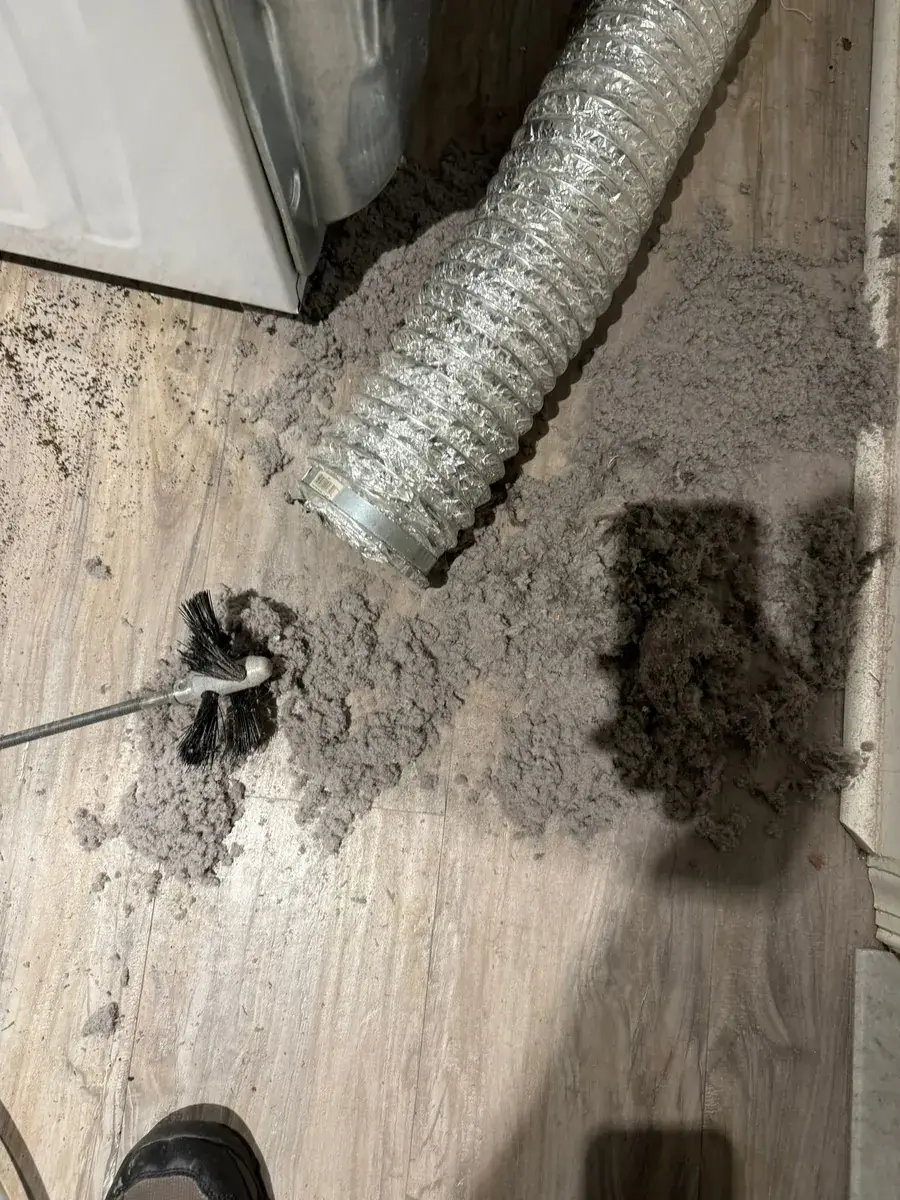
Not sure whether your vent needs attention? These are the signs Springfield homeowners most often call us about:
| Warning sign | What it usually means |
|---|---|
| Clothes need a second cycle | Airflow is choked by lint; moist air is recirculating instead of exhausting |
| Dryer top or laundry area feels hot and humid | Exhaust is backing up into the house instead of leaving it |
| Burning smell while the dryer runs | Lint is collecting near the heating element — stop the dryer and call |
| No flap movement at the exterior hood | The termination is blocked by matted lint, a stuck damper, or a nest |
| Lint gathering behind or around the dryer | The transition hose is leaking, kinked, or clogged |
What the Free Video Inspection Actually Shows
Almost nothing about a dryer vent is visible from the laundry room. You can see the transition hose behind the dryer and the hood outside, but the run in between — the stretch that actually clogs and catches fire — is hidden inside walls, joist bays, and roof cavities. That is why every Springfield job starts with a camera in the duct, before we quote a number. On the screen you see what we see: how deep the lint sits, whether the duct is smooth rigid metal or the foil flex that sheds and snags, and whether any section is crushed, disconnected, or sagging where it should run straight.
The inspection also settles the question that decides the price — is this a routine cleaning or a deep one? A routine cleaning is annual upkeep on a run that has been maintained: a manageable lint load, a clear termination, usually under an hour of work. A deep cleaning is a first-time clearing, or a vent that has gone years without service — lint compacted the length of the duct, a caked exterior hood, sometimes a nest packed into the roof cap. Those are genuinely different jobs, and the camera tells us which one your vent is before you approve anything, so the flat written quote matches the real work and nothing gets invented once we are behind the dryer.
It also catches the problems a cleaning alone will not fix. Foil or thin plastic flex duct is not rated for a dryer and is a recognized fire risk; a transition hose kinked behind the appliance chokes airflow no matter how clean the rest of the run is; a damper stuck shut at the hood traps warm, moist exhaust indoors. When we find any of it, you get it in writing with photos and a plain explanation of your options — and if a nest needs clearing or a bird guard belongs on the cap, that is on the quote too, spelled out, before a brush ever goes into the duct.
How Often Should a Springfield Dryer Vent Be Cleaned?
Once a year is the standard answer, and for most Springfield homes it is the right one. Clean more often if the run is long or roof-terminated, if your household does heavy laundry, if pets add hair to the lint load, or if the dryer is older and runs hot. Clean immediately — before the next load — if you notice a burning smell or the dryer starts shutting itself off from overheating.
If you have never had it done, do not assume the previous owner did. Like ductwork, dryer vents almost never get serviced at resale, and a home inspection report will note the visible hood at best — not the thirty feet of duct behind it. First-time cleanings in older Springfield homes routinely pull out startling amounts of compacted lint, and sometimes the remains of a bird's nest at the cap. That first cleaning resets the clock; annual maintenance after that is quick and uneventful, which is exactly how fire prevention should feel.
The work is backed the same way everything we do is backed: a flat written quote before we start, a price match guarantee if you bring a competitor's written quote for the same scope, a 6-month workmanship warranty, and Google Guaranteed protection with money-back coverage up to $2,000 on qualifying jobs. E Cleaning is family-owned, serving the area since 2016, a licensed PA contractor (PA 187935) insured to $2 million, and rated 4.8 stars across 144 Google reviews.
Booking takes a minute, and we're open 24 hours a day, Sunday through Friday — closed Saturdays — for the times something cannot wait. If it has been more than a year — or you have never had it done — the free inspection will tell you exactly where your vent stands.
How much does dryer vent cleaning cost?
Routine and deep cleaning are different services — the free inspection determines which one your system actually needs. Prices vary house to house; your exact price comes as a flat written quote before any work begins.
| Dryer vent routine — basement / 1st floor | $129.99 |
| Dryer vent routine — 2nd floor & up | $149.99 |
| Dryer vent deep cleaning | $299.99 |
| Nest removal · bird guard installation | from $250 · from $150 |
Three promises. In writing. On every job.
Price Match Guarantee
Bring a competitor's written quote for the same scope of work — we'll match it. You never overpay for doing it right.
6-Month Warranty
Every job carries a 6-month workmanship warranty. If a problem traced to our work shows up, we come back and make it right — free.
Google Guaranteed
Booked through Google Local Services, qualifying jobs carry Google's own money-back protection up to $2,000, administered by Google.
Backed by a real license and $1M/$2M insurance — see the actual documents
Don't put off air you breathe — finance it with Wisetack
Check your options in about a minute with no impact to your credit score, choose terms that fit your budget, and pay over time instead of all at once.
*All financing is subject to credit approval. Your terms may vary. Wisetack loans are issued by Hatch Bank. See additional terms at wisetack.com/faqs.
4.8 stars from 144 Google reviews — and easy to find
E Cleaning Duct & Vent Cleaning is based at 555 S Goddard Blvd, King of Prussia, and serves Springfield and all of Montgomery County from right here. Check our Google profile: real jobs, real photos, and a rating our crew protects on every visit.
- Google Guaranteed business — screened, licensed and insured (see the documents)
- Read every review on our Google profile — we don't cherry-pick what you can verify
Dryer Vent Cleaning questions from Springfield homeowners
Do you charge extra to come out to Springfield?
No. There are no travel or trip fees in Springfield Township or anywhere else we serve. The inspection is free, and the flat written quote you approve is the full price — the same policy across Montgomery County.
My laundry is on the second floor of a renovated colonial. Is that harder to clean?
It is a longer job, not a problem. Second-floor laundries in Springfield's older colonials usually vent upward to a roof cap or across long in-wall runs, so there is simply more duct to brush and more elbows collecting lint. We clean the entire run and check the termination, and the free inspection tells us the layout before we quote.
Can you clean a roof-terminated dryer vent?
Yes. Roof caps are common in Springfield — on twins near the Philadelphia line and in homes where a renovation moved the laundry upstairs. We clear the cap, check the damper and screen for matted lint or nests, and verify airflow at the termination before we leave. You never have to get on the roof yourself.
How long does a dryer vent cleaning take?
Most Springfield jobs take under an hour. Long roof-terminated runs, or first-time cleanings with years of buildup, can take longer — and you will know the scope before we start, because it is spelled out on the written quote.
Do you serve Wyndmoor, Erdenheim, Flourtown, and Oreland?
Yes — all of Springfield Township, plus the surrounding communities. If you are on a border street and not sure which township your address technically falls in, it makes no difference to us: there are no zone fees, just the free inspection and the flat written quote.
Can you do the dryer vent and the air ducts in one appointment?
Yes, and it is one of the most common ways Springfield homeowners book us. One crew handles both, you get a single written quote covering both scopes, and both systems get before-and-after documentation. See our Springfield air duct cleaning page for what that side of the visit covers.
Ready for honest dryer vent cleaning in Springfield?
Free video inspection, a flat written quote before any work, and real before/after proof — call (484) 367-5944 or book online now.
