
Dryer Vent Cleaning in Thorndale, PA
E Cleaning cleans dryer vents throughout Thorndale — a commuter community where townhome rows and shared walls raise the stakes on lint. A free inspection shows you the problem before anything else happens, a flat written quote comes before any work, and there are no trip fees. PA licensed, insured up to $2 million, rated 4.8 stars across 144 Google reviews.
Shared Walls Raise the Stakes on a Clogged Dryer Vent
Thorndale grew up as a rail commuter community at the end of SEPTA's Paoli/Thorndale Line, and it grew densely — townhome rows, twins, and closely spaced singles make up a large share of the housing around the station and the Route 30 corridor. That density is exactly why we treat dryer vent cleaning here as fire prevention first and appliance maintenance second: when homes share walls, a clogged vent is never only one family's problem.
The mechanism is mundane, which is what makes it dangerous. Lint is fine, dry, and packed by design into a warm tube attached to the one appliance in your house built around a heating element. The vent does not clog overnight — it clogs one load at a time, and the dryer compensates by running longer and hotter, until one day something gives. Nobody notices the slide because every load looks like the last one.
Now set that against how laundry actually happens in a commuter town. In Thorndale, wash day gets compressed into weeknights after the train gets in and into big weekend batches — so the dryer runs in the evening, often unattended, sometimes after everyone has gone to bed. A restricted vent is most dangerous precisely when nobody is near the machine. The U.S. Fire Administration (FEMA) separately estimates 2,900 home clothes dryer fires reported each year. In an attached row, whatever happens in your laundry closet is shared with the neighbors on both sides of the wall — and that cuts both ways, because their maintenance habits matter to you too.
The warning signs are easy to dismiss one at a time: loads taking longer than they used to, the laundry room feeling hot and humid mid-cycle, a faint scorched-dust smell while the machine runs, barely any lint on the screen because it is collecting in the duct instead, or an outside flap that hardly moves when the dryer is going. Any one of them is a reason to have the run inspected. Two or more means stop running the dryer unattended until it is cleaned.
Which Floor Is the Laundry On? In Thorndale, That Decides the Job
Every dryer vent job comes down to three questions: where the machine sits, where the duct exits, and how the household uses it. Thorndale's housing answers those questions three different ways — sometimes on the same block.
Basement hookups in the station-area homes. The older singles and twins near Business 30 — the old Lincoln Highway — mostly keep laundry in the basement. The run is short, out through the rim joist and done, but the exit sits low, near grade: mulch, leaves, and drifted snow block the flap, old screened caps mat over with lint, and birds find an inviting cavity there every spring. A short run behind a choked termination clogs just as effectively as a long one, and because these houses are older, many still have the original cap that came with the first dryer decades ago.
Upstairs laundry closets in the commuter-era construction. The townhomes and singles built around Thorndale from the 1980s onward put laundry up on the bedroom floor. The convenience costs duct: the run snakes through walls and ceiling chases to find an outside wall, turning several elbows on the way. Every 90-degree bend adds resistance roughly equal to several feet of straight pipe, and lint drops out of the airstream wherever the air slows — which means at every bend. These concealed runs clog years sooner than a straight basement run doing identical laundry, and you cannot see any of it happening behind the drywall.
Roof terminations on three-story rows. Some of Thorndale's taller townhomes have no practical side exit at all, so the vent climbs straight up and out the roof. The dryer has to lift lint vertically the entire way, roof caps mat faster than wall caps, and nobody ever sees the cap from the ground — so the first symptom anyone notices is towels needing a second cycle.
Stacked units in tight closets. Condos and smaller townhome floor plans around Thorndale often use a stacked washer-dryer in a bifold closet, and the machine gets pushed hard against the wall so the doors will shut. That crushes the foil transition hose behind it — the short flexible piece connecting the dryer to the wall — kinking the airflow before the lint even reaches the duct. Crushed and torn transitions are among the most common problems we find in these closets, and they restrict a vent just as surely as a clog does.
Winter makes all of it worse. Chester County winters mean heavier loads — towels, blankets, layers, kids' sports gear — and warm, moist exhaust meeting cold duct. Condensation forms inside the run, damp lint sticks to the duct wall instead of riding out, and a base layer builds that every later load catches on. Vents that limped through summer choke in January, which is why late fall and winter are our busiest stretch for this work along the corridor.
Full-Run Lint Extraction: Both Ends, the Whole Length
A proper cleaning covers the entire duct — from the dryer's exhaust outlet to the outdoor termination — and verifies both ends. Brushing the first few feet from the laundry room and calling it done just relocates the clog deeper into the run, where it is harder to reach and easier to forget.
We inspect before we quote. That means checking airflow at the termination, checking the condition of the transition hose behind the machine, and putting a camera inside the run where it is warranted — with you seeing what we see. Then one flat quote goes on paper before anything is disconnected. Anything beyond a straightforward cleaning — a bird's nest packed in the duct, roof access on a three-story unit, replacing a crushed foil transition with semi-rigid duct, adding a proper bird guard — is named on that same written quote before work starts. Nothing gets discovered mid-job and quietly added to the bill.
The cleaning itself runs rotary agitation down the full length of the duct while a HEPA-filtered vacuum captures the lint — not a blower shooting it across your yard or down the face of a townhome row. The exterior termination gets cleared and its flap tested, because a clean duct behind a matted cap solves nothing. Roof terminations get real roof access: the vertical run, the cap, and the transition all cleaned, with the ladder work done properly by an insured crew.
- Inspection and airflow check before any quote
- One flat written quote before the dryer is even pulled out
- Rotary cleaning of the full run, from the machine to the termination
- HEPA-filtered lint capture — nothing blown across the yard or the building face
- The exterior cap cleared and the flap tested
- The transition hose behind the dryer inspected
- A working airflow test and after photos when we finish
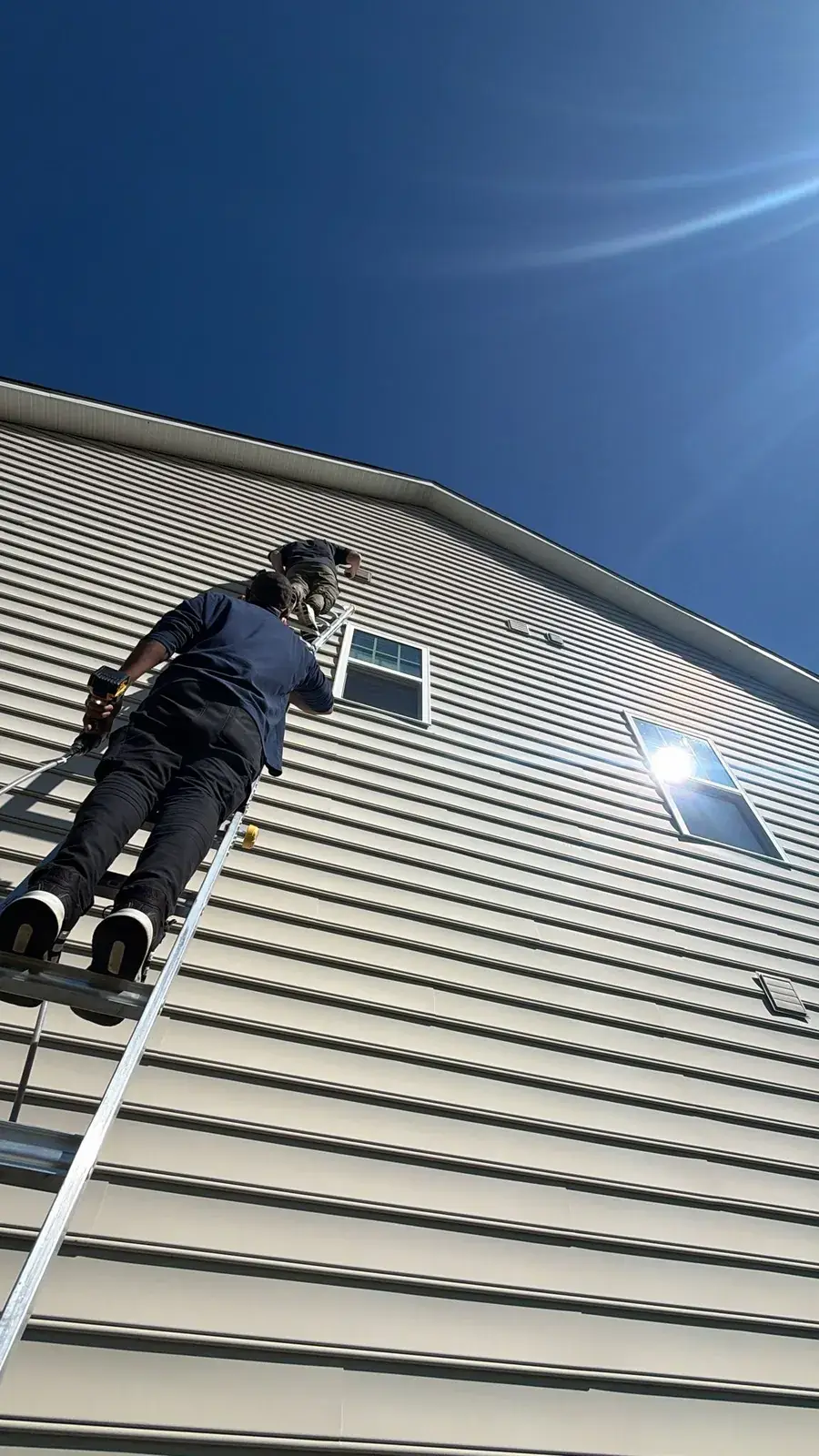
Most visits take 45 to 90 minutes. A packed, never-cleaned roof run on a three-story townhome takes longer — and you will know that from the written quote, not from a surprise at the end of the job.
One thing worth understanding about why this service exists at all: the lint screen you empty between loads only catches a portion of what each load sheds. The rest rides the exhaust into the duct, every single cycle, no matter how diligent the household is. That is why vents clog even in homes where the screen is cleaned religiously — screen-cleaning is necessary, but it was never the whole job. And a restricted run costs you before it ever becomes a safety issue: the dryer takes longer per load and works harder doing it, so the machine wears out years early. Cleaning the vent protects the appliance as much as the house.
Maintenance Cleaning or First-Time Deep Clean — Named Honestly, In Writing
A yearly maintenance cleaning on a vent that gets regular care is a genuinely different job from a first-time cleaning on a run that has been packing lint since the house was built — different labor, different time on site, honestly different services. We quote the one your vent actually needs and name it in writing, so a maintenance visit is never billed like a rescue job, and a rescue job is never underquoted to win the booking and padded later. If the inspection shows your vent is genuinely fine, we tell you that too and leave you with working airflow numbers instead of an invoice.
Much of Thorndale's attached housing is association-managed, and we work with that rather than around it. The exterior side of the job is done cleanly — lint captured rather than scattered across the front of the building, terminations left looking right — and the after photos we hand you are exactly what a property manager wants to see when they ask what was done and by whom.
Every job carries our 6-month workmanship warranty — if a problem traced to our work shows up within six months, we come back and make it right free — plus a Price Match Guarantee against any competitor's written quote for the same scope of work, and Google Guaranteed protection up to $2,000 on qualifying jobs. We are family-owned and have been cleaning vents since 2016, a PA licensed contractor (PA 187935) insured up to $2 million — the documents are viewable on our licensed & insured page. Wisetack financing is available if you would rather spread payments out.
Scheduling in Thorndale and Along the Route 30 Corridor
We cover all of Chester County with no trip fees, and the Route 30 corridor is home turf — regular jobs in Downingtown, Caln, and Coatesville mean a Thorndale appointment rarely waits long. Hours are around the clock, Sunday through Friday — we're closed Saturdays if a dryer problem cannot wait until morning.
Many customers pair this visit with air duct cleaning in Thorndale — one appointment, one flat written quote covering both systems, and the whole air side of the house handled at once.
How much does dryer vent cleaning cost?
Routine and deep cleaning are different services — the free inspection determines which one your system actually needs. Prices vary house to house; your exact price comes as a flat written quote before any work begins.
| Dryer vent routine — basement / 1st floor | $129.99 |
| Dryer vent routine — 2nd floor & up | $149.99 |
| Dryer vent deep cleaning | $299.99 |
| Nest removal · bird guard installation | from $250 · from $150 |
Three promises. In writing. On every job.
Price Match Guarantee
Bring a competitor's written quote for the same scope of work — we'll match it. You never overpay for doing it right.
6-Month Warranty
Every job carries a 6-month workmanship warranty. If a problem traced to our work shows up, we come back and make it right — free.
Google Guaranteed
Booked through Google Local Services, qualifying jobs carry Google's own money-back protection up to $2,000, administered by Google.
Backed by a real license and $1M/$2M insurance — see the actual documents
Don't put off air you breathe — finance it with Wisetack
Check your options in about a minute with no impact to your credit score, choose terms that fit your budget, and pay over time instead of all at once.
*All financing is subject to credit approval. Your terms may vary. Wisetack loans are issued by Hatch Bank. See additional terms at wisetack.com/faqs.
4.8 stars from 144 Google reviews — and easy to find
E Cleaning Duct & Vent Cleaning is based at 555 S Goddard Blvd, King of Prussia, and serves Thorndale and all of Chester County from right here. Check our Google profile: real jobs, real photos, and a rating our crew protects on every visit.
- Google Guaranteed business — screened, licensed and insured (see the documents)
- Read every review on our Google profile — we don't cherry-pick what you can verify
Dryer Vent Cleaning questions from Thorndale homeowners
Do you charge extra to come out to Thorndale?
No. We do not charge trip fees anywhere in Chester County, Thorndale included. The inspection is free, and the flat written quote you get before any work begins is based on the vent run itself — its length, routing, and condition — not on your address.
My townhome's dryer vents through the roof. Can you clean that?
Yes. Roof terminations are common on Thorndale's three-story townhomes, and we clean them regularly — with proper roof access, the full vertical run, and the cap itself, not just a brush from the laundry-room end. Roof work is scoped on the written quote before we start, so there is no surprise for going up a ladder.
How often should a dryer vent be cleaned in Thorndale?
Once a year is the standard fire-safety guidance, and it fits most households. Long, elbow-heavy runs from upstairs laundry closets — the norm in Thorndale's newer construction — should stay strictly on that schedule or tighter. A short basement run may stretch longer between cleanings, but the exterior cap should still be checked yearly, because a matted screen chokes even a clean duct.
My towels take two cycles to dry. Is it the dryer or the vent?
Usually the vent, and it is the cheapest thing to rule out first — our inspection is free and shows you the airflow directly. A restricted run makes the dryer work longer and hotter on every load, which also wears the machine out early. If the vent turns out to be clear and the dryer itself is failing, you will know that before spending anything.
There's a bird nest in my dryer vent. Do you handle that?
Yes. Low wall caps near grade — common on Thorndale's older basement-laundry homes — are prime nesting spots every spring. We remove the nest and can install a proper bird guard so it does not happen again. Both items are named on the flat written quote before any work begins, never added mid-job.
Can you clean my air ducts on the same visit?
Yes — see our air duct cleaning in Thorndale page. Many customers book both services together: one appointment, one flat written quote covering both, and after photos for each system.
Ready for honest dryer vent cleaning in Thorndale?
Free video inspection, a flat written quote before any work, and real before/after proof — call (484) 367-5944 or book online now.
