
Dryer Vent Cleaning in Trainer, PA
Dryer vent cleaning in Trainer, PA starts with a free inspection of the complete vent run — from the connection behind the drum to the hood outside — and a flat written quote you approve before any work begins. In a borough where most homes share at least one wall with a neighbor, a lint-packed vent is a fire risk the whole block has a stake in, and E Cleaning — family-owned, PA-licensed (PA 187935), insured up to $2 million — clears the entire run, not just the ends.
Shared walls, small lots: what laundry safety means in Trainer
Trainer packs its housing tight. The borough covers roughly a square mile of southwestern Delaware County riverfront, wedged between the City of Chester upriver and Marcus Hook toward the state line, with Lower Chichester on the inland side — and most of its homes are rows, twins and closely set frame houses built in the early twentieth century for the workers of the waterfront plants. On blocks like these, houses touch. A dryer fire that starts in one basement has a party wall on either side of it, and smoke and flame in attached housing rarely stay polite about property lines.
That is the frame we bring to dryer vent work in Trainer: fire prevention first, appliance performance second. The performance matters — a clear vent dries clothes faster and works the machine less — but in a borough this dense, the more important fact is that lint is fine, dry and highly flammable, the vent duct is where it accumulates, and clearing it removes the fuel from the most preventable kind of house fire there is.
Logistics are the easy part. US 13 runs straight through the borough, I-95 passes just inland with exits minutes from any block, and our crew comes down from 555 S Goddard Blvd in King of Prussia via I-476 and I-95 without a trip fee attached to the drive. We are open 24 hours a day, Sunday through Friday — closed Saturdays — which suits a shift-work town: if the only time you can meet us at the house is 5am before work or 9pm after it, that is a normal appointment for us, not a special request. The inspection of your vent run is free, and the flat written quote comes before any work begins, every time.
Basement hookups, converted closets and the vent runs they create
Almost none of Trainer's housing existed when the clothes dryer was invented, so every dryer vent in the borough is an afterthought — and where the laundry ended up decides what kind of afterthought you own.
The most common setup is the original one: washer and dryer in the basement, against or near the rear foundation wall. In a shallow run like that, the vent punches through the rim joist and terminates a foot or two off the ground outside — short and simple, but with a termination low enough to collect yard dirt, leaf litter and its own escaping lint until the flap sticks. In the borough's deeper rows and twins, the machine sometimes sits toward the middle or front of the basement instead, and the vent has to travel much of the length of the house through elbows and joist bays before it finds daylight. Every added foot and every added elbow is a place lint slows down, falls out of the airstream and packs in.
Then there are the relocations. As Trainer houses turn over — and an affordable borough turns over steadily — flips and remodels often move the laundry up out of the basement into a first-floor closet or a second-floor hallway. Every foot the dryer moves away from an exterior wall gets added to a concealed duct snaking through wall cavities, and some of these runs go all the way up and out through the roof, where no one has looked at the termination in years. Duplex and apartment conversions stack the issue: two households and two dryers under one roof, with vent runs improvised at different times by different hands, and tenant turnover that almost never includes anyone looking inside the vent.
Seasonality finishes the picture. A river-town winter runs the dryer hard — coats, blankets, back-to-back loads for months — and the months when the machine works hardest are exactly the months a restricted vent is most dangerous. Whatever configuration your home has, the free inspection traces the full run and shows you where it actually stands before anything is quoted.
The numbers behind the smoke detector
Dryer fires are unusually well documented, and the documentation points at one cause above all others. U.S. fire departments respond to an estimated 15,970 home fires involving clothes dryers or washing machines each year, and according to NFPA data, failure to clean is the leading factor, contributing to one-third (33%) of dryer fires. The U.S. Fire Administration (FEMA) separately estimates 2,900 home clothes dryer fires are reported each year. The mechanism is simple: a restricted vent traps hot, moist air in the duct and the machine, the dryer runs hotter and longer to compensate, and the lint packed along the run is sitting fuel.
Attached housing raises the stakes on both ends. A blocked vent in a detached township colonial threatens one structure; the same vent in a Trainer row shares its risk with the family on the other side of the party wall. Landlords carry the weight doubled — a converted duplex with two neglected dryer vents is two ignition points under a single roof, and in most conversions neither tenant has any idea when, or whether, the vents were last cleaned.
The warning signs cost nothing to check this week:
- Loads need a second cycle to dry — especially towels and jeans
- The top of the dryer or the laundry room itself feels hot mid-cycle
- A hot or faintly burnt smell while the machine runs
- The outdoor flap barely opens — or does not move — during a cycle
- Lint gathering behind the machine or around the hose connection
- Nobody can remember the vent ever being professionally cleaned
One of these earns the free inspection. Two or more mean the inspection should happen before the next heavy laundry day.
Why we clean the full run — every foot, every elbow
Lint does not gather politely at the two ends of a dryer vent where a shop-vac can reach it. It packs along the entire length — thickest at the elbows, at crushed spots in the transition hose behind the machine, and at the outdoor termination where the flap slows the airflow. So the only cleaning that honestly solves the problem is a full-run cleaning, and that is the only kind we do: the dryer comes away from the wall, the transition hose comes off and gets cleared, and a rotary brush drives through the complete duct — from the connection behind the drum, through every elbow and concealed section, to the exterior hood — while vacuum extraction with HEPA filtration captures everything the brush breaks loose. The termination is cleared, its flap checked for free movement, and the whole system reconnected before we test it.
The test is the part you can verify yourself. With the dryer running, airflow at the outside hood should be strong enough to feel — and after a full-run cleaning, it is. That, plus after-photos of the cleared run and hood, is how the job proves itself, rather than asking you to take a technician's word for it.
Like our duct work, the scope is set honestly before anything starts. A vent that gets maintained on a schedule is a routine visit; a run that has never been opened, a packed multi-story riser from a laundry conversion, or a termination that turns out to be blocked by a bird's nest is genuinely more work. If the inspection finds nesting, we handle the nest removal and can install a proper bird guard afterward — one designed to keep birds out without becoming a lint trap itself. Whatever the inspection finds, the full scope and the total go into a flat written quote you approve before any work begins, and no figure changes once the work is underway.
A Trainer dryer vent appointment, step by step
Trace and inspect the run
The technician inspects the complete vent path — transition hose, concealed duct, exterior termination — free of charge. You see what we see, whether that is a light lint film or a run packed solid.
Approve the written quote
The full scope and total go into a flat written quote before we touch anything. Routine or deep, short rim-joist run or three-story riser — the number you approve is the number you pay.
Protect and disconnect
The laundry area is protected, the dryer is pulled out, and the transition hose is disconnected, cleared and assessed for damage or crushing behind the machine.
Extract the full run
The rotary brush and vacuum extraction work the entire duct, every foot and every elbow, and the exterior hood is cleared of lint and debris with its flap checked for free movement.
Reconnect, test, document
Everything is reconnected, the dryer runs while we verify airflow at the termination, lint behind the machine is cleaned up, and you get after-photos for your records.
Most basement-laundry homes in Trainer take about an hour. Long conversion runs, roof terminations and first-ever cleanings on packed ducts take longer — and because the flat written quote was approved before we started, the extra time never changes your price. Every job is backed by our 6-month workmanship warranty: if a problem traced to our work shows up within six months, we come back and make it right free. Financing is available through Wisetack.
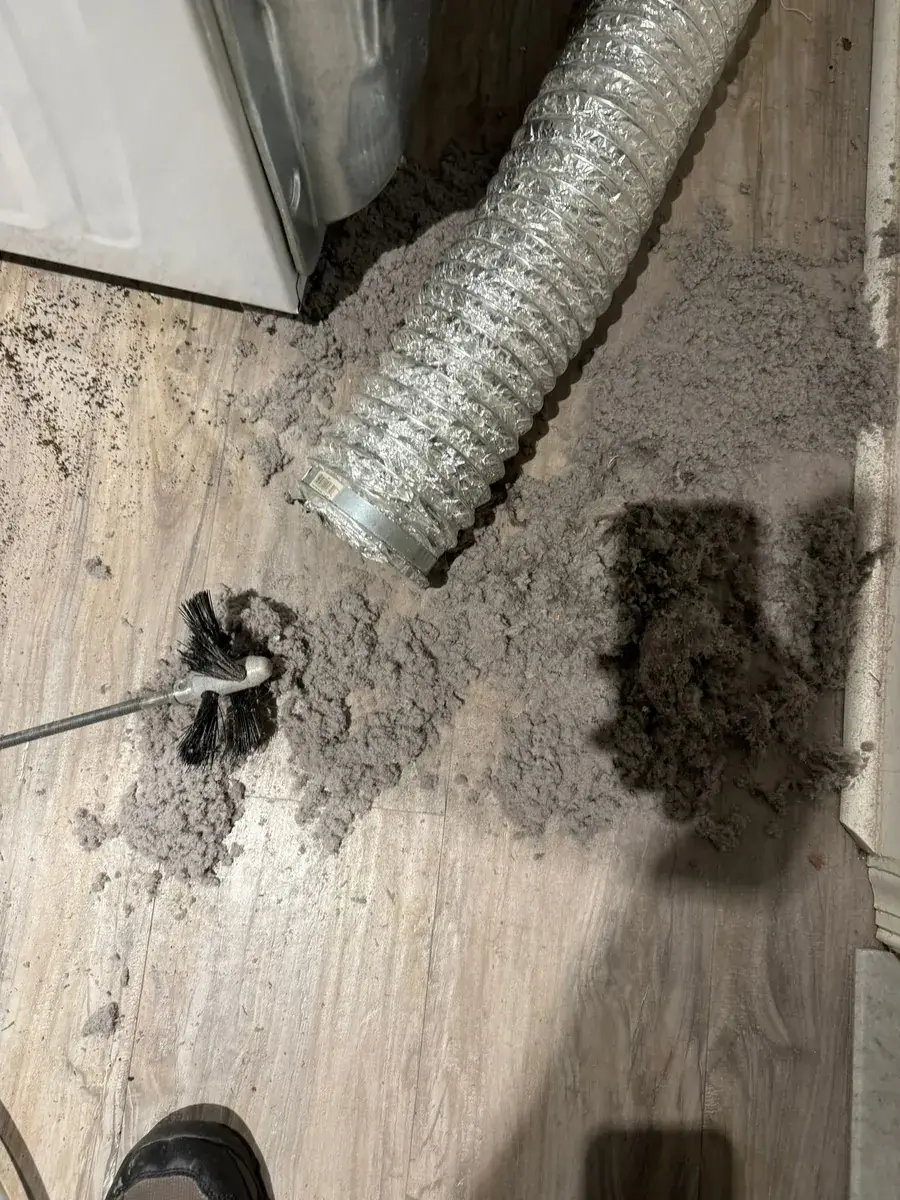
What comes out of a neglected run
Years of lint pack into a duct in layers, and most of it sits in the sections no household vacuum can reach. Full-run extraction pulls it from the entire length — which is why the airflow difference at the outside hood is something you can feel by hand.
Flat terms, checkable credentials, no doorstep math
The bait-and-switch playbook that plagues duct cleaning has a dryer vent version too: a teaser number over the phone, then a "discovery" once the technician is standing in your basement and the real total appears. Our structure makes that move impossible in Trainer. The inspection of the run is free. The quote is flat, written and approved before any work begins. There are no trip fees, no per-foot surprises and no renegotiation at the door — and if your vent turns out to be clear, we say exactly that and you owe nothing.
Everything we claim, you can verify. We are a PA-licensed contractor — PA 187935, with the license and insurance certificates viewable on our licensed & insured page — insured up to $2 million, rated 4.8 stars across 144 Google reviews, and backed by Google Guaranteed, Google's program providing money-back protection up to $2,000 on qualifying jobs. Bring us a competitor's written quote for the same scope of work and our Price Match Guarantee means we match it. Every job carries the 6-month workmanship warranty, and the free video inspection and after-photos give you documentation on both ends of the work.
We are on this end of Delaware County constantly — clearing dryer vents next door in Marcus Hook, upriver in Chester and inland in Lower Chichester — with the full town list on our Delaware County service page. And since the crew is already at your house, many Trainer homeowners have us look at the HVAC side on the same visit: air duct cleaning in Trainer under the same flat written quote, one crew covering both systems.
How much does dryer vent cleaning cost?
Routine and deep cleaning are different services — the free inspection determines which one your system actually needs. Prices vary house to house; your exact price comes as a flat written quote before any work begins.
| Dryer vent routine — basement / 1st floor | $129.99 |
| Dryer vent routine — 2nd floor & up | $149.99 |
| Dryer vent deep cleaning | $299.99 |
| Nest removal · bird guard installation | from $250 · from $150 |
Three promises. In writing. On every job.
Price Match Guarantee
Bring a competitor's written quote for the same scope of work — we'll match it. You never overpay for doing it right.
6-Month Warranty
Every job carries a 6-month workmanship warranty. If a problem traced to our work shows up, we come back and make it right — free.
Google Guaranteed
Booked through Google Local Services, qualifying jobs carry Google's own money-back protection up to $2,000, administered by Google.
Backed by a real license and $1M/$2M insurance — see the actual documents
Don't put off air you breathe — finance it with Wisetack
Check your options in about a minute with no impact to your credit score, choose terms that fit your budget, and pay over time instead of all at once.
*All financing is subject to credit approval. Your terms may vary. Wisetack loans are issued by Hatch Bank. See additional terms at wisetack.com/faqs.
4.8 stars from 144 Google reviews — and easy to find
E Cleaning Duct & Vent Cleaning is based at 555 S Goddard Blvd, King of Prussia, and serves Trainer and all of Delaware County from right here. Check our Google profile: real jobs, real photos, and a rating our crew protects on every visit.
- Google Guaranteed business — screened, licensed and insured (see the documents)
- Read every review on our Google profile — we don't cherry-pick what you can verify
Dryer Vent Cleaning questions from Trainer homeowners
How often should a dryer vent be cleaned in a Trainer rowhouse?
Once a year is the sound baseline for most attached homes, and heavy-use households — big families, back-to-back winter loads, older machines — often need it more. The honest answer for your specific run comes from the free inspection: a short rim-joist vent and a three-story conversion riser accumulate lint at very different rates, and we scope the visit to what the run actually shows.
My dryer is in the basement and the vent goes straight out the back wall. Is that still worth cleaning?
Yes — short runs clog too, just differently. Basement terminations in Trainer sit low to the ground, where the hood collects yard dirt, leaf litter and its own escaping lint until the flap sticks shut. A stuck flap chokes airflow exactly like a packed duct does. The free inspection checks the full run, hood included, and if it is genuinely clear we tell you so and you owe nothing.
Can you clean a dryer vent that goes up through the roof?
Yes. Roof terminations are common in Trainer homes where a remodel moved the laundry to an upper floor, and they are the runs most likely to be packed, since nobody sees the termination from the ground. We clean the complete run from the machine to the roof hood, verify airflow with the dryer running, and document the result with after-photos.
There's a bird's nest in my dryer vent. Can you remove it?
Yes — nesting in dryer vent terminations is something we handle regularly, and it is one of the clearest fire hazards we find, since nest material sits directly in the path of hot, lint-laden air. We remove the nest, clean the full run behind it, and can install a proper bird guard afterward: one built to keep birds out without becoming a lint trap itself. Everything goes on the same flat written quote before work begins.
I own a duplex in Trainer. Can you do both units in one visit?
Yes, and we recommend it — conversions usually mean two vent runs improvised at different times, and neither tenant typically knows when they were last cleaned. We coordinate access with your tenants, clean and airflow-test both runs in a single visit, and the inspection findings and after-photos give you dated documentation for your records.
What are your hours for dryer vent service in Trainer — do you work weekends?
We are open 24 hours a day, Sunday through Friday, and closed Saturdays. Sundays are fully available, as are overnight, early-morning and evening slots during the week — useful in a shift-work town. The free inspection and flat written quote work the same at every hour we operate.
Ready for honest dryer vent cleaning in Trainer?
Free video inspection, a flat written quote before any work, and real before/after proof — call (484) 367-5944 or book online now.
