
Dryer Vent Cleaning in Upland, PA
Dryer vent cleaning in Upland, PA clears the entire run — from the transition hose behind the machine to the hood or roof cap where it exits — with rotary agitation and vacuum extraction, after a free video inspection and a flat written quote you approve before any work begins. E Cleaning is family-owned, PA-licensed (PA 187935), insured up to $2 million, Google Guaranteed, and rated 4.8 stars across 144 Google reviews.
Wash day in a mill village that grew into a borough
Upland occupies barely a square mile of high ground above Chester Creek in southern Delaware County, with the city of Chester wrapped around its southern and eastern sides, Brookhaven straight north, little Parkside at its northeastern corner and Chester Township along the west. The borough began as a village for the families who worked the Crozer cotton mills on the creek, and its housing still shows it: brick and frame twins, short rowhouse runs and tight-lot singles from the late 1800s and early 1900s, filled in later with interwar blocks and a modest band of postwar homes.
Housing built for mill workers was built close — close to the mills and close to itself. That compactness writes the rules for every dryer vent in town. A twin gives up half its exterior walls to the party wall, so vent runs crowd toward the rear wall or squeeze out a narrow side. Rowhouse-style blocks give up both sides, leaving only front and back — and nobody vents a dryer out the front. Side yards are a few feet wide where they exist at all, which puts exhaust hoods low on walls nobody walks past, behind downspouts, fences and shrub lines. A hood no one ever sees is a hood no one ever checks, and on blocks this old, some of them have been quietly felting shut for decades.
The borough's default laundry floor is the one its houses were born with: the basement. Homes of this era put the washtubs by the foundation wall, and when clothes dryers arrived mid-century they took the spot alongside — usually venting through the rim joist or straight through the old stone or brick foundation. Short runs, but the oldest hookups in town, many still wearing their original hardware.
We reach Upland down I-476 from our King of Prussia headquarters at 555 S Goddard Blvd, working in through central Delaware County — open 24 hours a day, Sunday through Friday, closed Saturdays. Every visit runs the same way: a free video inspection of the vent run first, a flat written quote before any work begins, and no trip fees.
The vent follows the laundry — and the laundry has been moving
A dryer vent's risk profile is set by geometry: how long the run is, how many elbows it turns, what it exits through, and whether anyone can see the termination. Upland's housing, renovated in layers across more than a century, now holds every version.
Basement hookups against stone. Still the majority case, and the friendliest geometry — a short push to daylight through the rim joist, or a bored path through masonry a foot thick or more. The catch is age and invisibility. These are the borough's original hookups: thin foil transition hoses kinked flat behind the machine, flappers stiffened by decades of paint and weather, screens matted solid with lint. A short run that is mostly blocked behaves worse than a long run that is clear.
First-floor moves. Renovated kitchens and rear additions have pulled many Upland laundries up out of the cellar. A machine in the middle of a narrow, deep floor plan cannot reach an outside wall directly, so the duct travels — through joist bays toward the back of the house, gaining length and elbows with every framing bay it crosses. Longer, slower runs are where damp lint stops flying and starts matting.
Upstairs closets. The full modern conversion in updated twins and singles stacks the laundry near the bedrooms and sends the vent up through framing and across ceiling cavities, sometimes all the way to a roof cap. Not one foot of that run is visible from anywhere in the house — which is precisely why those vents go longest between cleanings.
Then winter arrives, and Upland does what every Delco borough does: bedding, blankets, work clothes and kids' layers, load after load, through the coldest months. Warm, moist exhaust pushing through sheet metal that runs cold in unheated chases condenses along the way, and damp lint grips where dry lint would have carried through. The heaviest laundry season and the stickiest duct conditions land on the same weeks of the calendar — a vent that seemed fine in September can be meaningfully restricted by February without one dramatic warning along the way.
The fire math on close-set blocks
The numbers deserve to be quoted exactly. U.S. fire departments respond to an estimated 15,970 home fires involving clothes dryers or washing machines each year, according to the NFPA (2010–2014 data), and failure to clean is the leading factor, contributing to one-third (33%) of dryer fires. The U.S. Fire Administration (FEMA) separately estimates 2,900 reported home clothes dryer fires per year. The mechanism is not complicated: lint is dry, fine and very flammable, and a restricting vent stores it against a machine whose whole job is producing heat. Every load through a clogging duct runs a little longer and a little hotter than the last.
In a borough of twins, short rows and driveway-width gaps, that is never a single-household calculation. A party wall means your neighbor's vent maintenance is partly your business and yours is partly theirs — not a cause for alarm, but an excellent argument for a schedule. And a restricted vent causes plenty of trouble long before fire enters the picture. Gas dryers, common in housing of this age, push combustion byproducts through the same duct, and a blocked run sends them backward into the house. Moist exhaust vents into the laundry area as humidity. Towels need a second cycle. Heating elements die young.
A vent in an Upland home is overdue when:
- Towels, jeans and bedding routinely need a second cycle to dry
- The laundry area turns warm and humid while the machine runs
- There is a hot, scorched or dusty smell mid-cycle
- The outdoor flapper hangs still — or is painted shut — while the dryer is on
- Lint collects behind the machine or fuzzes the hose connection
- No one can recall the run ever being professionally cleared
None of these mean an emergency tonight. They mean the duct is narrowing — and it only narrows further until it is cleaned.
One camera, one quote, then every foot of the duct
The service starts with looking, not selling. A video camera goes through the vent run and you watch the footage with the technician: how much lint is riding the walls, whether there is compaction, nesting material, a crushed section or a separated joint. That footage makes the scoping call honest — a vent on a regular maintenance rhythm is a routine job, while a run carrying years of matting, a nest or damaged duct is genuinely a different, deeper one — and whichever applies goes into a flat written quote you approve before anything is touched. If the camera shows a clear run, we say exactly that, and the inspection has cost you nothing.
The cleaning itself covers the full length, because a vent cleared at one end and packed at the other is still a fire hazard with better manners. The dryer comes away from the wall and the transition hose comes off and gets cleaned — and if it is an aging foil hose, we will tell you plainly that it should be replaced with semi-rigid duct, and why. A rotary agitation brush then drives through the duct from the connection point to the exterior termination, working each elbow in stages while vacuum extraction runs on the line, so freed lint is captured rather than blown deeper into the run or scattered indoors. At the far end, the wall hood or roof cap is cleared, the flapper freed to swing, the screen de-linted and any nesting material removed. Where birds keep returning to a warm, lint-lined hood — a spring habit on Upland's hidden side walls — we can install a proper bird guard that protects the opening without strangling its airflow.
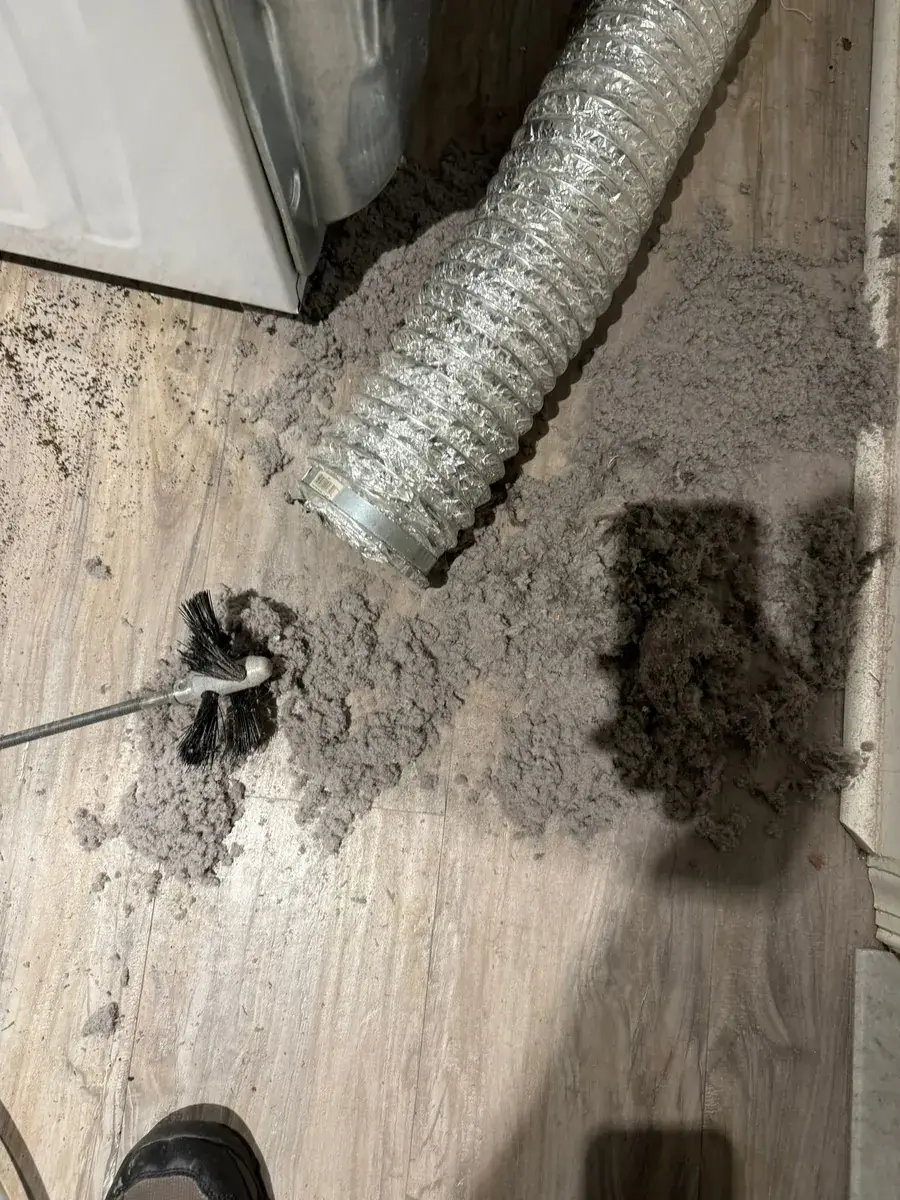
Captured, not scattered
Vacuum extraction runs on the line while the brush works, so the lint of years leaves the duct inside the machine — not in the laundry-room air, and not packed toward the hood. After-photos document the cleared run when the job is done.
What every Upland dryer vent visit includes
| Stage | What happens |
|---|---|
| Free video inspection | A camera scopes the full run while you watch. Routine or deep gets decided on evidence, and a clear vent is reported as a clear vent — no charge either way. |
| Flat written quote | The scope and the total in writing before any work. No per-foot arithmetic, no fuel surcharges, nothing added once the dryer is pulled out. |
| Full-run clearing | Rotary agitation from the transition connection to the outdoor termination, elbow by elbow, with vacuum extraction capturing the lint the entire way. |
| Terminations and hardware | Transition hose cleaned and honestly assessed; hood or roof cap cleared, flapper freed, screen de-linted; nesting material removed, with bird guards available where birds keep coming back. |
| Verification and warranty | Strong, steady airflow confirmed at the termination with the machine running, after-photos for your records, and the 6-month workmanship warranty behind the job. |
Most Upland dryer vent cleanings take about an hour. Roof terminations, long concealed runs from upstairs conversions and nest removals take longer — our crews carry ladders and work roof caps as ordinary jobs, not premium ones. Because the flat written quote is approved before the work starts, a stubborn run never changes your price mid-visit. And if a problem traced to our work shows up within six months, we come back and make it right free.
Everything is checkable before we ever knock
Dryer vent work draws the same teaser-price mailers as the rest of the cleaning trades — a small number to get someone through your door, a bigger number once they are standing in your laundry room. Our structure removes that moment entirely: the inspection is free and on camera, the quote is flat and in writing before any work begins, there are no trip fees, and nothing grows at the door. If a competitor gives you a written quote for the same scope of work, our Price Match Guarantee means we match it.
The rest you can verify from your couch. We are a PA-licensed contractor — PA 187935, with the license and insurance certificates viewable on our licensed & insured page — insured up to $2 million, rated 4.8 stars across 144 Google reviews, and backed by Google Guaranteed, Google's program providing money-back protection up to $2,000 on qualifying jobs. Financing is available through Wisetack, and we are open 24 hours a day, Sunday through Friday — closed Saturdays — so shift workers can book early mornings or evenings without taking time off.
Because the crew is already parked outside, many Upland households pair the vent with air duct cleaning in Upland in the same visit — one appointment, one written quote covering both systems. The neighboring towns ride the same routes: dryer vent cleaning in Chester just downhill, Brookhaven over the northern line and Parkside at the borough's corner — with every town listed on our Delaware County service page.
How much does dryer vent cleaning cost?
Routine and deep cleaning are different services — the free inspection determines which one your system actually needs. Prices vary house to house; your exact price comes as a flat written quote before any work begins.
| Dryer vent routine — basement / 1st floor | $129.99 |
| Dryer vent routine — 2nd floor & up | $149.99 |
| Dryer vent deep cleaning | $299.99 |
| Nest removal · bird guard installation | from $250 · from $150 |
Three promises. In writing. On every job.
Price Match Guarantee
Bring a competitor's written quote for the same scope of work — we'll match it. You never overpay for doing it right.
6-Month Warranty
Every job carries a 6-month workmanship warranty. If a problem traced to our work shows up, we come back and make it right — free.
Google Guaranteed
Booked through Google Local Services, qualifying jobs carry Google's own money-back protection up to $2,000, administered by Google.
Backed by a real license and $1M/$2M insurance — see the actual documents
Don't put off air you breathe — finance it with Wisetack
Check your options in about a minute with no impact to your credit score, choose terms that fit your budget, and pay over time instead of all at once.
*All financing is subject to credit approval. Your terms may vary. Wisetack loans are issued by Hatch Bank. See additional terms at wisetack.com/faqs.
4.8 stars from 144 Google reviews — and easy to find
E Cleaning Duct & Vent Cleaning is based at 555 S Goddard Blvd, King of Prussia, and serves Upland and all of Delaware County from right here. Check our Google profile: real jobs, real photos, and a rating our crew protects on every visit.
- Google Guaranteed business — screened, licensed and insured (see the documents)
- Read every review on our Google profile — we don't cherry-pick what you can verify
Dryer Vent Cleaning questions from Upland homeowners
How often should a dryer vent be cleaned in Upland?
Once a year is the sensible rhythm for most households — more often with heavy laundry use, a long or elbow-heavy run, a gas dryer, or an old hookup still wearing its original foil transition hose. Upland's basement vents are short but tend to be the most neglected in town, while converted upstairs laundries carry the longest concealed runs. The free video inspection tells you honestly where yours stands before you spend anything.
My vent exits through a thick stone foundation wall. Is that a problem to clean?
No — bored masonry exits are common in basements of Upland's era, and the passage through the stone cleans the same way any duct section does. The trouble in these setups is almost never the masonry; it is the aged hardware on either side of it — a kinked foil hose behind the machine and a painted-shut or felted hood outside. The camera inspection checks all three before anything is quoted.
I honestly do not know where my dryer vents out. Can you find it?
Yes, and you are not alone — hidden side-wall hoods and concealed upstairs runs make this a common question on Upland's close-set blocks. The camera traces the duct from the machine to wherever it actually terminates. Occasionally we find a run that was never properly terminated at all, dumping into a wall cavity or crawlspace — a finding you will see on the footage and in the written quote before any work is approved.
Birds built a nest in my vent hood. Can you handle that?
Yes. A warm, lint-lined duct behind a broken flapper is prime spring nesting territory, especially at the low, hidden hoods along Upland's narrow side yards. We remove the nesting material as part of clearing the run, and we can install a proper bird guard that keeps the opening protected without restricting airflow — all scoped in the same flat written quote before work begins.
Is a blocked vent more serious with a gas dryer?
Yes. On a gas dryer the vent carries combustion byproducts along with the moisture and lint, and a fully blocked run gives them nowhere to go but back indoors. That comes on top of the risks every dryer shares — lint stored against a heat source, longer and hotter cycles, early wear on the machine. Gas-dryer households in Upland's older housing should hold the once-a-year rhythm firmly.
Do you charge a trip fee to Upland, and when can you come?
No trip fees, ever — Upland sits on routes we already run daily through central Delaware County from our King of Prussia base. We are open 24 hours a day, Sunday through Friday — closed Saturdays — so early-morning and evening appointments around work shifts are normal scheduling, not special requests. Call (484) 367-5944 or book online; the free video inspection and flat written quote come first every time.
Ready for honest dryer vent cleaning in Upland?
Free video inspection, a flat written quote before any work, and real before/after proof — call (484) 367-5944 or book online now.
