
Dryer Vent Cleaning in Warwick, PA
E Cleaning cleans dryer vents across Warwick Township — the farmhouses and village homes around Knauertown and St. Peters, and the wooded-lot properties running up to the Berks County line. Every visit begins with a free inspection of the full vent run, you approve a flat written quote before any work starts, and there is no trip fee for the drive north. Family-owned, PA-licensed, insured, and rated 4.8 stars across 144 Google reviews.
Dryer Vent Cleaning Where the Dryer Works Hardest
Warwick Township sits at the top of Chester County against the Berks County line, and it is the kind of place where a clothes dryer genuinely earns its keep. Life out here produces laundry the suburbs never see: barn coats and garden clothes caked from a wet spring, work gear from wood lots and long gravel drives, towels from dogs that have been in the creek, and layer upon layer of winter clothing through the months when the wood stove is running. Line-drying weather is short, wash loads are heavy, and from October through April nearly everything in the house goes through the machine. Every one of those loads pushes warm, lint-laden air down a duct most homeowners have never seen the inside of — and in a township of long driveways and screened lots, the outside end of that duct is often somewhere nobody ever walks past.
That is the quiet problem with dryer vents in a rural township. In a dense borough, a lint-choked termination hood is visible from the sidewalk. On a wooded lot off Ridge Road, it exits behind an addition, under a deck, or high on a gable, and it can stop moving air entirely without anyone noticing anything except that the towels now take two cycles. Warwick has no borough center and no commercial strip; homes gather loosely around the old villages of Knauertown and St. Peters and otherwise scatter along winding two-lane roads, with the forests of the French Creek valley to the north and farm country rolling south toward East Nantmeal. Mailing addresses here read Elverson, Pottstown, or Saint Peters as often as anything else, which is why some companies quote the township hesitantly, sight unseen, or with a distance charge attached. We do not. E Cleaning runs the Route 23 corridor regularly from our King of Prussia base, Warwick Township is inside our standard Chester County coverage, and every visit opens with a free inspection of the full vent run — no trip fee, no rural surcharge. The complete list of communities we serve is on our Chester County service area page.
Where Warwick Laundry Rooms Ended Up — and What That Does to the Vent
Ask where the washer and dryer live and you can nearly date a Warwick house. The township's oldest homes — stone farmhouses along the creek valleys and the village houses of Knauertown and St. Peters — went up long before the clothes dryer existed, so the laundry was retrofitted wherever the plumbing allowed: a stone-foundation basement, a back ell, a converted summer kitchen or mudroom addition. Those locations create very particular vent runs. A basement hookup behind fieldstone walls usually exits through masonry low to the grade, often after a long horizontal push to reach an outside wall, and the cool, damp air of an old stone cellar makes the physics worse: warm, moist exhaust meets a cold duct, moisture condenses, and lint stops behaving like dust and starts packing into a dense, damp mat that a shop vacuum will never move. A farmhouse laundry that landed mid-floor-plan as wings were added over generations can leave one of the longest residential vent runs in the county, with an elbow at every framing change — and every elbow is a shelf where lint settles first.
The township's newer layer — custom homes built on wooded and former-farm lots from the 1970s through the 2000s — flipped the problem upside down. Builders put the laundry room on the second floor near the bedrooms, which spares the stairs and complicates the exhaust: the vent climbs through interior framing and terminates through the roof or high on a gable end, entirely out of sight and out of reach of ordinary homeowner maintenance. Roof caps collect lint, screen over in freezing weather, and get checked by almost nobody, because checking them means a ladder and a steep pitch. In between sit the ranches and split-levels with conventional basement or first-floor hookups — the shortest runs in the township, but also the homes where a previous owner's foil transition hose is often still doing a job it was never rated for. Each setup means a different length of duct, a different access problem, and a different climb, which is exactly why we inspect the actual run first and put the quote in writing before any tool comes off the truck.
The Fire-Safety Math Is Different on a Wooded Lot
The reason to keep a dryer vent clear is the same everywhere, but the stakes shift in a township like this. Warwick's homes sit far apart, screened by trees, at the ends of long drives, and emergency response simply works across longer distances here than in a rowhouse borough. Much of the township relies on private wells rather than a municipal hydrant grid, and many houses already run combustion appliances all winter — oil or propane heat, wood stoves, fireplaces. Against that backdrop, a lint-restricted dryer duct is the one significant fire risk in the house that costs almost nothing to remove.
The U.S. Fire Administration (FEMA) counts an estimated 2,900 home clothes dryer fires reported each year. Lint is fine, dry, and highly flammable, and a restricted vent concentrates heat precisely where that lint accumulates — the mechanics do not care whether the house is a new build or a 200-year-old farmhouse. The Warwick calls we get follow the housing stock closely: new owners of old stone houses who have no idea where the vent run even goes, families in the wooded-lot builds whose second-floor laundry vents through a roof nobody has looked at since construction, and households whose only symptom is that every load now needs a second cycle. All of them get the same first step — a free inspection with footage they watch themselves.
Most homeowners here pair the laundry visit with ductwork on the same appointment — see our air duct cleaning in Warwick — and we cover the neighboring communities on the same runs: Saint Peters village down above the creek, Elverson to the west near the Morgantown interchange, and South Coventry across the eastern line.
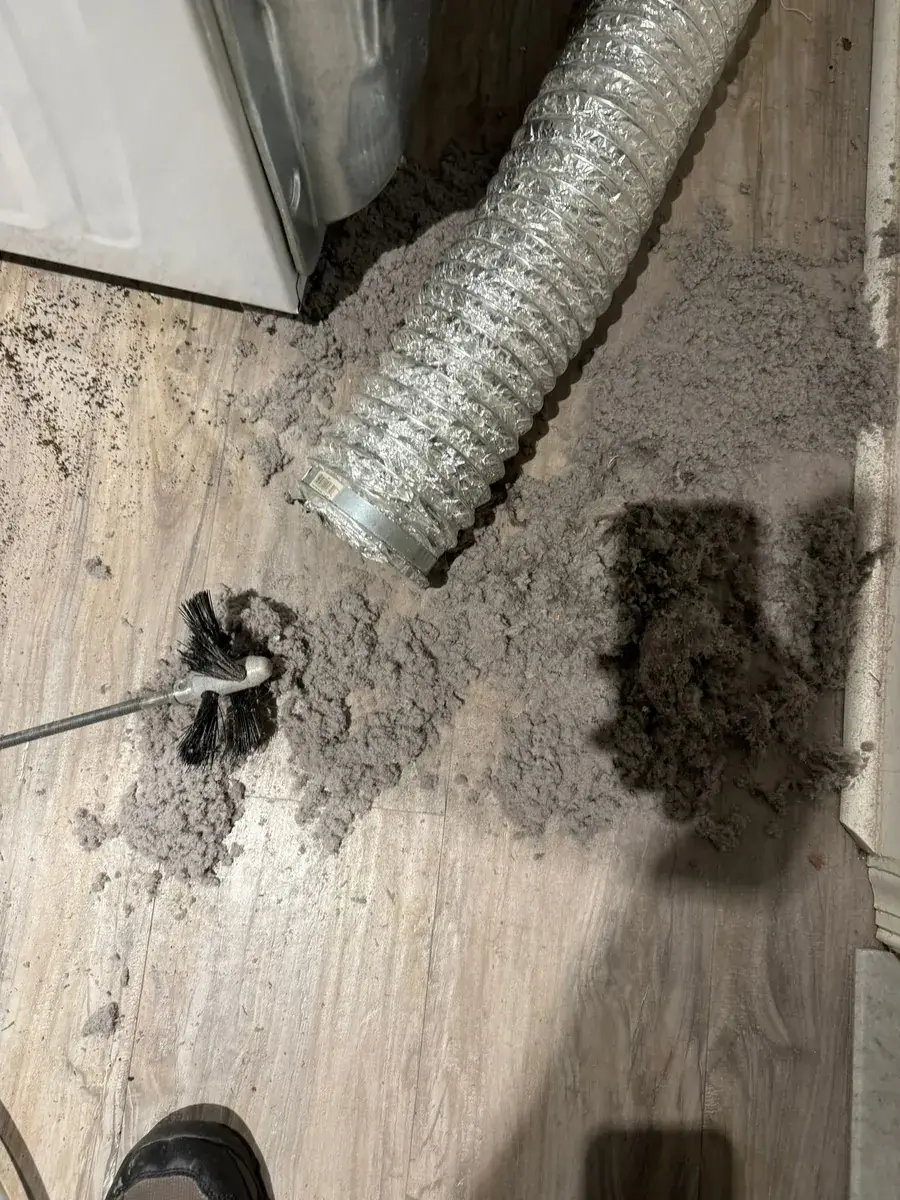
Full-Run Lint Extraction — the Entire Line, Both Ends Verified
A real dryer vent cleaning treats the duct as one continuous system, from the connection behind the machine to the open air outside. We start with a free inspection of the run so you see its actual condition before deciding anything. Then the dryer comes away from the wall and the transition hose — the short flexible section between the machine and the wall connection — is disconnected and checked, because this is where some of the heaviest packing hides and where crushed or foil-type hose gets flagged as a hazard rather than reconnected and ignored.
From there, rotary agitation brushes work the full length of the duct while a HEPA-filtered vacuum captures the lint as it breaks free, so nothing gets shoved deeper into the line and nothing blows back into the laundry room. Elbows, vertical climbs, and long horizontal farmhouse runs each get worked until the line is clear end to end. The job finishes at the far end, not the near one: the termination is cleared, the flapper or cap is checked for free movement, matted screens are cleaned or called out, and then we prove the result the only way that means anything — steady, strong airflow at the exit with the dryer running. You get after-photos alongside the before footage. Low masonry exits behind stone foundations, gable terminations, and roof caps on the two-story builds are all normal work for us, done safely with the right equipment rather than skipped because they are inconvenient.
Routine or Deep — the Inspection Decides, and the Quote Comes First
Two very different jobs get sold under the name "dryer vent cleaning," and we scope them honestly as the separate services they are. A routine cleaning fits a vent that has been maintained on a sensible schedule and carries a normal year or two of lint — quick, tidy, preventive. A deep cleaning is a genuinely bigger job: a line untouched for many years, damp lint hardened into a mat inside a cold basement duct, a blockage such as a nest at the termination, or a crushed and separated section that has been dumping lint into a wall cavity. That work takes more passes, more time, and sometimes partial disassembly of the run. The free inspection determines which service your vent actually needs, and the flat written quote names it before we begin — a routine visit will never quietly "become" something bigger at your door. Here is what every Warwick dryer vent visit includes:
- Free inspection of the entire run, with footage you watch yourself.
- Flat written quote before any work — routine or deep, named on paper first.
- Dryer moved and transition hose checked, with unsafe hose types flagged in writing.
- Rotary brushing under HEPA-filtered vacuum through every foot of duct, elbows included.
- Termination cleared — wall hood, gable, or roof cap — and the flapper checked for free movement.
- Airflow verified at the exit with the dryer running.
- After-photos documenting the finished line, next to the before footage.
A routine visit typically takes about an hour. Long farmhouse runs, roof terminations, and deep cleanings take longer, and the written quote reflects that before anything starts. If we find a nest, removal goes into a clearly quoted scope and a bird guard can be installed so the opening is not re-occupied next spring. And if the inspection turns up something that is not a cleaning problem at all — a run built from the wrong material, a disconnected section exhausting into a crawlspace — you get it documented with photos whether or not the repair ever becomes our work.
No Trip Fees Up Route 23 — and Guarantees That Are Actually in Writing
Homeowners in the north end of the county are used to two moves from service companies: a distance excuse before the visit, or a growing number after the truck arrives. Our process is built so neither can happen. The inspection is free. The quote is flat, written, and approved by you before work begins. The invoice matches the quote. And there is no trip fee or rural surcharge for the drive out Ridge Road — Warwick Township is standard territory for us, the same as any town ten minutes from our shop.
Behind the paperwork stands a real guarantee stack. Bring us a competitor's written quote for the same scope of work and we match it. Every job carries a 6-month workmanship warranty — if a problem traced to our work shows up within six months, we come back and make it right free. And because we are Google Guaranteed, Google adds its own money-back protection of up to $2,000 on qualifying jobs — that program is Google's, administered by Google. We are a PA-licensed contractor (PA 187935) and insured to $2 million, and rather than asking you to take our word for it, the actual license and insurance certificates are viewable on our licensed & insured page.
Scheduling fits rural life: we are open 24 hours a day, Sunday through Friday — closed Saturdays — so a dead-blocked vent or a burning smell does not have to wait for business hours. Wisetack financing is available when a larger job is easier to handle in payments, and pairing the dryer vent with an air duct cleaning on the same visit is the most common way Warwick homeowners book us. Reserve online in a couple of minutes, or call and talk to someone who knows Knauertown from St. Peters without opening a map.
How much does dryer vent cleaning cost?
Routine and deep cleaning are different services — the free inspection determines which one your system actually needs. Prices vary house to house; your exact price comes as a flat written quote before any work begins.
| Dryer vent routine — basement / 1st floor | $129.99 |
| Dryer vent routine — 2nd floor & up | $149.99 |
| Dryer vent deep cleaning | $299.99 |
| Nest removal · bird guard installation | from $250 · from $150 |
Three promises. In writing. On every job.
Price Match Guarantee
Bring a competitor's written quote for the same scope of work — we'll match it. You never overpay for doing it right.
6-Month Warranty
Every job carries a 6-month workmanship warranty. If a problem traced to our work shows up, we come back and make it right — free.
Google Guaranteed
Booked through Google Local Services, qualifying jobs carry Google's own money-back protection up to $2,000, administered by Google.
Backed by a real license and $1M/$2M insurance — see the actual documents
Don't put off air you breathe — finance it with Wisetack
Check your options in about a minute with no impact to your credit score, choose terms that fit your budget, and pay over time instead of all at once.
*All financing is subject to credit approval. Your terms may vary. Wisetack loans are issued by Hatch Bank. See additional terms at wisetack.com/faqs.
4.8 stars from 144 Google reviews — and easy to find
E Cleaning Duct & Vent Cleaning is based at 555 S Goddard Blvd, King of Prussia, and serves Warwick and all of Chester County from right here. Check our Google profile: real jobs, real photos, and a rating our crew protects on every visit.
- Google Guaranteed business — screened, licensed and insured (see the documents)
- Read every review on our Google profile — we don't cherry-pick what you can verify
Dryer Vent Cleaning questions from Warwick homeowners
How often should a dryer vent be cleaned in Warwick Township?
Once a year is the standard recommendation, and Warwick households have particular reasons not to stretch it: heavy winter laundry loads during wood-stove season, damp basement runs behind stone foundations that pack lint faster, and long or roof-terminated runs that hide problems until airflow is nearly gone. Big families, pet owners, and anyone drying work or barn clothes daily may need attention sooner. The free inspection gives you a definitive answer for your specific run — if the line is clear, we tell you so and you pay nothing.
Our mailing address says Elverson or Pottstown — do you still cover us, and is there a trip fee?
Yes, and no fee. Much of Warwick Township carries an Elverson, Pottstown, or Saint Peters mailing address, and none of that affects coverage. The entire township — the villages, the farm properties, and the wooded lots along the Berks County line — is inside our standard Chester County service area. There is no trip fee and no rural surcharge; the flat written quote you approve before work begins is exactly what you pay.
Our farmhouse vent run is long with several elbows. Can it actually be cleaned, or does it need rerouting?
Almost all of them can be cleaned. Long retrofit runs in the old stone houses are routine work for us: rotary brushes work the full length under HEPA vacuum, and each elbow — where lint settles first — gets specific attention. The free inspection maps the run before anything starts. If the layout itself is genuinely a problem, such as a run assembled from the wrong material or one exceeding what the dryer can push, we document it honestly with footage rather than just cleaning and walking away.
Our laundry room is on the second floor and vents through the roof. Do you handle that?
Yes. Roof terminations are common in the newer two-story homes on Warwick's wooded lots, and they are among the most neglected vents we see, because checking them requires a ladder and a steep pitch. The run is brushed along its full length from inside under HEPA vacuum, the roof cap is cleared and checked safely with proper equipment, and airflow is verified at the termination with the dryer running. The written quote covers the whole run, roof included, before we start.
What warning signs should we watch for between cleanings?
Clothes needing a second cycle is the classic one. Also watch for a dryer or laundry room that runs unusually hot, a burning or musty smell during drying, lint gathering around the door seal, and — worth an actual walk around the house on a rural lot — a termination hood that never flaps or shows lint matted on the ground below it. Any one of these justifies a free inspection; federal fire data makes failure to clean the leading factor in dryer fires, so the signs are more than an efficiency issue.
Is the shiny foil hose behind our dryer a problem?
Often, yes. Thin foil accordion-style hose crushes easily behind the machine, sags between supports, and traps lint in every ridge — and in many older Warwick homes it was installed decades ago and never revisited. During every visit we disconnect and inspect the transition hose, flag unsafe types in writing, and recommend the right replacement. It is one of the cheapest fixes in the whole fire-safety picture, and one of the most commonly needed ones we find in retrofit laundry setups.
Ready for honest dryer vent cleaning in Warwick?
Free video inspection, a flat written quote before any work, and real before/after proof — call (484) 367-5944 or book online now.
