
Dryer Vent Cleaning in West Brandywine, PA
E Cleaning cleans dryer vents across West Brandywine Township — basement hookups in the ranches off Route 82, second-floor laundry rooms in the newer colonials, and retrofitted farmhouse setups along the Horseshoe Pike corridor. Every visit starts with a free video inspection of the full vent run and a flat written quote before any work begins. Licensed PA contractor #187935, insured to $2 million, rated 4.8 stars across 144 Google reviews, and never a trip fee.
The quietest fire risk in a spread-out township
West Brandywine Township covers a stretch of open, rolling countryside in north-central Chester County, directly north of Coatesville, with PA Route 82 running up its spine and the Horseshoe Pike — US 322 — crossing its northern reaches on the way to Honey Brook. Wallace Township sits to the northeast, East Brandywine to the east, Caln to the south, and West Caln to the west, and the West Branch of the Brandywine gives the township both its name and its wooded creek corridor. There is no borough center here: homes stand on subdivision streets carved out of former farmland, on wooded acre lots, and at the ends of long private lanes, most of them carrying a Coatesville mailing address even though the city itself is a township away.
That spread-out character is the reason we treat dryer vent cleaning in West Brandywine as fire prevention first and appliance maintenance second. Lint is famously flammable — campers carry it as fire starter — and a clogged vent traps the dryer's heat exactly where the lint sits. In a dense borough, a fire company may be around the corner; in a township of field roads and long driveways, help has genuine distance to cover. Nobody should be counting on response time as a safety plan. The honest plan is a vent that cannot start the fire in the first place.
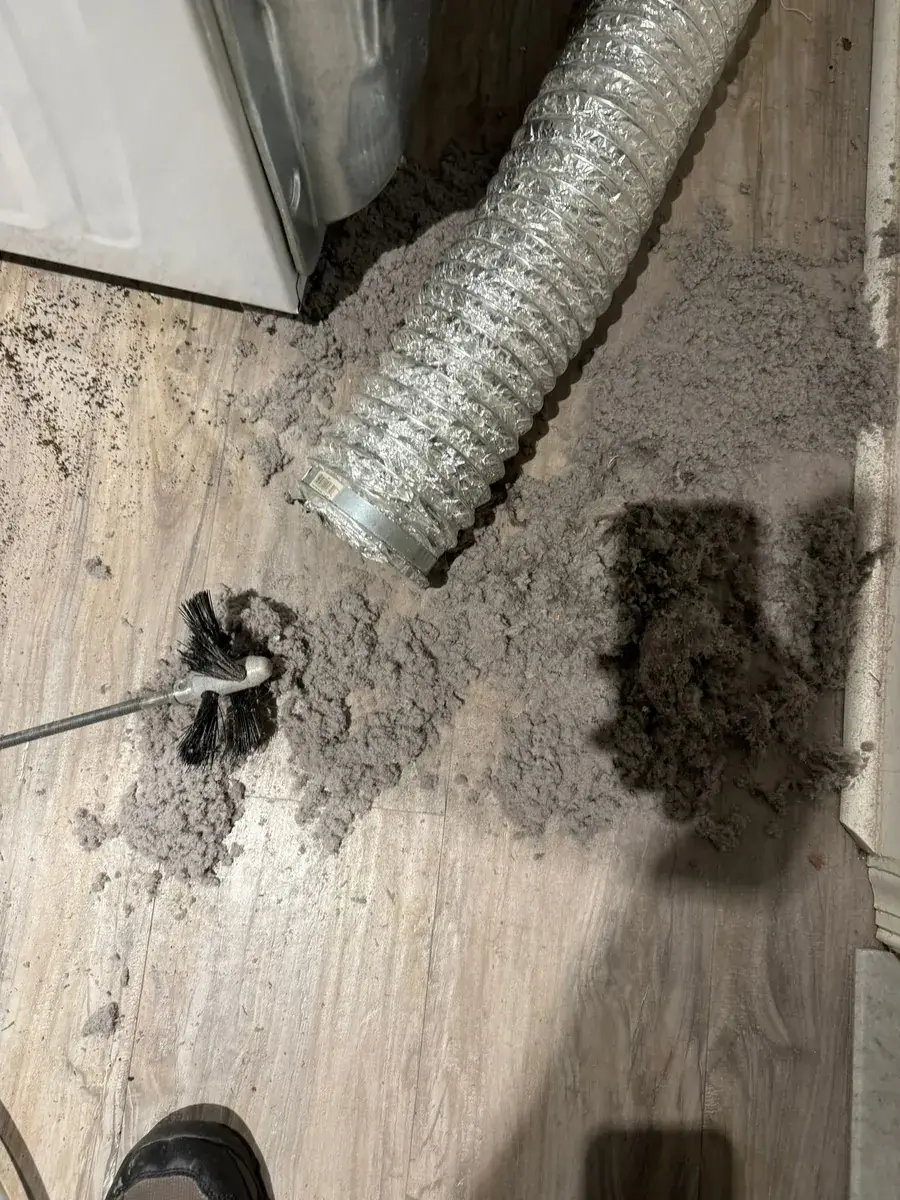
The mechanism is simple and slow. Every load pushes hot, moist air and a fine mist of lint through the duct. A little sticks at every elbow and every rough joint; airflow drops a little more each month; drying times stretch; the machine runs hotter and longer to do the same work. By the time a homeowner notices towels taking two cycles, the duct is often carrying years of packed lint between the laundry room and the outside wall — fuel, stored in the one place in the house designed to concentrate heat.
Basement hookups, upstairs laundry rooms, and farmhouse retrofits: three very different vent runs
Ask where the dryer lives, and you can nearly guess the age of a West Brandywine house. The township grew in waves — farmhouse decades, ranch decades, colonial decades — and each wave put the laundry somewhere different. Because the vent run follows the laundry, each wave also left behind a different cleaning job.
The ranches and split-levels from the township's first suburban wave, roughly the 1960s through the 1980s, almost always keep the laundry in the basement. The vent run there is short and simple on paper: a few feet through the rim joist, exiting low on the exterior wall. In practice, low terminations have their own troubles. Ground-level hoods get buried under mulch beds and drifted snow, screened behind shrubs that have had forty years to grow, and gummed shut by lint until the flapper no longer closes — an open door for mice and nesting birds. Short runs also get ignored precisely because they are short; the transition hose behind the dryer and the hood outside still pack with lint on the same schedule as any other vent.
The two-story colonials of the 1990s and 2000s subdivisions moved the laundry upstairs, next to the bedrooms it serves. Convenient for the household, demanding for the vent: the duct now drops through wall cavities, crosses joist bays, turns through multiple elbows, and often terminates high on a gable or through the roof. Every added foot and every added elbow is another place lint stops. Roof caps mat over with lint and weather, and no homeowner is checking them from the lawn. These long, concealed runs are the ones we most often find loaded to the point of real restriction — and they are exactly what full-run extraction equipment exists for.
The farmhouses along Route 82 and the back roads had laundry retrofitted into a mudroom, a pantry corner, or a stone-walled basement long after the house was built. Retrofit vent paths are improvised by definition: long horizontal runs, older foil flex duct, odd terminations drilled through thick stone. We put a camera through before we promise anything, because in a retrofit the run is never quite where you assume it is.
Nesting birds, field edges, and the seasonal rhythm of rural laundry
An exterior dryer vent in open country is prime real estate. The warm, sheltered cavity behind a broken or lint-propped flapper looks like a ready-made nest box to birds coming off the fields and the wooded corridor along the West Branch, and every spring we pull nesting material out of terminations across rural Chester County. A nest does not just restrict airflow — it can block the run outright, pushing heat and moisture back toward the machine. When the camera finds one, we remove it as part of the job, and we can install a proper bird guard so the same tenant does not move back in.
Laundry in the township also runs on a rural calendar. Summer households line-dry more; from the first cold snap through late spring, the dryer carries everything — and the loads themselves are heavier here. Barn coats and work clothes, kids' sports gear from fall through spring, dog towels and boot-room laundry from long muddy winters on township roads: heavy fabric sheds more lint per load than anything else in the house. A vent that got by on light summer duty meets its real test in January, which is precisely when a blocked ground-level termination is also most likely to be hidden under snow.
We clean dryer vents across the whole township — the subdivision streets down near the Caln line, the wooded lots along the West Branch, and the farm lanes up toward the Brandamore crossroads and the Horseshoe Pike. The same crew works the neighboring townships on the same routes: see dryer vent cleaning in East Brandywine, Honey Brook, and West Caln, or the full Chester County service area. And since the truck is already in your driveway, it is worth knowing what your HVAC ductwork looks like inside too — see air duct cleaning in West Brandywine.
Full-run lint extraction: what a real dryer vent cleaning covers
A real dryer vent cleaning covers the entire run — from the connection behind the dryer to the termination outside — with the lint mechanically removed, not pushed deeper. Anything less is a wipe-down. Our method is built around that full run, and around showing you evidence instead of asking you to take our word for it.
The visit starts with a free video inspection. We scope the run, measure its length and count its turns, check the transition hose behind the machine and the termination outside, and show you exactly what the duct is carrying. Then you get one flat quote in writing before any tool comes out. Whether your run is six feet through a rim joist or a long climb from a second-floor laundry room to a roof cap, the number is set before we start and does not move mid-job — not for ladder work, not for extra elbows, not for anything the camera already showed us.
The cleaning itself is full-run lint extraction: a rotary agitation brush is driven through the entire length of the duct, joint by joint and elbow by elbow, while a high-powered vacuum captures the loosened lint so it leaves your house instead of resettling. We clean the transition hose behind the dryer — or tell you plainly if it is a plastic or foil type that ought to be replaced rather than cleaned — clear the exterior hood or roof cap, confirm the flapper moves freely, and verify strong airflow at the termination before we call the job done. You get after-photos to hold against the inspection footage.
Included on every dryer vent job
- Video inspection of the full vent run before you are quoted.
- One flat written quote — set before work begins, never revised on a doorstep.
- Transition hose behind the dryer cleaned, or honestly flagged for replacement.
- Rotary-brush extraction from the drum connection to the outside termination.
- Exterior hood or roof cap cleared and the flapper checked.
- Airflow verified at the termination, with after-photos provided.
- 6-month workmanship warranty on the work.
Routine or deep? The camera decides — not a sales script
A routine cleaning is maintenance: a vent serviced on a regular rhythm gets a full-run extraction and goes back to breathing freely. A deep cleaning is a different job — years of packed lint, a nest in the termination, a crushed section behind the dryer, or a joint that has pulled apart inside a wall calls for more time, more access, and sometimes repair. Those are genuinely different services, and we scope them honestly in both directions: we will not sell a deep-cleaning scope to a vent that only needs its regular service, and we will not run a quick brush through a duct the camera shows is packed solid and call it clean.
The camera is also how the serious problems get caught. A duct joint that has separated inside a joist bay quietly dumps warm, moist lint into the framing — a moisture problem and a fire load at once, and common in the township's long concealed second-floor runs. A crushed flex section behind the dryer chokes airflow no matter how clean the rest of the run is. An aging plastic or foil transition hose is a known hazard we flag every time we see one. And a nest means removal plus, if you want it, a bird guard so the vent stays clear next spring. None of that gets discovered by an outfit that quotes a teaser price over the phone and never looks inside the duct.
That honesty is backed by real commitments. If a competitor hands you a written quote for the same scope of work, our Price Match Guarantee means we match it. Any problem traced to our work within six months is corrected free under the workmanship warranty. And qualifying jobs booked through Google carry Google's own Google Guaranteed money-back protection up to $2,000 — Google's program, administered by Google.
A family company on West Brandywine's side of the county
E Cleaning is a family-owned duct and vent company, founded in 2016 and based in King of Prussia. West Brandywine is part of our regular Chester County route — up Route 82, across the Horseshoe Pike, and down the township roads between — and there is never a trip fee to reach you. We are a licensed PA contractor (PA 187935) insured up to $2 million, Google Guaranteed, and rated 4.8 stars across 144 Google reviews. Financing is available through Wisetack, and we answer the phone 24 hours a day, Sunday through Friday — closed Saturdays — because a dryer that suddenly will not dry, or a burning smell in the laundry room, does not wait for business hours.
If your dryer is taking two cycles, the laundry room feels humid when the machine runs, the outside flapper never seems to move, or you simply cannot remember the last cleaning, the next step takes two minutes.
How much does dryer vent cleaning cost?
Routine and deep cleaning are different services — the free inspection determines which one your system actually needs. Prices vary house to house; your exact price comes as a flat written quote before any work begins.
| Dryer vent routine — basement / 1st floor | $129.99 |
| Dryer vent routine — 2nd floor & up | $149.99 |
| Dryer vent deep cleaning | $299.99 |
| Nest removal · bird guard installation | from $250 · from $150 |
Three promises. In writing. On every job.
Price Match Guarantee
Bring a competitor's written quote for the same scope of work — we'll match it. You never overpay for doing it right.
6-Month Warranty
Every job carries a 6-month workmanship warranty. If a problem traced to our work shows up, we come back and make it right — free.
Google Guaranteed
Booked through Google Local Services, qualifying jobs carry Google's own money-back protection up to $2,000, administered by Google.
Backed by a real license and $1M/$2M insurance — see the actual documents
Don't put off air you breathe — finance it with Wisetack
Check your options in about a minute with no impact to your credit score, choose terms that fit your budget, and pay over time instead of all at once.
*All financing is subject to credit approval. Your terms may vary. Wisetack loans are issued by Hatch Bank. See additional terms at wisetack.com/faqs.
4.8 stars from 144 Google reviews — and easy to find
E Cleaning Duct & Vent Cleaning is based at 555 S Goddard Blvd, King of Prussia, and serves West Brandywine and all of Chester County from right here. Check our Google profile: real jobs, real photos, and a rating our crew protects on every visit.
- Google Guaranteed business — screened, licensed and insured (see the documents)
- Read every review on our Google profile — we don't cherry-pick what you can verify
Dryer Vent Cleaning questions from West Brandywine homeowners
Do you charge a trip fee to come out to West Brandywine?
No. West Brandywine Township sits on our regular Chester County route, and there are no trip fees or travel charges anywhere we serve. A home off Route 82, a lane up near the Brandamore crossroads, and a subdivision street near the Caln line all get the same free video inspection and the same flat written quote before any work begins.
Our laundry room is on the second floor. Does that change the cleaning?
It changes the run, not the process. Second-floor laundry rooms — standard in the township's 1990s–2000s colonials — usually vent through a long concealed run with several elbows, terminating at a gable or roof cap. Full-run extraction cleans the entire length, and any ladder or roof-cap work is built into the flat written quote up front, not added at the door.
Something is nesting in our exterior dryer vent. Can you handle that?
Yes. Nests are common in rural townships like West Brandywine, especially in spring near field edges and the creek corridor. We remove the nesting material, run the camera to confirm the duct is clear end to end, and can install a bird guard so it does not happen again. If the vent is blocked outright, stop running the dryer until the run is cleared — a fully blocked vent sends heat straight back at the machine.
How often should a West Brandywine household clean its dryer vent?
Once a year is the right rhythm for most homes. Big households running daily loads, long second-floor-to-roof runs, pets, and older foil flex duct all argue for staying on the annual schedule strictly; a short, well-kept basement run can sometimes stretch a little longer. The free video inspection settles it honestly — if the camera shows your run is still clean, we tell you that and leave.
How long does a dryer vent cleaning take?
Most routine cleanings take about 45 to 90 minutes. Long roof-terminated runs, nest removals, and deep cleanings on vents that have gone years without service take longer because there is simply more lint and more access work. The written quote you approve after the free inspection includes a realistic time estimate for your specific run.
We have an electric dryer — is a clogged vent still a risk?
Yes. Lint ignites from trapped heat regardless of fuel, so the fire risk applies to electric and gas dryers alike. Gas models add a second concern, since the vent also carries combustion exhaust that should never back up into the house. Many West Brandywine homes run electric or propane dryers because gas mains never reached much of the township — the cleaning schedule is the same either way.
Ready for honest dryer vent cleaning in West Brandywine?
Free video inspection, a flat written quote before any work, and real before/after proof — call (484) 367-5944 or book online now.
