
Dryer Vent Cleaning in Whitemarsh, PA
E Cleaning cleans dryer vents across Whitemarsh Township — from basement hookups in Lafayette Hill's postwar homes to roof-terminated runs in newer townhomes — removing the lint that slows your dryer and feeds vent fires. Every job starts with a free inspection and a flat written quote before any work begins, from a family-owned company that is PA-licensed (PA 187935), insured to $2 million, and rated 4.8 stars across 144 Google reviews.
Where Whitemarsh does its laundry — and why the vent run is the whole story
In dryer vent cleaning, the machine matters less than the run: how far the vent travels, how many turns it makes, and where it exits the house. Whitemarsh Township's housing runs from pike-village stone homes to new townhome rows, so the vent runs we clean here vary as much as anywhere in Montgomery County — and each setup fails in its own way.
In the township's older housing — the stone and stucco homes around Barren Hill and Cold Point and along Germantown and Butler pikes — the laundry almost always lives in the basement. The vent typically climbs out of the machine, turns, and travels a long horizontal stretch through the joists before exiting through a rim joist or foundation wall. Every elbow in that run is a lint trap: airflow slows at each turn, lint falls out of the airstream, and the blockage builds outward from the bends. Long basement runs are the ones we most often find half-closed at the midpoint — the part of the duct no homeowner can see or reach.
Lafayette Hill's ranches and split-levels from the 1950s through the '70s usually have shorter, simpler wall exits — but the ducting is often original, and the transition hose behind the dryer is frequently the old white vinyl or thin foil type that manufacturers and fire officials have warned against for years. Those hoses kink behind the machine, sag, and collect lint in every low spot. We inspect the transition hose on every job and flag replacement in your written quote if yours has aged out.
The newer construction toward the Plymouth Meeting and Fort Washington edges of the township — and the townhome and carriage-home communities that have filled in over recent decades — flips the picture entirely. The laundry moves upstairs, and the vent goes up instead of out: a vertical run inside the wall to a roof termination. Vertical runs fight gravity, so lint that would ride the airflow out of a short horizontal run instead falls back and packs the duct. Roof caps clog with lint too, and they are almost never checked, because checking one means getting on the roof. We bring the ladder.
Attached housing raises the stakes further. In a townhome row, a dryer fire is not just your emergency — it is your neighbor's. And winter is when Whitemarsh dryers work hardest: comforters, extra layers, sports laundry, and cold stretches that keep everything indoors. The best time to have the vent cleaned is before that season leans on it.
The lay of the land in Whitemarsh — and what it means for your vent
Whitemarsh Township sits in southeastern Montgomery County, wrapped along the Schuylkill River and threaded by the old pike villages that grew up on Germantown, Ridge, and Butler pikes. It is a township, not a tight borough grid — homes here are spread out and set back, which usually means longer, less direct vent runs than a dense city block, and laundries tucked into basements or dedicated rooms rather than the stacked closets of an apartment.
The land climbs from the river up into rolling ground toward Fort Washington and the Wissahickon valley. Along the water at Miquon and Spring Mill, the older riverside homes sit low and close to the Schuylkill, where damp basement air is a fact of life — and moisture matters for a vent. Humid air makes lint pack heavier and cling to the duct walls instead of riding out with the airflow, and over time it speeds corrosion at metal joints and at the exterior hood. Up on the higher, drier ground around Cold Point, Barren Hill, and the Lafayette Hill streets, the homes are older and the vent lines are often the originals the house was built with — thin, dented, and overdue.
Location is also how we keep the no-trip-fee promise. Whitemarsh sits just a few turnpike exits from our King of Prussia shop, with Plymouth Meeting, Conshohocken, and the Blue Route (I-476) all close by. We cover the whole township at one flat, written price — the pike villages, the riverside pockets at Miquon and Spring Mill, the mid-century streets of Lafayette Hill, and the newer townhome and carriage-home rows filling in toward the Plymouth Meeting and Fort Washington edges.
The fire-safety math on a clogged dryer vent
Lint is one of the most flammable materials in your house, and a clogged vent parks it directly against a heat source while forcing the dryer to run hotter and longer. That combination is exactly how dryer fires start — and the national numbers show how often it happens.
Warning signs your Whitemarsh dryer vent is closing up
- Loads need a second cycle to dry completely
- The top of the dryer — or the whole laundry room — feels hot mid-cycle
- A faint burning smell while the dryer runs
- The laundry room turns humid during a load
- Lint collecting behind or under the machine
- The exterior flap barely moves while the dryer is running
- Little or no lint on the lint screen — it is going into the duct instead
- Airflow or vent-blockage error codes on newer machines
Any one of these is worth a look; two or more mean the vent is restricting airflow right now. And restriction does not just raise fire risk — it stretches every load, wears out the heating element early, and wastes energy on every cycle. If you cannot remember the last time the vent was cleaned, that is a sign in itself.
What a full-run dryer vent cleaning from E Cleaning covers
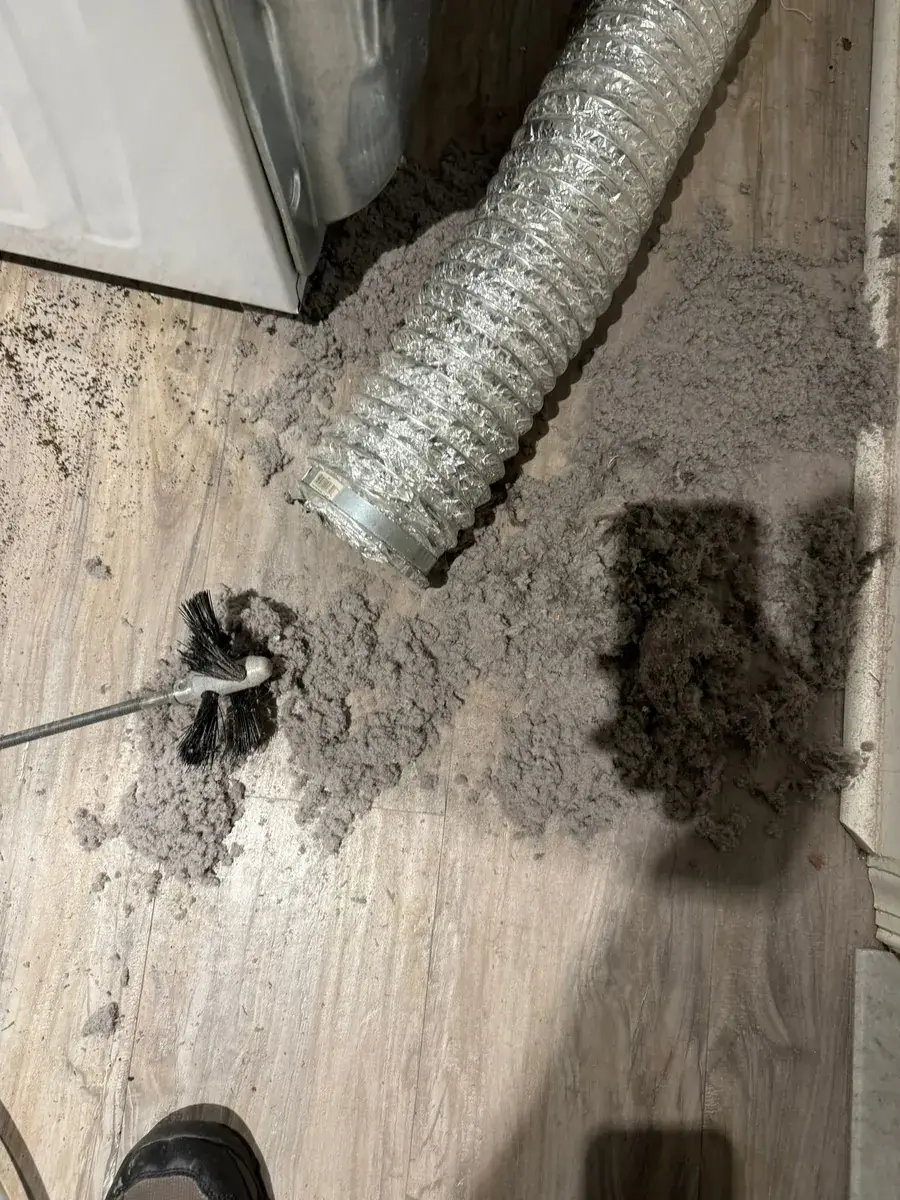
We clean the entire run — from the connection at the back of the dryer to the termination on the wall or roof — not just the few feet a homeowner can reach. Rotary brushes sized to your duct scrub the vent walls while HEPA-filtered vacuum extraction captures the lint, so it ends up in our equipment rather than scattered around your laundry room.
Inspection first, quote in writing, then the work
Before anything is quoted, we inspect the run and show you what we find — including the parts you cannot see, like the mid-run and the exterior termination. You get a flat written quote before any work begins. If the vent turns out to be clear, we say so and you owe nothing for the look.
A full cleaning covers the transition hose behind the dryer, inspected and flagged for replacement in the quote if it is vinyl, crushed, or worn; the complete duct run including every elbow; and the exterior hood or roof cap, cleared of lint with its flap or screen checked so it closes properly against weather and pests. When we find a bird's nest in an exterior hood — a common spring discovery — we remove it and talk through guard options so it does not come back. We verify airflow at the termination before and after the cleaning, and you get after-photos of the finished run.
Roof-terminated vents, common in the township's newer townhomes, take extra equipment and care — and we scope them plainly in the written quote rather than springing a surcharge at the door.
How often should this happen? For most Whitemarsh homes, once a year. Households with long or vertical runs, roof terminations, big families, or pets shedding into every load should consider every six to nine months. A short, straight run in a light-use home can sometimes stretch longer. The inspection tells us which case is yours, and we will give you an honest interval rather than an automatic upsell.
Routine or deep? The inspection decides — not a script
A vent cleaned within the last year or two usually needs a routine full-run cleaning: brush the duct end to end, extract the lint under HEPA-filtered vacuum, clear the hood, and confirm the airflow came back. A vent that has gone many years — or has never been cleaned — is a genuinely different job, and we scope it honestly instead of forcing every home into one number.
The difference is what is packed inside the run. Years of neglect cake the duct walls with dense, felted lint that a single brush pass will not release, and long or vertical runs can pack nearly solid at the elbows and behind the roof cap. A deep cleaning means more agitation, more time, and sometimes opening the run in sections to reach a stubborn blockage or a bird's nest — genuinely more work, quoted as its own service rather than hidden inside a routine price. The free inspection is what decides which one your vent needs, and we show you the evidence before we quote a price.
What the free inspection actually checks
- Airflow strength at the exterior hood or roof cap — the clearest early tell of a blockage
- The condition of the transition hose behind the dryer
- How deep the lint sits along the run and at each elbow
- Whether the termination flap or screen opens and closes freely
- Any sign of nesting, moisture, or a crushed or disconnected section of duct
Most routine cleanings wrap up in under an hour; a long roof run or a true deep clean takes longer, and we tell you which yours is before we start rather than after. Timing helps too — dryers work hardest through Whitemarsh's cold months, when everything dries indoors, and exterior hoods draw nesting birds in spring, so late summer and early fall are the easiest windows to get ahead of both.
No trip fees, no surprises — anywhere in Whitemarsh
Our crews are based in King of Prussia, minutes from Whitemarsh by the turnpike or Ridge Pike, and we do not charge trip fees — not to Miquon, not to Spring Mill, not to the far end of Lafayette Hill. The flat price you approve in writing after the free inspection is the price you pay.
Every job is backed by our guarantee stack: a 6-month workmanship warranty — if a problem traced to our work appears within six months, we return and fix it free; a price match if a competitor hands you a written quote for the same scope of work; and, because we are Google Guaranteed, money-back protection up to $2,000 on qualifying jobs. We are a PA-licensed contractor (PA 187935) insured to $2 million — the license and insurance certificates are viewable on our licensed & insured page. Wisetack financing is available if you prefer to pay over time.
Since the furnace and the dryer usually share the same corner of the basement, many homeowners pair this visit with air duct cleaning in Whitemarsh and have both systems handled in one appointment, under one written quote. We also serve the neighboring communities — see our dryer vent pages for Lafayette Hill, Flourtown, and Oreland, or browse the full Montgomery County service area.
We answer around the clock, Sunday through Friday — we're closed Saturdays for urgent blockages.
How much does dryer vent cleaning cost?
Routine and deep cleaning are different services — the free inspection determines which one your system actually needs. Prices vary house to house; your exact price comes as a flat written quote before any work begins.
| Dryer vent routine — basement / 1st floor | $129.99 |
| Dryer vent routine — 2nd floor & up | $149.99 |
| Dryer vent deep cleaning | $299.99 |
| Nest removal · bird guard installation | from $250 · from $150 |
Three promises. In writing. On every job.
Price Match Guarantee
Bring a competitor's written quote for the same scope of work — we'll match it. You never overpay for doing it right.
6-Month Warranty
Every job carries a 6-month workmanship warranty. If a problem traced to our work shows up, we come back and make it right — free.
Google Guaranteed
Booked through Google Local Services, qualifying jobs carry Google's own money-back protection up to $2,000, administered by Google.
Backed by a real license and $1M/$2M insurance — see the actual documents
Don't put off air you breathe — finance it with Wisetack
Check your options in about a minute with no impact to your credit score, choose terms that fit your budget, and pay over time instead of all at once.
*All financing is subject to credit approval. Your terms may vary. Wisetack loans are issued by Hatch Bank. See additional terms at wisetack.com/faqs.
4.8 stars from 144 Google reviews — and easy to find
E Cleaning Duct & Vent Cleaning is based at 555 S Goddard Blvd, King of Prussia, and serves Whitemarsh and all of Montgomery County from right here. Check our Google profile: real jobs, real photos, and a rating our crew protects on every visit.
- Google Guaranteed business — screened, licensed and insured (see the documents)
- Read every review on our Google profile — we don't cherry-pick what you can verify
Dryer Vent Cleaning questions from Whitemarsh homeowners
Do you charge extra to come out to Whitemarsh?
No. We are based in King of Prussia — minutes away by the turnpike or Ridge Pike — and there are no trip fees anywhere in our Montgomery County service area. You get a free inspection and a flat written quote before any work, and that quote is the same whether you are in Whitemarsh or next door to our shop.
My townhome's dryer vents through the roof — can you clean that?
Yes. Roof-terminated vents are common in Whitemarsh's newer townhome communities, and they are exactly the runs that need professional attention: lint falls back down vertical ducts and roof caps clog because nobody checks them. We bring the ladder, clean the full run, and clear the cap — all scoped in your written quote up front.
How often should a dryer vent be cleaned in a Whitemarsh home?
Once a year for most households. If you have a long basement run with several elbows, a vertical run to a roof termination, a big family, or pets, every six to nine months is smarter. Our free inspection tells you where your run actually stands, and we recommend an honest interval — not an automatic upsell.
The hose behind my dryer is the old white vinyl kind — can you replace it?
Yes, and you should replace it. Vinyl and thin-foil transition hoses kink, sag, and collect lint, which is why fire officials have warned against them for years. We inspect the transition hose on every Whitemarsh job, and if it needs replacing, that goes into your flat written quote before any work begins.
A bird built a nest in my exterior dryer vent — is that urgent?
Treat it promptly. A nest blocks airflow almost completely, which pushes the dryer toward overheating, and nesting material is as flammable as lint. We remove nests as part of a full vent cleaning, check the flap, and talk through guard options so it does not happen again. Our line answers 24-hour for urgent blockages.
Can I have my air ducts cleaned in the same visit?
Yes — it is the most common pairing we do in Whitemarsh, since the furnace and the dryer usually sit in the same basement. See air duct cleaning in Whitemarsh for what that service includes; we will scope both jobs together in one written quote.
Ready for honest dryer vent cleaning in Whitemarsh?
Free video inspection, a flat written quote before any work, and real before/after proof — call (484) 367-5944 or book online now.
