
Dryer Vent Cleaning in Willow Grove, PA
E Cleaning cleans dryer vents throughout Willow Grove end to end — from the transition hose behind the dryer to the exterior termination hood — with a free camera inspection first and a flat written quote before any work begins. Clogged vents are the leading factor in home dryer fires, and clearing them is one of the most straightforward fire-prevention jobs in your house. Licensed PA contractor, insured to $2 million, rated 4.8 stars across 144 Google reviews.
Where Willow Grove does laundry — and why it matters for the vent
Willow Grove is a commuter crossroads: the Turnpike's Willow Grove interchange on one side of town, the SEPTA Warminster Line on the other, and Easton Road running through the middle. That means busy households where the dryer runs on weeknights and stacks up loads on weekends. It is an unincorporated community rather than a borough — spread mostly across Upper Moreland Township, with edges in Abington and Upper Dublin — and it is one of the denser residential pockets in eastern Montgomery County. Density is the detail that matters for dryer vents: more attached and closely spaced housing, more retrofitted laundry locations, and more vent runs that were never designed for the appliance now hanging off them.
In the postwar capes and ranches that make up much of Willow Grove's housing, laundry usually lives in the basement. Those are the friendliest vents to own — a short run through the rim joist to a sidewall hood — but they are also the most ignored, because nobody looks at the hookup behind a basement dryer for years at a time. Crushed foil transition hoses, ducts that separated at a joint long ago and have been quietly blowing lint into a joist bay, termination hoods buried behind shrubs: we find all of it.
Split-levels put the laundry on the lower level with vent runs that snake behind finished walls, and the older twins near the Easton Road corridor often had laundry retrofitted wherever it would fit — a first-floor closet, a former pantry, sometimes an upstairs hall closet added during a renovation. Every relocation adds length and elbows, and every elbow slows airflow and gives lint a place to settle; as a rule of thumb, each 90-degree elbow costs about five feet of effective vent length.
The townhome and apartment communities along the Route 611 corridor and near the mall are a different job entirely. Upper-floor laundry closets and stacked units mean long concealed runs to a roof termination or a distant sidewall — the longest, hardest-working dryer vents in town, and the ones that clog fastest. In attached housing there is an extra reason to stay on top of it: a dryer fire in a twin or a townhome row is your neighbors' emergency too.
The laundry load here is also seasonal, the way it is everywhere in southeastern Pennsylvania. Winter means heavier fabrics, longer cycles, and a vent pushing against cold, dense outside air — exactly when a marginal vent tips into a real problem. If your dryer struggled through last winter, the vent is the first thing worth checking.
Willow Grove's housing eras tell you where the lint hides
Willow Grove sits at the eastern edge of Montgomery County, pressed against the Bucks County line — County Line Road is exactly what its name says — with Hatboro, Horsham, Abington, and Upper Dublin as its immediate neighbors and the Easton Road / Old York Road corridor (Route 611) running through it. The community grew in waves across the twentieth century, and you can nearly date a house here by where its laundry sits and how far the exhaust has to travel to reach daylight.
The older twins and homes near the Old York Road corridor tend to keep laundry in an unfinished basement or in a spot it was retrofitted into decades later. Their vents are often punched straight through a masonry foundation or a band joist — short runs, but through thick material, and almost always the most neglected in town, because nobody thinks about a duct they cannot see behind a basement dryer. The postwar capes and ranches that fill so much of Willow Grove share that basement-laundry geometry: a friendly, short sidewall run that has quietly gone years, sometimes decades, without anyone looking inside it.
Split-levels change the picture. Their laundry usually lands on the lower or intermediate level, and the vent has to turn through interior walls before it finds an outside surface — more elbows, more distance, more places for lint to settle and stay. Every one of those ninety-degree turns costs roughly five feet of effective airflow, so a run that looks short on paper can behave like a long one and clog like one too.
The townhome and condominium developments and the apartment communities toward the Route 611 corridor, the mall, and the Turnpike interchange are the extreme case. Stacked and upper-floor laundry closets vent through long vertical chases to a roof cap or a high sidewall, and those are the hardest-working, fastest-clogging dryer vents in Willow Grove. The further, higher, and more elbowed the run, the less a homeowner's shop vac at the hood can reach — no vac clears a twenty-five-foot concealed duct with three turns in it, which is exactly the kind of run a professional brush-and-vacuum system is built for.
Dryer fires are preventable — and the numbers are not small
The case for cleaning is not theoretical. Lint is fuel: it is dry, fine, and packed into a duct that sits inches from a heating element running at several hundred degrees. When airflow drops, heat builds, and the material lining the vent is the most flammable thing in the room.
The U.S. Fire Administration (FEMA) estimates 2,900 home clothes dryer fires are reported each year. Most of them announce themselves in advance, if you know the warning signs:
- Clothes need a second cycle to dry, especially towels and jeans
- The dryer top or the laundry room is noticeably hot during a cycle
- A burning or hot-lint smell while the dryer runs
- Little or no airflow at the exterior hood, or a flapper that barely opens
- Lint collecting behind or around the dryer
- The dryer shuts itself off mid-cycle on a thermal limit
Why does lint end up in the vent at all when the dryer has a lint screen? Because the screen catches most of what a load sheds, but never all of it. A steady fraction of fine fiber rides the exhaust stream past the screen on every cycle, and it condenses wherever the air slows down — at elbows, at sagging spots in flexible duct, at the exterior flapper, and anywhere moisture lingers in the run. That is why even a diligently emptied lint screen does nothing to stop the duct itself from narrowing year after year. It is a slow process, which is exactly what makes it easy to miss: the dryer that takes eighty minutes today took forty when it was new, and nobody noticed the change happening one load at a time.
A clogged vent also costs you before it ever burns anything: cycles run longer, the heating element works harder and fails sooner, and every load uses more energy than it should. If your dryer is gas, a blocked vent has one more failure mode — combustion exhaust that cannot leave the house the way it was designed to. Modern dryers and detectors give you layers of protection, but a clear vent is the layer that takes the least effort and does the most work.
What does a complete dryer vent cleaning include?
The honest way to describe the service is as a path, because that is how we clean it — the entire route your dryer's exhaust travels, not just the piece that is easy to reach. It starts behind the dryer at the transition hose, continues through the wall connection and the concealed duct run, and ends at the termination hood outside. Lint can choke that path at any point, and a cleaning that skips a segment did not finish the job.
Before anything else, a technician inspects the run with a camera and shows you what is inside — the same free video inspection we do on air ducts. You then get a flat written quote before work begins, scoped to what your vent actually needs: an annual maintenance cleaning of a well-kept vent is a different job from a first-time clearing of a run that has never been serviced, and we tell you plainly which one you are looking at.
Two honest categories cover nearly every vent. A routine cleaning maintains a run that has been serviced in the last year or two and is still moving air — we clear the season's buildup, check the hardware, and you are set for another year. A deep cleaning is for a vent that has never been professionally cleaned, has gone many years between visits, or is packed hard enough that airflow has collapsed; it takes longer, sometimes means working the duct from both ends, and now and then turns up a bird nest or a joint that pulled apart inside a wall. The camera settles the question — it shows you the same thing it shows us, so the written quote reflects the real condition of your vent instead of a guess.
- How far lint has narrowed the duct, and exactly where the tightest point sits
- Separated or disconnected joints leaking lint into a wall cavity or joist bay
- A crushed, kinked, or accordion-style transition hose behind the dryer
- Bird nests or debris packed into the exterior termination hood
- Moisture staining that points to a sag or low spot holding water in the run
- Whether the vent is genuinely clogged or simply due for routine upkeep
The cleaning combines rotary brushes sized to your duct with vacuum extraction, working the full length of the run so lint is captured rather than pushed deeper. We disconnect and clean the transition hose, clear the wall connection, brush out the concealed run, and open up the exterior hood — where we regularly remove bird nests, since a warm vent hood is prime real estate every spring. We confirm the flapper closes properly, verify airflow at the hood with the dryer running before we leave, and photograph the finished work.
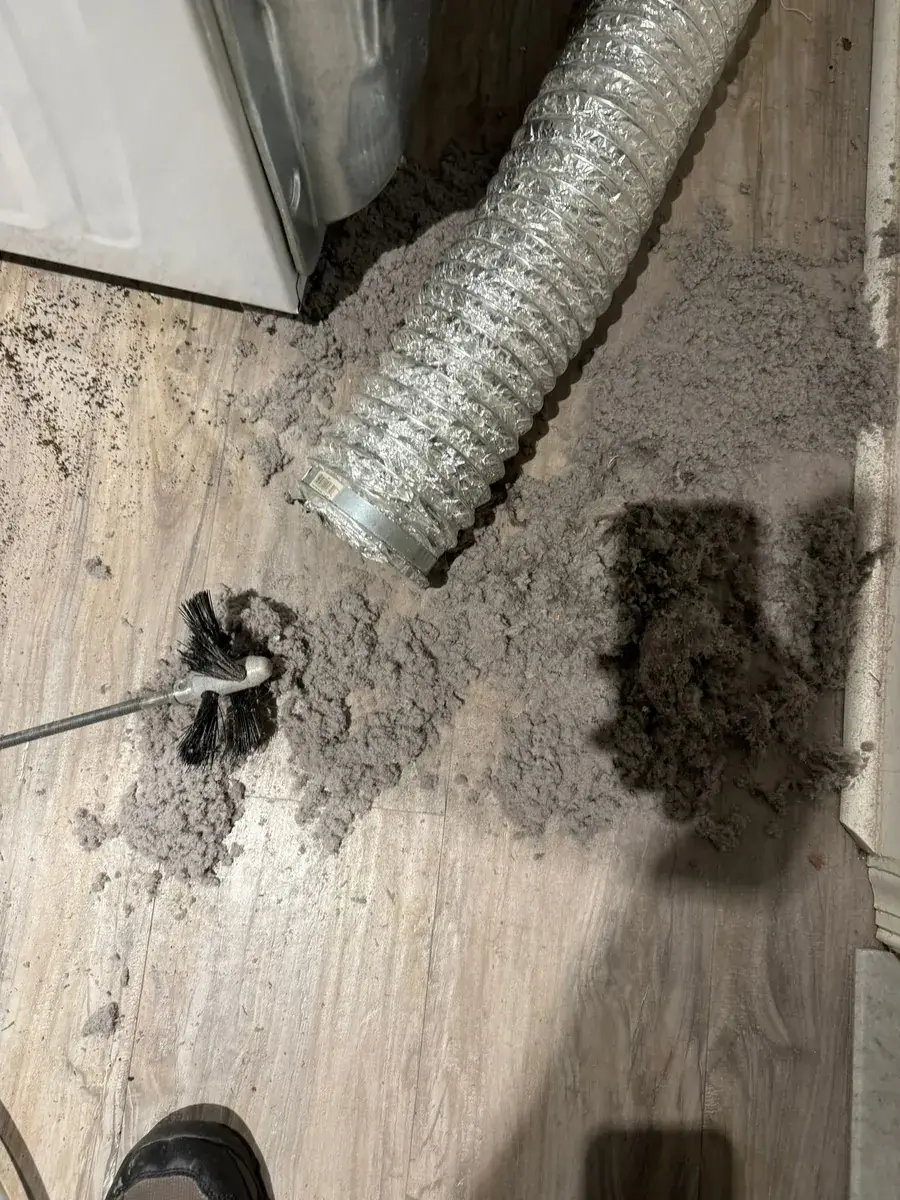
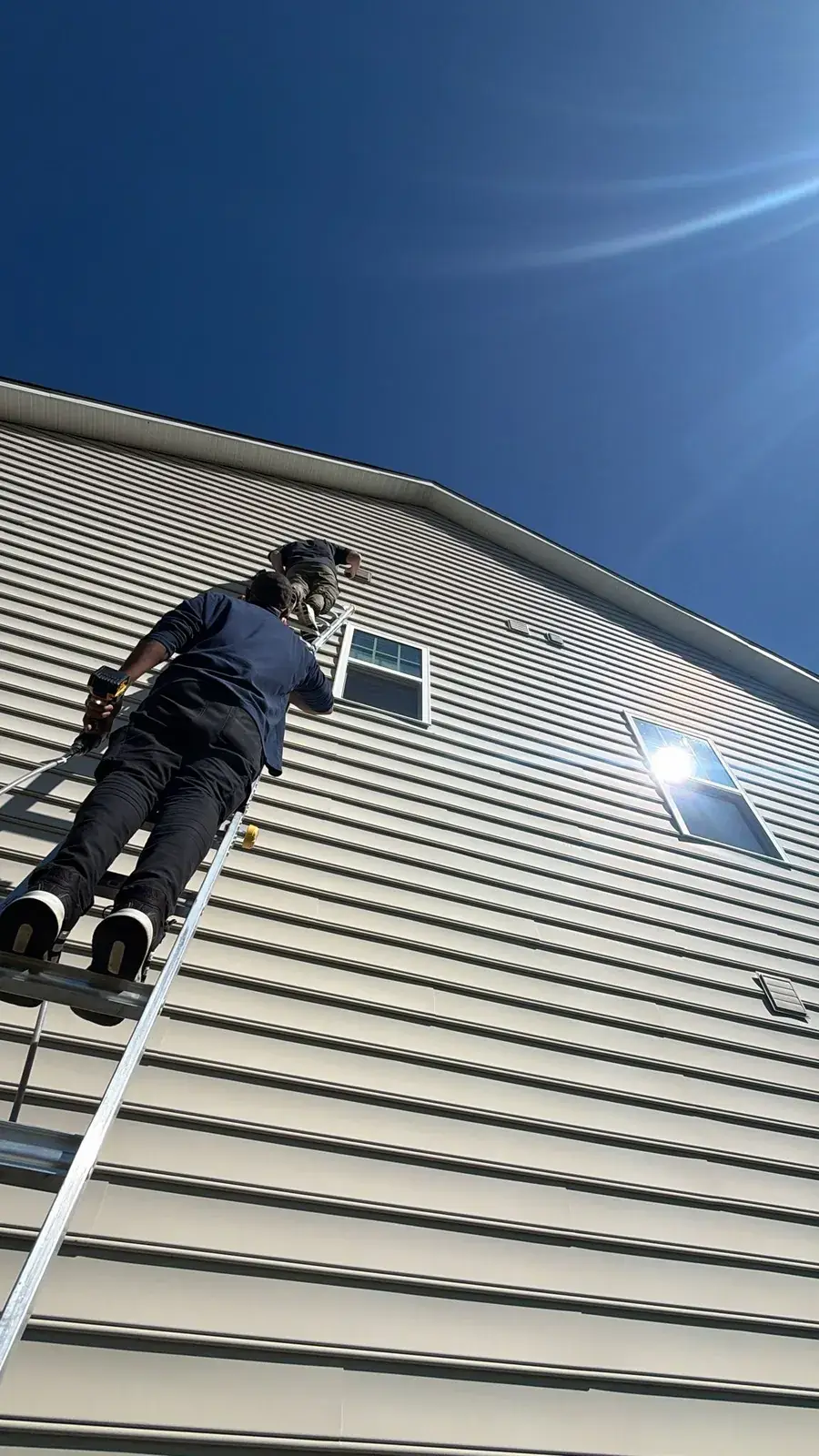
Roof-terminated vents — common in Willow Grove's townhomes and stacked units — are within scope, ladder work included. And if we find a vinyl or foil accordion hose behind your dryer, we flag it in the written quote: those hoses trap lint in every ridge and are the weak link in the whole system. Semi-rigid or rigid metal is the safe replacement.
For most households, once a year is the right rhythm. Long runs, upper-floor laundry, large families, and pet-heavy homes push that to every six to nine months, while a short basement run in a two-person home can sometimes stretch longer. The camera does not lie — if your vent is clean, we will say so and see you next year.
No trip fees, no games — a flat quote before we touch anything
E Cleaning is based in King of Prussia, about twenty-five minutes from Willow Grove, and there is no trip fee to come here — or anywhere else we serve. The quote you approve is flat and written, produced after the free inspection and before any work, and it is the number that appears on your invoice.
Every job is backed by our full guarantee stack: a Price Match Guarantee if you bring a competitor's written quote for the same scope, a 6-month workmanship warranty on every job, and Google Guaranteed protection up to $2,000 on qualifying jobs. We are a PA licensed contractor (PA 187935) insured to $2 million, and the documents are viewable at /licensed-insured/.
Most Willow Grove customers book dryer vent cleaning either as an annual standalone visit or together with air duct cleaning while the equipment is already on site. We cover the surrounding towns daily as well — Upper Moreland, Glenside, and Upper Dublin — as part of our Montgomery County service area.
We answer the phone around the clock, Sunday through Friday — we're closed Saturdays, and financing is available through Wisetack.
How much does dryer vent cleaning cost?
Routine and deep cleaning are different services — the free inspection determines which one your system actually needs. Prices vary house to house; your exact price comes as a flat written quote before any work begins.
| Dryer vent routine — basement / 1st floor | $129.99 |
| Dryer vent routine — 2nd floor & up | $149.99 |
| Dryer vent deep cleaning | $299.99 |
| Nest removal · bird guard installation | from $250 · from $150 |
Three promises. In writing. On every job.
Price Match Guarantee
Bring a competitor's written quote for the same scope of work — we'll match it. You never overpay for doing it right.
6-Month Warranty
Every job carries a 6-month workmanship warranty. If a problem traced to our work shows up, we come back and make it right — free.
Google Guaranteed
Booked through Google Local Services, qualifying jobs carry Google's own money-back protection up to $2,000, administered by Google.
Backed by a real license and $1M/$2M insurance — see the actual documents
Don't put off air you breathe — finance it with Wisetack
Check your options in about a minute with no impact to your credit score, choose terms that fit your budget, and pay over time instead of all at once.
*All financing is subject to credit approval. Your terms may vary. Wisetack loans are issued by Hatch Bank. See additional terms at wisetack.com/faqs.
4.8 stars from 144 Google reviews — and easy to find
E Cleaning Duct & Vent Cleaning is based at 555 S Goddard Blvd, King of Prussia, and serves Willow Grove and all of Montgomery County from right here. Check our Google profile: real jobs, real photos, and a rating our crew protects on every visit.
- Google Guaranteed business — screened, licensed and insured (see the documents)
- Read every review on our Google profile — we don't cherry-pick what you can verify
Dryer Vent Cleaning questions from Willow Grove homeowners
How often should I have my dryer vent cleaned in Willow Grove?
Once a year for most households. Long or roof-terminated runs, upper-floor laundry closets, big families, and homes with pets should consider every six to nine months, since those vents load up faster. A short basement run in a small household can sometimes go longer — the free camera inspection tells you honestly where yours stands.
Do you charge extra to come to Willow Grove?
No. There are no travel fees anywhere in our service area — Willow Grove is about twenty-five minutes from our King of Prussia base. You get the free inspection first and a flat written quote before any work begins, and that process is identical in every town we serve.
Can you clean second-floor and roof-terminated dryer vents in townhomes?
Yes. Upper-floor laundry closets with long concealed runs to a roof termination are common in Willow Grove's townhome and apartment communities, and they are the vents that clog fastest. We handle the ladder and roof work, clean the full run, and verify airflow at the termination before we leave.
My dryer takes two cycles to dry a load. Is that the vent?
It is the most common symptom of a clogged vent, though a kinked or crushed transition hose behind the dryer can cause the same thing. The free camera inspection identifies which one you have, the written quote covers exactly that scope, and we verify airflow at the exterior hood after cleaning so you can see the difference.
Do you replace the flexible hose behind the dryer?
We inspect it on every job. If it is vinyl or foil accordion hose — common behind older basement hookups in Willow Grove — we recommend replacing it with semi-rigid or rigid metal and include that in the flat written quote before any work starts. Those hoses trap lint in every ridge and are the weakest link in the vent path.
I rent an apartment near the mall — can you work with my landlord?
Yes. We regularly coordinate with landlords, property managers, and HOAs in Willow Grove's apartment and townhome communities. Whoever pays gets the same process: free camera inspection, flat written quote, and after-photos documenting the completed work for their records.
Ready for honest dryer vent cleaning in Willow Grove?
Free video inspection, a flat written quote before any work, and real before/after proof — call (484) 367-5944 or book online now.
