
Dryer Fire Statistics Every Homeowner Should Know (NFPA & USFA Data)
Dryer fires are one of the few household risks with solid national numbers behind them, and those numbers all point in the same direction: this is a common, predictable, and largely preventable fire. This guide lays out the statistics every homeowner should actually know, explains where each figure comes from, shows why fires cluster in the winter months, and weighs what prevention costs against what recovery costs. Every statistic below is cited to the NFPA or the U.S. Fire Administration — no rounded-up scare numbers, no vague “studies show.”
How Many Dryer Fires Happen Each Year in the United States?
Two authoritative sources track this, and they measure slightly different things. The National Fire Protection Association (NFPA) estimates that U.S. fire departments respond to 15,970 home fires involving clothes dryers or washing machines each year, based on 2010–2014 data. That figure covers both laundry appliances, though the dryer — the one with a heating element, a motor, and an exhaust line full of lint — is what drives the risk.
The U.S. Fire Administration (FEMA) publishes a narrower count: an estimated 2,900 home clothes dryer fires are reported each year. The USFA figure is smaller because it counts only reported fires specifically involving clothes dryers, while the NFPA estimate models total fire-department responses involving either laundry appliance. Neither number contradicts the other — they are two lenses on the same problem, and both describe thousands of preventable home fires every single year. Spread across the calendar, the USFA estimate alone works out to roughly eight reported dryer fires somewhere in the country every day.
What Do the Key Numbers Look Like Side by Side?
Here are the figures worth remembering, with their exact sources. If you only keep one in your head, keep the 33% — it is the statistic that turns a national problem into a personal to-do item, because “failure to clean” is the one factor entirely inside your control.
| Statistic | Figure | Source |
|---|---|---|
| Home fires involving clothes dryers or washing machines | An estimated 15,970 per year | NFPA (2010–2014 data) |
| Home clothes dryer fires reported | An estimated 2,900 per year | U.S. Fire Administration (FEMA) |
| Leading factor in dryer fires | Failure to clean — one-third (33%) | NFPA (2010–2014 data) |
| Seasonal pattern | More frequent in fall and winter, peaking in January | U.S. Fire Administration (FEMA) |
Notice what is missing from that table: exotic causes. Dryer fires are rarely freak electrical events or manufacturing defects. The leading factor identified by the NFPA is a maintenance task — one that a professional handles in about an hour, with the exact cost put in writing before any work begins.
Why Is “Failure to Clean” the Leading Cause of Dryer Fires?
Because lint is close to ideal fuel, and a dryer is a heat source bolted to a tube slowly filling with it. Lint is dry, fine, fibrous, and loosely packed — the same properties that make good kindling good. The NFPA identifies failure to clean as the leading factor in dryer fires, contributing to one-third (33%) of them, and the mechanics explain why that number is so high.
Your lint screen only catches a portion of what comes off your clothes. The rest rides the exhaust airflow into the flexible transition duct behind the dryer and on into the vent run inside your walls, where it settles at every elbow and sag. As the buildup narrows the pipe, airflow slows, which causes even more lint to drop out of the airstream — a compounding cycle. Meanwhile the dryer runs hotter and longer against the restriction, stressing its heating element and thermal safeties. Restricted airflow, accumulating fuel, and rising heat in the same enclosed pipe: that is the recipe behind the 33%.
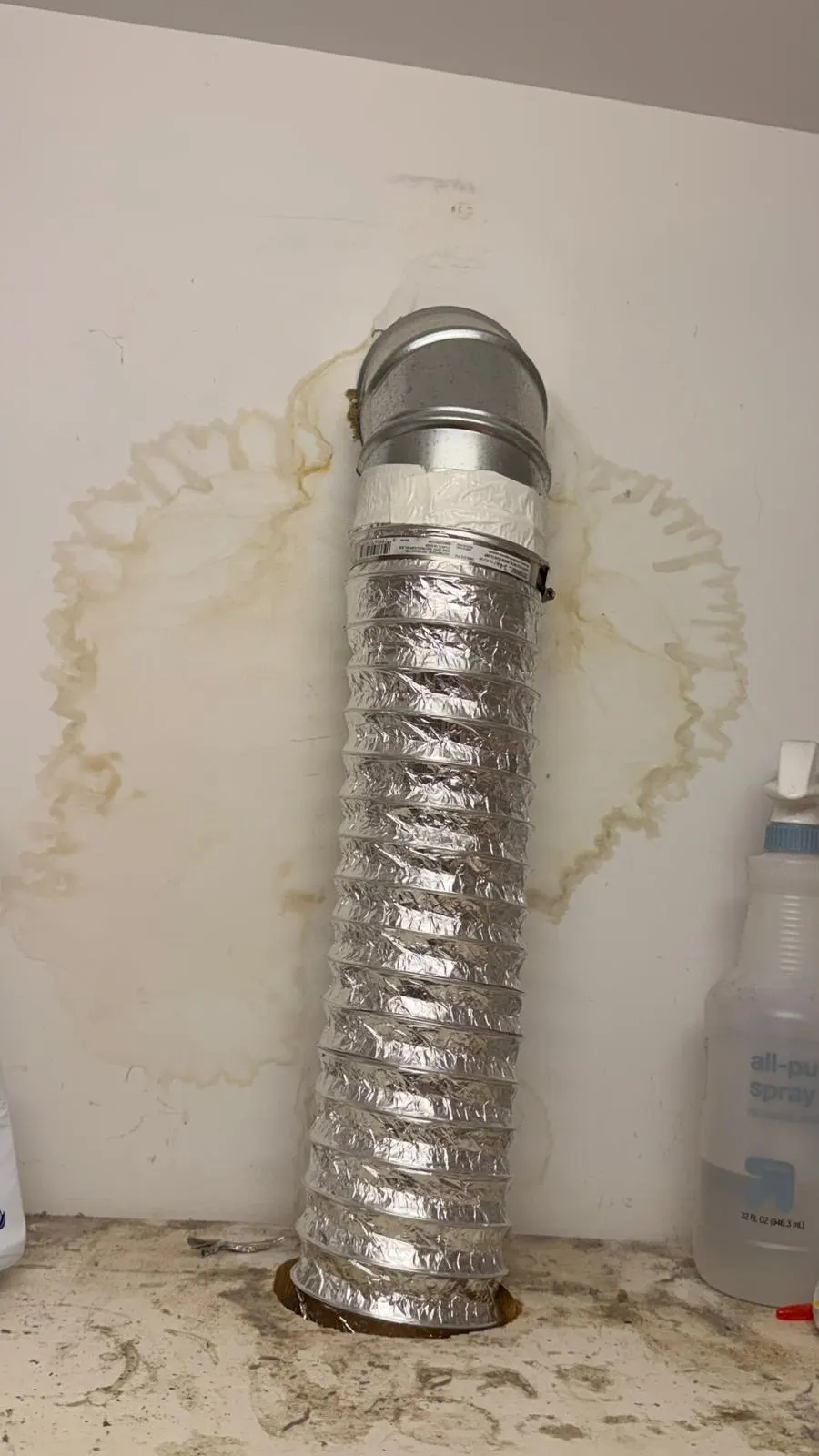
The most dangerous four feet in the house
The flexible transition duct behind the dryer is where problems concentrate. It crushes easily when the dryer gets pushed against the wall, its ridged interior traps lint far faster than smooth metal pipe, and it sits closest to the dryer's heat. The stained, matted duct in this photo is what years of skipped cleanings look like from behind the appliance.
If your transition duct is plastic or thin foil, replacing it with semi-rigid or rigid metal is one of the highest-value safety upgrades you can make — plastic and foil can ignite and sag, while metal resists both. We check this connection on every dryer vent cleaning we do.
When Do Dryer Fires Peak During the Year?
In the cold months. According to the U.S. Fire Administration, home clothes dryer fires are more frequent in the fall and winter, peaking in January. That seasonal pattern is not a coincidence — winter stacks the deck against your vent in several ways at once.
Winter laundry is heavier: sweaters, flannel sheets, blankets, and comforters shed more fiber per load and demand longer, hotter cycles. Households also simply wash more in winter — holiday guests, sick kids, extra layers. At the same time, the exhaust side gets worse: exterior vent flaps stiffen or freeze partially shut, and snow can block low wall terminations outright. More lint production plus more runtime plus more restriction, all in the same season, is exactly the combination the statistics reflect. For homeowners around Montgomery, Chester, Bucks, and Delaware counties, the practical takeaway is simple: fall is the smartest time on the calendar to have your vent professionally cleaned, so the line is at full capacity before the January peak.
What Does a Dryer Fire Cost Compared to a Routine Cleaning?
Run the comparison honestly and it is not close. A professional dryer vent cleaning is a small, once-a-year line item — and with E Cleaning you know the exact number before anything happens. Every job starts with a free video inspection inside the line, followed by a flat, written quote covering the whole run: no per-foot charges, no trip fees anywhere in our service area, and after-photos included when we finish. For what the wider market typically charges, see our dryer vent cleaning cost guide.
Now consider the other side of the ledger, even in a best-case fire that firefighters contain to the laundry area. The dryer itself is a total loss, often along with the washer standing next to it. Smoke and soot do not stay in the laundry room; they travel through the house and into the HVAC system, and professional smoke remediation, cleaning, and repainting routinely run into the thousands. Add your homeowner's insurance deductible, possible water damage from suppression, days of disruption, and the paperwork of a claim that may raise your premiums. And that is the lucky version — a fire that starts inside a wall-cavity vent run while the household is asleep is a different story entirely. An annual cleaning is not just cheaper than a fire; it is cheaper than the deductible on one.
How Do You Prevent a Dryer Fire?
Prevention is neither complicated nor expensive — which is exactly why “failure to clean” leading the cause list is so frustrating to fire professionals. Here is the checklist we give our own customers:
- Clean the lint screen before or after every single load. It takes five seconds and protects airflow at the source.
- Have the full vent line professionally cleaned once a year — from the dryer connection through every elbow to the exterior termination, not just the first few reachable feet.
- Replace plastic or foil transition ducts with metal. Rigid or semi-rigid metal resists ignition, crushing, and sagging.
- Check the exterior termination seasonally. The flap should open freely when the dryer runs and sit fully closed when it stops — no lint beard, no bird nest, no snow blocking it.
- Never run the dryer while you are asleep or out of the house. Most of the damage in dryer fires comes from nobody being there for the first minutes.
- Keep the area around the dryer clear of clothing piles, boxes, and cleaning products.
- Watch drying times. A load that suddenly needs two cycles is the earliest, most reliable warning that your vent is restricting.
Want to know where your own laundry setup stands? Take the two-minute risk quiz on our dryer vent fire safety page — it walks through the same factors we check on real jobs.
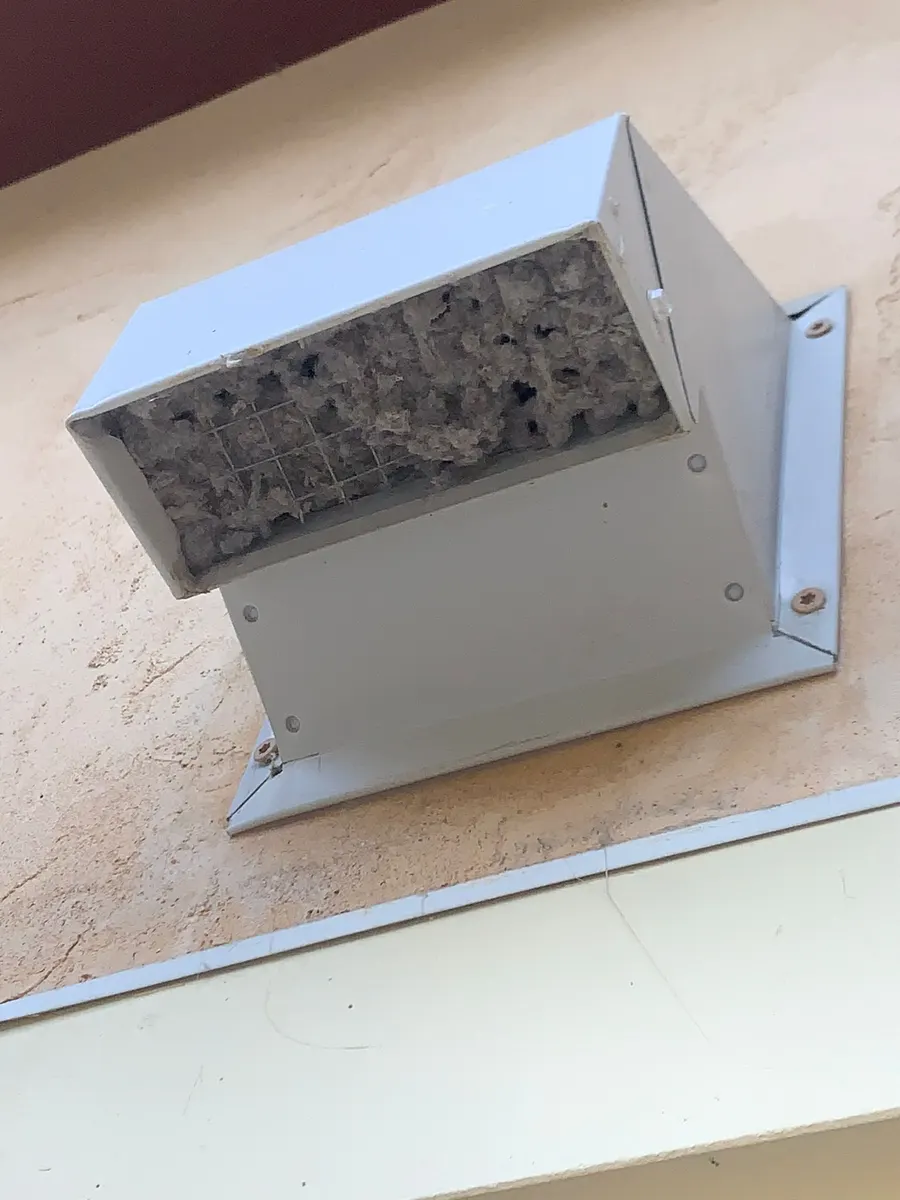
The check anyone can do this weekend
Walk outside while your dryer is running and find the vent termination. You should feel strong, warm airflow and see the flap standing open. If the airflow is weak, if lint is matted around the cap like the one in this photo, or if you cannot find any airflow at all, your line is restricted — and every load you run is adding fuel behind that restriction.
That five-minute check costs nothing and catches the exact condition the NFPA's 33% statistic describes before it becomes dangerous.
What Warning Signs Mean Your Vent Is Already a Risk?
Restricted vents announce themselves well before they become fires — the signals are just easy to rationalize away. Clothes that need more than one cycle to dry. A dryer top or laundry room that gets noticeably hot during use. A humid, damp feeling in the laundry area. A burning or scorched smell on long loads. Lint collecting behind or beneath the dryer. Little or no airflow at the exterior flap. Any one of these means the exhaust path is compromised; two or more mean it should be inspected now rather than at the next annual date.
The good news is that you do not have to guess. Every E Cleaning dryer vent job starts with a free video inspection inside the line, so you see the actual buildup before any work begins, and after-photos when we finish so you see the result. You can read exactly how a visit works on our process page. We are a PA-licensed contractor (PA 187935), insured up to $2 million, and Google Guaranteed with money-back protection up to $2,000 on qualifying jobs.
What Should You Do With These Numbers?
Treat them as a calendar item, not a scare story. The statistics say dryer fires are common, that the leading factor is skipped cleaning, and that risk peaks in January. The response that follows from all three is the same: put a professional vent cleaning on the schedule once a year, ideally before winter, and do the free five-second and five-minute checks in between. Households that bundle it with air duct cleaning handle both jobs in a single visit — one free video inspection, one flat written quote covering everything.
We serve Montgomery, Chester, Bucks, Delaware, Berks, and Philadelphia counties from our King of Prussia base, around the clock, Sunday through Friday — we're closed Saturdays.
