
Mold in Your Air Ducts? What to Do (and What Not to Panic About)
Mold questions are some of the most anxious calls we get — and one of the most abused sales angles in this industry. This guide walks through how mold actually gets into ductwork, how to tell probable growth from ordinary dust, what a legitimate remediation sequence looks like, and how to spot the companies that "find" mold in every house they enter. The photos are from real jobs across Montgomery, Chester, Bucks, and Delaware counties.
How does mold get into air ducts in the first place?
Mold needs two things to grow: food and moisture. The food is already there — the thin layer of dust, skin cells, pet dander, and pollen that settles inside every duct system over time. The missing ingredient is water, and in ductwork it almost always arrives as condensation.
Condensation forms wherever warm, humid air touches a cold surface, the same way a glass of iced tea sweats on a July afternoon. During a humid Pennsylvania summer, your air conditioner pushes air chilled to roughly 55 degrees through metal ducts and out through metal registers. Any spot where that cold metal meets muggy air — a supply boot in a damp crawl space, an uninsulated trunk line in a basement, a ceiling diffuser under a poorly ventilated attic — can sweat repeatedly, day after day. Wet dust is mold food with a water supply attached.
These are the moisture sources we see most often on real jobs:
- Sweating ceiling diffusers — cold supply air chills the metal while humid room or attic air condenses on it
- Uninsulated ducts running through humid basements, crawl spaces, and attics
- A dirty, damp evaporator coil — the AC coil and its drain pan stay wet by design, and a coating of dust turns them into a growth surface
- A clogged condensate drain that backs up and keeps the air handler area wet
- An oversized air conditioner that cools the house quickly but shuts off before it has dehumidified the air
- Chronically high indoor humidity — when a home sits above roughly 60% relative humidity, every dusty surface becomes easier to colonize
Notice that every item on that list is a moisture problem first and a duct problem second. That matters later, because removing mold without fixing the moisture is a temporary fix at best.
Is that black stuff on your vents actually mold?
Not always. A good share of what homeowners describe as mold turns out to be ordinary dust, filter bypass grime, or dark sooty streaking from candles and cooking. The honest answer is that nobody can certify a substance as mold by eyesight alone — that takes a laboratory. But there are visual clues that separate probable growth from plain dirt.
Dust and soot follow the airflow: they build up in feathered streaks that trace the direction air moves across the grille. Mold tends to appear as spotting or speckling — clusters of dark dots that follow the damp areas rather than the air stream, concentrated around diffuser vanes, on the drywall ring surrounding a vent, or wherever condensation beads up. If you wipe the area and the spotting returns in the same damp locations, growth is the likelier explanation.
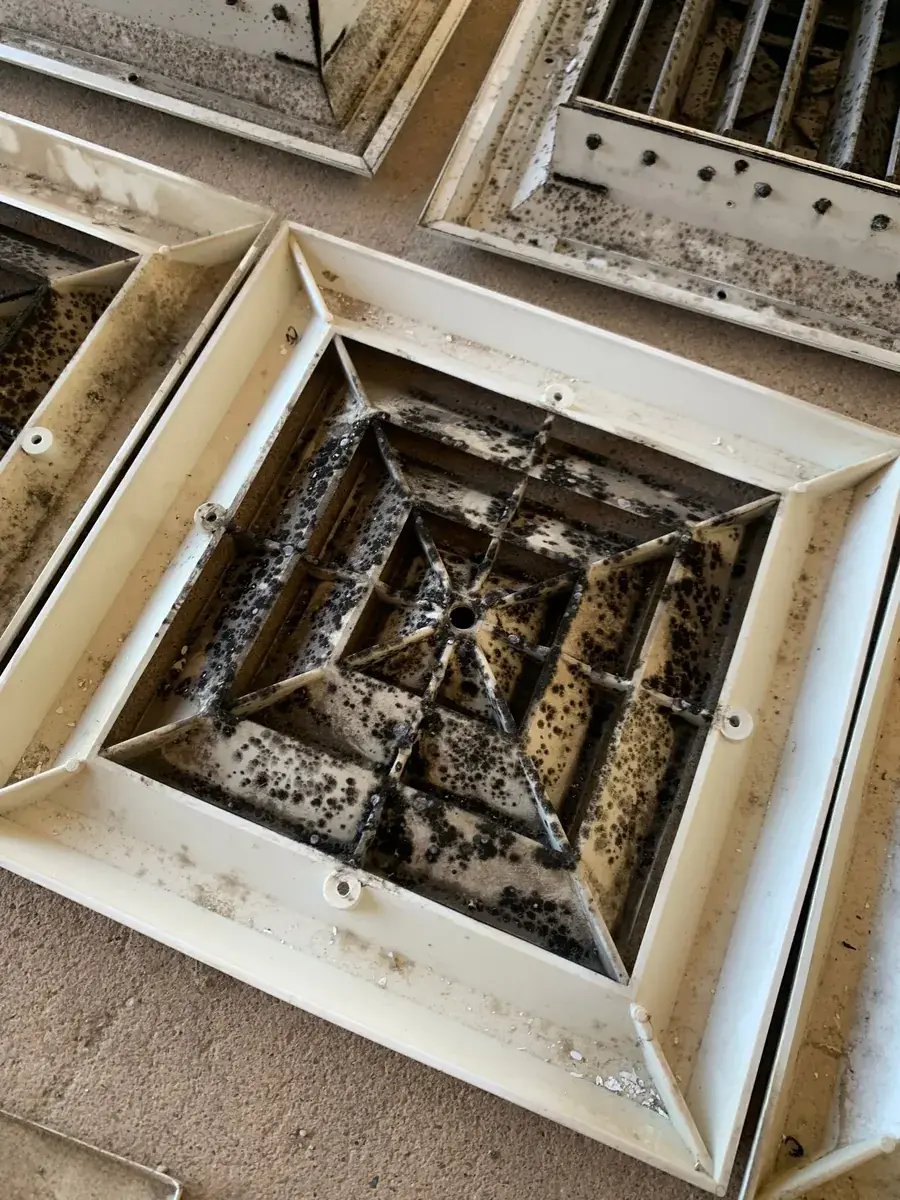
The diffuser above came from a real customer job, and it shows the classic pattern: dark speckling clustered on and around a metal diffuser that sweats during cooling season. This is exactly the kind of finding our free video inspection is built to document — you see the condition of your own vents and duct interiors on camera before anyone quotes you a price, as described on our process page.
If you want laboratory certainty, an independent environmental testing company can sample the material and identify it. For most homeowners, though, the practical standard is simpler: visible mold-like growth in the air path is a legitimate reason to have the system inspected and cleaned. You do not need a lab report to justify acting on what you can plainly see.
Is mold in your air ducts dangerous?
It deserves respect, not panic. Growth in the air path means spores and fragments can ride the airflow into living spaces whenever the blower runs, and sensitive people — those with allergies, asthma, or other respiratory conditions — may find their symptoms aggravated. Reactions vary widely from person to person; many people notice nothing at all, while others deal with congestion, irritated eyes, or coughing that eases when they leave the house.
Two honest caveats keep this in perspective. First, a few speckled ceiling diffusers are a maintenance problem, not a toxic emergency — a small area of surface growth on metal registers is about as fixable as household problems get. Second, no duct cleaning company should promise health outcomes from a cleaning, and we will not either. What is well supported is this: the EPA's own consumer guidance lists visible mold growth inside ducts among the specific situations where duct cleaning is warranted, rather than a judgment call. When the system is pushing air across a surface with active growth on it, that surface should be cleaned — or, in some cases, replaced.
What should you do if you find mold in your ductwork?
The order of operations matters more than speed. Here is the sequence that actually solves the problem instead of postponing it:
- Confirm what you are looking at. Get eyes — ideally a camera — on the actual duct interiors, not just the grille. We run a free video inspection inside the ducts before quoting any work, so the extent of the problem, or the absence of one, is documented on screen.
- Find the moisture source. Sweating diffuser, damp coil, humid crawl space, blocked condensate drain — until the water is explained, nothing else you do will hold.
- Physically remove the growth and the dust it lives on. This is source removal: professional Nikro negative-pressure machines put the whole duct run under vacuum while agitation tools scrub the buildup loose, and HEPA filtration captures what comes out. It is the approach NADCA sets as the industry standard, and it removes the material rather than coating it.
- Sanitize after removal — never instead of it. Once surfaces are physically clean, an EPA-registered sanitizing product can be applied to the duct interiors. We offer this as an add-on, itemized on the written quote you approve up front, and only after the cleaning is done.
- Fix the underlying humidity or coil issue. Insulate the sweating duct, clean the coil, clear the drain, add dehumidification. This step is what keeps you from repeating steps one through four next summer.
Skip step three and you have perfumed mold. Skip step five and you have scheduled its return.
Why does spraying or fogging alone not fix moldy ducts?
Because the growth lives on and in the dust layer, and a chemical mist does not remove dust. Fogging a dirty duct treats the surface of the pile while leaving the reservoir of organic material — and the moisture that wets it — completely intact. A few weeks of humid weather later, the system is right back where it started, minus whatever the fogging cost.
There is also a right way to use sanitizers. EPA-registered products are registered for use on clean surfaces; applying them over heavy soil undercuts the product before it starts. That is why our sanitization add-on is sequenced strictly after source-removal cleaning and is never sold as a standalone treatment. Any company offering to "kill the mold" with a spray, a fog, or an ozone blast without physically cleaning the ducts first is selling the step that feels impressive while skipping the step that works.
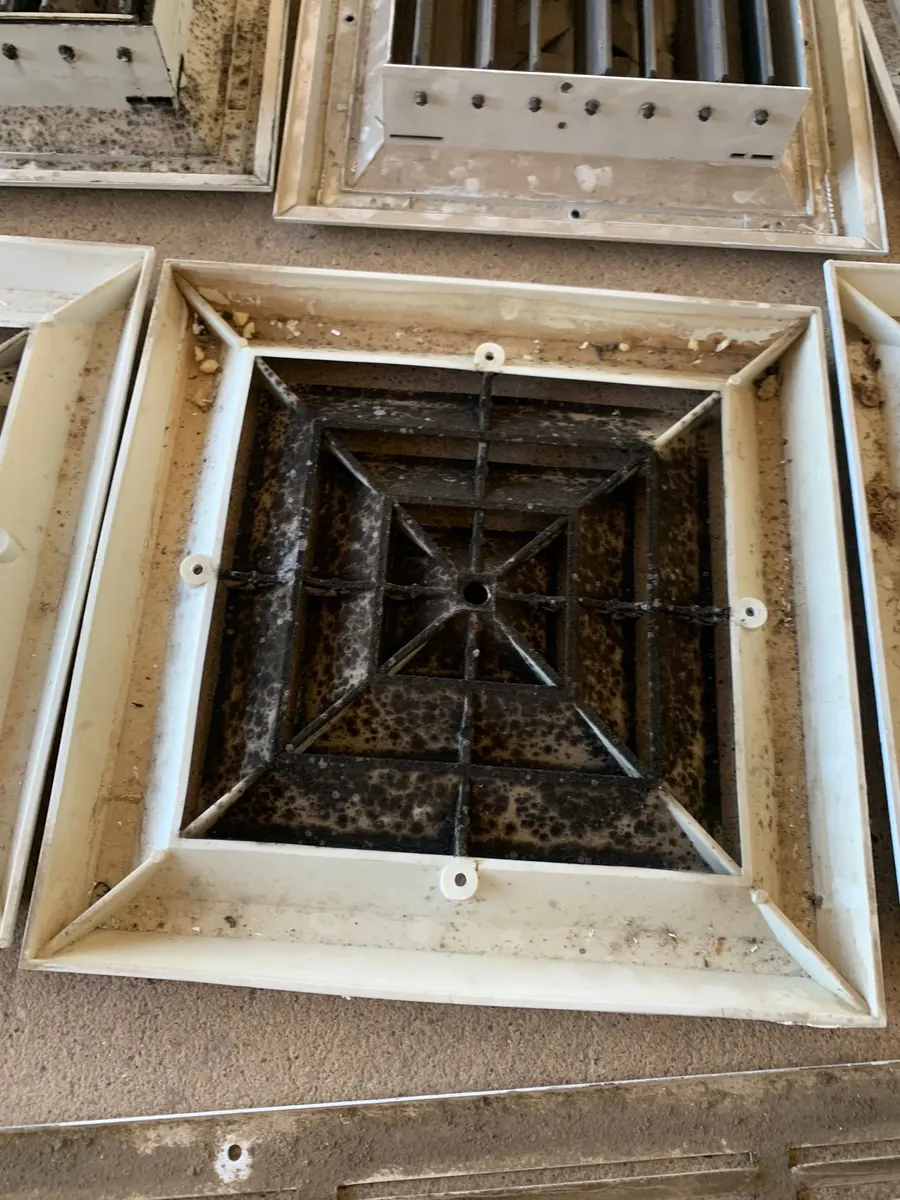
The comparison above shows what physical cleaning accomplishes on a diffuser: the buildup is gone, not painted over or perfumed. That is the standard to hold any company to — and it is why we photograph our work and provide after-photos when the job is done.
When do you also need to fix humidity or coil problems?
Any time mold shows up, something upstream made it possible. Cleaning handles the growth that exists; these fixes prevent the sequel. Some belong to a duct cleaner, some to your HVAC contractor, and it is worth knowing which is which before anyone quotes you.
| What you notice | Likely underlying cause | The lasting fix |
|---|---|---|
| Dark spotting on ceiling diffusers | Diffuser metal sweating in humid room or attic air | Clean and sanitize the diffusers; improve attic ventilation or insulate around the boot |
| Musty smell only during cooling season | Damp, dust-coated evaporator coil or drain pan | Coil and pan cleaning by an HVAC technician |
| Sweating ducts in the basement or crawl space | Uninsulated metal duct in humid air | Duct insulation; a dehumidifier in the space |
| Whole-house mustiness, indoor humidity above 60% | Oversized AC that short-cycles, or no dehumidification | HVAC assessment; whole-house or portable dehumidifier |
| Growth on internal fiberglass duct liner that has been wet | Saturated porous insulation | Replacement of the wet liner — per EPA guidance, wet porous duct insulation cannot be reliably cleaned |
We flag these conditions during the video inspection when we see them. If the lasting fix belongs to an HVAC contractor rather than to us — a coil cleaning, a drain repair, an equipment sizing issue — we will say so instead of selling you a service that will not solve it.
How can you tell real mold help from a scare tactic?
Mold is the favorite lever of the bait-and-switch side of this industry, because fear closes sales. The pattern is depressingly consistent: a $49–$99 "whole house special" gets a crew through your door, someone shines a flashlight into a return, announces mold, and a job advertised for less than a dinner out becomes a four-figure emergency before they leave. We broke down the whole playbook in our guide to the $49 duct cleaning special.
The red flags are recognizable once you know them: mold "diagnosed" instantly on sight with no photos or inspection footage offered; pressure to sign and pay the same day; an on-the-spot swab or petri-dish "test" performed by the same company that profits from a positive result; no written pricing; and a quote that grows room by room as the walkthrough continues.
What legitimate looks like is just as recognizable: a flat written quote in your hands before any work begins, inspection footage you can watch yourself, a clear separation between the cleaning and any add-ons, and no diagnosis beyond what the company is qualified to make. A duct cleaner who says "this looks like microbial growth — here is the photo, and here is what removal costs" is being straight with you. One who declares a toxic mold emergency to add a zero to the invoice is not.
What does it cost to deal with mold in your ducts?
Every air duct cleaning job starts with a free video inspection inside the ducts and ends with after-photos of the finished work — and in between, you get a flat, written quote before any work begins, based on what the camera actually shows rather than a guess over the phone. Routine cleaning and deep cleaning are scoped honestly as different services, sanitization with EPA-registered products is itemized as its own add-on, and there are no trip fees anywhere in our service area. The number you approve is the number on the invoice — no surprise charges, no door-step upsell — and financing is available through Wisetack. While the crew is on site, many customers also add dryer vent cleaning, scoped and quoted the same way.
E Cleaning is family-owned and has served the Philadelphia suburbs since 2016. We are PA licensed (PA 187935), insured up to $2 million, and Google Guaranteed with money-back protection up to $2,000 on qualifying jobs. If the camera shows dust rather than growth — or nothing worth cleaning at all — we will tell you that, too. And if you are still deciding whether your system needs attention in the first place, start with our guide to the signs your air ducts need cleaning.
