
What Is Source-Removal Duct Cleaning? The Method Explained
Every company in the phone book says it "deep cleans" ducts. Source removal is the term that separates a real duct cleaning from a glorified vacuuming: the buildup is knocked loose from every duct surface and extracted from the system entirely, not stirred up near the registers or sprayed with something that smells nice. Here is how the method works piece by piece, what the equipment actually does, and how to tell whether the crew in your basement is really doing it.
What does "source removal" actually mean?
Source removal means removing the contamination at its source — the settled dust, pet dander, hair, and construction debris lining the inside of your ductwork — rather than masking it, deodorizing over it, or pushing it around. The method rests on two actions working at the same time: mechanical agitation to break buildup loose from the duct walls, and continuous negative-pressure vacuum to carry every loosened particle out of the system and into a sealed, filtered collection unit.
Neither half works on its own. A vacuum without agitation only captures the loose surface dust and leaves the compacted, felt-like layer bonded to the metal. Agitation without a vacuum is worse — it knocks years of debris airborne with nowhere to go but deeper into the system or out into your rooms. The whole point of source removal is that the dislodging and the extraction happen together, so debris travels one direction only: out.
There is plenty to extract. Industry sources such as Stanley Steemer estimate the average six-room home can accumulate 40 pounds of dust in a year, and a share of that settles inside the duct runs every season the blower operates. In systems that have never been opened, we routinely pull out buildup that has been compacting since the house was built.
How does negative pressure work in duct cleaning?
Negative pressure turns your entire duct system into a controlled vacuum chamber. The technician connects a high-powered vacuum unit — the negative-air machine — to the main trunk line near the furnace through a wide collection hose, then seals off the supply and return registers throughout the house. With the openings blocked and the machine running, air inside the ductwork can flow in only one direction: toward the collection unit.
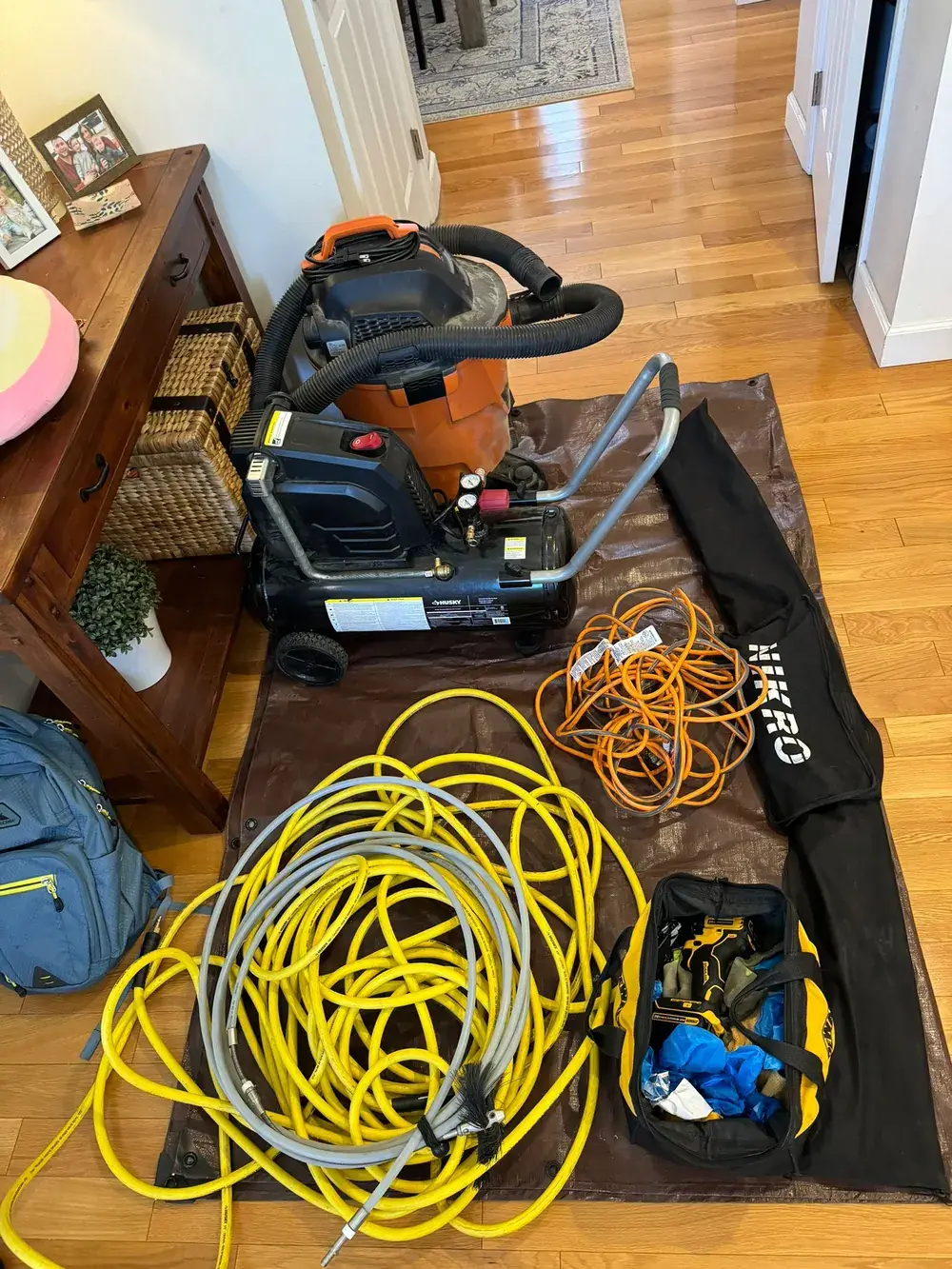
That one-way airflow is what makes the rest of the job safe and effective. When agitation tools start breaking buildup loose at the far end of a duct run, the loosened dust does not drift into bedrooms or settle back down two feet away — it gets pulled through the system, down the trunk, and into the sealed machine. Negative pressure is also why a properly done duct cleaning leaves the house cleaner than the crew found it, not dustier. If a company cleans ducts without putting the system under suction, every particle they disturb has to land somewhere, and that somewhere is usually your furniture.
What does mechanical agitation do?
Agitation is the muscle of the method. Settled duct dust is not fluffy — after years of heating and cooling cycles it compacts into a dense, felt-like lining that suction alone will not lift. Agitation tools physically scrub, whip, and blast that layer off the duct walls so the negative-pressure airflow can carry it away. On a typical job the toolkit includes:
- Air whips — flexible, compressed-air-driven tips that flail against the duct walls, beating loose the compacted dust as they travel down each run
- Rotary brushes — spinning bristle heads sized to the duct that scrub buildup off round branch lines and rectangular trunks
- Compressed-air wands and nozzles — directed air blasts that sweep debris out of corners, joints, and boots and push it toward the vacuum
- Contact vacuuming — HEPA-filtered vacuum heads run directly along accessible surfaces like register boots and the blower compartment
- Register and grille cleaning — the covers come off and get cleaned individually, since they collect the same film the ducts do
Order of operations matters. The technician works each branch run from the register end toward the trunk, then cleans the trunk toward the collection hose, so debris is always being herded in the direction the airflow is already moving. Flex duct gets gentler agitation than rigid metal, because aggressive brushing can tear the inner liner.
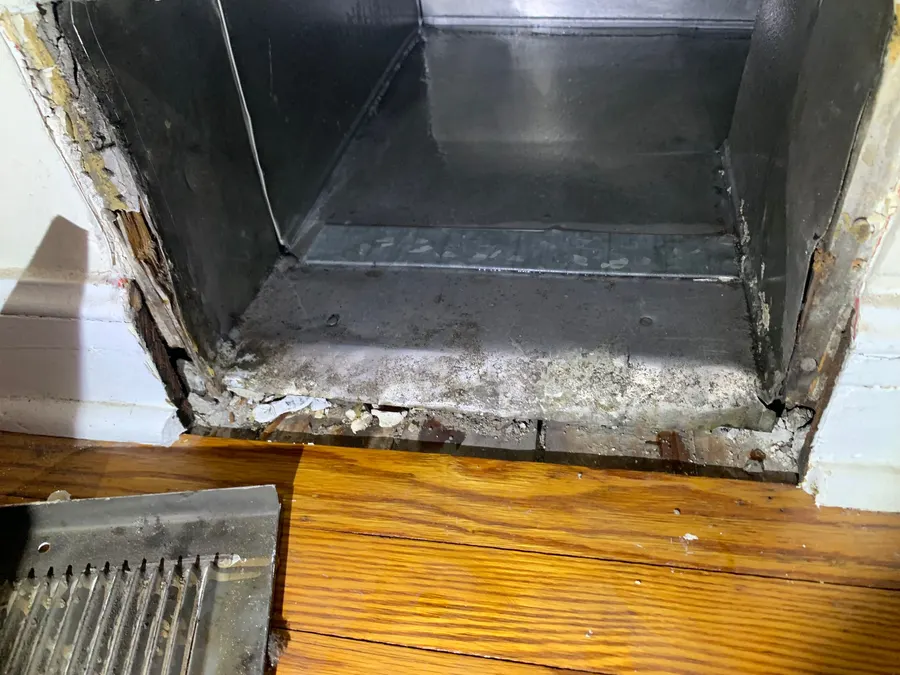
The photo above shows a main trunk line mid-cleaning on one of our jobs — you can see the line where scrubbed metal meets the buildup still waiting for the whip. Before-and-after shots like this are part of every job we do, because the inside of a duct is the one part of the work you cannot see from the hallway.
Why does HEPA filtration matter?
Everything the negative-air machine inhales has to be exhausted somewhere, and that is where filtration earns its place in the method. HEPA filters are rated to capture 99.97% of particles down to 0.3 microns — fine enough to hold the dust, dander, and debris fragments the cleaning stirs up. A collection unit with HEPA filtration can safely run indoors, pulling contaminated air in one end and releasing filtered air out the other, with the debris locked in a sealed compartment.
Without that filtration, a duct-cleaning vacuum becomes a dust redistributor: it pulls debris out of the ductwork and sprays the finest fraction — the particles most likely to stay airborne and be inhaled — back into the living space. The fine fraction is exactly the part worth controlling.
An honest caveat belongs here: the EPA does not endorse routine duct cleaning as a proven fix for indoor air quality, and no one should promise a cleaning will cure allergies. What source removal does is take the reservoir of settled dust and dander out of the air path so the system stops recirculating it — which can help reduce the particle load in the house, and which is clearly warranted when there is visible mold, heavy debris, pest activity, or renovation dust. If you are not sure your system qualifies, our guide to the signs your air ducts need cleaning walks through what to look for.
Is source removal the industry standard?
Yes. NADCA — the National Air Duct Cleaners Association — publishes the industry standard for HVAC system cleaning, and source removal is the method that standard describes: mechanical agitation to dislodge contaminants, combined with collection under negative pressure. When people talk about duct cleaning "done to NADCA standards," this is the process they mean.
To be fully transparent: E Cleaning follows the source-removal method with professional negative-pressure equipment, but we do not claim NADCA membership or certification, and you should be skeptical of any company that flashes a logo without a verifiable listing. What actually protects you is the method and the proof — a free video inspection inside your ducts before any work begins, and after-photos when the job is done. You can see exactly how we structure a visit on our process page.
How is source removal different from "blow-and-go" cleaning?
"Blow-and-go" is the industry nickname for the $49–$99 "whole house special" you see advertised online and on flyers. The crew arrives with a shop vacuum and a compressor wand, blows air a few feet into each register, vacuums what falls out, and either leaves in under an hour or — more often — begins upselling room by room until the ticket hits several hundred dollars anyway. The dust deep in the runs never moves, and there is no containment, so some of what they disturb ends up in the house.
| What to compare | Source removal | Blow-and-go |
|---|---|---|
| What happens to the dust | Extracted from the system into a sealed, HEPA-filtered collection unit | Blown around near the registers; much of it stays in the ducts or enters the rooms |
| Equipment | Negative-air machine, air whips, rotary brushes, compressed-air tools, HEPA vacuum | Shop vacuum and a compressor wand |
| Coverage | Every supply run, return run, trunk line, and register in the system | A few feet inside each register opening |
| Containment | System under negative pressure for the entire cleaning | None |
| Time on site | Several hours for a typical single system | Often under an hour |
| Pricing | Flat, written quote after a free video inspection — before any work begins | $49–$99 teaser that grows once the crew is inside your home |
| Proof | Video inspection before, after-photos when done | Take their word for it |
The teaser price is not a discount — it is a lead-generation tactic, because no one can run a multi-hour, two-technician, equipment-heavy job for $49 and stay in business. We wrote a full breakdown of how that pitch works in our guide to the $49 duct cleaning special.
What does the Nikro equipment actually do?
Nikro is a U.S. manufacturer of professional duct-cleaning equipment, and their machines are what our crews bring into your home. The negative-air machines are the heart of the setup: portable, high-suction vacuum units with HEPA filtration that connect to your trunk line and keep the whole system under negative pressure while the cleaning happens. Because they are portable rather than truck-mounted, they work in basements, utility closets, and attic systems where a hose run from the driveway would lose suction or simply not reach.
Alongside the vacuum units, the compressed-air side of the kit — the whips, wands, and agitation tools described above — does the dislodging. The pairing is the method in miniature: Nikro suction holding the system under vacuum, agitation tools feeding it debris, HEPA filtration making sure what comes out of the ducts does not go back into your air.
What should a real source-removal cleaning cost?
Not $49 — and not a number invented at your door. Every air duct cleaning we do starts with a free video inspection inside your ductwork, and you receive a flat, written quote before any work begins. That quote covers the full source-removal process — negative pressure, agitation on every run, HEPA collection — plus after-photos when we finish. There are no trip fees anywhere in our service area, no surprise invoice, and no door-step upsell: the written quote you approve is the invoice you pay.
Routine cleaning and deep cleaning are honestly scoped as different services — if the camera shows years of compacted buildup, growth, or post-renovation debris, we tell you before the work starts, not halfway through it, and sanitization with EPA-registered products is quoted the same way when it is actually warranted. Most customers add dryer vent cleaning while the crew is on site; lint is a fuel, not just a nuisance, and our dryer vent fire safety guide covers why that line deserves the same attention as the ducts. Financing through Wisetack is available if you would rather spread the cost out.
How can you tell you got a real source-removal cleaning?
You do not need to be an HVAC expert — the giveaways are visible from the hallway. A legitimate source-removal job looks like this:
- A large negative-air machine is connected to your trunk line near the furnace, running for the duration of the job
- Registers are sealed or covered while each run is cleaned, and the covers come off for individual cleaning
- You see agitation tools — whips or brushes — going into the ducts, not just a vacuum hose held near the opening
- The crew shows you the inside of your ducts on camera before the work and photos after it
- The job takes hours, not minutes, and the written quote you approved before the work is the invoice you pay
E Cleaning is family-owned, serving Montgomery, Chester, Bucks, and Delaware counties since 2016 from our King of Prussia base. We are PA licensed (PA 187935), insured up to $2 million, and Google Guaranteed with money-back protection up to $2,000 on qualifying jobs. If the camera shows your ducts do not need cleaning, we will tell you that too — the video inspection is free either way.
