
Clothes Taking Two Cycles to Dry? Your Vent Is Telling You Something
A dryer that needs two cycles is not a weaker dryer — it is a suffocating one. Drying is an airflow process: heat evaporates the water, but moving air is what actually carries that moisture out of the drum and out of the house. When lint narrows the vent line, the moisture has nowhere to go, and no amount of extra heat fixes that. Here is what is really happening inside the run, what the second cycle costs you in electricity and appliance life, where DIY cleaning stops working, and how to confirm the problem is genuinely fixed instead of just quieter.
Why Do Clothes Take Two Cycles to Dry?
Because drying is an exhaust problem, not a heat problem. A clothes dryer works by pulling room air in, heating it, tumbling it through wet laundry so it picks up moisture, and then pushing that saturated air out through the vent line. Every ounce of water in your towels has to leave the house as vapor through that one pipe. When the pipe is partially blocked with lint, the saturated air backs up, the humidity inside the drum climbs, and evaporation slows to a crawl. The dryer keeps tumbling warm, wet air past warm, wet clothes — which is why the load comes out damp at the end of a full cycle that used to be plenty.
There is a second mechanism stacked on top. Dryers protect themselves with high-limit thermostats that cut power to the heating element when the exhaust side gets too hot. A restricted vent traps heat exactly there, so the element short-cycles — on, off, on, off — and the average temperature in the drum drops even though the dryer feels hot to the touch. Restricted airflow plus reduced effective heat is the exact recipe for the two-cycle load. If your dryer runs hot on the outside but the clothes stay damp, the vent is telling you where the problem lives.
How Does Lint Restrict the Airflow in the First Place?
Lint escapes the lint screen on every load — the screen catches most of it, never all of it. Whatever gets past rides the airstream into the vent line, and it falls out of the air wherever the air slows down. That means elbows, long horizontal stretches, sagging sections of flex duct, and the screen or flap at the exterior termination. Each thin layer that settles makes the pipe slightly narrower, which slows the air a little more, which drops the next batch of lint a little sooner. Restriction compounds: a vent does not clog at a steady pace, it clogs faster and faster as it goes.
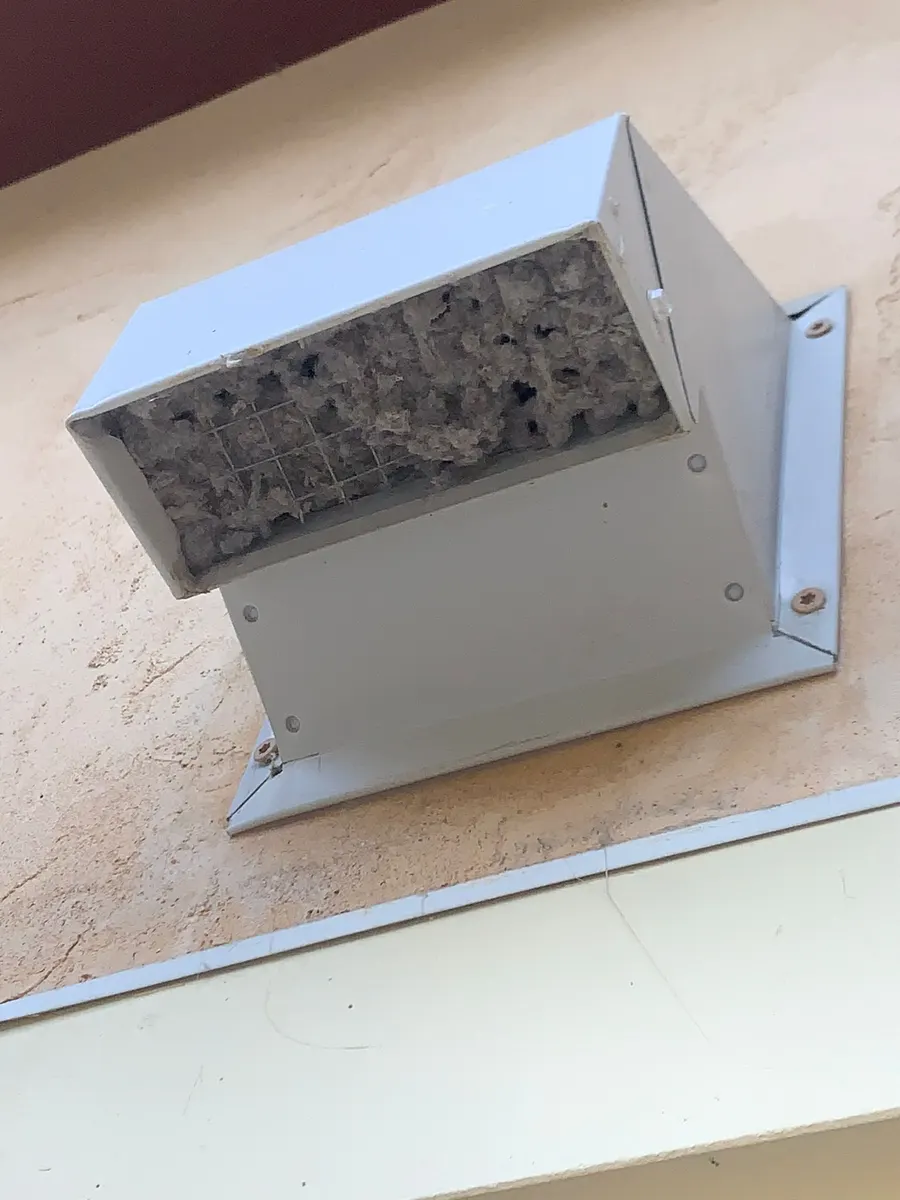
The usual choke points
The exterior termination is the most common one we find. A wall cap's flap gets propped half-open by a mat of lint, or a screen meant to keep birds out becomes a lint filter that was never meant to exist. Behind the dryer, the flexible transition hose is another classic: pushing the dryer back against the wall crushes the foil duct into a kink that no cleaning can fix — it has to be re-routed or replaced.
Inside the wall, every elbow behaves like extra pipe length. Air loses momentum at each turn, so a short run with three elbows can restrict worse than a long straight one. This is why upper-floor laundry rooms, with their longer and more convoluted runs, clog faster than a basement dryer venting straight out the wall.
How Much Is the Second Cycle Costing You?
Run the math with your own numbers — it is not close. Most residential electric dryers draw several kilowatts while the heating element is on, so a typical full cycle uses somewhere around 3 to 4 kilowatt-hours. A second full cycle roughly doubles that, every single load. As a round example, at 17 cents per kilowatt-hour — check your own electric bill for your exact rate — an extra 3.5 kWh cycle costs about 60 cents per load. That sounds small until you multiply it out across a family's laundry schedule.
| Example household (8 loads/week, electric dryer) | Healthy vent | Restricted vent |
|---|---|---|
| Cycles per load | 1 | 2 |
| Approx. energy per load | ~3.5 kWh | ~7 kWh |
| Cost per load at $0.17/kWh (example rate) | ~$0.60 | ~$1.19 |
| Approx. drying cost per year | ~$250 | ~$495 |
| One professional vent cleaning | Free video inspection first · flat written quote before work begins · no trip fees | |
In that example, the restriction quietly burns a couple hundred extra dollars a year — and the table only counts electricity. It does not count the hour of your day each doubled load eats, or the wear the extra runtime puts on the machine itself, which is where the real money leaks out.
What Is Two-Cycle Drying Doing to the Dryer Itself?
Every second cycle logs double hours on parts that were engineered for single-cycle duty. The drive motor, belt, rollers, and drum bearings all accumulate runtime twice as fast, so a machine that should last well over a decade starts developing squeals and shudders years early. The heating element takes it worse: short-cycling against the high-limit thermostat — heating up, tripping, cooling, reheating — is exactly the kind of thermal stress that burns out elements and heating coils prematurely.
Then there are the one-strike components. Most dryers carry a thermal fuse that permanently blows if the exhaust side overheats; when it goes, the dryer either stops heating entirely or stops running, and you are booking an appliance repair visit for a part that failed doing its job — protecting you from your clogged vent. Moisture-sensing dryers suffer in a subtler way: with saturated air recirculating, the sensor bars misread the load and the auto-dry cycle gives up early or runs endlessly. Replacing a dryer costs many times what keeping its vent clear does, year after year. That ratio is the whole argument for treating slow drying as a maintenance alarm instead of a quirk.
Is a Slow Dryer Dangerous, or Just Annoying?
Both — and the dangerous part deserves to be said plainly. Lint is dry, fibrous, and finely divided, which makes it excellent kindling, and a restricted vent concentrates heat in exactly the place where that kindling collects. Two-cycle drying is the early, polite version of the warning. The later versions are a burning smell on long loads, a dryer top too hot to rest your hand on, and a laundry room that turns humid every time the machine runs.
Most of those fires are preventable with the most boring fix in home safety: keep the exhaust path clear. If you want the full picture — warning signs, prevention habits, and what fire investigators consistently find — our guide to dryer vent fire safety covers it in depth. The short version is that a vent restricted enough to double your dry time is restricted enough to take seriously.
When Should You Stop DIYing and Call a Pro?
There is real DIY territory here, and we want you to own it: clean the lint screen every load, vacuum the screen housing occasionally, pull the dryer out once in a while to check that the transition hose is not crushed, and glance at the exterior flap to make sure it opens when the dryer runs. A consumer brush kit can help with the first few feet of the run. Past that point, DIY starts to cost more than it saves — a brush that is too short cleans the easy section and compacts loosened lint deeper into the line, and cheap rod kits can separate mid-run, leaving the brush itself as the new blockage. Call a professional when any of these apply:
- You cleaned what you can reach and the second cycle is still needed. The restriction is deeper in the run than your tools go.
- The run has elbows or disappears into a wall or ceiling. You cannot brush what you cannot see, and elbows are where the buildup lives.
- The laundry is on an upper floor or the vent exits through the roof. Long vertical runs and roof caps are ladder-and-equipment work, not weekend work.
- You smell burning, or the dryer or the clothes come out unusually hot. Stop running the dryer and get the line inspected before the next load.
- You suspect a nest. Birds and rodents love vent terminations; nest material has to be extracted deliberately, not shoved with a brush.
- The vent has never been professionally cleaned. Years of accumulation compacts into dense plugs that consumer brushes skate over.
What Does Professional Cleaning — and Real Verification — Look Like?
A proper dryer vent cleaning treats the entire run as one system: from the connection behind the dryer, through every elbow in the wall, to the exterior termination. We start every job with a free video inspection inside the line, so you see the actual condition — where the buildup is, how bad it is, and whether there is a nest or a crushed section hiding in there. Then the line is cleaned with rotary agitation to break the lint loose and vacuum extraction to pull it out of the system, so it leaves your house instead of resettling two feet down the pipe.
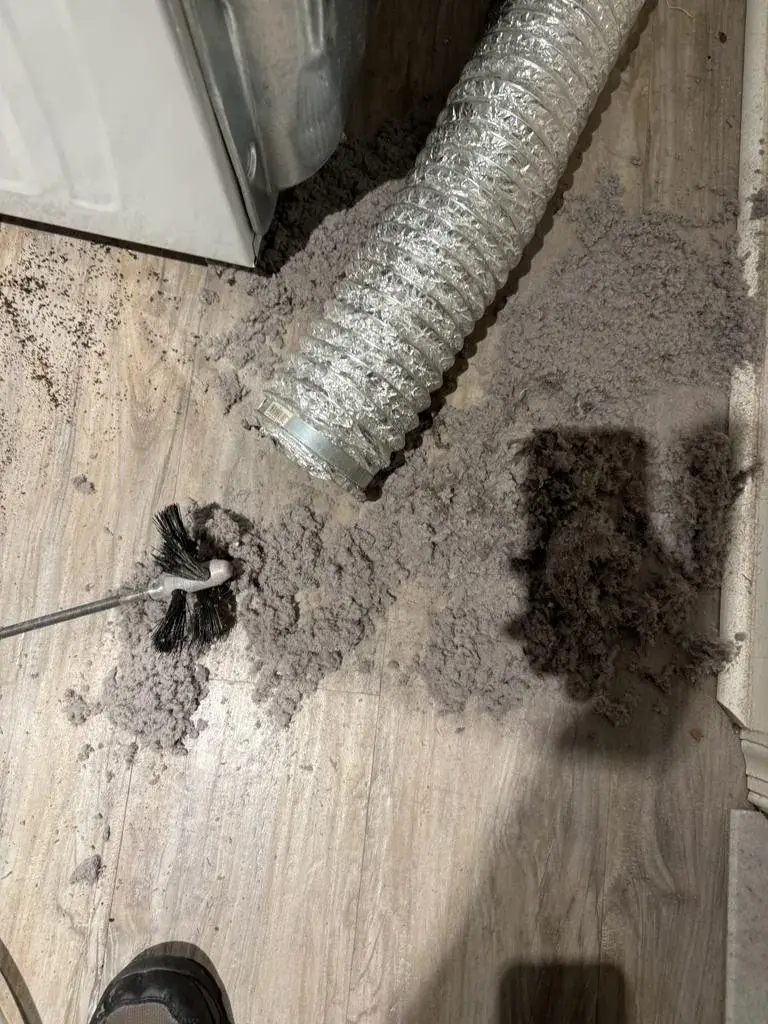
How you know it actually worked
Verification is the part most companies skip and the part you should insist on, whoever you hire. After the cleaning, you should see proof: after-photos of the line and the termination, the exterior flap opening freely under the dryer's own airflow, and a strong, steady stream of air at the cap while the dryer runs. The final test is the one that started this whole article — your next full load should dry in a single cycle.
That before-and-after evidence is standard on every E Cleaning job, and you can read the step-by-step on our process page. We prove the problem before we touch it, and we prove the result before we leave.
What Should You Do This Week?
Treat the second cycle as the deadline it is. Check the simple stuff first: empty the lint screen, pull the dryer out and straighten or replace a crushed transition hose, and watch the exterior flap while the dryer runs. If the flap barely moves, or the clothes still need a second cycle after that, the restriction is inside the run — book a cleaning rather than buying a longer brush. Every E Cleaning job starts with a free video inspection inside the line, and you get a flat, written quote before any work begins — routine cleanings and deep cleanings for nests or long-neglected lines are honestly scoped as different services, so you are never sold one and billed for the other. There are no trip fees anywhere in our service area, no surprise invoice, and no door-step upsell, and financing is available through Wisetack. Our dryer vent cost guide breaks down exactly what is included and what fair market pricing looks like. We are a PA-licensed contractor (PA 187935), insured up to $2 million, serving Montgomery, Chester, Bucks, Delaware, Berks, and Philadelphia counties from King of Prussia, around the clock, Sunday through Friday.
