
Air Duct Cleaning in Lower Makefield, PA
E Cleaning provides professional air duct cleaning throughout Lower Makefield Township, PA — from the colonial subdivisions off Yardley-Newtown Road to the neighborhoods along the Delaware. Every job starts with a free video inspection inside your ductwork, and you receive a flat written quote before any work begins. Licensed PA contractor 187935, insured to $2 million, and rated 4.8 stars across 144 Google reviews.
Duct cleaning shaped by Lower Makefield's housing stock
Lower Makefield sits in lower Bucks County along the Delaware River, with New Jersey directly across the water. It borders Upper Makefield to the north, Newtown Township to the west, Middletown Township to the southwest, and Falls Township and Morrisville to the south — and it wraps around Yardley borough, which is why most of the township carries a Yardley mailing address even though the borough itself is a separate, much smaller municipality. I-295 crosses the river here at the Scudder Falls Bridge, PA 332 runs along the township's northern reaches toward Newtown, and River Road traces the Delaware on the eastern edge.
Lower Makefield is a township, not a borough — and that distinction shows in how it was built. Instead of a compact walkable core, the township filled in wave by wave as farmland converted to subdivisions across the second half of the twentieth century. The earlier waves left ranches, capes, and split-levels from the 1950s and 1960s. The bigger waves came later: street after street of two-story colonials built through the 1970s, 1980s, and 1990s, when Lower Makefield grew into one of lower Bucks County's largest residential townships. Pockets of newer single-family construction, townhomes, and age-restricted communities round out the mix.
For ductwork, those eras matter more than the address. Unlike the slab-built postwar housing further south in the county, Lower Makefield homes overwhelmingly have basements — which means basement furnaces feeding classic trunk-and-branch sheet-metal duct systems, with supply runs branching out through joist bays to every room. In the larger colonials, those runs get long: a supply feeding a far corner bedroom on the second floor may travel a substantial distance from the furnace, and many of the bigger homes run two zones or even two separate systems, one per floor. A duct system serving a 1970s or 1980s colonial today may be forty or fifty years old, and if no owner along the way ever had it professionally cleaned, everything that ever entered it is still in there.
The way a Lower Makefield home is laid out shapes the ductwork as much as its age. The 1950s and 1960s ranches and capes tend toward shorter, simpler runs off a single basement furnace, while the split-levels step their duct geometry with the half-floors. The big two-story colonials are the ones that most often surprise their owners: many run a basement air handler for the first floor and a second air handler tucked into an attic or an upstairs closet for the bedrooms, with flexible ductwork snaking through the attic. That attic flex duct sags between its supports, collects debris in the low spots, and is easy to crush or pull loose during storage or roof work — so it can hide problems a rigid basement trunk never would. Zoned systems with motorized dampers add one more layer the camera has to check run by run.
That is why we never quote a Lower Makefield job over the phone by square footage or vent count alone. A technician runs a camera through your actual supply and return runs first, shows you the footage, and only then puts a flat price in writing. If the camera shows clean ducts, we say so, and you owe nothing.
What actually ends up inside Lower Makefield ductwork
Three things, mostly: dust, renovation debris, and — in some parts of the township — moisture.
The dust itself is ordinary suburban life: pet hair, carpet and upholstery fibers, skin cells, pollen and fine plant debris from a leafy, mature-canopy township, and road grit that drifts in from busy corridors like I-295. Renovation adds sharper spikes. Housing built in the 1970s through the 1990s is now squarely in remodel territory — kitchens, bathrooms, and especially basement finishing projects are common here, and drywall sanding is exactly the kind of fine dust that a running HVAC system pulls straight into its returns. EPA guidance is direct about when duct cleaning is clearly warranted: significant renovation debris, visible mold, heavy buildup, or evidence of pests.
Moisture is the more local story. The neighborhoods along River Road have dealt with Delaware River flooding over the years, and even well away from the river, decades-old basements can run damp in humid summers. A basement furnace and trunk line living in damp air can develop musty odors that get distributed through the whole house every time the blower runs — and visible mold inside ductwork is one of the few cases where the EPA says cleaning is plainly justified. The free video inspection settles the question with footage instead of guesswork.
We keep the health claims measured, because the honest version is persuasive enough. The EPA does not endorse routine duct cleaning as a proven indoor-air-quality cure. What it does report is that indoor levels of some pollutants may be 2 to 5 times — occasionally more than 100 times — higher than outdoor levels, and that people spend about 90% of their time indoors. Removing years of settled debris from the system that circulates your air takes one real contributor out of that equation: many homeowners notice less dust resettling on furniture and fewer musty odors when the system runs, and allergy sufferers often report relief, though results vary home to home.
Camera first, price in writing, then source removal
Our process is built to remove the two things homeowners rightly distrust about this industry: not knowing what is actually in the ducts, and not knowing what the final invoice will say. You see the inside of your own system before you decide anything, and the price you approve is the price you pay.
The free video inspection is where that decision gets made. The camera travels your supply and return runs and shows what is actually there: a light seasonal dusting or caked, felted buildup; clean metal or moisture staining and visible mold; the drywall dust, nails, and cut-offs a remodel left behind; nests, droppings, or insect debris; and crushed or disconnected flex duct leaking conditioned air into an attic. It also shows whether an earlier surface-only pass ever reached past the first few feet of a run. That matters beyond appearances: when buildup coats the walls of a duct and cakes the register vanes, it narrows the opening the system was engineered around, which can restrict airflow and leave some rooms heating or cooling less evenly while the blower works harder to compensate. Clearing a run back to bare metal restores the airflow the system was built for.
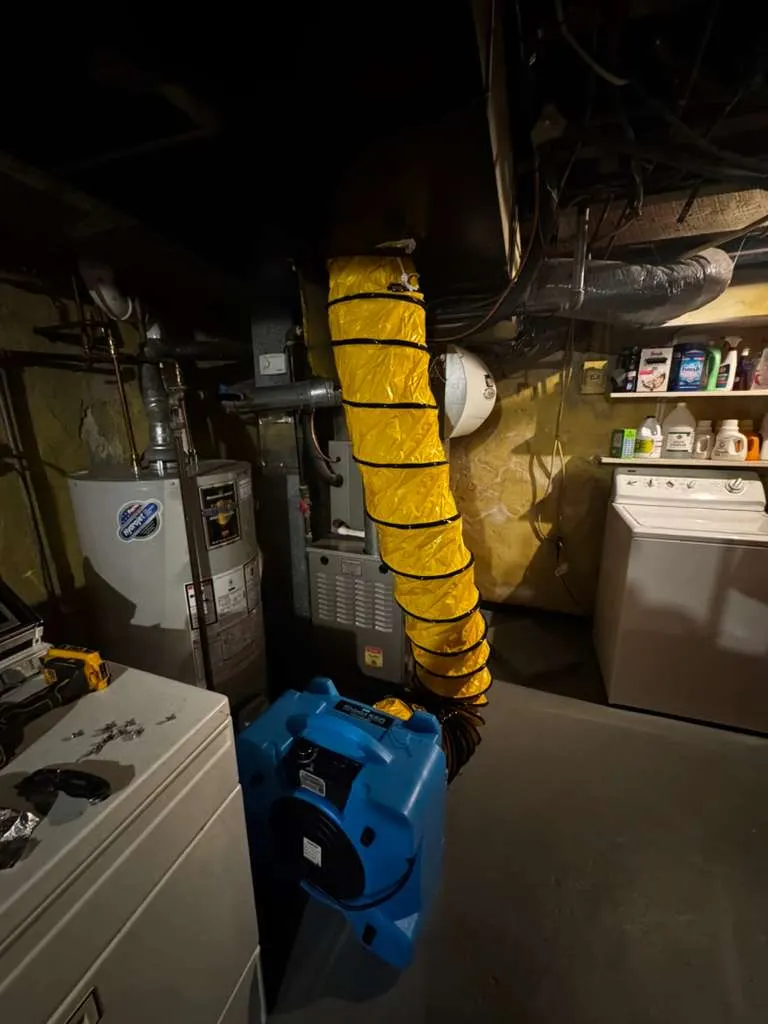
The cleaning itself is source removal — the approach NADCA sets as the industry standard. We connect a professional Nikro negative-pressure machine to your trunk line, which puts the entire duct system under vacuum with HEPA filtration. Then air whips and agitation tools work through every supply and return run, breaking loose the compacted buildup so the vacuum carries it into the collection unit instead of into your living room. In a typical Lower Makefield colonial that means working the basement trunk, every branch run through the joist bays, and the returns — and in two-system homes, repeating the setup for each system. When the work is done you get after-photos of your own ducts, and if sanitization was scoped, we apply EPA-registered products as the final step.
One more honest distinction most companies blur: routine cleaning and deep cleaning are different services, and we scope them as such.
| Routine cleaning | Deep cleaning | |
|---|---|---|
| When it fits | Maintained systems with normal household dust accumulation | Decades of buildup, renovation debris, pest evidence, or mold-affected runs |
| What it involves | Negative-pressure vacuum with agitation through all supplies and returns | Everything in routine, plus heavier agitation, additional access points, and component-level attention where the camera shows it is needed |
| How it is scoped | By the free video inspection — one flat written quote for what your system actually needs, before any work begins | |
We work around the clock, Sunday through Friday — we're closed Saturdays, and Wisetack financing is available if you would rather spread the cost out.
When does a Lower Makefield home actually need duct cleaning?
When the evidence says so. These are the signals worth acting on — and a free video inspection turns any of them from a suspicion into footage:
- Dust puffing visibly from supply registers when the heat or air conditioning starts
- Registers and return grilles darkening again within weeks of being wiped clean
- A musty or damp smell whenever the blower runs — a common complaint in older basements
- A recent remodel, basement finishing project, or drywall work anywhere in the house
- Droppings, insects, or nesting material in or near any vent
- Allergy symptoms that flare indoors and ease when you leave home
On frequency, we will not pretend there is a universal schedule. Many duct-cleaning professionals suggest revisiting the system every three to five years, but the real answer depends on the house: a 1980s colonial that has never been cleaned and just came through a kitchen remodel is a strong candidate; a lightly lived-in newer townhome with good filtration may need nothing at all. The camera decides, not a sales script.
Season shapes the timing too. Through a Bucks County heating season the house stays sealed and the furnace cycles for months, recirculating the same air and whatever rides in the ducts — which is when many homeowners first notice dust resettling faster and a stale edge to the air. Summer flips the problem to moisture: humid air settles into older basements, and condensation around the cooling coil creates the damp conditions that let musty odors and mold take hold near the ductwork. Spring loads the returns with pollen from the township's mature tree canopy. There is no wrong month to clean, and we work year-round, Sunday through Friday — but the quieter shoulder weeks of spring and fall are an easy time to reset the system between the heavy heating and cooling loads.
Lower Bucks mailboxes fill with too-good-to-be-true whole-house duct coupons, and the pattern behind them is well documented: a teaser price gets a crew in the door, then the doorstep upsell begins. Our answer is structural rather than rhetorical — the video inspection is free, the quote is flat and written before work begins, we match any competitor's written quote for the same scope of work, every job carries a 6-month workmanship warranty, and the work is backed by Google Guaranteed protection. No surprise invoice, no pressure at the door.
No trip fees anywhere in Lower Makefield Township
We cover the entire township at no travel charge — the subdivisions off Yardley-Newtown Road, the neighborhoods around the I-295 corridor, and the streets along River Road. Whether your mailing address says Yardley or Morrisville, if the house sits in Lower Makefield, the process is identical: free video inspection first, flat written quote before any work, the same as everywhere else in Bucks County.
The same crew serves the surrounding towns, so if you are trading recommendations with neighbors, we also handle Yardley, Newtown, and Upper Makefield.
And because your dryer exhausts through its own dedicated line that duct cleaning never touches, many homeowners pair this visit with dryer vent cleaning in Lower Makefield — one crew, one written quote covering both systems.
How much does air duct cleaning cost?
Routine and deep cleaning are different services — the free inspection determines which one your system actually needs. Prices vary house to house; your exact price comes as a flat written quote before any work begins.
| Air duct routine cleaning (per HVAC unit) | $299.99 |
| Air duct deep cleaning (per HVAC unit) | $650 |
| Multi-unit homes | Discount available |
| Dryer vent routine add-on | from $129.99 |
Three promises. In writing. On every job.
Price Match Guarantee
Bring a competitor's written quote for the same scope of work — we'll match it. You never overpay for doing it right.
6-Month Warranty
Every job carries a 6-month workmanship warranty. If a problem traced to our work shows up, we come back and make it right — free.
Google Guaranteed
Booked through Google Local Services, qualifying jobs carry Google's own money-back protection up to $2,000, administered by Google.
Backed by a real license and $1M/$2M insurance — see the actual documents
Don't put off air you breathe — finance it with Wisetack
Check your options in about a minute with no impact to your credit score, choose terms that fit your budget, and pay over time instead of all at once.
*All financing is subject to credit approval. Your terms may vary. Wisetack loans are issued by Hatch Bank. See additional terms at wisetack.com/faqs.
4.8 stars from 144 Google reviews — and easy to find
E Cleaning Duct & Vent Cleaning is based at 555 S Goddard Blvd, King of Prussia, and serves Lower Makefield and all of Bucks County from right here. Check our Google profile: real jobs, real photos, and a rating our crew protects on every visit.
- Google Guaranteed business — screened, licensed and insured (see the documents)
- Read every review on our Google profile — we don't cherry-pick what you can verify
Air Duct Cleaning questions from Lower Makefield homeowners
Do you charge a trip fee to come to Lower Makefield?
No. There are no trip fees or travel charges anywhere in Lower Makefield Township — from the River Road neighborhoods to the subdivisions near the Newtown line. Every job starts with a free video inspection, and the flat written quote you approve before work begins reflects the job itself, never the distance.
My mailing address says Yardley — do you still cover my house?
Yes. Most of Lower Makefield Township carries a Yardley mailing address even though Yardley borough is a separate, smaller municipality. We serve both, along with the rest of Bucks County, under the same terms: free video inspection first, one flat written quote before any work.
Our colonial has two HVAC systems, one per floor. How does that work?
Two-system homes are common in Lower Makefield's larger colonials, and we clean both — the negative-pressure setup is simply repeated for each system. The free video inspection covers both sets of ductwork, and your flat written quote spells out the full scope for the whole house before anything starts.
Our basement smells musty when the heat runs. Will duct cleaning fix it?
It depends on the cause, and the camera will tell us. Damp basements — not unusual in older homes here, especially near the river — can produce musty odors that the blower distributes house-wide, and visible mold or heavy buildup in ducts is a case where cleaning is clearly warranted. If the ducts turn out not to be the problem, we tell you so for free.
How long does air duct cleaning take in a typical Lower Makefield home?
Most single-family visits run two to four hours, and large two-system colonials can take longer. The duration depends on the number of vents, the layout, and whether routine or deep cleaning was scoped — all of which is settled in your flat written quote before work begins.
What guarantees stand behind the work?
Three guarantees, plus full licensing and insurance: we match any competitor's written quote for the same scope of work; every job carries a 6-month workmanship warranty; and qualifying jobs are covered by Google Guaranteed protection. E Cleaning is a PA licensed contractor (PA 187935) insured to $2 million.
Ready for honest air duct cleaning in Lower Makefield?
Free video inspection, a flat written quote before any work, and real before/after proof — call (484) 367-5944 or book online now.
