
Dryer Vent Cleaning in Lower Makefield, PA
E Cleaning cleans dryer vents across Lower Makefield Township, PA — basement hookups in the older ranches, second-floor laundry rooms in the big colonials, and the concealed runs in the township's townhome and age-restricted communities. The inspection is free, the quote is flat and in writing before any work begins, and there is no trip fee anywhere in lower Bucks. Licensed PA contractor 187935, rated 4.8 stars across 144 Google reviews.
The floor your laundry sits on decides what your dryer vent has become
Lower Makefield is one of lower Bucks County's largest residential townships — a broad stretch of subdivisions between the Delaware River and the Newtown line, built out over decades rather than all at once. That long build-out left behind at least three distinct generations of laundry setups, and each generation gave its dryer vent a different personality and a different way of failing.
Basement laundry in the older homes. The township's 1950s-to-1970s ranches, capes, split-levels, and early colonials almost all put the washer and dryer in the basement. The vent run itself is often mercifully short — out through the rim joist and done — but these setups fail at the endpoints. The transition hose behind the dryer is frequently the original foil accordion type, crushed flat against the wall for decades and packed with lint at every crease. And the exterior termination sits at or near grade, often behind foundation plantings, where lint mats stay damp, flaps rust or jam, and birds, mice, and wasps move in the moment a pest guard fails.
Upstairs laundry in the newer colonials. From the 1980s onward, builders moved laundry up — first to main-floor mudrooms, then to dedicated second-floor laundry rooms near the bedrooms. Convenient for the household, demanding for the vent: the run now travels a long, fully concealed path through joist bays and wall chases before reaching a sidewall high on the house or a roof termination. Every added foot and every 90-degree elbow restricts airflow — a single hard bend costs roughly as much airflow as several feet of straight pipe — and because the entire run is hidden, nobody sees the problem building. These long upstairs runs are consistently the most lint-loaded lines we open in Lower Makefield.
Attached housing. The township also includes townhome, condominium, and age-restricted communities, where units share walls and vents commonly travel to rooftop terminations. Two things change in attached housing: the run is usually longer and less accessible than the homeowner assumes, and the consequences are shared — a dryer fire on one side of a party wall is every neighbor's emergency.
A river-edge township of subdivisions, and what that means for your vent
Lower Makefield occupies the eastern edge of lower Bucks County, with the Delaware River — and the Pennsylvania–New Jersey line — forming its entire eastern boundary. The township wraps around the small, older river borough of Yardley and meets Newtown Township to the northwest, Upper Makefield to the north, and Falls Township and Morrisville to the south. I-95 runs through the township along the river corridor, US Route 1 passes to the south, and PA Route 332 (Yardley-Newtown Road) ties the older river neighborhoods to the newer development inland. That geography shapes dryer-vent work in two concrete ways.
It is a township of subdivisions, not a walkable borough grid. Unlike the tight, pre-war blocks of Yardley and Morrisville — where a short vent can punch straight through a wall to the sidewalk — Lower Makefield's homes sit on larger, spread-out lots with more house between the laundry room and the outdoors. That means longer, more-turning vent runs, and more concealed pipe where lint quietly compacts out of sight.
The river valley is humid. Homes near the Delaware and its low-lying tributaries sit in ground that holds moisture, and that damp air reaches the exterior termination. Lint that would blow clear off a dry sidewall instead absorbs humidity, mats into a felt-like plug at the flap, and stays there — which is exactly why the grade-level terminations on the township's older basement-laundry homes clog faster than homeowners expect. Lot size, elevation, and river humidity are quietly working on your vent in ways a quick peek behind the dryer will never reveal.
Six signals a Lower Makefield dryer vent is closing up
A clogging vent gives fair warning before it becomes a hazard. Any one of these is reason enough for an inspection — ours is free and ends with a flat written quote, not a pitch:
- Loads that used to dry in one cycle now need two
- The dryer cabinet or the laundry room air feels unusually hot mid-cycle
- A scorched or burning-dust smell while the machine runs
- Little or no airflow at the exterior flap, or lint bearding around it
- Condensation on laundry-area windows or lint accumulating behind the dryer
- No record of the vent ever being professionally cleaned
The calendar matters here too. Winter is peak drying season — more loads, heavier fabrics, and a vent working its hardest precisely when a restriction is most likely to tip into a blockage. Spring brings nesting season, and the grade-level terminations on the township's older basement-laundry homes are exactly where birds and small animals look first. And in the humid stretches of a Delaware Valley summer, lint at a shaded, ground-level termination stays damp and mats down instead of blowing clear. A vent that seemed fine in the fall can be genuinely blocked by the following summer.
What a dryer vent cleaning visit looks like, start to finish
We clean the whole line — from the connection behind the dryer to the termination outside — because a half-cleaned vent is just a vent that clogs again in a few months. Here is the sequence every Lower Makefield visit follows:
Free inspection of the full run
The technician checks the transition hose behind the machine, traces the concealed run, and examines the termination — whether that is a flap at grade behind the shrubs or a cap on a two-story roof.
Flat written quote
You get one written price for exactly what your vent needs before any work begins. If the line turns out to be clear, we say so and you owe nothing.
Brush and vacuum extraction
A rotary brush scours the duct walls while high-powered vacuum extraction pulls the loosened lint out of the line — never deeper into it. The transition hose and accessible lint housing get cleared too.
Termination and hardware check
We clear the exterior flap, check the pest guard, and flag anything worth replacing — like a crushed foil transition hose that should be smooth metal — in writing, so the decision is yours with the facts in front of you.
Airflow verification and after-photos
Strong, steady exhaust at the termination is the pass/fail test, and you get photo documentation of the cleared line.
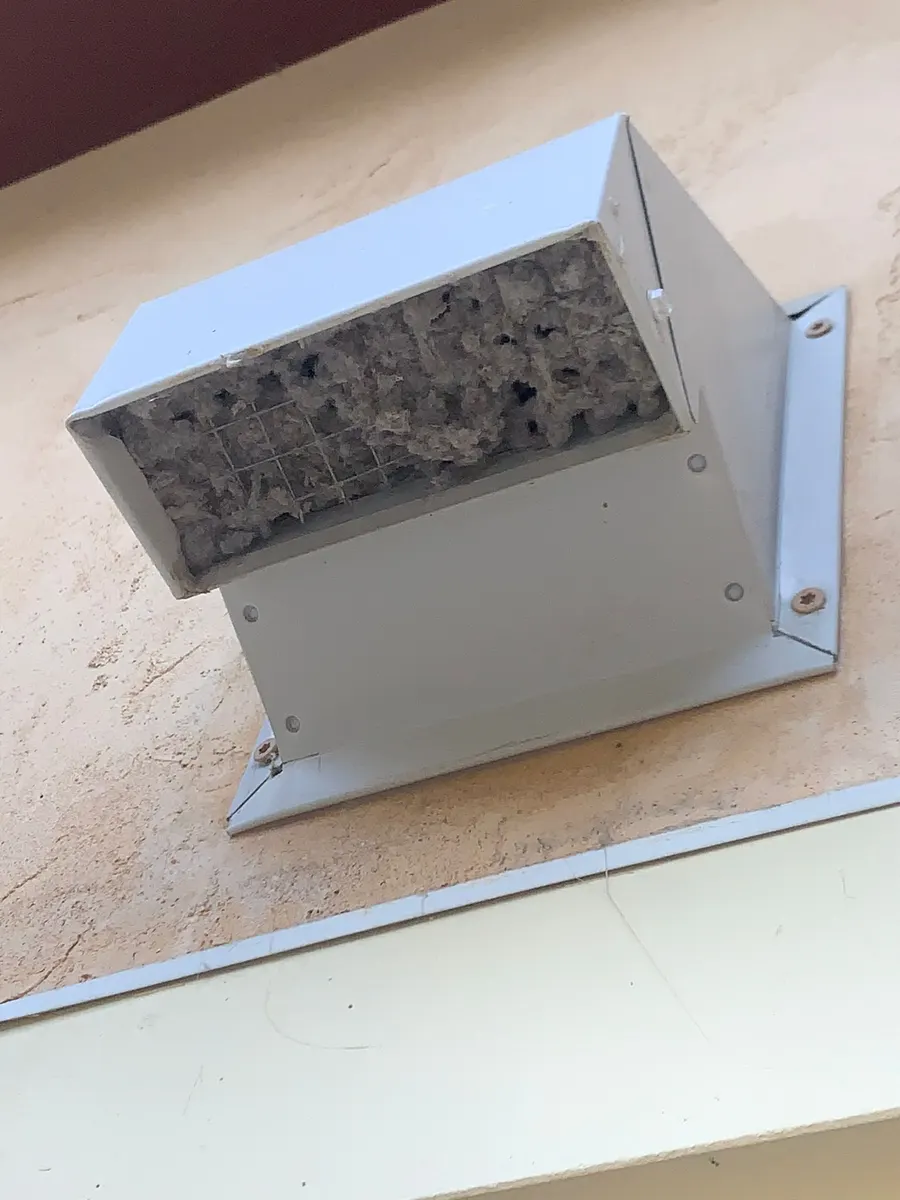
Second-floor laundry venting through the roof is routine work for us — we are equipped for rooftop terminations, which is where many of the township's newer colonials and townhomes exhaust. Every job carries a 6-month workmanship warranty, we match any competitor's written quote for the same scope, and we work around the clock, Sunday through Friday — we're closed Saturdays.
Two different jobs — and the free inspection decides which one you need
Not every dryer vent needs the same work, so we scope two genuinely different services honestly instead of selling the bigger one by default. A routine cleaning suits a vent that has been maintained: the lint is loose, the run is intact, and a rotary brush with vacuum extraction clears it in a single visit. A deep cleaning is for a vent that has never been professionally cleaned, is fully blocked, or hides a bird's nest or years of compacted, moisture-hardened lint — work that takes disassembly, more time, and sometimes nest removal or a new pest guard. The free inspection is what tells the two apart, in writing, before you commit to either.
What the inspection actually shows. Because most of a Lower Makefield vent run is hidden inside walls, joist bays, or a two-story chase, we look at the parts you cannot see. The technician checks the transition hose behind the machine for crushing and kinks, traces the concealed line for compaction points and elbows, and examines the termination for lint bearding, a jammed flap, moisture, or nesting. A short run that is loosely packed is a routine job; a long upstairs run choked solid at three elbows is a deep one — and you see that difference before any number is set.
Our equipment, and the fire-safety reason it matters. We run professional Nikro negative-pressure vacuum machines paired with rotary brushes and agitation tools, so lint is pulled out of the line rather than pushed deeper into it. That matters because lint is highly combustible: a restricted vent makes the dryer run hotter and longer, cycling the heating element against a bed of trapped lint. Failure to clean is the leading factor in home dryer fires, contributing to about one-third of them, per NFPA — and clearing the full run, not just the first few feet, is what actually removes that risk.
Once a year for most homes — and no trip fees anywhere in the township
Annual cleaning is the standard fire-safety rhythm for most households. Families running daily loads, pet owners, and homes with long or many-elbow runs — which describes a lot of Lower Makefield's second-floor laundry rooms and attached housing — often benefit from more frequent checks. The free inspection makes the cadence honest: we tell you what the line actually looks like, not what a schedule says it should.
Every address in the township gets the same terms — no trip fees, no mileage charges, one flat written quote before work begins — whether your mail says Yardley or Morrisville. The same standards apply across all of Bucks County, and the same crew covers the neighboring towns, including Yardley, Falls Township, and Morrisville.
Worth knowing: the dryer vent is its own dedicated line, completely separate from your HVAC ductwork. Many Lower Makefield homeowners pair this service with air duct cleaning in Lower Makefield in a single visit — one crew, one free inspection of both systems, one written quote covering everything.
How much does dryer vent cleaning cost?
Routine and deep cleaning are different services — the free inspection determines which one your system actually needs. Prices vary house to house; your exact price comes as a flat written quote before any work begins.
| Dryer vent routine — basement / 1st floor | $129.99 |
| Dryer vent routine — 2nd floor & up | $149.99 |
| Dryer vent deep cleaning | $299.99 |
| Nest removal · bird guard installation | from $250 · from $150 |
Three promises. In writing. On every job.
Price Match Guarantee
Bring a competitor's written quote for the same scope of work — we'll match it. You never overpay for doing it right.
6-Month Warranty
Every job carries a 6-month workmanship warranty. If a problem traced to our work shows up, we come back and make it right — free.
Google Guaranteed
Booked through Google Local Services, qualifying jobs carry Google's own money-back protection up to $2,000, administered by Google.
Backed by a real license and $1M/$2M insurance — see the actual documents
Don't put off air you breathe — finance it with Wisetack
Check your options in about a minute with no impact to your credit score, choose terms that fit your budget, and pay over time instead of all at once.
*All financing is subject to credit approval. Your terms may vary. Wisetack loans are issued by Hatch Bank. See additional terms at wisetack.com/faqs.
4.8 stars from 144 Google reviews — and easy to find
E Cleaning Duct & Vent Cleaning is based at 555 S Goddard Blvd, King of Prussia, and serves Lower Makefield and all of Bucks County from right here. Check our Google profile: real jobs, real photos, and a rating our crew protects on every visit.
- Google Guaranteed business — screened, licensed and insured (see the documents)
- Read every review on our Google profile — we don't cherry-pick what you can verify
Dryer Vent Cleaning questions from Lower Makefield homeowners
Do you charge extra to come out to Lower Makefield?
No. There are no trip fees or travel charges anywhere in Lower Makefield Township, and a Yardley or Morrisville mailing address makes no difference — most of the township carries one. The inspection is free, and the flat written quote you receive before any work reflects the vent itself, never the drive.
Our laundry room is on the second floor and vents through the roof. Is that a problem?
Not for us — rooftop terminations are routine and common in the township's newer colonials and townhomes. We clean the full concealed run from the dryer connection up to the roof cap, verify airflow at the top, and document the cleared line with after-photos. These long upstairs runs clog faster than short basement runs, so they are worth checking annually.
We live in a townhome community. Can you work on attached housing?
Yes. Townhome and condo vents in Lower Makefield are often longer and less accessible than owners expect, and shared walls raise the stakes for everyone on the row. We clean the full line to its sidewall or roof termination and put the scope in a flat written quote first — useful paperwork if your association asks for documentation.
How often should a dryer vent be cleaned here?
Once a year for most households. Failure to clean is the leading factor in dryer fires, contributing to about one-third of them per NFPA data. Heavy laundry loads, pets, and long or many-elbow runs — typical of second-floor laundry rooms — argue for more frequent checks, and the free inspection tells you honestly whether the line needs work at all.
The dryer runs hot but clothes come out damp. Is that the vent?
Very often, yes. When the exhaust path is restricted, moisture has nowhere to go, so cycles run long and hot while clothes stay damp — the classic signature of a lint-packed line. The free inspection confirms it before you spend anything on the dryer itself, and if the vent is not the culprit, we tell you that too.
Can we have the dryer vent and air ducts done in one visit?
Yes, and many Lower Makefield homeowners do exactly that. The dryer line and the HVAC ductwork are separate systems — duct cleaning never touches the dryer exhaust — but one crew handles both in a single visit, with one free inspection and one flat written quote covering the whole job.
Ready for honest dryer vent cleaning in Lower Makefield?
Free video inspection, a flat written quote before any work, and real before/after proof — call (484) 367-5944 or book online now.
