
Dryer Vent Cleaning in Falls, PA
E Cleaning clears and inspects dryer vents throughout Falls Township, PA — slab-built Levittown-section homes, Fairless Hills ranchers, and the townhome communities along the US 1 and US 13 corridors. You get a free inspection first and a flat written quote before any work begins, with no trip fee anywhere in lower Bucks. Licensed PA contractor 187935 and rated 4.8 stars across 144 Google reviews.
Falls Township sits on the Delaware, and its postwar slabs shape every dryer run
Falls Township occupies the southeastern corner of lower Bucks County, bordered on the east by the Delaware River across from the Trenton, New Jersey area. It is a township rather than a borough — a spread-out patchwork of dense postwar housing tracts, newer development strung along the highways, and the industrial riverfront where the former U.S. Steel Fairless Works once ran. That mix is the reason two homes a mile apart in Falls can have completely different dryer vents.
Two building booms defined most of the houses people do laundry in here. Fairless Hills went up in the early 1950s as housing for workers at that steel plant — the community, like the plant, takes its name from U.S. Steel’s Benjamin Fairless. Right beside it, Levitt & Sons built the Falls Township sections of Levittown between 1952 and 1958: mass-produced homes turned out by the tens of thousands across lower Bucks, the great majority on concrete slabs with no basement.
That slab construction is the single fact that governs dryer venting in Falls. No basement means the laundry lives on the main floor, and the vent has to punch straight out through an exterior wall at or near ground level instead of dropping low and running out beneath the house. Ground-level terminations are easy to reach, but they are also where lint mats trap moisture and where birds and rodents test the flap every spring. Newer townhomes near the US 1 and US 13 corridors flip the problem the other way — laundry on an upper floor and a long, hidden run climbing to a roof cap.
Geography adds one more pressure. Sitting right on the Delaware, Falls laundry rooms fight real river-corridor humidity for much of the year, so a vent that is even partly restricted tips into damp clothes, condensation, and musty odors faster than the same vent would inland. US 1, US 13, PA 413, and I-95 all thread through or past the township, and we cover every neighborhood between them with no trip fee.
Where the dryer sits decides how its vent behaves
The single biggest factor in a dryer vent’s fire risk is the run — how long it is, how many bends it takes, what it is made of, and where it terminates. Falls Township’s housing mix produces three very different laundry setups, and each one fails in its own way.
Slab homes with main-floor laundry. Much of the housing in the Levittown sections of Falls, and in neighboring Fairless Hills, was built in the early-to-mid 1950s on concrete slabs with no basements. That means laundry lives on the main floor — in a utility area off the kitchen, a converted carport, or a later addition. The good news is that many of these runs are short, exiting at ground level just a few feet from the machine. The catch is their age and their weak points: decades-old foil transition hoses crushed flat behind the dryer, and ground-level terminations where lint mats hold moisture and where birds, mice, and wasps find an easy opening the moment a flap or guard fails.
Relocated and extended runs. Postwar houses were built simple, and seventy years of additions have moved plenty of Falls laundry areas from their original spots. Every relocation lengthens the vent run and adds elbows, and each 90-degree bend restricts airflow roughly as much as several feet of straight pipe. A run that grew from four feet to twenty with three bends is effectively a different — and far more clog-prone — appliance than the one the house was built with. Worse, homeowner-added sections are the ones most likely to be ribbed foil or plastic instead of smooth rigid metal, so lint snags on every ridge.
Multi-story and attached housing. The newer townhome and apartment communities near the highway corridors put laundry in second-floor closets, with vents traveling long, concealed distances through floor systems to a sidewall or roof termination. These are the runs that collect lint fastest and get looked at least, simply because nobody can see them. And in attached housing, a dryer fire is never one household’s problem — shared walls raise the stakes for every neighbor on the row.
Is your dryer trying to tell you something?
A restricted vent announces itself long before it becomes dangerous. If you recognize any of these in your Falls home, it is time for an inspection — ours is free, and it comes with a flat written quote, not a sales pitch:
- Towels and jeans need a second cycle to dry
- The dryer top or the laundry area feels noticeably hot mid-cycle
- A faint burning or scorched-dust smell while the dryer runs
- The exterior flap barely moves, or lint is bearding around the termination
- Moisture or condensation in the laundry area, or lint collecting behind the machine
- It has been more than a year since the vent was cleaned — or it never has been
Timing matters in Falls, too. Winter is the heaviest drying season — more loads, thicker fabrics, and a vent working hardest exactly when a clog is most likely, while cold outdoor air meeting warm, moist exhaust can freeze a marginal flap shut. Then spring brings nesting season, and the ground-level terminations common on the township’s slab homes are a favorite spot for birds if the guard is damaged or missing. A vent that ran fine in October can be fully blocked by May.
What our free dryer vent inspection shows — and how we scope the job
Every job in Falls starts with a free inspection of the whole run, and that inspection is what tells us — and you — whether your vent needs a routine cleaning or a deeper one. Those are two genuinely different jobs, not a sales ladder, and we do not guess which one applies over the phone.
The technician disconnects and checks the transition hose behind the machine, traces the concealed run through the wall or floor, and examines the exterior termination — whether that is a ground-level flap a few feet from a Levittown-section utility room or a rooftop cap above a two-story townhome. On long or hidden runs we put a camera down the line so you can see the same thing we see. The inspection reveals the things that actually decide the work: how much lint is in there and whether it is a light, even coating or packed solid; whether the run is crushed, kinked, or sagging; whether the transition hose is sound or deteriorated; whether the exterior flap opens fully and the pest guard is intact; and whether a bird nest, animal debris, or moisture staining is present.
Routine cleaning is for vents that have been kept up — cleaned within roughly the last few years, carrying a normal season’s worth of lint, on a standard accessible run. It is a straightforward brush-and-vacuum that restores full airflow.
Deep cleaning is for vents that have never been done, or not in many years — lint packed hard against the walls, a nest or animal debris to remove, or a long multi-bend or rooftop run that takes more time and equipment to clear completely. Treating one of these as a quick routine clean just leaves buildup behind, so we scope it honestly for what it is.
Whichever it turns out to be, you get a flat written quote for exactly what your vent needs before any work begins — and if we open it up and the line is genuinely clear, we tell you so and you owe nothing. No trip fee, no doorstep upsell, no surprise invoice.
How we actually clear the line
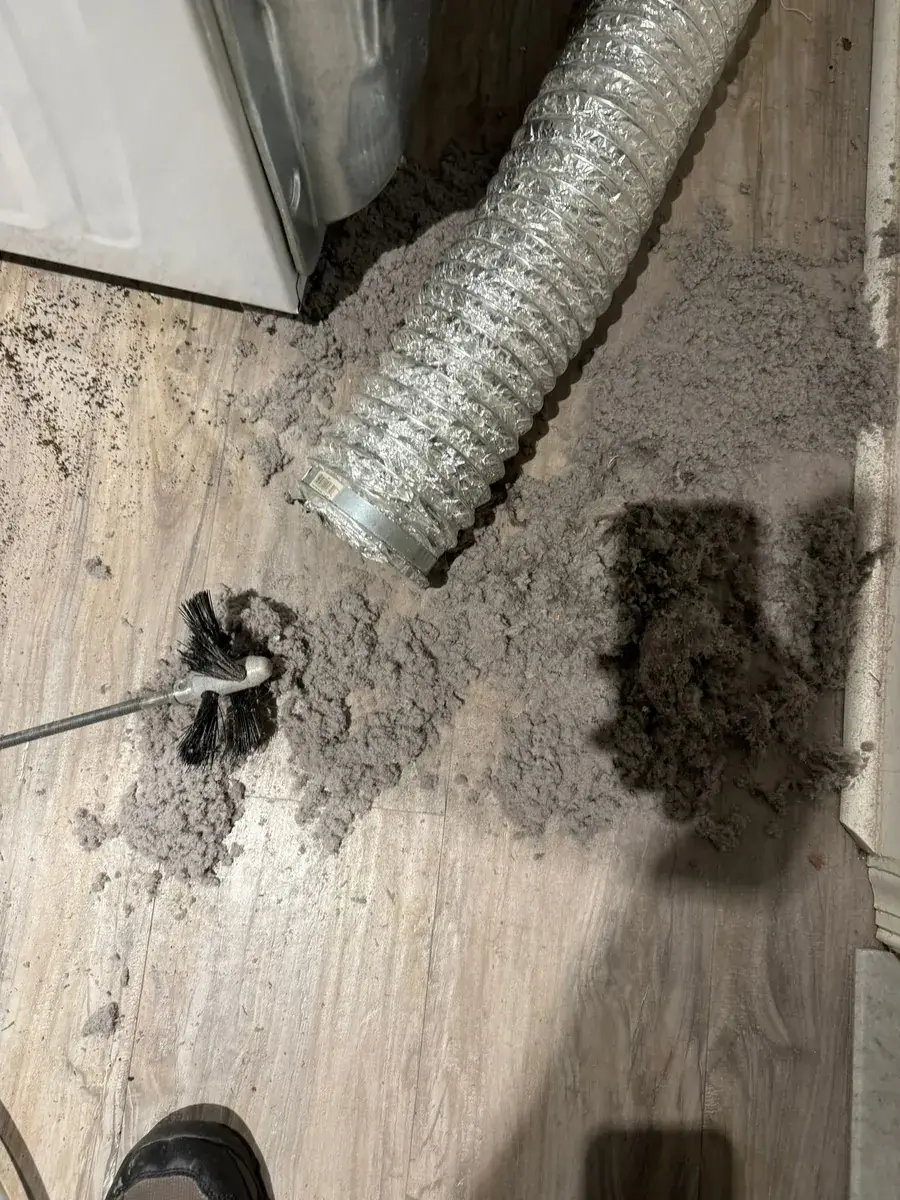
We clean the entire line, from the connection behind your dryer to the exterior termination — nothing partial, because a vent cleaned halfway is a vent that clogs again in months. The method pairs a rotary brush that scours the duct walls with high-powered vacuum extraction, so packed lint is broken loose and pulled out of the run rather than pushed deeper into it.
- Disconnect and inspect the transition hose behind the dryer
- Run a rotary brush the full length of the duct to break lint off the walls
- Vacuum-extract the loosened lint out of the line, not through it
- Clean out the accessible lint-trap housing where fine lint collects
- Clear and reseat the exterior flap; check the pest guard
- Verify strong, steady airflow at the termination — the pass/fail test
- Reconnect the dryer and hand you after-photos of the cleared run
Second-floor laundry closet venting through the roof? We are equipped for rooftop terminations, which is where townhome runs in Falls most often end. Crushed or deteriorated foil transition hose behind the dryer? We flag it in the written quote — smooth rigid metal is the safer replacement — so you decide with the facts in front of you. A standard accessible run is usually about an hour; packed deep-cleans, nest removals, and long rooftop runs take longer, and your quote reflects the real job. Every visit is backed by our 6-month workmanship warranty.
Flat written quote, no trip fees, anywhere in the township
From the Tullytown line to the Morrisville border, every Falls address gets the same deal: a free inspection, then one flat written price before work begins. No trip fees, no mileage charges, no doorstep upsell. We are open 24 hours a day, Sunday through Friday, and closed Saturdays, and the same standards apply across all of Bucks County.
Beyond the flat quote, three real commitments back the work. Our Price Match Guarantee means that if you bring a competitor’s written quote for the same scope, we match it. Every job carries a 6-month workmanship warranty — if a problem traced to our work turns up within six months, we come back and make it right. And qualifying jobs are covered by Google Guaranteed, Google’s own money-back protection of up to $2,000, administered by Google. We are a licensed PA contractor (PA 187935) and insured — you can view our license and insurance anytime — and larger jobs can be financed through https://wisetack.us/#/mx5z71d/prequalify.
How often should this happen? Once a year is the standard fire-safety rhythm for most households; large families, pet owners, and homes with long or many-bend runs — common in Falls given all those additions and second-floor closets — often benefit from more frequent checks. The same crew handles Falls Township’s neighbors, including Bristol, Middletown, and Morrisville. And because the dryer line and your HVAC ductwork are separate systems, many homeowners pair this with air duct cleaning in Falls — two jobs, one visit, one written quote.
How much does dryer vent cleaning cost?
Routine and deep cleaning are different services — the free inspection determines which one your system actually needs. Prices vary house to house; your exact price comes as a flat written quote before any work begins.
| Dryer vent routine — basement / 1st floor | $129.99 |
| Dryer vent routine — 2nd floor & up | $149.99 |
| Dryer vent deep cleaning | $299.99 |
| Nest removal · bird guard installation | from $250 · from $150 |
Three promises. In writing. On every job.
Price Match Guarantee
Bring a competitor's written quote for the same scope of work — we'll match it. You never overpay for doing it right.
6-Month Warranty
Every job carries a 6-month workmanship warranty. If a problem traced to our work shows up, we come back and make it right — free.
Google Guaranteed
Booked through Google Local Services, qualifying jobs carry Google's own money-back protection up to $2,000, administered by Google.
Backed by a real license and $1M/$2M insurance — see the actual documents
Don't put off air you breathe — finance it with Wisetack
Check your options in about a minute with no impact to your credit score, choose terms that fit your budget, and pay over time instead of all at once.
*All financing is subject to credit approval. Your terms may vary. Wisetack loans are issued by Hatch Bank. See additional terms at wisetack.com/faqs.
4.8 stars from 144 Google reviews — and easy to find
E Cleaning Duct & Vent Cleaning is based at 555 S Goddard Blvd, King of Prussia, and serves Falls and all of Bucks County from right here. Check our Google profile: real jobs, real photos, and a rating our crew protects on every visit.
- Google Guaranteed business — screened, licensed and insured (see the documents)
- Read every review on our Google profile — we don't cherry-pick what you can verify
Dryer Vent Cleaning questions from Falls homeowners
Do you charge extra to come out to Falls Township?
No. There are no trip fees or travel charges anywhere in Falls — Fairless Hills, the Levittown sections, or the townhome communities off US 1 and US 13. The inspection is free, and the flat written quote you get before any work reflects the job itself, never the drive.
How often should a dryer vent be cleaned in a Falls home?
Once a year for most households — failure to clean is the leading factor in dryer fires, contributing to about one-third of them according to NFPA data. Short ground-level runs in slab homes still need attention because their terminations collect lint mats and attract nesting pests, while long townhome runs to the roof clog even faster.
My laundry closet is on the second floor and vents through the roof. Can you handle that?
Yes. Roof terminations are routine for us and common in the newer townhome communities around Falls. We clean the full concealed run from the dryer connection to the rooftop cap, verify airflow at the top, and document the result with after-photos.
Do you replace the flexible hose behind the dryer?
We inspect it on every visit. Crushed or aging foil transition hose is one of the most common problems we find behind dryers in Falls’ 1950s-era homes, and if yours needs replacing with smooth metal hose, we include that in the flat written quote before any work begins — your call, with the facts in front of you.
There’s a bird nest in my exterior dryer vent. Can you remove it?
Yes. Ground-level terminations on slab homes are prime nesting spots each spring. We remove the nest and packed debris, clear the full line, and check whether the flap or pest guard needs attention so it does not happen again — all scoped in your written quote.
Can I book dryer vent and air duct cleaning together?
Yes, and many Falls homeowners do. They are separate systems — the dryer exhausts through its own dedicated line that duct cleaning never touches — but one crew can handle both in a single visit, with one free inspection and one flat written quote covering everything.
Ready for honest dryer vent cleaning in Falls?
Free video inspection, a flat written quote before any work, and real before/after proof — call (484) 367-5944 or book online now.
