
Dryer Vent Cleaning in Morrisville, PA
E Cleaning cleans dryer vents end to end in Morrisville, PA — from basement hookups in the borough's older twins to roof-vented laundry closets in newer townhomes. Every visit starts with a free video inspection of the full vent run, and you get a flat written quote before any work begins. Licensed, insured to $2 million, and rated 4.8 stars across 144 Google reviews.
Where Morrisville does its laundry — and why the vent run cares
In most of Morrisville's older housing, the dryer lives in the basement, and that single fact decides almost everything about the vent: how long the run is, how many elbows it turns, and how much lint it traps along the way. Morrisville is a compact borough at the southeastern tip of Bucks County, pressed against the Delaware River directly across from Trenton, with Falls Township wrapping around it on the land side. Its blocks of twins, rowhomes, and small colonials went up before anyone planned a first-floor laundry room, so the machines ended up downstairs — and the vent has to find its own way out.
Think about what that means in a mid-block twin or rowhome. There are only two outside walls that matter, front and back, and the dryer sits below grade somewhere between them. The vent has to climb out of the basement and travel to whichever wall is closer, which routinely produces runs of fifteen to twenty-five feet with three or four elbows. Every foot of duct and every turn slows the airflow, and slower airflow means lint falls out of the airstream instead of riding it outside. The longer and more crooked the run, the faster it packs — and the less a store-bought brush kit from the hardware store can do about it.
Attached housing raises the stakes
Twins and rowhomes share party walls, which means a dryer fire in one home is never just that household's emergency. An estimated 2,900 home clothes dryer fires are reported each year, according to the U.S. Fire Administration. On a dense borough block, the honest way to read that number is simple: keeping your own vent clear is also something you do for the people on the other side of the wall. It is one of the cheapest pieces of fire prevention a homeowner can buy, and unlike most fire safety, it also pays you back immediately in shorter dry times and lower energy use.
There's a practical wrinkle in older Morrisville basements, too. Vent lines installed decades ago were often assembled from whatever was on hand — sections of rigid metal spliced with flexible foil, joints taped rather than clamped, low spots sagging between joists. Those improvised stretches are where we find the heaviest packing, and they are exactly what the camera inspection is for: you see the condition of your specific line before anyone talks about work.
A compact river borough, hemmed in tight
Geography explains why Morrisville's houses sit as close together as they do. The borough packs its homes into barely two square miles of low, flat ground along the Delaware — US 1 slips across to Trenton on the Trenton–Morrisville Toll Bridge, River Road (Route 32) traces the water north, and everything in between was platted on narrow, deep lots long before the automobile suburb. That tight footprint is exactly what forces a basement dryer's vent into a long, turning run to reach an outside wall. The low, near-river elevation compounds it: these basements sit close to the water table and stay humid year-round, which is hard on the older metal ducting strapped to the joists and speeds up how fast a long line loads with lint.
Basement, first floor, or upstairs: how the laundry's location changes the job
The location of the machine determines the route of the vent, and the route determines the work — which is why we camera the full run before quoting anything. In Morrisville we see three broad setups, each with its own failure pattern.
Basement laundry — the borough default. Long horizontal runs strapped along the joists, often decades old, frequently mixing rigid and flexible sections. Low spots collect lint, foil segments tear and snag, and the length alone guarantees the line packs faster than a short straight shot. These runs need professional rotary tooling; nothing sold at retail reaches the middle of a twenty-foot line with force.
First-floor laundry — common in the postwar capes and ranchers on the borough's outer blocks and just over the line in Falls Township, and in additions on older homes. The runs are shorter, but they often pass through crawl spaces or exit through the band joist into hoods that sit low to the ground, where they clog with lint mats, get blocked by mulch and snow, and make easy targets for nesting birds.
Upper-floor and roof-vented setups — laundry closets in townhomes and second-floor conversions usually vent up and out through the roof. Roof terminations clog the worst of all, because nobody ever looks at them: the lint beard grows out of sight until the dryer quits drying. Roof work is part of our normal service, ladder included, not a surprise add-on.
Slab-on-grade homes — just past the borough line, the postwar Levittown-era tracts in Falls Township sit on concrete slabs with no basement at all, and some of Morrisville's newer infill is built the same way. With nowhere to run a vent underneath, the line goes sideways through an interior wall or climbs into the attic to exit a gable or the roof — paths that hide their lint completely until dry times crawl. Older converted twins and duplexes bring a different problem: a shared or stacked laundry serving two units runs almost constantly, so the vent loads at double speed and rarely gets a second look from either tenant.
River humidity and the winter laundry pile
Morrisville's riverside air adds one more factor: damp lint. Humid basement air makes lint heavier and stickier, so it packs into elbows instead of blowing through. Then winter arrives — heavier fabrics, more loads, longer cycles — right when vent flaps stick and terminations ice over. Late fall and winter are when marginal vents in this area finally fail, which makes autumn the smart time to have the line cleaned and checked.
Our lower Bucks crew covers the whole neighborhood: dryer vent cleaning in Falls Township, Lower Makefield, and Bristol, with the full list on our Bucks County page. And if your registers are dusty too, we handle air duct cleaning in Morrisville — many customers schedule both for the same visit.
How to tell your dryer vent is overdue
If towels need a second cycle, suspect the vent before you suspect the dryer. A blocked vent strangles airflow, and every symptom flows from that — heat that can't escape, moisture that can't leave, and a machine working twice as hard to do half the job. Watch for these signs:
- Loads need a second cycle, or jeans and towels come out damp
- The dryer top or the laundry area feels unusually hot mid-cycle
- A burning or hot-lint smell while the dryer runs
- The outside flap barely moves, or lint is bearding around the hood
- Lint collecting behind or under the machine
- Clothes finish with a musty smell instead of a clean one
What our dryer vent cleaning covers
We work the line from the outside in, and we verify instead of assuming. The visit starts at the exterior termination — wall hood or roof cap — where we check the flap, the screen if one was installed, and the state of the lint buildup. Then the camera goes through the full run, and you see the footage: how much lint, where it's packed, whether any section is crushed, torn, or disconnected. That inspection is free, and it's the basis for a flat written quote before any tool touches the vent.
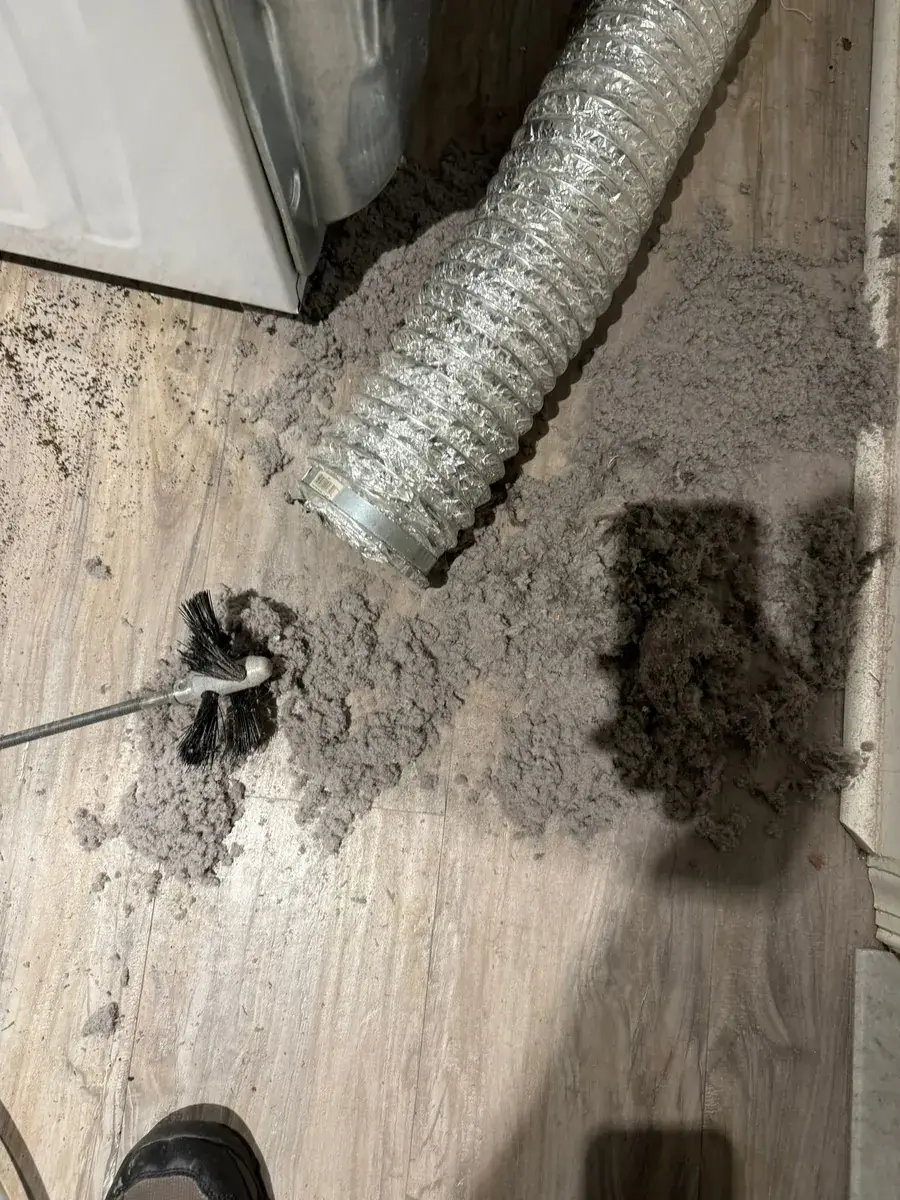
The cleaning itself pairs a rotary brush, driven the entire length of the line, with HEPA-filtered vacuum extraction, so dislodged lint is captured rather than blown into the basement or the yard. Behind the machine, we inspect the transition hose — the short section connecting dryer to wall, and the most commonly crushed piece of the whole system — then reconnect it properly, confirm strong airflow at the termination, and photograph the finished run so you can see the result without climbing anything.
The exterior hood is where jobs are won or lost
A surprising number of vents fail at the very last inch. Older wall hoods were often fitted with a wire screen or fine mesh to keep animals out — but that mesh catches lint by the fistful, and within a year it can choke a line that is otherwise clean. The current standard is a hood with a swinging backdraft damper and no screen at all, so lint carries straight through while cold air and pests stay out; where we find a screened cap strangling a vent, we say so and quote the swap in writing. When we finish, we don't just glance at the flap — we confirm strong, warm air pushing the damper fully open, because a line that looks clear on camera but barely moves the damper isn't truly done.
Why the camera matters
Two Morrisville vents can look identical at the wall and be in completely different condition inside. One is a straight eight-foot run that needs a quick maintenance pass; the other is a twenty-five-foot basement snake with a torn foil splice and a decade of packing. The camera tells us — and you — which job your house actually is, before anyone commits to anything.
Nests, crushed hoses, and the other things we actually find
Lint is the usual suspect, but it isn't the only one. Spring brings birds to unguarded wall hoods — a warm, sheltered tube is prime nesting territory, and a nest blocks a vent completely. We remove nesting debris and can fit a proper guard that keeps animals out without trapping lint. Behind dryers, the most common find is a foil transition hose crushed flat when the machine was pushed against the wall; we replace weak transitions with semi-rigid duct that holds its shape. In finished basements and ceilings, we occasionally find joints that separated years ago and have been quietly dumping lint — and warm, moist air — into the framing ever since. Each of these is documented with photos, priced in writing, and fixed only with your approval.
How often should a Morrisville dryer vent be cleaned?
Once a year for most households. Long basement runs, big families, pet-heavy homes, and dryers that run daily justify a six-to-twelve-month cycle, while a short straight run in a one-person household can stretch longer. If the annual camera check shows a clean line, we say so — the inspection is free either way, and honest advice is the point of it.
Straight talk on scope and cost
We don't quote dryer vent work sight unseen, because the run behind the wall is what defines the job. A routine annual re-clean and a first-ever cleaning of a packed twenty-five-foot line are different services, and we scope them honestly as exactly that. What you can count on: a free video inspection, one flat written quote before any work begins, no trip fees anywhere in Bucks County, and the same guarantee stack behind every job — Price Match on any competitor's written quote for the same scope, a 6-month workmanship warranty, and Google Guaranteed protection up to $2,000 on qualifying jobs.
How much does dryer vent cleaning cost?
Routine and deep cleaning are different services — the free inspection determines which one your system actually needs. Prices vary house to house; your exact price comes as a flat written quote before any work begins.
| Dryer vent routine — basement / 1st floor | $129.99 |
| Dryer vent routine — 2nd floor & up | $149.99 |
| Dryer vent deep cleaning | $299.99 |
| Nest removal · bird guard installation | from $250 · from $150 |
Three promises. In writing. On every job.
Price Match Guarantee
Bring a competitor's written quote for the same scope of work — we'll match it. You never overpay for doing it right.
6-Month Warranty
Every job carries a 6-month workmanship warranty. If a problem traced to our work shows up, we come back and make it right — free.
Google Guaranteed
Booked through Google Local Services, qualifying jobs carry Google's own money-back protection up to $2,000, administered by Google.
Backed by a real license and $1M/$2M insurance — see the actual documents
Don't put off air you breathe — finance it with Wisetack
Check your options in about a minute with no impact to your credit score, choose terms that fit your budget, and pay over time instead of all at once.
*All financing is subject to credit approval. Your terms may vary. Wisetack loans are issued by Hatch Bank. See additional terms at wisetack.com/faqs.
4.8 stars from 144 Google reviews — and easy to find
E Cleaning Duct & Vent Cleaning is based at 555 S Goddard Blvd, King of Prussia, and serves Morrisville and all of Bucks County from right here. Check our Google profile: real jobs, real photos, and a rating our crew protects on every visit.
- Google Guaranteed business — screened, licensed and insured (see the documents)
- Read every review on our Google profile — we don't cherry-pick what you can verify
Dryer Vent Cleaning questions from Morrisville homeowners
Do you charge extra to come out to Morrisville?
No. There are no trip or travel fees in Morrisville or anywhere else we serve — our crews run lower Bucks routes constantly. The visit starts with a free video inspection of the vent run, and the flat written quote you approve is the number you pay.
My rowhome's vent runs the full depth of the house. Can you clean all of it?
Yes. Long, multi-elbow basement runs are exactly what our rotary brush and HEPA vacuum equipment are built for, and the camera confirms the line is clear end to end — we don't guess from the outside. Long runs are the ones that need professional cleaning most, because no retail brush kit reaches their middle with any force.
Do you clean roof-vented dryer lines in Morrisville?
Yes — ladder and roof work is part of the standard service, not an add-on surprise. Second-floor laundry closets and townhome setups that vent through the roof tend to clog the worst because the termination is out of sight. We clean the run, clear the roof cap, and photograph the result.
How long does a dryer vent cleaning take?
Most Morrisville visits take about an hour. A severely packed line, a bird nest, or a damaged exterior hood can extend that, but you'll know before we start — the free video inspection shows exactly what's in the run, and the written quote reflects the real scope.
How often should I have the vent cleaned if my laundry is in the basement?
Once a year is right for most households. Damp river-valley air makes lint stickier, so long basement runs in Morrisville tend to pack faster than short straight ones. Laundry-heavy homes with kids or pets often do better on a six-to-twelve-month cycle.
What does dryer vent cleaning cost in Morrisville?
We price it the honest way: a free video inspection of your specific run first, then one flat written quote before any tool touches the vent. A routine annual re-clean and a first-time cleaning of a packed line are scoped as different services, and we'll match any competitor's written quote for the same scope of work.
Ready for honest dryer vent cleaning in Morrisville?
Free video inspection, a flat written quote before any work, and real before/after proof — call (484) 367-5944 or book online now.
