
Dryer Vent Cleaning in Bristol, PA
E Cleaning cleans dryer vents end to end across Bristol Borough and Bristol Township — every foot of duct from the connection behind the machine to the exterior hood or roof cap. Every job starts with a free inspection of the full vent run, and you get a flat, written quote before any work begins. We are family-owned, Pennsylvania-licensed (PA 187935), insured up to $2 million, and Google Guaranteed.
Where Bristol does its laundry — and why the vent path is the whole story
In Bristol, a dryer vent problem is really a floor-plan problem. The borough's rowhomes and twins keep the washer and dryer in the basement, where the vent may have to travel most of the length of the house before it finds an exterior wall. In the township's Levittown sections there is no basement at all — the laundry sits at grade on a concrete slab, and the vent path depends entirely on where seventy years of remodeling left the machines.
Start with the borough. Bristol Borough is one of Pennsylvania's oldest river towns, and the blocks around Mill Street and Radcliffe Street were built generations before anyone owned a clothes dryer. A rowhome shares party walls on both sides, which leaves a basement dryer exactly two ways out: the front wall or the back. Since the laundry hookup usually landed mid-house, next to the old laundry sink and the plumbing stack, the vent often runs a long horizontal path across the basement ceiling before it ever reaches daylight. Every added foot and every elbow along that path slows the airflow, and slow air is precisely what lets lint drop out of the airstream and pack in place. Long borough basement runs are the vents we most often find loaded from end to end.
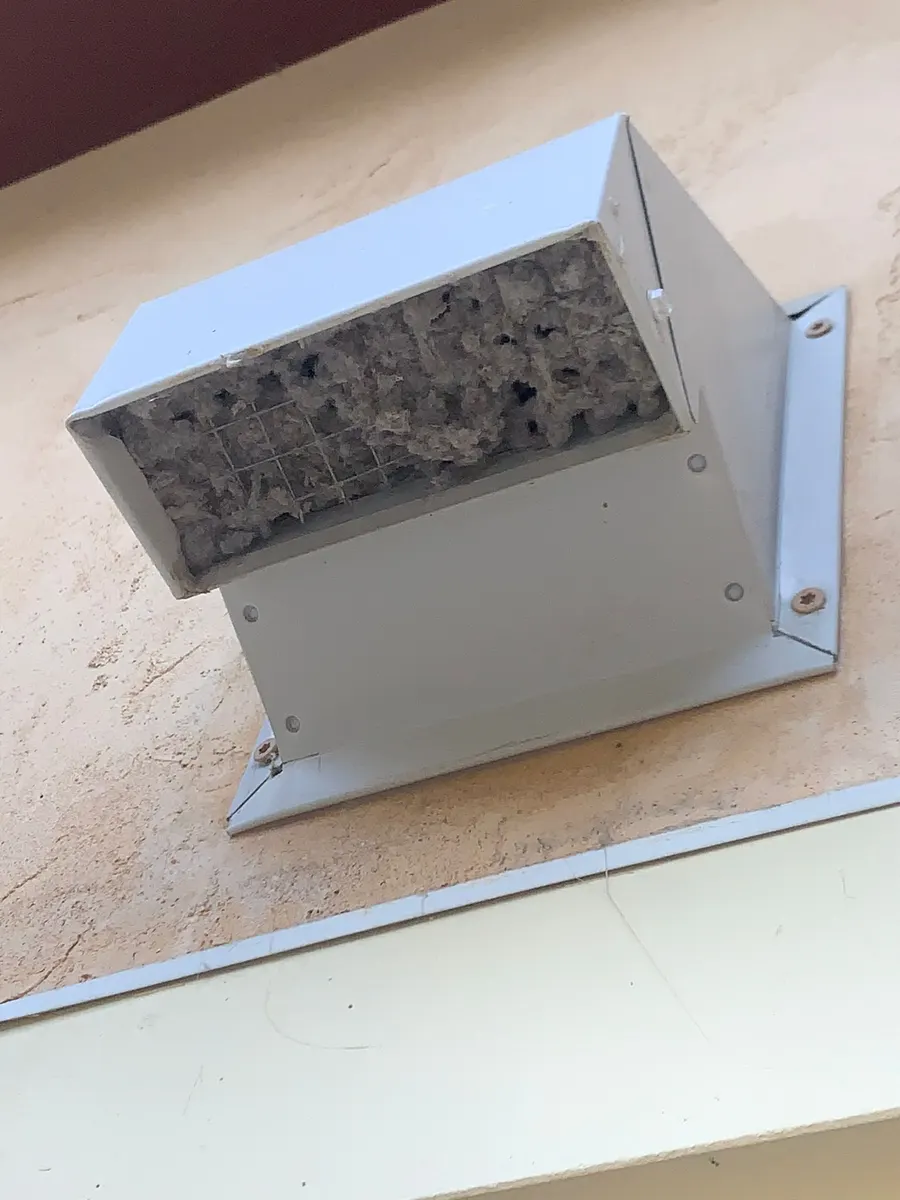
Then there are the exits themselves. In a nineteenth- or early-twentieth-century masonry building, the vent leaves through a hole cut in brick or stone, frequently close to grade in an alley or side yard where the hood takes weather, road grit off the street, and the occasional nesting bird. A flap that has rusted stiff, matted over with lint, or been covered with a fine screen “to keep animals out” restricts the vent even when the duct behind it is clean. That is why the exterior termination gets checked on every Bristol job, not just the duct.
The township is the opposite problem. In the Levittown sections and much of the rest of Bristol Township, the postwar houses went up on slabs with no basements, so laundry lives at grade — a utility corner, a closet off the kitchen, sometimes the garage. The original vent runs were mercifully short: a few feet straight through the wall. Short is good. But decades of remodeling have moved a lot of those machines. Additions absorbed the old utility area, laundry migrated to a hall closet or an upstairs alcove in expanded two-story homes, and the vent path that followed is longer, bends more, and often disappears into ceilings where nobody has looked since the drywall went up. Croydon's capes and bungalows along the Route 13 corridor tell the same story with more improvisation — hookups added wherever the plumbing allowed, vented however the installer could manage at the time.
Bristol's setting adds a quieter factor: moisture. Summer air along the Delaware runs humid, and a dryer pulling damp air has to work longer on every load. A vent already narrowed by lint turns that into two or three cycles per basket of towels — money out the door every week, and heat building up in the machine while it happens. Homes near the US 13 and I-95 corridors also collect more fine dust in and around the laundry area, dust the lint screen never sees but the vent slowly does.
Put simply: the shortest, healthiest vents in Bristol are the original slab-house wall exits, and the longest, most vulnerable ones are borough basement runs and relocated laundries. If you do not know which kind you have, that is exactly what the free inspection answers — before you commit to anything.
Why this matters: lint is fuel, and a blocked vent supplies the heat
The numbers are worth stating plainly. U.S. fire departments respond to an estimated 15,970 home fires involving clothes dryers or washing machines each year, and failure to clean is the leading factor, contributing to one-third (33%) of dryer fires, according to NFPA data from 2010–2014. The U.S. Fire Administration (FEMA) separately estimates 2,900 home clothes dryer fires are reported each year. The mechanism is simple: a restricted vent traps hot, moist air in the duct, the dryer runs longer and hotter to compensate, and the lint packed inside sits directly in the path of that heat.
The township has its own version of the risk. A slab-house vent that exits low on an exterior wall sits behind shrubs and gets mowed around for decades without anyone lifting the flap. In two-story additions and newer townhome rows in lower Bucks, vents that terminate through the roof are effectively invisible — a clogged roof cap announces itself only through symptoms at the machine, usually years into the buildup.
One habit worth keeping straight: clean the lint screen every load, but do not mistake the screen for vent maintenance. The screen catches what you can see; the duct collects what you cannot. By the time symptoms show up at the dryer, the buildup inside the line is typically measured in years, not weeks.
Warning signs Bristol homeowners should not ignore:
- Towels and jeans need two or three cycles to dry
- The dryer, its door, or the laundry area feels unusually hot mid-cycle
- A burning or scorched smell while the dryer runs
- Little or no airflow at the outside hood, or a flap that never lifts
- Lint gathering behind the machine or around the exterior vent
- The dryer shuts itself off or trips its thermal safety
There is also the quiet cost that arrives long before any fire: a dryer pushing damp air through a packed vent burns gas or electricity re-drying the same laundry, load after load. Restoring full airflow shortens cycles immediately — the fire-risk reduction rides along with it.
How we clean a Bristol dryer vent — and how you know the cost before we start
Every Bristol job follows the same sequence: a free inspection of the complete vent run first, then a flat, written quote before any work begins. A routine annual maintenance cleaning and a deep, first-time restoration of a vent that has never been serviced are genuinely different jobs, and we scope them honestly as different services — either way, you approve the written number before a single tool comes out.
Free inspection
We trace the full run — from the transition hose behind the dryer, through every elbow and concealed section, to the wall hood or roof cap — and show you what is actually inside it.
Flat written quote
Based on what the inspection found, you get one written number for the honestly scoped job: routine cleaning if the vent needs maintenance, deep cleaning if it is packed, obstructed, or has never been touched. No doorstep revisions.
Source-removal cleaning
We detach and inspect the transition hose, run rotary brushes through the entire length of the duct, and capture the loosened lint with vacuum extraction so it ends up in our equipment — not blown across your basement or yard. The exterior hood or roof cap gets cleared and its flap checked.
Verification
We reconnect everything, run the dryer, and confirm strong airflow at the termination before we leave, with after-photos for your records.
Routine vs. deep — the honest difference
A vent cleaned on a regular schedule is a quick, predictable maintenance visit. A borough basement run packed solid along its full length, a nest lodged behind an exterior hood, or a crushed section hidden in a remodeled ceiling is restoration work — more time, more equipment, sometimes a repair recommendation instead of a cleaning. The inspection tells us which situation yours is, and the written quote reflects it before work starts, not after.
Two findings come up often enough in Bristol to flag in advance. First, plastic or foil accordion-style transition hose behind the dryer: it sags, traps lint in every ridge, and falls short of current safety guidance — when we see it, we point it out and can swap in semi-rigid metal. Second, improvised vent paths in remodeled homes — a duct that dumps into a garage, a crawl area, or a ceiling cavity instead of reaching the outdoors. You get photos and a straight recommendation in both cases, never a surprise line item.
Lower Bucks gets its share of coupon-flyer offers that turn into invented emergencies once the crew is inside. Our answer to that whole playbook is structural: the inspection is free and documented, the quote is flat and in writing before work begins, and Google Guaranteed backs qualifying jobs with money-back protection up to $2,000 on top of our Pennsylvania contractor license (PA 187935) and insurance up to $2 million. Financing is available through Wisetack for larger scopes.
Booking in Bristol Borough, Bristol Township, and next door
We schedule around the clock, Sunday through Friday — we're closed Saturdays when a vent problem cannot wait. Lower Bucks is a regular run for our crews, so there is no travel fee and no minimum — the free-inspection-then-written-quote process is identical whether you are on a borough block near the river or in a township neighborhood off Route 413.
Landlords and property managers, take note: the borough's apartments over storefronts and the township's rental homes hold some of the least-serviced dryer vents in the area, because nobody living with the machine owns the building it vents through. A per-unit vent cleaning is inexpensive insurance in attached housing, and the written documentation — inspection findings, quote, after-photos — is useful for your records. Tenants: if the dryer needs multiple cycles, this page is an easy thing to forward.
The same process applies throughout the area. We clean dryer vents in Tullytown, Falls Township, and Bensalem, and across the county — see the full list on our Bucks County page. Many Bristol customers pair this visit with air duct cleaning in Bristol, since the dryer usually sits a few steps from the air handler and the crew is already at the house — both jobs get their own free inspection and their own written quote.
How much does dryer vent cleaning cost?
Routine and deep cleaning are different services — the free inspection determines which one your system actually needs. Prices vary house to house; your exact price comes as a flat written quote before any work begins.
| Dryer vent routine — basement / 1st floor | $129.99 |
| Dryer vent routine — 2nd floor & up | $149.99 |
| Dryer vent deep cleaning | $299.99 |
| Nest removal · bird guard installation | from $250 · from $150 |
Three promises. In writing. On every job.
Price Match Guarantee
Bring a competitor's written quote for the same scope of work — we'll match it. You never overpay for doing it right.
6-Month Warranty
Every job carries a 6-month workmanship warranty. If a problem traced to our work shows up, we come back and make it right — free.
Google Guaranteed
Booked through Google Local Services, qualifying jobs carry Google's own money-back protection up to $2,000, administered by Google.
Backed by a real license and $1M/$2M insurance — see the actual documents
Don't put off air you breathe — finance it with Wisetack
Check your options in about a minute with no impact to your credit score, choose terms that fit your budget, and pay over time instead of all at once.
*All financing is subject to credit approval. Your terms may vary. Wisetack loans are issued by Hatch Bank. See additional terms at wisetack.com/faqs.
4.8 stars from 144 Google reviews — and easy to find
E Cleaning Duct & Vent Cleaning is based at 555 S Goddard Blvd, King of Prussia, and serves Bristol and all of Bucks County from right here. Check our Google profile: real jobs, real photos, and a rating our crew protects on every visit.
- Google Guaranteed business — screened, licensed and insured (see the documents)
- Read every review on our Google profile — we don't cherry-pick what you can verify
Dryer Vent Cleaning questions from Bristol homeowners
Do you charge extra to come to Bristol?
No. There is no travel fee, fuel surcharge, or minimum anywhere in our service area, and lower Bucks is a regular route for our crews. Every Bristol job — borough or township — starts with a free inspection of the vent run, followed by a flat written quote before any work begins.
My rowhome's dryer vent runs almost the whole length of the basement. Can you clean a run that long?
Yes. Long horizontal runs are the norm in Bristol Borough's rowhomes, because party walls on both sides leave only the front or back wall as an exit. Rotary brushes and vacuum extraction handle the full length, elbows included. Long runs also load up fastest, so they are the vents that benefit most — the free inspection shows you exactly how much is in yours before you decide.
My Levittown-section house has no basement and I honestly don't know where the vent goes. Is that a problem?
It is common, not a problem. Slab-house laundries have been relocated by decades of remodeling, and the vent path often disappears into a ceiling or an addition along the way. The free inspection traces the complete run and finds the termination, and the written quote you approve reflects what the run actually is — not a guess.
How often should a dryer vent be cleaned in Bristol?
Once a year is the sensible baseline for attached borough homes, long basement runs, and relocated laundries. An original slab-house vent that exits a few feet through the wall can sometimes stretch longer if airflow stays strong. Keep in mind that failure to clean contributes to one-third of dryer fires, per NFPA data — when in doubt, the free inspection settles it.
Birds keep getting into my exterior vent hood. Do you handle that?
Yes. Low wall hoods in alleys and side yards are prime nesting spots, and a nest blocks the vent completely. If the inspection finds nesting material, removal is scoped into the written quote — honestly, as the deeper job it is — and we make sure the flap closes properly afterward. If the hood itself is damaged, you get photos and a straight recommendation.
Can you clean the air ducts on the same visit?
Yes, and many Bristol customers bundle the two, since the dryer usually sits near the air handler. Each service gets its own free inspection and its own flat written quote — see our air duct cleaning in Bristol page for how that visit works.
Ready for honest dryer vent cleaning in Bristol?
Free video inspection, a flat written quote before any work, and real before/after proof — call (484) 367-5944 or book online now.
