
Air Duct Cleaning in Rutledge, PA
Air duct cleaning in Rutledge, PA starts with a free video inspection inside your ductwork — you watch the footage, then approve a flat written quote before any work begins. E Cleaning is family-owned, PA-licensed (PA 187935), insured up to $2 million and Google Guaranteed, and Rutledge is an easy run from our King of Prussia base — I-476 south to Baltimore Pike, then into the borough past Morton.
One of the smallest boroughs in Pennsylvania, near the center of Delaware County
Rutledge covers roughly a tenth of a square mile of central Delaware County, which makes it one of the smallest boroughs in Pennsylvania — a pocket of tree-shaded residential blocks with Morton pressed against its eastern edge, Swarthmore across the line to the west and Ridley Township wrapping around the south. Fewer than a thousand people live here, nearly all of them in houses that were standing before World War II. The borough was laid out in the 1880s as one of the county's early planned rail-commuter communities, and it has kept that character with unusual purity: no commercial strip, no highway of its own, just porches, mature street trees and a grid you can walk end to end in about ten minutes.
Small does not mean isolated. SEPTA's Media/Wawa Regional Rail line stops at Morton station, steps past the borough line, and the road connections that serve Morton serve Rutledge equally well: Kedron Avenue — Route 420 — runs north to south a couple of blocks east, Baltimore Pike crosses just to the north, I-476 is a few minutes away, and MacDade Boulevard passes below through Ridley Township on its way along the riverfront towns. Center City Philadelphia sits roughly ten miles to the northeast. For our crews, that geography makes Rutledge an easy stop on routes we already run every week. For Rutledge's ductwork, the geography that matters is vertical — two and three stories of balloon-framed Victorian standing over a stone-walled basement, with a heating system that has been reinvented at least twice since the house was built.
We reach the borough from our headquarters at 555 S Goddard Blvd in King of Prussia by the same corridor we ride to jobs across central Delco — I-476 south to Baltimore Pike, east toward Morton, then into Rutledge's little grid. Every job here runs on the terms we use everywhere we work: a free video inspection inside the ducts before anything else, a flat written quote before any work begins, no trip fees, and scheduling 24 hours a day, Sunday through Friday — closed Saturdays.
Victorians built for coal, retrofitted for everything since
Rutledge went up essentially in one building campaign, and its signature house is the tall frame Victorian: steep roofs, generous porches, plaster-and-lath walls and, structurally, the balloon framing of its era — long studs running unbroken from the sill plate up toward the roofline, leaving open cavities that travel the full height of the house. A scattering of early-twentieth-century foursquares and modest interwar infill rounds out the stock, and because the borough ran out of open land almost immediately, genuinely new construction is close to nonexistent. When we open up a duct system in Rutledge, we are nearly always working inside a house that predates forced-air heating entirely — a house that has had ductwork imposed on it, not designed into it.
The heating history of these homes runs coal to oil to gas, and the ductwork arrived somewhere in the middle of the story. Some houses converted a gravity coal furnace — the old octopus in the basement — to forced air and inherited its oversized, leaky trunk runs. Others kept their radiators and added cooling much later, which in a tall Victorian usually means an air handler in the attic feeding flex duct down through closets: a second, completely separate system living at the top of the house. And in many retrofits, installers used what balloon framing offered for free — the open stud cavities and joist bays became return-air paths, panned over with sheet metal rather than built as sealed duct. A cavity return breathes whatever the structure sheds: plaster dust working loose behind lath, early insulation breaking down, and soot that settled into the framing back when the coal furnace was still burning.
The practical upshot is that no two Rutledge systems are alike, and a fair number of houses hold two systems at once — an aging furnace and its trunk lines below, an attic flex-duct network above, each with its own runs, its own access quirks and its own decades of accumulation. That is exactly why we will not quote a Rutledge house over the phone. The camera goes into the actual runs first, you watch what it finds, and the flat written quote reflects the system you own rather than an average of systems you don't.
Old plaster below, old trees above: where a Rutledge home's dust comes from
A house here collects dust from inside and outside at the same time. Inside, the building sheds into its own returns — plaster keys crumbling behind century-old lath, early insulation degrading in wall cavities, and the gaps between original floorboards feeding panned joist bays with everything that settles through them. Outside, the borough's mature street trees run their full seasonal cycle over every roof and window: pollen in spring, canopy dust through summer, leaf litter ground fine through fall. And the regional load never rests — Route 420 and Baltimore Pike carry steady traffic within blocks of every Rutledge address, while the I-95 corridor and Philadelphia International Airport work the air a few miles to the southeast.
The quantities involved surprise people. According to the U.S. EPA, indoor levels of some pollutants may be 2 to 5 times — occasionally more than 100 times — higher than outdoor levels, and people spend about 90% of their time indoors. Industry sources such as Stanley Steemer estimate the average six-room home can accumulate 40 pounds of dust in a year. A Rutledge Victorian that has been recirculating air through cavity returns since forced air was installed has been running that arithmetic for a very long time.
Signs a Rutledge house is ready for a look inside its ducts:
- Dust reappears on furniture within a day or two of wiping it away
- Supply registers or the return grille show dark edges or matted buildup
- A musty, closed-up smell when the furnace or the attic system starts a cycle
- The house was recently purchased, renovated or cleared out after a long ownership
- Allergy or asthma symptoms flare indoors, especially overnight
- Nobody can say when — or whether — the ducts were last cleaned
Source removal: the whole system goes under vacuum before anything is loosened
Source removal — the approach NADCA sets as the industry standard — rests on one rule: establish suction before creating dust. We connect a professional Nikro negative-pressure machine to the main trunk of your system and seal every register in the house, which puts the entire duct network under continuous vacuum. Only then do the agitation tools go in — compressed-air whips and rotary brushes that break loose the buildup that years of humidity have bonded to the duct walls. Because the system is already under negative pressure, everything that comes loose has exactly one direction available: toward the machine and its HEPA filtration, never into your rooms.
That ordering is what makes the method work in Rutledge's improvised systems. A balloon-frame cavity return or a panned joist bay is not something a brush can be pushed through — but it does not need to be. Under vacuum, the moving air itself carries freed debris out of stretches no tool physically enters, which is the only honest way to clean a return path that is really the skeleton of the house. Attic flex-duct systems get the opposite consideration: flex runs are worked with gentler agitation matched to the material, because tearing a flex liner in the name of cleaning it is no favor to anyone.
Free video inspection
The camera goes through your supply and return runs while you watch. This is where routine versus deep gets decided — by footage, not by a pitch.
Flat written quote
One number for the full defined scope, in writing, before any work begins. It does not change mid-job.
Protect and seal
Floors and furniture are covered, every register is sealed, and the Nikro machine is connected at the trunk.
Clean under vacuum
Air whips and rotary brushes work every supply and return branch while suction runs continuously.
Registers washed
Grilles and registers come off, get washed, and go back on.
After-photos
You get photos of the cleaned runs for your records before we leave.
Routine or deep: two honestly different services, decided by the camera
The industry habit of quoting one phone price for every house is where its bait-and-switch problems begin, because the two jobs hiding behind that price are not the same job. We scope them honestly as different services, and the camera — not a salesperson standing in your basement — decides which one your house needs.
| What the camera finds | What that means for the job |
|---|---|
| Ducts professionally cleaned within the last few years, light recent dust | Routine cleaning — lighter agitation, fewer passes, a shorter visit that brings the system back to baseline |
| Runs never opened since installation, heavy bonded buildup, renovation debris | Deep cleaning — heavier tooling, more passes and more hours on site; the full reset an old retrofit usually needs |
| Visible mold or construction debris beyond normal accumulation | Scoped and itemized separately in the written quote before any work — never a mid-job discovery |
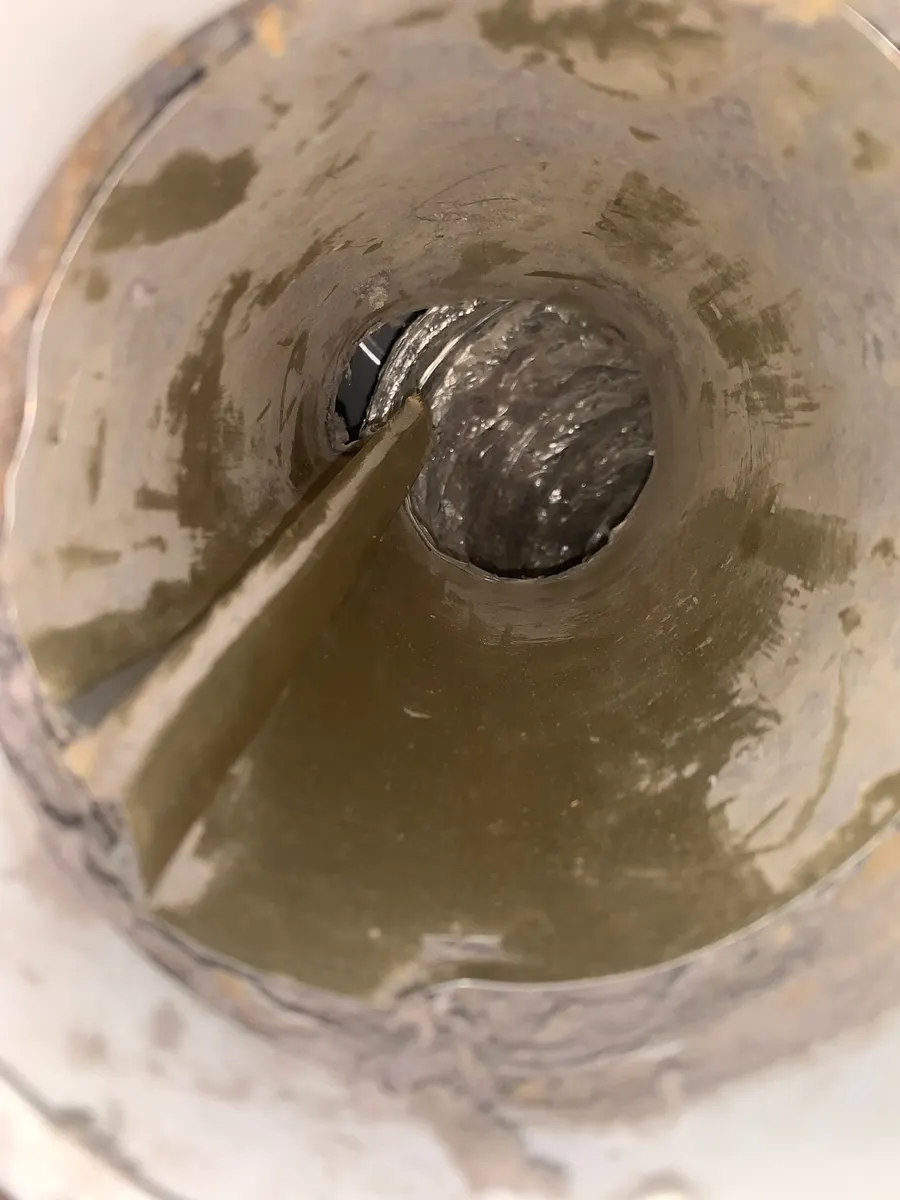
What decades look like inside a run
Round supply branches in older systems cake with bonded dust that no filter change ever touches. The free inspection puts your actual runs on screen, so the routine-or-deep call is made on evidence you have seen yourself.
Most single-system Rutledge homes take a few hours door to door. A tall Victorian carrying both a basement furnace and an attic system takes longer, and a first-ever deep cleaning longer still — and none of that moves your price, because the flat written quote was approved before the first tool came out. If the camera finds a system that is genuinely clean, we say so and leave you the footage; the inspection costs nothing either way. If lingering odors are part of the complaint, an EPA-registered sanitizing or deodorizing treatment can be added after cleaning, itemized on the same written quote. And every job carries our 6-month workmanship warranty: if a problem traced to our work shows up within six months, we come back and make it right free.
A written quote before work begins — the opposite of the coupon game
The "$49–$99 whole-house special" flyers reach Rutledge mailboxes just like everyone else's, and the model behind them is always the same: a teaser number that cannot possibly cover a truck, a trained technician and hours of commercial equipment time, followed by per-vent add-ons and urgent on-the-spot mold discoveries once a stranger is inside your basement. Our structure makes that conversation impossible. The video inspection is free, the quote is flat and written before any work begins, and no number is ever negotiated inside your house.
What stands behind the work is specific and checkable. We are a PA-licensed contractor — PA 187935, with the license and insurance certificates viewable on our licensed & insured page — insured up to $2 million, and rated 4.8 stars across 144 Google reviews. Bring us a competitor's written quote for the same scope of work and our Price Match Guarantee means we match it. Qualifying jobs carry Google Guaranteed protection — Google's own program, administered by Google, with money-back protection up to $2,000. Financing through Wisetack is available if spreading the cost helps.
Our crews work this corner of the county constantly: air duct cleaning next door in Morton, across the western line in Swarthmore and south through Ridley — the full town list lives on our Delaware County service page. And since the crew is already parked outside, many Rutledge homeowners add dryer vent cleaning in Rutledge to the same visit — one crew, one written quote covering both systems.
How much does air duct cleaning cost?
Routine and deep cleaning are different services — the free inspection determines which one your system actually needs. Prices vary house to house; your exact price comes as a flat written quote before any work begins.
| Air duct routine cleaning (per HVAC unit) | $299.99 |
| Air duct deep cleaning (per HVAC unit) | $650 |
| Multi-unit homes | Discount available |
| Dryer vent routine add-on | from $129.99 |
Three promises. In writing. On every job.
Price Match Guarantee
Bring a competitor's written quote for the same scope of work — we'll match it. You never overpay for doing it right.
6-Month Warranty
Every job carries a 6-month workmanship warranty. If a problem traced to our work shows up, we come back and make it right — free.
Google Guaranteed
Booked through Google Local Services, qualifying jobs carry Google's own money-back protection up to $2,000, administered by Google.
Backed by a real license and $1M/$2M insurance — see the actual documents
Don't put off air you breathe — finance it with Wisetack
Check your options in about a minute with no impact to your credit score, choose terms that fit your budget, and pay over time instead of all at once.
*All financing is subject to credit approval. Your terms may vary. Wisetack loans are issued by Hatch Bank. See additional terms at wisetack.com/faqs.
4.8 stars from 144 Google reviews — and easy to find
E Cleaning Duct & Vent Cleaning is based at 555 S Goddard Blvd, King of Prussia, and serves Rutledge and all of Delaware County from right here. Check our Google profile: real jobs, real photos, and a rating our crew protects on every visit.
- Google Guaranteed business — screened, licensed and insured (see the documents)
- Read every review on our Google profile — we don't cherry-pick what you can verify
Air Duct Cleaning questions from Rutledge homeowners
Do you charge a trip fee to come out to Rutledge?
No. Rutledge sits in the central Delaware County territory we work every week — I-476 south to Baltimore Pike, then in past Morton. There are no trip fees or fuel surcharges anywhere we serve. The free video inspection starts every job, the flat written quote you approve before work begins is the entire price, and we schedule 24 hours a day, Sunday through Friday — closed Saturdays.
Can you clean the wall-cavity returns in a balloon-framed Victorian?
Yes — they are among the most common things we find in Rutledge. A cavity or panned-joist return cannot be brushed the way sealed duct can, but under negative pressure it does not need to be: continuous suction carries freed debris out of stretches no tool physically enters. The free camera inspection maps how your return path was actually built before anything is quoted.
My house has radiators downstairs and an attic air conditioner. Is that cleanable?
Yes. Attic air handlers feeding flex duct down through closets are common in Rutledge's taller Victorians, and flex runs are cleaned with agitation matched to the material so the liner is never damaged. If the house also has a separate basement furnace system, both networks can be inspected on the same visit and scoped together in the same flat written quote.
How do I know whether my house needs routine or deep cleaning?
You do not have to know in advance — the camera decides. They are honestly scoped as different services: a system professionally cleaned within the last few years usually needs the lighter routine service, while a retrofit that has never been opened usually needs the deep one. The free video inspection determines which applies to your house, you see the footage, and the answer goes into the flat written quote before any work begins.
How long does air duct cleaning take in a Rutledge home?
Most single-system homes take a few hours door to door. A Victorian running two systems — a basement furnace and an attic air handler — or a first-ever deep cleaning takes longer. Because the flat written quote is approved before work starts, a longer job never changes the price, and you receive after-photos of the cleaned runs when we finish.
We just bought an older house in Rutledge. Should we clean the ducts before moving in?
It is the ideal moment for a camera look. Ownership changes are exactly when duct history disappears, and homes prepared for sale often had paint and drywall work done with the system running, pulling fine dust into the returns. The inspection is free either way — if the previous owners had the ducts cleaned recently, we tell you exactly that and leave you the footage.
Ready for honest air duct cleaning in Rutledge?
Free video inspection, a flat written quote before any work, and real before/after proof — call (484) 367-5944 or book online now.
