
Dryer Vent Cleaning in Rutledge, PA
Dryer vent cleaning in Rutledge, PA begins with a free video inspection of the entire vent run — from the connection behind the dryer to the hood where it exits the house — and a flat written quote before any work starts. E Cleaning is family-owned, PA-licensed (PA 187935), insured up to $2 million and Google Guaranteed, and reaches Rutledge in minutes from our King of Prussia base via I-476 and Baltimore Pike.
A tenth-of-a-square-mile borough where no dryer vent came with the house
Rutledge is one of the smallest boroughs in Pennsylvania — roughly a tenth of a square mile of tree-shaded blocks near the center of Delaware County, home to fewer than a thousand people, with Morton on its eastern edge, Swarthmore to the west and Ridley Township wrapping the south. It was laid out in the 1880s as a planned rail-commuter community and remains almost entirely residential: tall frame Victorians and early-twentieth-century houses on compact lots under old trees, with SEPTA's Media/Wawa Line stopping at Morton station just past the borough line and the Route 420 and Baltimore Pike corridors minutes away.
Every one of those houses shares a quiet fact: it was built decades before the household clothes dryer existed. There is no such thing as an original dryer vent in Rutledge — every run in the borough was improvised into a finished house at some point in the last seventy years, by whoever did the work, along whatever path the house allowed. Some of those improvisations are three feet of straight pipe through a convenient wall. Others are twenty-plus feet of elbows crossing a basement ceiling, or a concealed chase climbing two stories to the roof. From the laundry room, all of them look identical — the same silver hose disappearing into a wall — which is exactly why we put a camera through the full run before quoting anything.
We cover Rutledge from our headquarters at 555 S Goddard Blvd in King of Prussia — I-476 south to Baltimore Pike, in past Morton along the Kedron Avenue corridor — the same loop our crews ride through central Delco every week. The terms in Rutledge are the terms everywhere we work: a free video inspection of the entire vent run first, a flat written quote before any work begins, no trip fees, and scheduling 24 hours a day, Sunday through Friday — closed Saturdays.
Where the laundry sits in a Rutledge house — and what that does to the vent
The classic Rutledge setup is a basement laundry: washer and dryer standing on the floor of a stone-foundation basement beneath a frame Victorian, parked next to the plumbing near the middle of the house. Middle-of-the-house is the problem. The vent has to travel from the machine to an exterior wall, and in a house with a deep footprint that means a long horizontal run across the basement ceiling with an elbow at every turn of the framing. Elbows are where moving lint slows down, drops out of the airstream and starts a deposit — so the longest, most bend-heavy runs in the borough are also the ones compounding lint fastest, out of sight overhead.
Not every laundry stayed downstairs. Plenty of Rutledge houses have picked up rear additions and enclosed porches over a century of ownership, and laundry rooms migrated into them — which usually shortens the run but tucks the exterior hood somewhere nobody ever walks: behind the porch, under a deck line, low to the ground behind shrubs. A hood no one sees is a hood no one notices failing. And in renovated homes the laundry has climbed to the second floor for convenience, which sends the vent up a concealed wall chase or out through the roof — the longest fully hidden runs in town, impossible for a homeowner to check without equipment.
The floor your laundry sits on genuinely changes the work. A basement hookup usually means extracting along an open ceiling run to a wall hood; an addition laundry means a short run but often an awkward, half-hidden termination; an upstairs laundry can mean working a roof exit. All three are routine for us — but they are not the same visit, which is why the camera measures the truth of your run before the quote is written. Rutledge's old trees add one more local wrinkle: quiet, sheltered hoods in a leafy borough are prime nesting real estate for birds, and a nest turns a slow vent into a blocked one.
Dryer fires by the numbers — on blocks of close-set wooden houses
The statistics deserve plain statement. U.S. fire departments respond to an estimated 15,970 home fires involving clothes dryers or washing machines each year, and failure to clean is the leading factor, contributing to one-third (33%) of dryer fires — that is NFPA data. The U.S. Fire Administration (FEMA) estimates 2,900 home clothes dryer fires are reported each year. The mechanism is mundane: the drying process manufactures its own tinder, packing fine, bone-dry lint into a heated metal tube that sits a few inches from the machine's heating element.
A failing vent announces itself long before it becomes dangerous. Rutledge households tend to notice some combination of these:
- Loads that used to dry in one cycle now need two or three
- The laundry area turns noticeably hot and humid mid-cycle
- A damp, musty or faintly scorched smell around the machine
- The flap on the outside hood barely moves while the dryer runs
- Lint gathering behind or underneath the dryer
- No one can remember the vent ever being professionally cleared
There is a cost argument even before the safety one: a choked vent makes every load run longer, which burns more energy and wears out the dryer's heating element and motor years ahead of schedule. Winter compounds it — heavier fabrics, more indoor drying, and a run that may already be near capacity after a year of quiet buildup. The inspection that settles the question costs nothing.
Full-run lint extraction: from the drum connection to the outside air
The measure of a dryer vent cleaning is whether it treats the run as one system. Vacuuming the few feet behind the machine — which is all a homeowner or a rushed crew can reach — leaves the elbows, the concealed sections and the termination untouched, and those are precisely where the dangerous accumulation packs in. Our method works the entire length: rotary brushes travel the full run from the transition behind the dryer to the exterior hood while HEPA-filtered vacuum extraction runs continuously, capturing lint as it comes loose so it leaves the house instead of being shoved deeper toward the termination or blown back into the laundry.
The camera goes first, always. It establishes how long the run really is, where the elbows sit, what the duct is made of and what is inside it — and that footage, not a guess, becomes your flat written quote. Only after you approve the number does any work begin. Every Rutledge visit includes the complete system:
- Free video inspection of the complete run before any quote is written
- Inspection of the transition hose behind the dryer — the most commonly failed section in the whole system
- Extraction of the full concealed duct: ceiling runs, wall chases and every elbow between them
- The exterior termination cleared, with the hood flap checked for free movement
- An airflow check with the dryer running after reassembly
- After-photos of the completed work for your records
Routine and deep cleanings are scoped honestly as different services. A vent on an annual schedule is a quicker, lighter job; a run being cleared for the first time in a decade holds compacted lint that has to be broken loose foot by foot. The camera decides which job your house is, and the written quote says so plainly before any tool comes out.
Terminations, nests and transition hoses — what the footage turns up
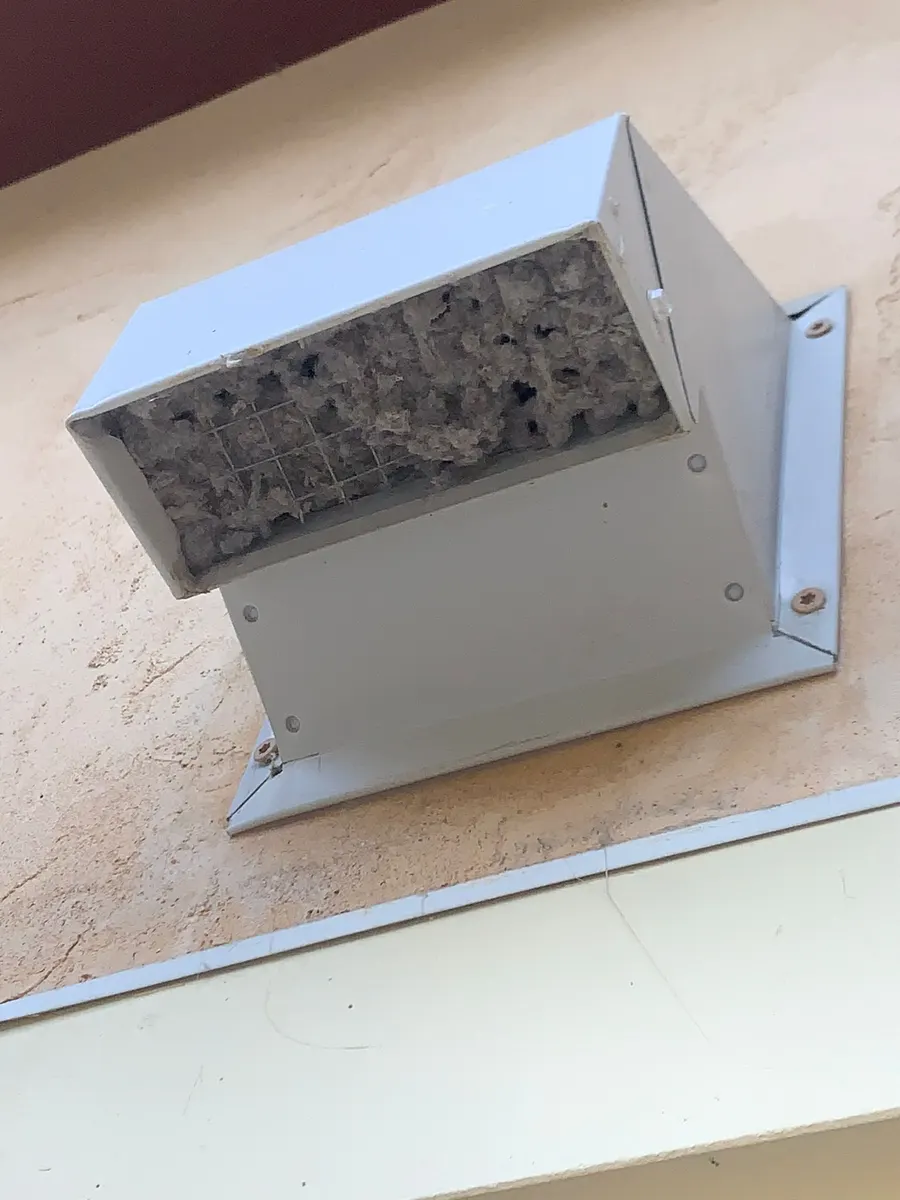
The end of the run tells the story
A matted hood like this chokes the entire system no matter how clean the duct behind it is. Terminations hidden behind porches and shrubs — common in Rutledge — can fail quietly for years before anyone notices.
Two findings come up repeatedly in this borough. The first is nests: low, sheltered hoods under old trees attract birds, and a nest converts a partial blockage into a total one. We remove nests when the camera finds them, and we can install a bird guard on the termination so the vent stays clear — both itemized on the same written quote before any work starts. The second is the failed transition hose: the crushed, kinked or torn section hiding behind the machine, leaking heat and lint into the laundry room. We inspect it on every visit and flag it in writing if it needs replacement.
| Your laundry setup | What it means for the visit |
|---|---|
| Basement hookup venting to a wall hood | Extraction along the open ceiling run — usually the quickest job in Rutledge |
| Addition or first-floor laundry | A short run, but often a low or hidden termination that needs clearing and a careful check |
| Second-floor laundry with a wall chase or roof exit | The longest concealed runs; roof terminations take extra time and care |
Most Rutledge runs are finished in about an hour door to door; first-ever clearings and roof terminations run somewhat longer. The time never moves the price, because the flat written quote came first. Every job carries our 6-month workmanship warranty — if a problem traced to our work appears within six months, we come back and make it right free.
One written number, backed the same way in every borough we serve
Dryer vent work is a favorite of the teaser-price flyer, because run length genuinely varies house to house — which gives a doorstep operator endless room to "discover" that yours is longer than average once he is standing in your basement. Our process deletes that room. The camera measures the run before anything is priced, the quote is flat and in writing before any work begins, and the number you approved is the number you pay. No trip fees, no per-foot escalations, no revisions at the door.
The backing is concrete. We are a PA-licensed contractor — PA 187935, with the license and insurance certificates viewable on our licensed & insured page — insured up to $2 million and rated 4.8 stars across 144 Google reviews. Bring us a competitor's written quote for the same scope of work and our Price Match Guarantee means we match it. Qualifying jobs carry Google Guaranteed protection — Google's own program, administered by Google, with money-back protection up to $2,000. Financing through Wisetack is available if it helps.
The same crews cover this pocket of Delaware County every week: dryer vent cleaning next door in Morton, across the line in Swarthmore and south through Ridley — the full town list is on our Delaware County service page. And because one visit can cover both systems, many Rutledge homeowners pair this with air duct cleaning in Rutledge — one crew, one written quote, both jobs photographed when done.
How much does dryer vent cleaning cost?
Routine and deep cleaning are different services — the free inspection determines which one your system actually needs. Prices vary house to house; your exact price comes as a flat written quote before any work begins.
| Dryer vent routine — basement / 1st floor | $129.99 |
| Dryer vent routine — 2nd floor & up | $149.99 |
| Dryer vent deep cleaning | $299.99 |
| Nest removal · bird guard installation | from $250 · from $150 |
Three promises. In writing. On every job.
Price Match Guarantee
Bring a competitor's written quote for the same scope of work — we'll match it. You never overpay for doing it right.
6-Month Warranty
Every job carries a 6-month workmanship warranty. If a problem traced to our work shows up, we come back and make it right — free.
Google Guaranteed
Booked through Google Local Services, qualifying jobs carry Google's own money-back protection up to $2,000, administered by Google.
Backed by a real license and $1M/$2M insurance — see the actual documents
Don't put off air you breathe — finance it with Wisetack
Check your options in about a minute with no impact to your credit score, choose terms that fit your budget, and pay over time instead of all at once.
*All financing is subject to credit approval. Your terms may vary. Wisetack loans are issued by Hatch Bank. See additional terms at wisetack.com/faqs.
4.8 stars from 144 Google reviews — and easy to find
E Cleaning Duct & Vent Cleaning is based at 555 S Goddard Blvd, King of Prussia, and serves Rutledge and all of Delaware County from right here. Check our Google profile: real jobs, real photos, and a rating our crew protects on every visit.
- Google Guaranteed business — screened, licensed and insured (see the documents)
- Read every review on our Google profile — we don't cherry-pick what you can verify
Dryer Vent Cleaning questions from Rutledge homeowners
How often should a dryer vent be cleaned in Rutledge?
Once a year is the standard guidance, and it fits this borough's housing well — the long basement ceiling runs under Rutledge's frame Victorians accumulate lint faster than short, straight runs do. Households drying heavy loads daily, or homes where the laundry moved upstairs onto a long concealed run, may warrant a look sooner. If there is no record of the vent ever being cleaned, start with the free inspection — it settles the question with footage instead of guesswork.
Our laundry is on the second floor and the vent exits through the roof. Can you handle that?
Yes. Upper-floor laundries in renovated Rutledge homes vent through concealed wall chases or roof terminations, and both are routine for us. A roof exit takes longer than a basement wall hood, but the process is identical: camera through the full run first, flat written quote second, extraction third. The floor your laundry sits on changes the work — never the process.
There is a bird nest in our vent hood. Do you remove it?
Yes. Low, sheltered hoods behind porches and shrubs — exactly what Rutledge's leafy lots produce — are prime nesting spots, and a nest can block a vent completely. We remove the nest as part of the visit when the camera finds one, and we can install a bird guard on the termination so it does not happen again. Both are itemized on the same written quote before any work starts.
Is vacuuming behind the dryer enough, or do I need the full run cleaned?
Vacuuming behind the machine only reaches the first few feet. The dangerous accumulation lives farther in — at the elbows of a long ceiling run, inside concealed chases, and at the exterior termination — which is exactly the stretch a shop vac and a lint brush never touch. Full-run extraction works the entire duct with rotary brushes and continuous HEPA-filtered vacuum, and the free camera inspection shows you the difference in your own vent before you decide anything.
How long does dryer vent cleaning take in a Rutledge home?
Most runs are done in about an hour door to door. Long basement ceiling runs with multiple elbows, first-ever clearings with heavily compacted lint, and roof terminations can take somewhat longer. Because your flat written quote is approved before the work begins, a longer job never changes the price — and you get after-photos plus an airflow check with the dryer running before we leave.
Is there a trip fee for coming out to Rutledge?
No. Rutledge is minutes off I-476 via Baltimore Pike, squarely inside the central Delaware County territory our crews cover every week, and we charge no trip fees anywhere. The video inspection is free, the quote is flat and written before any work begins, and we schedule 24 hours a day, Sunday through Friday — closed Saturdays.
Ready for honest dryer vent cleaning in Rutledge?
Free video inspection, a flat written quote before any work, and real before/after proof — call (484) 367-5944 or book online now.
