
Air Duct Cleaning in West Nottingham, PA
E Cleaning provides professional air duct cleaning throughout West Nottingham Township — the far southwestern corner of Chester County, where the Octoraro Creek and the Mason-Dixon Line meet. Every job starts with a free video inspection inside the ductwork, you approve a flat written quote before any work begins, and there is no trip fee for the drive to the state line. After-photos come standard when the work is done.
The Corner Township: Where Chester County Meets Maryland and Lancaster County
West Nottingham Township holds down the extreme southwestern corner of Chester County — the one place on the county map where two outside borders meet. The Mason-Dixon Line runs along the township's southern edge, with Cecil County, Maryland on the far side; the Octoraro Creek traces the western flank, with Lancaster County across the water. East Nottingham Township lies to the east, Lower Oxford Township to the north, and U.S. Route 1 crosses the township on its last Pennsylvania miles — the PA 272 interchange near the Nottingham crossroads is the final exit before the highway slips into Maryland toward Rising Sun. Oxford, the nearest borough, sits a short drive to the northeast.
This corner also holds Nottingham County Park and the serpentine barrens around it — a rare, stony landscape of thin mineral soil that supports plants found almost nowhere else in the region. Beyond the barrens, the township is classic far-southern Chester County: working farms, wooded creek valleys, long gravel lanes, and houses set on parcels measured in acres rather than feet.
Being the corner township carries a practical cost when you need a trade at the house. Duct cleaning companies based near Philadelphia or the Main Line fill their schedules long before their service maps stretch to the state line, and those that do come this far often quietly add a travel charge to make the drive worthwhile. E Cleaning does neither. We are a family-owned company that has worked Chester County since 2016, and the bottom of the county — Oxford, both Nottingham townships, and the roads between — is part of our normal weekly routes. There is no trip fee to West Nottingham, the video inspection that starts every job is free, and the flat written quote you approve is the exact amount on the invoice. Distance from the city should not mean worse service or a padded bill, and out here it does not have to.
West Nottingham's Houses — and the Ductwork Hiding Inside Them
The oldest homes in the township are its farmhouses: stone and frame houses from the 18th and 19th centuries standing along the pike roads and creek valleys, built generations before anyone imagined forced-air heat. When ductwork reached these houses it arrived as a retrofit, usually in the middle of the last century — trunk lines run through fieldstone basements, supply ducts boxed into corner chases and closets, and return paths improvised from panned joist bays, which are open framing cavities capped with sheet metal and pressed into duty as ducts. A panned return was never smooth, sealed pipe to begin with; it pulls air across century-old framing on every cycle, and in a surprising number of farmhouses it has never once been professionally cleaned. Retrofit systems also vary widely in how accessible they are, which is exactly why we put a camera in first and tell you honestly what can be reached before a quote is written.
The middle layer of housing is postwar: ranches and Cape Cods strung along Route 272 and the secondary roads, many still breathing through their original steel ductwork. Steel holds its shape for fifty or sixty years, but the seams loosen with age, and a loose seam on the return side quietly pulls unfiltered basement air into the system along its entire length — dust, moisture, and all.
The newest layer went up from the 1990s onward, as the Route 1 corridor put Oxford and northern Maryland within commuting reach and single-family homes rose on former farmland. These houses commonly pair heat pumps with flexible duct. Flex duct grabs dust on its ribbed interior walls, and a heat pump moves air in every season, so whatever the ducts hold makes far more trips through the living space each year than it would with an old heat-only furnace. Builder-grade systems also frequently carry construction debris sealed inside since the drywall crew left — sawdust, gypsum dust, insulation scraps that a camera finds within the first few feet.
Fuel rounds out the picture. Much of the township sits beyond natural-gas mains, so oil and propane furnaces are the rule rather than the exception, and plenty of households run a wood stove through the winter. Both leave a fine film of combustion residue in a home over the years, and return ductwork collects its share. None of it is cause for alarm — but it is a genuine difference from a gas-heated development house upcounty, and it is one of the specific things the inspection camera looks for.
Field Dust, Barrens Grit, and a House Sealed Up for Winter
Open country does not translate to clean ductwork — usually the opposite. Homes in West Nottingham contend with dust sources a paved cul-de-sac never sees: fine field dust lifted by tilling and harvest on the farms next door, grit carried in from long gravel lanes and unpaved drives, and heavy pollen rolling off hayfields and treelines from spring through fall. In a dry summer, the thin, stony soils around the serpentine barrens give up dust to every passing wind. Add farm dogs and barn cats that live half indoors, boots and work clothes shed at the mudroom door, and two genuine mud seasons a year, and the return side of a heating system out here earns its keep.
Moisture plays its part too. Many of the township's older homes sit near the Octoraro's feeder streams on fieldstone foundations, and a damp basement is effectively part of the duct system when the returns — especially panned joist returns — sit at basement level pulling that air in. Damp dust cakes instead of drifting, which is a large part of why long-neglected rural systems photograph so dramatically on inspection day.
Two well-documented numbers frame the stakes. Industry sources such as Stanley Steemer estimate the average six-room home can accumulate 40 pounds of dust in a year. And the U.S. EPA reports that indoor levels of some pollutants may be 2 to 5 times — occasionally more than 100 times — higher than outdoor levels, while people spend about 90% of their time indoors. Through a sealed-up southern Chester County winter with the furnace or heat pump cycling around the clock, whatever the ducts hold keeps making the rounds.
We keep the health claims honest: the EPA does not endorse routine duct cleaning as a proven fix for indoor air quality, and nobody should promise it will cure allergies. Many homeowners do notice less settled dust and steadier airflow afterward, and cleaning is clearly warranted when there is visible mold, heavy debris, pest evidence, or renovation dust — every one of which the free video inspection puts on a screen in front of you before you commit to anything.
We also handle the laundry side of the house — dryer vent cleaning in West Nottingham — and we serve the neighboring communities, including Oxford, East Nottingham, and Lower Oxford. Every town we cover is listed on our Chester County service page.
Routine or Deep? The Camera Decides — Not a Sales Script
Every air duct job in West Nottingham opens the same way: a camera goes into the supply and return runs, and you watch the footage with us. That free video inspection is not a formality — it is the decision point for the entire job, because routine cleaning and deep cleaning are genuinely different services, not two prices for the same work. Routine cleaning is maintenance: the right call for a system professionally cleaned within the last few years that needs its new accumulation removed. Deep cleaning is restoration: the right call for a system that has never been cleaned or has gone many years without it, where buildup has bonded to the duct walls and needs heavier agitation, more time on every run, and more attention at each register. In this township — with its retrofitted farmhouse systems and long-serving postwar ductwork — the inspection lands on deep cleaning more often than it does in the newer townships upcounty, and we will show you exactly why on screen rather than asking you to take a technician's word for it.
Whichever service the camera calls for, the quote arrives the same way: flat, written, covering the complete scope, and approved by you before a single register comes off the wall. The number reflects how many HVAC systems the house runs and the condition the camera found — homes with more than one system qualify for a multi-unit discount — and once you approve it, it does not move. Here is what the work includes:
- Free video inspection of the supply and return runs, reviewed with you on screen
- A flat written quote for the full scope, approved before work begins
- Every supply register and return grille removed and cleaned
- The system sealed and placed under negative pressure with a professional Nikro machine
- Air whips and agitation tools driven through each run to break buildup loose where it sits
- Dislodged debris captured through HEPA filtration instead of drifting back into the rooms
- Blower compartment and accessible system components cleaned
- After-photos from inside the ductwork, so the result is verifiable rather than a claim
The method is source removal: loosen contamination at the duct wall, then pull it out of the house under vacuum rather than blowing it around. It is the approach NADCA sets as the industry standard for HVAC cleaning, and it is the only way we work. If the inspection turns up visible mold, pest residue, or a persistent odor, an EPA-registered sanitizing treatment can be applied after the cleaning — and when it applies to your house, it shows up as a clearly described line on the same written quote, never as a doorstep discovery.
Timelines, Equipment, and the Commitments Behind the Quote
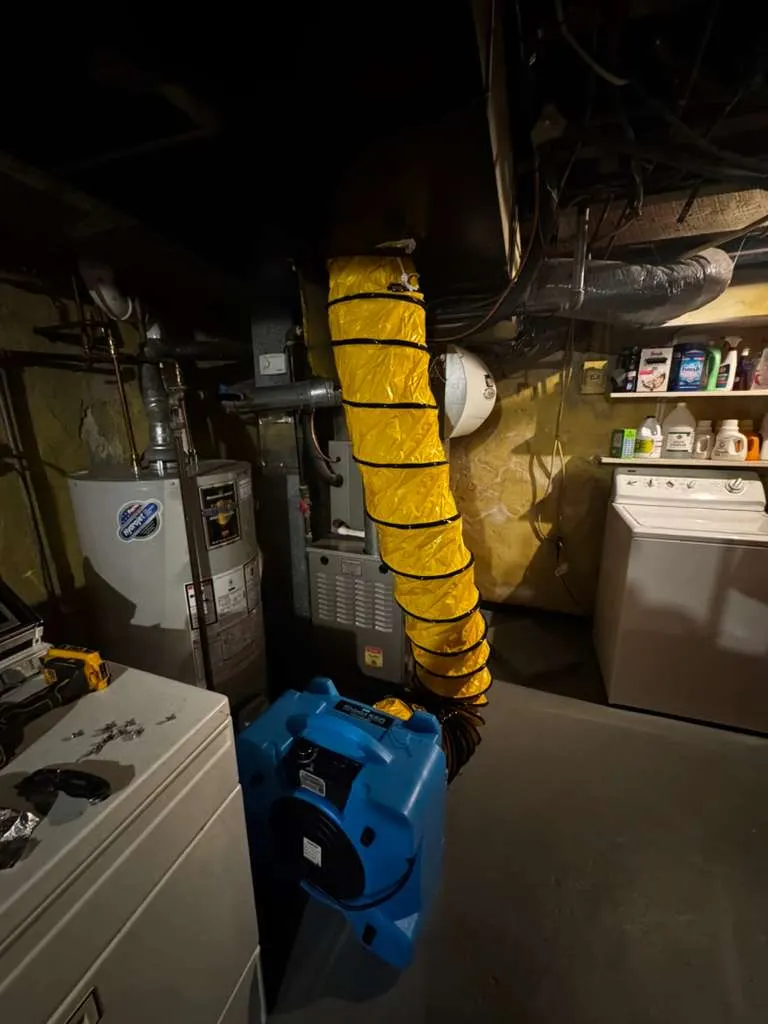
A routine cleaning on a single system generally takes a few hours; a deep cleaning on a long-neglected system, or a home running two systems, takes longer. Because the inspection happens before the quote, the time window we give you is built from your actual house — a retrofitted stone farmhouse, a one-story ranch, and a two-zone build near the Route 1 interchange are three different jobs, and we schedule them like it.
On the day of the job, the crew arrives in a marked van, lays floor protection along the working path, and seals each register before the vacuum comes on, so agitation in one branch does not push dust out of another. Most of the heavy equipment stages at the furnace — usually the basement, in this township's housing — and the negative-pressure connection is cut into the trunk line or coupled at the plenum, whichever the system layout favors. Your part of the prep is small: clear a path to the registers and the furnace, and tell us about anything unusual the house has picked up over the years — a capped-off run, a register hidden under carpet, an addition on its own zone. Farmhouses especially reward that conversation; the camera finds the surprises either way, but knowing where to look saves time on the clock.
When the cleaning is finished, we photograph the inside of the ductwork and walk you through the images beside the before footage, then reinstall every register and grille. Two pieces of honest after-care advice come with every job: put a fresh filter in the same day, because a clean system deserves better than a loaded filter, and note what the camera found, because the right interval to your next cleaning is a fact about your house rather than a subscription schedule. A system that gets maintained on a sensible cycle stays a routine-service system — which is the cheapest kind to own.
What we will not do is name a price over the phone for ducts nobody has looked inside. You have likely seen where that leads: the whole-house coupon special that turns into a doorstep negotiation, with a technician discovering new charges room by room. This industry earned its reputation the hard way, and we built our company against it — inspect first, quote flat and in writing, do the work as scoped, prove it with after-photos. No trip fee to the corner of the county, no upsell script, no invoice that reads differently from the paper you approved.
The commitments behind that are concrete. Our Price Match Guarantee means a competitor's written quote for the same scope of work gets matched. Every job carries a 6-month workmanship warranty — if a problem traced to our work appears within six months, we come back and correct it free. And because we are Google Guaranteed, qualifying jobs carry money-back protection of up to $2,000 through Google's program, administered by Google. We are a licensed Pennsylvania contractor (PA 187935), insured, and rated 4.8 stars across 144 Google reviews — you can view the license and insurance documents here. Financing is available through Wisetack, and we are open 24 hours a day, Sunday through Friday; we are closed Saturdays.
How much does air duct cleaning cost?
Routine and deep cleaning are different services — the free inspection determines which one your system actually needs. Prices vary house to house; your exact price comes as a flat written quote before any work begins.
| Air duct routine cleaning (per HVAC unit) | $299.99 |
| Air duct deep cleaning (per HVAC unit) | $650 |
| Multi-unit homes | Discount available |
| Dryer vent routine add-on | from $129.99 |
Three promises. In writing. On every job.
Price Match Guarantee
Bring a competitor's written quote for the same scope of work — we'll match it. You never overpay for doing it right.
6-Month Warranty
Every job carries a 6-month workmanship warranty. If a problem traced to our work shows up, we come back and make it right — free.
Google Guaranteed
Booked through Google Local Services, qualifying jobs carry Google's own money-back protection up to $2,000, administered by Google.
Backed by a real license and $1M/$2M insurance — see the actual documents
Don't put off air you breathe — finance it with Wisetack
Check your options in about a minute with no impact to your credit score, choose terms that fit your budget, and pay over time instead of all at once.
*All financing is subject to credit approval. Your terms may vary. Wisetack loans are issued by Hatch Bank. See additional terms at wisetack.com/faqs.
4.8 stars from 144 Google reviews — and easy to find
E Cleaning Duct & Vent Cleaning is based at 555 S Goddard Blvd, King of Prussia, and serves West Nottingham and all of Chester County from right here. Check our Google profile: real jobs, real photos, and a rating our crew protects on every visit.
- Google Guaranteed business — screened, licensed and insured (see the documents)
- Read every review on our Google profile — we don't cherry-pick what you can verify
Air Duct Cleaning questions from West Nottingham homeowners
How much does air duct cleaning cost in West Nottingham, PA?
We do not attach a number to ducts nobody has looked inside — that habit is how this industry earned its bait-and-switch reputation. Every West Nottingham job starts with a free video inspection; you then receive a flat written quote based on how many HVAC systems the house runs and what the camera actually found. That quote is the final price: no trip fee for the drive down, no additions at the door. Homes with more than one system qualify for a multi-unit discount.
Do you charge extra to come out to the state line?
No. West Nottingham, East Nottingham, Oxford, and the rest of far-southern Chester County are part of our regular routes, not an outer edge we surcharge. The inspection is free, the written quote is flat, and the drive is our cost, not yours.
Our farmhouse got its ducts long after it was built. Can they actually be cleaned?
Yes — and they are often the systems that need it most. Retrofitted ductwork is everywhere in the township's older homes: trunk lines through stone basements, boxed chases, panned joist returns. We run the camera through first, tell you plainly which runs are accessible and what condition they are in, and write the scope accordingly. You will never be quoted for work the house cannot receive.
We heat with oil and a wood stove. Does that change what our ducts need?
It can. Oil burners and wood heat both release fine combustion residue into a home over time, and the return ductwork collects a share of it alongside ordinary dust. That is one of the specific things the free video inspection looks for. If the camera also finds mold or persistent odor, an EPA-registered sanitizing treatment can be added after the cleaning — always as a clearly described line on the written quote, never a surprise.
How often should ducts be cleaned in a rural township like West Nottingham?
There is no honest one-size answer. Working farmland nearby, gravel lanes, oil or wood heat, indoor pets, and any recent renovation all shorten the sensible interval; a newer, tightly built home with none of those stretches it out. The free inspection settles it for your house specifically — and if the camera shows the ducts do not need cleaning yet, we will tell you exactly that.
Will duct cleaning fix my allergies?
We will not promise that, because the evidence does not support the promise — the EPA does not endorse routine duct cleaning as a proven cure for indoor air problems. What is fair to say: many homeowners notice less settled dust and steadier airflow afterward, and cleaning is clearly warranted when there is visible mold, heavy debris, pest evidence, or construction dust. The inspection is free, so you will know which situation your home is in before spending anything.
Ready for honest air duct cleaning in West Nottingham?
Free video inspection, a flat written quote before any work, and real before/after proof — call (484) 367-5944 or book online now.
