
Dryer Vent Cleaning in Conshohocken, PA
Dryer vent cleaning in Conshohocken, PA starts with a free video inspection and a flat, written quote before any work begins — then the entire vent is cleaned end to end, exterior termination included. E Cleaning is a family-owned, PA-licensed contractor (PA 187935), insured up to $2 million and Google Guaranteed, working out of King of Prussia just minutes across the river since 2016.
Rowhome basements, hillside twins, riverfront closets — the floor shapes the job
Conshohocken does laundry on every level of the borough. The older rowhomes and twins on the grid off Fayette Street mostly keep the washer and dryer in the basement. Renovated rows and the newer townhomes near the riverfront put laundry closets up on the bedroom floors. The apartment and condo buildings that replaced the old mills stack the machines inside each unit. Where your dryer sits is the first thing we ask, because it shapes the work — which is exactly why every job starts with a free video inspection and a flat, written quote before anything is cleaned.
A little geography explains the variety. Conshohocken is a small, densely built borough on the east bank of the Schuylkill River, about 13 miles northwest of Philadelphia, packed onto a hillside that climbs steeply up from the water. It grew up as a mill and iron town, and its housing grew with it — block after block of narrow brick and frame rowhomes and twins, built close together for mill workers in the late 1800s and early 1900s and still making up much of the borough today. Larger twins and singles sit higher up the hill; down along the river, former industrial land has filled in over the last two decades with townhome rows and mid-rise condo and apartment buildings. Four eras of housing, four different ways a dryer ends up vented.
The hillside itself shapes the runs. On a steep lot the downhill side of a basement often sits at or above grade while the uphill side stays buried, so two dryers on the same street can vent in opposite directions. Add mill-worker rows built narrow and deep, and vents punched through century-old stone or brick foundation walls, and you get a borough where no two basements are quite alike.
The difference is about the vent, not the machine. A basement dryer in a Conshohocken row often vents through the rim joist or foundation wall to a hood a few feet away — short, reachable, quick to clean and easy to verify. But a rowhome only has two exterior walls, front and back, so when the hookup sits mid-basement, the duct may travel most of the ceiling to reach daylight, picking up elbows as it goes. That run is covered by the same flat, written quote you approve before we start. It is also exactly the kind of long, horizontal path where airflow slows and lint settles into a packed layer, which is why rowhome vents tend to need this service more than their owners expect.
Upper-floor hookups are genuinely more work. Second- and third-floor laundry drops through wall cavities or rises through the roof, with more elbows, more vertical rise and more ladder work at the termination — which is why we scope the job honestly with the camera first, then put the number in writing. In the townhome rows built near the riverfront over the past couple of decades, a bedroom-level laundry closet venting through the roof is the standard arrangement — and a roof cap is the one part of the system nobody ever looks at from the ground.
The borough's big riverfront apartment and condo buildings add a third pattern: stacked washer-dryer closets with long, fully concealed runs to an outside wall or the roof. We clean in-unit vents the same way — free video inspection first, flat written quote before any work — and coordinate with property management or the condo association whenever building access or insurance paperwork requires it.
Timing matters more than most people think. Cold-weather months are heavy-laundry months — towels, blankets, hoodies and winter layers shed far more lint per load, right when the dryer is running hardest. A vent that limps through summer usually quits in January. Late fall is the smart time to book; a dryer already showing symptoms should not wait for a season.
Getting to you is the easy part. Conshohocken sits beside the I-76/I-476 interchange, one bridge away from our King of Prussia base, and we schedule 24 hours a day, Sunday through Friday. The written quote is the whole price for the borough — no trip fee, no fuel charge, no surprise invoice.
In a borough of party walls, a clean dryer vent is neighborly
Much of Conshohocken lives wall-to-wall: rowhomes and twins on the hillside grid, townhome rows near the river, multi-unit buildings along the waterfront. In attached housing, a dryer fire is never only one household's problem — heat and smoke do not respect a party wall, and the neighbors on either side share the outcome.
The numbers behind that concern are not small. U.S. fire departments respond to an estimated 15,970 home fires involving clothes dryers or washing machines each year, and failure to clean is the leading factor, contributing to one-third (33%) of dryer fires, according to NFPA data from 2010–2014. The U.S. Fire Administration (FEMA) separately estimates 2,900 home clothes dryer fires are reported each year.
Two Conshohocken patterns deserve extra attention. First, roof terminations: the newer townhomes' vertical runs end at caps that can mat over with lint or host a bird nest without anyone noticing, because the evidence is thirty feet off the ground. Second, rentals: the borough has plenty of rented rows and apartments, and vents in rental housing typically go longer between cleanings than anywhere else. If you rent and your dryer needs two cycles per load, that is worth a message to your landlord — this page is an easy one to forward.
There is also a bill attached to a blocked vent long before there is any danger. Pushing damp air through packed lint means re-running the same towels twice or three times, and every repeat cycle is gas or electricity spent on nothing. Plenty of customers recoup the cost of the cleaning over the following year in shorter cycles alone.
Fuel type raises the stakes further. If your dryer runs on gas, a blocked vent is doubly worth clearing: beyond the fire risk, a gas dryer depends on that same duct to carry its combustion exhaust out of the house, and a packed run has nowhere to send it.
One distinction worth keeping: the lint screen is not the vent. Cleaning the screen every load is good practice, but it only catches surface lint — the duct behind the wall collects the rest, load after load, year after year. Watch for these signs that the duct itself is the problem:
- One load of towels or jeans takes two or three cycles
- The machine, its door or the laundry area runs noticeably hot
- A scorched or burning smell during operation
- Weak or no airflow at the outside hood, or a flap that never lifts
- Lint gathering behind the dryer or around the exterior vent
- The dryer overheats and shuts itself down mid-cycle
What the camera shows — and why routine and deep are different jobs
Every Conshohocken visit opens the same way: a camera goes down the vent before anyone quotes a price, so the number you approve reflects your actual duct, not a guess from the doorway. What the lens finds is what decides whether your vent needs a routine cleaning or a deep one — and those are genuinely different services, not two names for the same work.
A vent cleaned within the last couple of years usually shows a light, even fuzz along the duct wall and a termination flap that still swings freely. That is a routine cleaning: brush the full run, clear the cap, verify the airflow, done. A vent that has never been cleaned, or has gone many years, shows something else — lint compacted into a dense, felt-like lining that has narrowed the pipe, sometimes with a crushed section, a joint pulled apart inside a wall chase, or a nest packed against the cap. That is a deep cleaning, and it takes more time, more passes and agitation the routine job never needs.
We scope it that way because guessing wrong helps no one. Treating a packed, long-neglected run as a quick routine job would leave it half-cleaned; charging deep-clean effort on a vent that only needs a routine pass would be its own kind of unfair. The free video inspection settles it — you watch the same screen we do, and the flat written quote follows from what is actually there. Common things the camera turns up in Conshohocken homes:
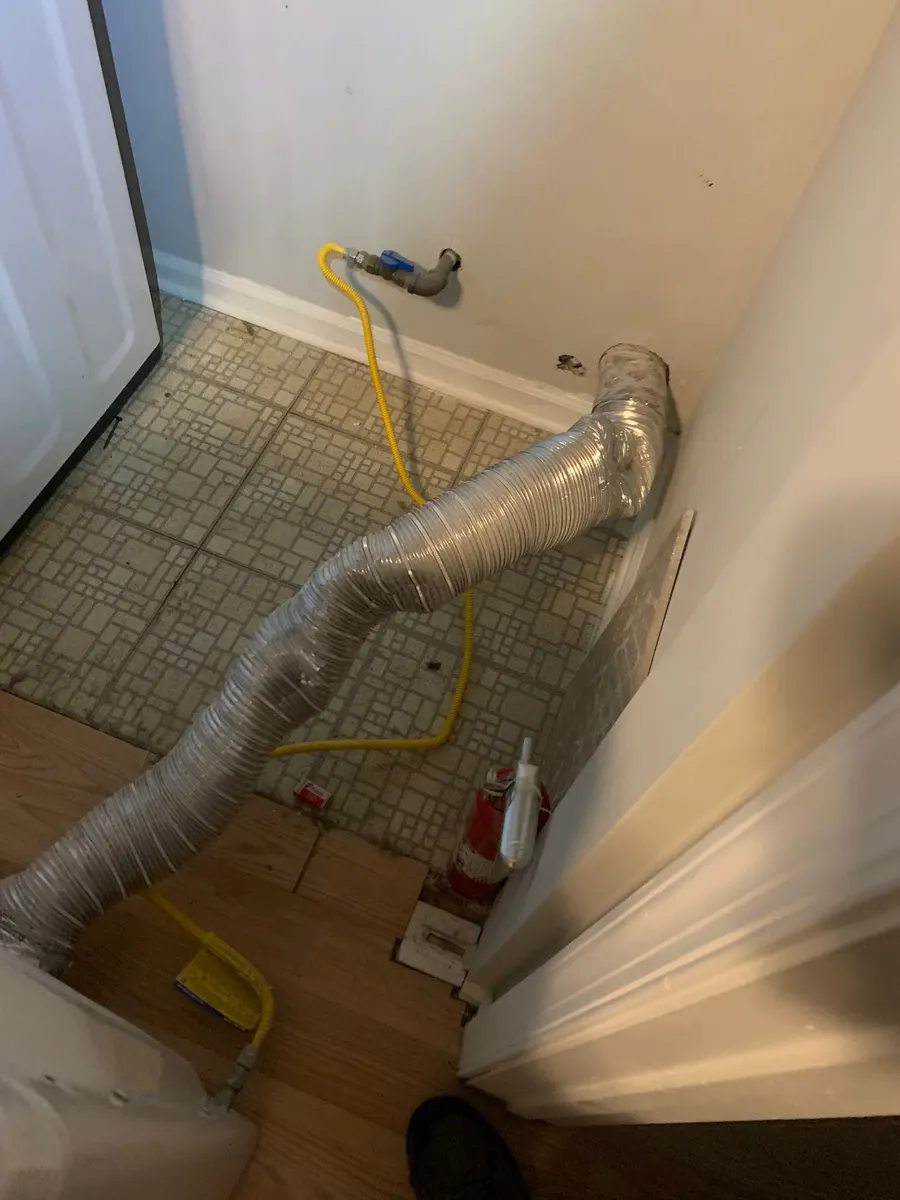
- Plastic or foil accordion-style transition hose — a fire and code concern we can swap for smooth semi-rigid metal
- A transition crushed flat behind a dryer pushed tight to the wall of a small laundry closet
- Duct improvised when a renovation moved the laundry up to a bedroom floor
- A separated joint inside a wall or ceiling chase, quietly shedding warm lint into the cavity
- A matted or nest-blocked roof cap at the top of a townhome's vertical run
Whatever the camera finds, nothing is added to the job without your say-so. If the inspection turns up damage rather than ordinary lint, you get the photos and the options in plain terms, and the decision stays yours.
End to end, in four steps
End to end means the entire path the exhaust travels: the transition hose behind the dryer, every foot of duct and every elbow inside the walls or ceiling, and the wall hood or roof cap where it exits the building. Cleaning part of that path and calling it done is how vents end up half-blocked six months later, so we do the whole run, every time, at the flat price we put in writing before we start.
Under an hour, most homes
Basement hookups in Conshohocken usually take less than an hour. Roof-terminated townhome runs and concealed apartment vents take longer. Either way, you see the pile of lint that came out, and after-photos come with the job.
Pull and inspect
We move the dryer, detach the transition hose and check it for sagging, crushing or plastic accordion-style hose — a lint trap in disguise that we can swap for semi-rigid metal on the spot if you want it gone.
Brush the full run
Rotary brushes travel the entire length of the duct to agitate the packed lint loose while a professional negative-pressure vacuum with HEPA filtration captures it at the source — so it ends up sealed in our equipment, not in your laundry room or your yard. It is mechanical cleaning, not a quick puff of compressed air that only shifts the problem down the pipe.
Clear the termination
Wall hood or roof cap, we clear the matting, check behind the flap for nests and debris, and make sure the flap or screen actually moves when air pushes through it.
Reconnect and verify
Everything goes back together, the dryer runs, and we confirm strong airflow at the termination before we leave — a result you can feel with your hand, not take on faith.
The quote is flat and includes all of the above, whether your laundry sits in the basement or up on the bedroom floor. If we find real damage — a crushed section, or a joint that has come apart inside a wall chase — you get photos and options, and nothing is added to the bill without your approval. Every job also carries our 6-month workmanship warranty: if a problem traced to our work shows up within six months, we come back and make it right at no charge. Bring a competitor's written quote for the same scope and our Price Match Guarantee meets it. Wisetack financing is available, and Google Guaranteed backs qualifying jobs with money-back protection up to $2,000.
Booking in Conshohocken — homeowners, landlords and condo boards
Call (484) 367-5944 or book online and tell us which floor the laundry is on. Every visit starts with a free video inspection, and you get a flat, written quote before any work begins — nothing gets renegotiated at the door. We run 24 hours a day, Sunday through Friday (we're closed Saturdays) when a vent problem cannot wait for a weekday.
Landlords and property managers get the same flat structure, which makes multi-unit scheduling simple: a written per-unit quote for the borough's rented rows and riverfront buildings, photos documenting each vent, and one visit that covers several units back to back. In attached housing, a per-unit cleaning is inexpensive insurance against a problem that would belong to the whole building.
The same no-trip-fee service applies next door. We clean dryer vents across the bridge in West Conshohocken, through the surrounding township in Whitemarsh and up the hill in Plymouth Meeting — the county-wide list is on our Montgomery County page. And since the crew is already at the house, many customers bundle this visit with air duct cleaning in Conshohocken — one crew, one visit, one written quote covering both.
How much does dryer vent cleaning cost?
Routine and deep cleaning are different services — the free inspection determines which one your system actually needs. Prices vary house to house; your exact price comes as a flat written quote before any work begins.
| Dryer vent routine — basement / 1st floor | $129.99 |
| Dryer vent routine — 2nd floor & up | $149.99 |
| Dryer vent deep cleaning | $299.99 |
| Nest removal · bird guard installation | from $250 · from $150 |
Three promises. In writing. On every job.
Price Match Guarantee
Bring a competitor's written quote for the same scope of work — we'll match it. You never overpay for doing it right.
6-Month Warranty
Every job carries a 6-month workmanship warranty. If a problem traced to our work shows up, we come back and make it right — free.
Google Guaranteed
Booked through Google Local Services, qualifying jobs carry Google's own money-back protection up to $2,000, administered by Google.
Backed by a real license and $1M/$2M insurance — see the actual documents
Don't put off air you breathe — finance it with Wisetack
Check your options in about a minute with no impact to your credit score, choose terms that fit your budget, and pay over time instead of all at once.
*All financing is subject to credit approval. Your terms may vary. Wisetack loans are issued by Hatch Bank. See additional terms at wisetack.com/faqs.
4.8 stars from 144 Google reviews — and easy to find
E Cleaning Duct & Vent Cleaning is based at 555 S Goddard Blvd, King of Prussia, and serves Conshohocken and all of Montgomery County from right here. Check our Google profile: real jobs, real photos, and a rating our crew protects on every visit.
- Google Guaranteed business — screened, licensed and insured (see the documents)
- Read every review on our Google profile — we don't cherry-pick what you can verify
Dryer Vent Cleaning questions from Conshohocken homeowners
My laundry is in the basement of a Conshohocken rowhome. What will it cost?
You get a flat, written quote before any work begins, based on a free video inspection of your actual run — even if the duct travels the full length of the basement ceiling to reach the front or back wall. Long horizontal rowhome runs are common in the borough; they are also the runs that pack with lint fastest, so they benefit most from the cleaning.
Can you clean the dryer vent in a riverfront apartment or condo unit?
Yes. In-unit stacked laundry closets are standard in Conshohocken's newer buildings, and we clean them the same way as any home: free video inspection first, then a flat written quote before any work begins. Where the building requires it, we handle access and insurance paperwork with management or the association.
Does an upper-floor laundry cost more to clean?
Upstairs runs are genuinely more work: they drop through wall cavities or rise through the roof, with more elbows, more vertical footage and ladder time at the termination. We scope that honestly — the free video inspection shows exactly what your run involves, and the flat written quote reflects it before we start. Nothing gets renegotiated at the door.
Is there a travel charge for Conshohocken?
No. We are based in King of Prussia, one bridge and a few minutes away via I-76 or the Matsonford Bridge. There are no trip fees anywhere in our service area — the flat, written quote you approve before work begins is the whole price.
My townhome's dryer vents through the roof. Can you handle that?
Yes. Roof terminations are the norm in the newer townhome rows near the riverfront, and they are the vents that need service most, because a clogged cap three stories up is invisible from the ground. We clean the full vertical run and clear the cap — inspected first, quoted flat in writing before the ladder goes up.
How often should attached homes in Conshohocken have vents cleaned?
Once a year is the right baseline for rowhomes, twins and townhomes, where homes share walls and vent runs are long or vertical. Failure to clean contributes to one-third (33%) of dryer fires per NFPA data, and heavy-laundry households or roof-vented homes should not stretch the interval further.
Ready for honest dryer vent cleaning in Conshohocken?
Free video inspection, a flat written quote before any work, and real before/after proof — call (484) 367-5944 or book online now.
