
Dryer Vent Cleaning in Dresher, PA
Dryer vent cleaning in Dresher, PA starts with a free video inspection and a flat, written quote you approve before any work begins — the complete vent cleaned from behind the dryer to the exterior termination. E Cleaning is family-owned, PA-licensed (PA 187935), insured up to $2 million and Google Guaranteed, and we have been clearing Montgomery County lint lines since 2016.
Garage level, basement or upstairs: what your laundry floor means here
Dresher's laundry rooms sort neatly by the decade the house was built. This corner of Upper Dublin Township filled in mostly during the postwar boom, so the classic setups dominate: split-levels with the washer and dryer on the lower level by the garage, colonials with a basement hookup, ranches with a first-floor utility corner. Those at-or-below-grade runs are usually the simplest jobs — easy access, a wall termination, no ladder work.
The newer chapter of Dresher housing is a different job. Townhome and carriage-style homes built in recent decades near the office corridor by the Turnpike — and older homes remodeled to move the laundry up beside the bedrooms — put the hookup on the second floor. Upstairs vents take more work for a concrete reason: the duct has farther to travel, dropping through wall cavities or climbing out through the roof, with more elbows, more vertical rise and more ladder work at the termination. That is exactly why we look before we quote — the free video inspection shows what your vent actually involves, and the flat written quote you approve before we start reflects the real job, not a number invented on your driveway.
Dresher's sprawling footprints create a third pattern worth knowing about. In wide ranches and split-levels, the laundry often sits toward the middle of the house, which means the vent may cross twenty or thirty feet of basement ceiling before it reaches an exterior wall. Every added foot and every added elbow slows airflow, and slow airflow is what lets lint drop out of the airstream and pack into a dense layer. A long run does not change how we work — you still get one flat number in writing before we start, and that is the number on the invoice — but it does mean the vent clogs faster than the short straight runs most people picture, and it deserves a spot on the regular maintenance list.
Upper Dublin's building history is written into its vent runs. The mid-century ranches and split-levels that make up much of Dresher went up when a dryer vent was an afterthought, and many still carry their original ribbed foil or plastic transition hose — the accordion kind that snags lint in every fold and sags into low spots where debris settles. Colonials from the same decades tend to have longer, straighter basement runs but more rigid elbows to negotiate. Homes updated in the last couple of decades usually have safer semi-rigid or solid metal duct, yet a remodel that relocated the laundry — from the basement up to a bedroom-level closet, say — often left a longer, taller run than the house was originally plumbed for. Knowing roughly when your home was built, and whether the laundry has ever moved, tells us a good deal before we even arrive.
Whichever setup you have, the process takes ten seconds to understand: tell us where the laundry sits on the booking call, we inspect first, and you approve a written quote before any work begins. Reaching Dresher is quick from our King of Prussia base: up the Turnpike to the Fort Washington interchange, then Susquehanna Road or Limekiln Pike into the neighborhood. 24 hours a day, Sunday through Friday, 24-hour for emergencies, and no travel fee anywhere in 19025.
A detached house is not a fireproof house
Dresher homeowners sometimes assume dryer-fire warnings are aimed at rowhome neighborhoods, not quiet streets of single-family houses. The statistics do not make that distinction. U.S. fire departments respond to an estimated 15,970 home fires involving clothes dryers or washing machines each year, and failure to clean is the leading factor, contributing to one-third (33%) of dryer fires, according to NFPA data from 2010–2014. The U.S. Fire Administration (FEMA) separately estimates 2,900 home clothes dryer fires are reported each year. Lint is highly flammable, a restricted vent traps the heat that ignites it, and neither fact cares how big your lot is.
The mechanics are the same in every Dresher laundry room: a partly blocked vent forces the dryer to run longer and hotter with each load, baking the lint inside the duct into a packed, dry fuel. In the newer townhome rows the stakes rise further — shared walls mean a laundry-room fire threatens the neighbors, and many of those vents terminate through the roof, where a clogged cap can go unseen for years because nobody ever looks at it.
Winter is when marginal vents fail. Cold months mean towels, blankets, sweatshirts and sports gear — the loads that shed the most lint — running through the dryer at the highest frequency of the year. A vent limping along at half capacity in September tends to quit in January. There is a cost angle long before there is a fire angle, too: a dryer pushing damp air through a packed line runs two or three cycles per load, and every extra cycle is gas or electricity spent re-drying the same laundry. Many households find the cleaning pays for itself within the year.
Call sooner rather than later if you notice any of these:
- Loads need a second or third cycle to dry completely
- The dryer or the laundry room feels hot while running
- A scorched or burning smell during a cycle
- Weak or no airflow at the outside hood, or a flap that stays shut
- Lint gathering behind the dryer or around the exterior vent
- The dryer overheats and shuts itself off mid-cycle
Routine or deep: the inspection tells us which your vent needs
Dryer vent cleaning is not one-size-fits-all. A vent kept on a yearly schedule needs a very different job than one that has not been touched in a decade, and the free video inspection is how we tell the two apart before you commit to anything.
A routine cleaning suits a vent that gets regular attention — a reasonable run carrying a manageable layer of lint. We brush and vacuum the full length, clear the termination, confirm the flap moves and verify airflow, and on a basement or first-floor hookup you are usually done inside an hour. Nothing about it is padded; it is the honest job a well-kept vent needs.
A deep cleaning is for the vents that earn it — the ones that have gone years without service, or that show up on the inspection packed dense. A long or roof-terminated run caked hard enough that a single pass will not move it, a transition hose matted solid, a hood plugged by a nest: these take more time, heavier agitation and sometimes removal work. Because the inspection catches all of that up front, the flat written quote you approve reflects the real job rather than a hopeful guess — and we never quote the bigger service when the smaller one will genuinely do.
The video inspection is where that call gets made, and it is not a formality. On the screen you see exactly what we see inside the duct, so the routine-versus-deep decision happens with you looking at the same picture we are:
- Exactly where the lint sits and how dense the buildup has become
- Whether the transition hose is safe metal or lint-trapping foil or plastic
- Crushed sections or joints that separated where a remodel rerouted the run
- Nests or debris blocking the exterior hood or the roof cap
- Whether the run's length and rise call for a routine or a deep cleaning
Timing matters more than most people expect. Spring is nesting season, when birds work in behind wall-hood flaps; late fall and winter are peak laundry months, when the heaviest loads meet the shortest drying days; and humid Pennsylvania summers let a damp, lint-lined duct turn musty. A vent looked at once a year rarely graduates from routine to deep — the runs that need the heavy job are almost always the ones nobody has checked in a long time.
From the drum to the daylight: how a Dresher visit runs
We clean the entire path the exhaust travels — the transition hose behind the dryer, every foot of duct, every elbow, and the hood or roof cap where it exits. Nothing is skipped because it is hard to reach; the hard-to-reach sections are where the lint is.
Pull and inspect
We move the dryer, detach the transition hose and check its condition. Foil or plastic accordion hose — common behind older Dresher setups — traps lint in every ridge; we point it out and can swap in semi-rigid metal on the spot.
Brush the full run
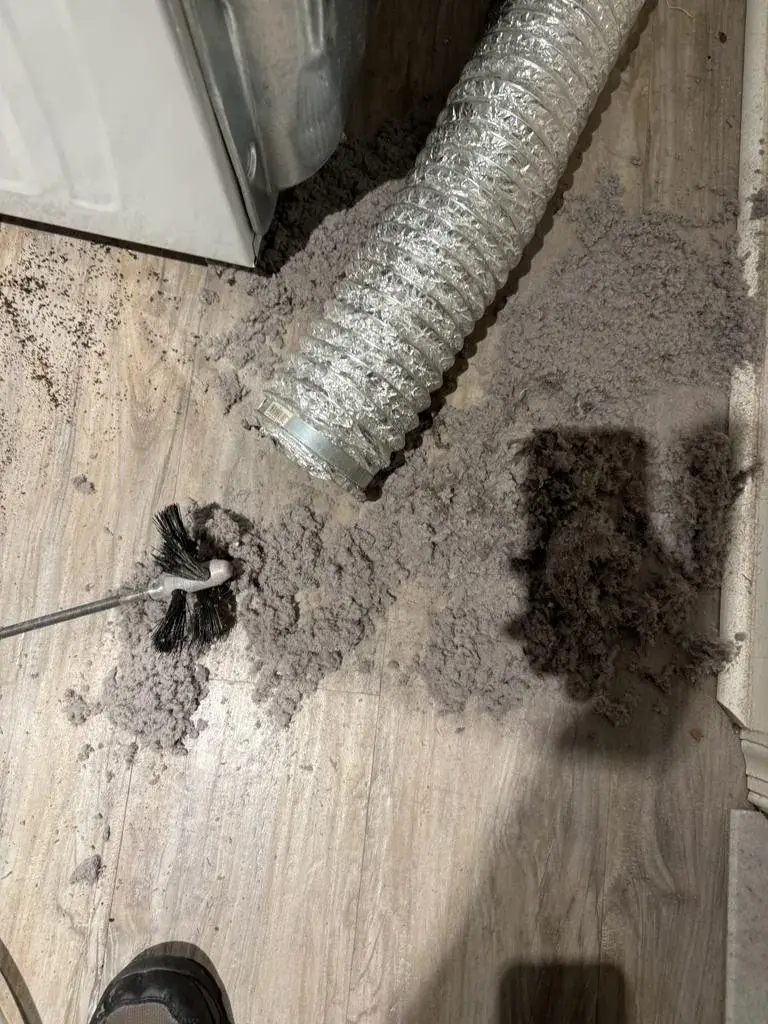
Rotary brushes travel the entire duct while a vacuum captures everything the brush breaks loose, so the lint ends up in our equipment rather than in your laundry room or across the yard.
Clear the termination
Wall hoods mat over with lint and attract nesting birds in spring; roof caps silently pack up against their screens. We clear whichever you have and make sure the flap or cap actually moves.
Verify airflow
We reconnect everything and test with the dryer running, so you see strong airflow at the termination before we leave — plus after-photos for your records.
What it takes
Most basement and first-floor hookups are done in under an hour. Upstairs and roof-terminated runs take longer — which is exactly the kind of thing the inspection catches up front, so the written quote you approve already accounts for it. Customers are routinely surprised by the volume of lint that comes out of a vent that "seemed fine."
Occasionally the brush finds a problem cleaning cannot fix — a crushed section inside a wall chase, or a joint that separated where a remodel rerouted the vent. When that happens you get photos and a straight explanation of the options; nothing is ever added to the bill without your approval. Financing through Wisetack is available, and Google Guaranteed backs qualifying jobs with money-back protection up to $2,000.
Booking in Dresher — and pairing it with the other ducts
Call (484) 367-5944 or book online; tell us which floor the laundry is on, we start with a free video inspection, and your flat written quote is settled before any work begins — everything included through the exterior termination and the airflow test, with no surprise invoice and no door-step upsell. We schedule 24 hours a day, Sunday through Friday (we're closed Saturdays) when a blocked vent cannot wait.
The same inspect-first, quote-in-writing approach covers the towns around you. We clean dryer vents in Ambler, Oreland and Willow Grove, and everywhere else on our Montgomery County service page. Since the crew is already at the house, many Dresher homeowners bundle the visit with air duct cleaning in Dresher — the HVAC ducts collect dust for decades the same way the dryer vent collects lint for years, and one visit can cover both.
How much does dryer vent cleaning cost?
Routine and deep cleaning are different services — the free inspection determines which one your system actually needs. Prices vary house to house; your exact price comes as a flat written quote before any work begins.
| Dryer vent routine — basement / 1st floor | $129.99 |
| Dryer vent routine — 2nd floor & up | $149.99 |
| Dryer vent deep cleaning | $299.99 |
| Nest removal · bird guard installation | from $250 · from $150 |
Three promises. In writing. On every job.
Price Match Guarantee
Bring a competitor's written quote for the same scope of work — we'll match it. You never overpay for doing it right.
6-Month Warranty
Every job carries a 6-month workmanship warranty. If a problem traced to our work shows up, we come back and make it right — free.
Google Guaranteed
Booked through Google Local Services, qualifying jobs carry Google's own money-back protection up to $2,000, administered by Google.
Backed by a real license and $1M/$2M insurance — see the actual documents
Don't put off air you breathe — finance it with Wisetack
Check your options in about a minute with no impact to your credit score, choose terms that fit your budget, and pay over time instead of all at once.
*All financing is subject to credit approval. Your terms may vary. Wisetack loans are issued by Hatch Bank. See additional terms at wisetack.com/faqs.
4.8 stars from 144 Google reviews — and easy to find
E Cleaning Duct & Vent Cleaning is based at 555 S Goddard Blvd, King of Prussia, and serves Dresher and all of Montgomery County from right here. Check our Google profile: real jobs, real photos, and a rating our crew protects on every visit.
- Google Guaranteed business — screened, licensed and insured (see the documents)
- Read every review on our Google profile — we don't cherry-pick what you can verify
Dryer Vent Cleaning questions from Dresher homeowners
My laundry is on the garage level of a Dresher split-level. Does that change the job?
It usually makes it simpler. The lower level of a split-level sits at or below grade — like basements, mudrooms and garage hookups — so access is easy and there is rarely ladder work. Either way the process is the same: a free video inspection first, then a flat written quote you approve before any work begins.
Is there a travel charge for coming out to Dresher or the 19025 area?
No. Dresher is a short run from our King of Prussia base via the Turnpike's Fort Washington interchange, and there are no trip fees or surcharges anywhere in our service area. The flat written quote you approve before work begins is the number on the invoice.
Our vent crosses the whole basement ceiling before it exits. Does a long run cost extra?
There are no surprises either way: we scope the vent with a free video inspection and hand you a flat written quote before we start, and once you approve it the number does not move — whether the run is eight feet or thirty. Long runs do clog faster than short ones, though, so they are worth cleaning on a regular schedule rather than waiting for symptoms.
Our townhome's dryer vents through the roof. Can you handle that?
Yes. Roof-terminated vents are standard in Dresher's newer townhome construction, and they need cleaning most because a clogged roof cap is invisible from the ground. We clean the full vertical run and clear the cap, and the ladder work is scoped into the written quote you approve before we begin.
How often should a Dresher dryer vent be cleaned?
Once a year is the sensible baseline, and households that dry many loads a week — or whose vents run long or exit through the roof — should not stretch it further. Per NFPA data, failure to clean is the leading factor in dryer fires, contributing to one-third of them.
Do you clear the outside vent hood too? Something nested in ours last spring.
Yes — the exterior termination is included in every dryer vent cleaning. Bird nests behind wall-hood flaps are a common spring find, and a nest blocks the run completely. We remove the blockage, clean the hood, confirm the flap moves freely and verify airflow with the dryer running before we leave.
How do I know if my Dresher vent needs a routine cleaning or a deep one?
You do not have to guess — the free video inspection decides it. A vent kept on a yearly schedule almost always needs only routine cleaning, while a run that has gone years without service, exits through the roof, or shows up packed solid may call for deep cleaning. Routine and deep are genuinely different services, and we scope which one your vent needs before you approve anything in writing — never the bigger job when the smaller one will do.
Ready for honest dryer vent cleaning in Dresher?
Free video inspection, a flat written quote before any work, and real before/after proof — call (484) 367-5944 or book online now.
