
Dryer Vent Cleaning in Dublin, PA
E Cleaning provides professional dryer vent cleaning throughout Dublin Borough — from basement hookups in the old village homes off Main Street to the stacked laundry closets of the borough's townhomes, twins, and apartments. Every job starts with a free video inspection of your actual vent run, and you get a flat written quote before any work begins — no trip fee anywhere in the borough. Family-owned since 2016, licensed PA contractor 187935, insured to $2 million, Google Guaranteed.
Where Dublin Keeps Its Dryers — and Why That Decides the Whole Job
In dryer vent cleaning, the address matters less than two questions: what floor is the laundry on, and how far does the exhaust have to travel before it reaches outside air? Dublin, small as it is, manages to offer nearly every possible answer.
Dublin is a compact borough at the meeting point of Route 313 and Route 113 in upper-central Bucks County, ringed on all sides by Bedminster and Hilltown townships. What sets it apart from those rural neighbors is density: the borough's small footprint holds a mix of old village homes, mid-century houses, and a genuinely large share of attached housing — townhomes, twins, and apartment buildings — for a town its size. Each of those housing types puts the washer and dryer somewhere different, and each puts the vent through a different kind of obstacle course.
Start with the village homes along and near Main Street. These houses were built generations before anyone owned a clothes dryer, so the laundry landed wherever it could — almost always the basement. The vent was punched through a stone or brick foundation wall or out through a rim joist, and because the shortest path was not always practical, many of these runs travel a long horizontal stretch through joist bays before they ever see daylight. Older installations were often done in flexible foil duct that sags between supports, and every sag becomes a low spot where damp lint settles and packs. In a basement hookup like this, a dryer sitting six feet from the wall can have twenty feet of exhaust run behind it.
The mid-century ranches and capes on the side streets are usually the borough's easiest configurations — a basement or first-floor hookup with a relatively short, direct path to an exterior wall. The catch is age. Many of these vents still run through their original materials, sometimes including vinyl or thin foil transitions that predate modern safety standards, and their exterior terminations have had decades to develop stuck flaps, matted screens, and brittle hoods that let lint out poorly and pests in easily.
Then there is the housing that makes Dublin unusual for upper Bucks: the townhome and twin communities and apartment buildings. Builders of attached homes put the laundry where the floor plan allowed — a second-floor closet near the bedrooms, or a closet buried in the middle of the unit. Central and upper-floor laundry means concealed vent runs through floor systems and wall chases, extra elbows at every turn, and terminations at a rear wall, a soffit, or the roof — often a termination the resident has never once laid eyes on. Because everything is behind drywall, a problem in one of these runs builds invisibly until the dryer itself starts complaining.
Season matters too. From late fall through early spring, nothing line-dries in upper Bucks County — the dryer carries every towel, every school uniform, every load of winter layers. Winter is exactly when a marginal vent tips over into a blocked one, and it is when most of our urgent Dublin calls come in.
In Attached Housing, a Dryer Fire Is Never Just Your Problem
Lint is fine, dry, and packed around a heat source — close to ideal fire fuel. When a vent cannot move air, the heat that should be leaving the house builds up inside the duct and the dryer instead, right where the lint is.
Those numbers deserve extra weight in a borough like Dublin. On a detached farm property in neighboring Bedminster or Hilltown, a dryer fire is one household's emergency. In a Dublin twin or townhome row, your dryer may sit a party wall away from your neighbor's living room, and walls and roof lines are shared. That is why residents of attached homes — and the landlords and property managers responsible for the borough's apartments — have more reason than most to keep vent maintenance on a schedule rather than waiting for symptoms.
The dryer usually does give warning before the situation turns dangerous. Signs worth acting on:
- Towels or jeans need a second cycle — the classic early symptom of a restricted vent
- The dryer's top or the laundry closet gets noticeably hot mid-cycle
- A burning or scorched smell while the dryer runs
- Lint accumulating behind the dryer or around the door seal
- The exterior flap barely moves while the dryer is on — or the vent terminates somewhere you have never seen
- The dryer shuts itself off mid-cycle — many newer models have thermal cutoffs that trip when exhaust heat builds
There is a plain cost angle as well. A dryer pushing exhaust through a half-blocked run works longer on every load, wears out its heating element and thermostat faster, and burns more energy doing it. A clean vent is the cheapest performance upgrade a laundry room can get.
Six Steps, in Order — Starting With a Camera, Not a Sales Pitch
Every Dublin dryer vent job follows the same sequence, and the first two steps cost you nothing: we look inside the run and put a number in writing. Only then does the cleaning begin.
Free video inspection
We run a camera through your vent line from the dryer connection to the termination and show you the footage on the spot. If the run is genuinely clean, we tell you so and you keep the footage — the inspection is free either way.
Flat written quote
Routine cleaning and deep cleaning are honestly different services — a season or two of normal lint is not the same job as years of compacted buildup, a saturated sag in an old foil run, or a bird's nest in the cap. The camera determines which one your vent needs, we scope it in writing, and the number you approve is the number you pay. No per-foot surprises, no mid-job conversion.
Behind the dryer
We pull the dryer and service the transition hose — often the dirtiest and most crushed few feet of the entire system — and clear the lint that collects at the connection point.
Full-run cleaning
Rotary agitation brushes travel the entire length of the vent while HEPA-filtered vacuum extraction pulls the loosened lint out of the line, so the debris ends up in our equipment rather than scattered across your basement, closet, or yard.
Termination service
We clear the exterior end — wall cap, soffit outlet, or roof cap — free stuck flaps and matted screens, and verify strong airflow at the outlet before we call the run clean.
After photos and proper reconnection
You get after-photos of the finished run, and we reconnect the dryer correctly. If we find old vinyl or thin foil transition duct back there, we will tell you plainly and recommend replacing it with semi-rigid metal — a small fix that matters.
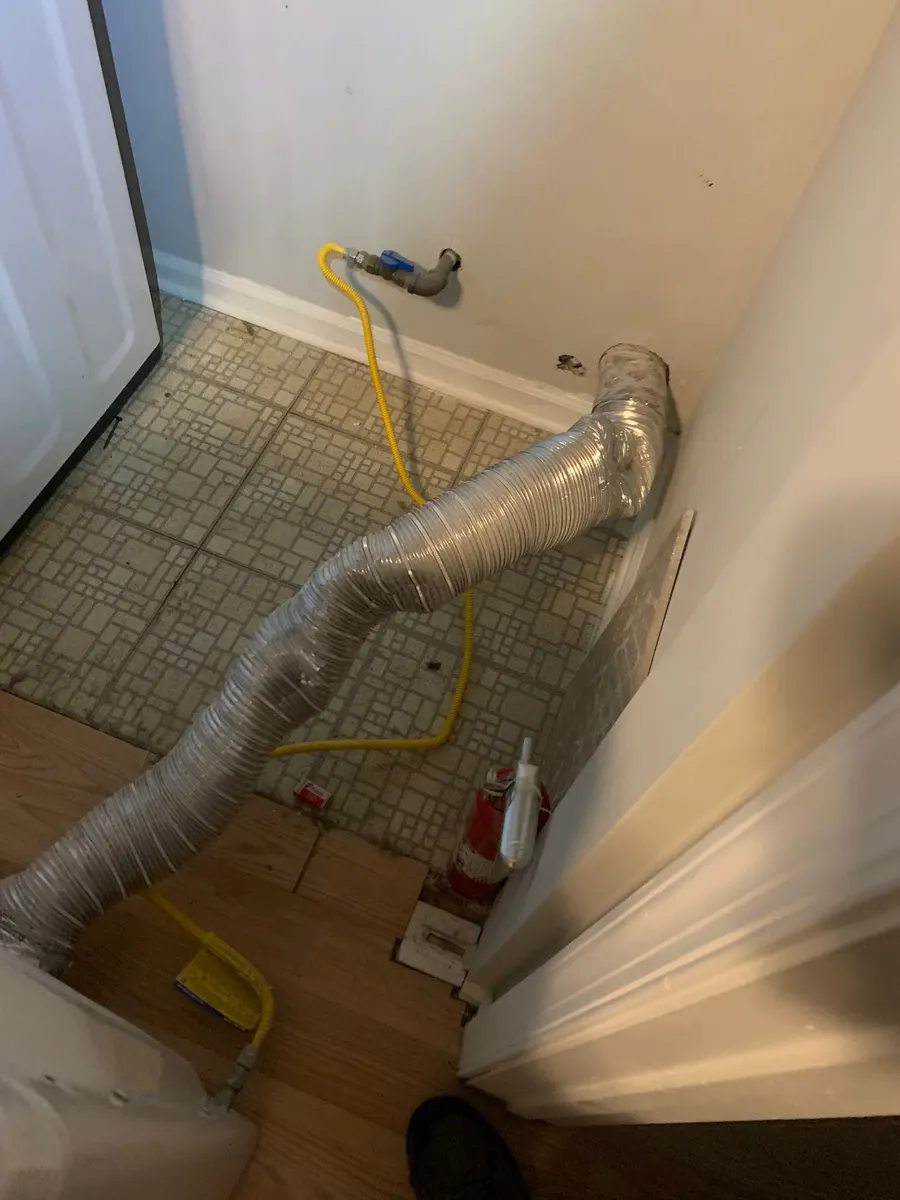
How often should a Dublin home do this?
Once a year is the right baseline for most households. Tighten that to every six to nine months if you have a long concealed run or an upper-floor laundry closet — common in the borough's townhomes — a roof or soffit termination, a large or pet-heavy household, or a basement run in one of the older village homes with known low spots. And if the annual camera check shows the vent is still clean, we say exactly that.
All of Dublin Borough, No Trip Fee
Main Street or the quietest cul-de-sac, a detached cape or a middle-of-the-row townhome — the terms are identical everywhere in Dublin: free video inspection, flat written quote before any work, no trip fee.
Our base is in King of Prussia and Route 313 brings our trucks straight through the borough, so Dublin is routine territory for us despite its upper-Bucks location. We work around the clock, Sunday through Friday — we're closed Saturdays when a vent problem cannot wait — and Wisetack financing is available at booking if you would rather spread the cost. Landlords and property managers with multi-unit buildings in the borough get the same terms, with per-unit written scoping and before-and-after documentation for their records.
Since one visit and one setup can cover both systems, many Dublin homeowners pair the vent service with air duct cleaning in Dublin on the same appointment. We serve the surrounding communities on identical terms — see dryer vent cleaning in Hilltown, Silverdale, and Plumstead, or the full Bucks County service area page for every town we cover.
- Family-owned and operated since 2016
- Licensed PA contractor #PA 187935, insured up to $2 million
- Google Guaranteed — money-back protection up to $2,000 on qualifying jobs
- Free video inspection before every job, after-photos when it is done
- Flat written quote before any work — never a revised number at the door
How much does dryer vent cleaning cost?
Routine and deep cleaning are different services — the free inspection determines which one your system actually needs. Prices vary house to house; your exact price comes as a flat written quote before any work begins.
| Dryer vent routine — basement / 1st floor | $129.99 |
| Dryer vent routine — 2nd floor & up | $149.99 |
| Dryer vent deep cleaning | $299.99 |
| Nest removal · bird guard installation | from $250 · from $150 |
Three promises. In writing. On every job.
Price Match Guarantee
Bring a competitor's written quote for the same scope of work — we'll match it. You never overpay for doing it right.
6-Month Warranty
Every job carries a 6-month workmanship warranty. If a problem traced to our work shows up, we come back and make it right — free.
Google Guaranteed
Booked through Google Local Services, qualifying jobs carry Google's own money-back protection up to $2,000, administered by Google.
Backed by a real license and $1M/$2M insurance — see the actual documents
Don't put off air you breathe — finance it with Wisetack
Check your options in about a minute with no impact to your credit score, choose terms that fit your budget, and pay over time instead of all at once.
*All financing is subject to credit approval. Your terms may vary. Wisetack loans are issued by Hatch Bank. See additional terms at wisetack.com/faqs.
4.8 stars from 144 Google reviews — and easy to find
E Cleaning Duct & Vent Cleaning is based at 555 S Goddard Blvd, King of Prussia, and serves Dublin and all of Bucks County from right here. Check our Google profile: real jobs, real photos, and a rating our crew protects on every visit.
- Google Guaranteed business — screened, licensed and insured (see the documents)
- Read every review on our Google profile — we don't cherry-pick what you can verify
Dryer Vent Cleaning questions from Dublin homeowners
Do you charge extra to come out to Dublin?
No. There are no trip fees or travel surcharges anywhere in Dublin Borough or the surrounding townships. Every job starts with a free video inspection of your vent run, and you get a flat written quote before any work begins — the amount you approve is the amount you pay, same as in every town we serve.
We live in a Dublin townhome and have never seen where our dryer vent exits. Can you find it?
Yes — this is one of the most common situations in the borough's attached housing. The camera traces your actual run from the dryer connection through the concealed chase to wherever it terminates: a rear wall, a soffit, or the roof. Once we know the route, we clean the full length and service the termination, and the footage shows you exactly what your vent looks like inside.
Our dryer is in the basement of an older home off Main Street. Is that a harder job?
Sometimes, and the inspection tells us honestly. Basement hookups in Dublin's village homes often run a long horizontal path through joist bays before exiting the foundation, and older flexible foil sections sag and trap damp lint in every low spot. The camera maps the actual route first, and the flat written quote reflects what the footage shows — routine cleaning if it is a normal lint load, a separately scoped deep cleaning only if the run genuinely needs it.
How often should a Dublin household have its dryer vent cleaned?
Once a year for most homes. Move to every six to nine months if you have a long or concealed run, an upper-floor laundry closet, a roof or soffit termination, or a large or pet-heavy household. If the annual inspection shows the vent is still clean, we tell you so — the inspection is free, and you keep the footage either way.
Do you clean dryer vents in Dublin apartment buildings and rentals?
Yes. We work with landlords and property managers on multi-unit buildings regularly: each unit's run gets its own video inspection and its own flat written quote, we schedule around tenants, and the before-and-after photos give owners documentation for their records. In attached buildings, one neglected vent is a shared risk, so owners often put the whole building on a single annual schedule.
The dryer still works — it just takes two cycles. Is that worth an inspection?
Yes, and sooner rather than later. Long dry times are the classic first symptom of a restricted vent: the dryer is running, but the exhaust cannot leave fast enough, so heat and moisture stay in the drum. It also means heat is building in the duct where the lint sits. The video inspection is free and will show you plainly whether the run is clogged, so there is no reason to guess.
Ready for honest dryer vent cleaning in Dublin?
Free video inspection, a flat written quote before any work, and real before/after proof — call (484) 367-5944 or book online now.
