
Dryer Vent Cleaning in Lower Gwynedd, PA
Dryer vent cleaning in Lower Gwynedd, PA starts with a free video inspection and a flat written quote before any work begins — the full run cleaned end to end, exterior termination included. E Cleaning is family-owned since 2016, a licensed PA contractor (PA 187935), insured to $2 million, Google Guaranteed, and rated 4.8 stars across 144 Google reviews. There is no trip fee anywhere in the township.
Where Lower Gwynedd keeps its laundry — and why the vent run changes the job
Lower Gwynedd is a spread-out, green township near the center of eastern Montgomery County, and it does its laundry in a lot of different places — which is exactly what makes a dryer vent here worth looking at before anyone quotes it. There is no tight borough grid. Homes sit on large, wooded lots strung between the historic villages of Spring House, where Bethlehem Pike meets Sumneytown Pike; Penllyn and Gwynedd Valley, along the SEPTA Lansdale/Doylestown regional rail line; and the old Gwynedd crossroads on the western edge near US 202.
The township is bordered by Ambler borough and Upper Dublin to the east, Whitpain to the southwest, Upper Gwynedd to the west, and Montgomery and Horsham townships to the north, with the Route 309 expressway running just past the eastern boundary. Big lots mean big houses, and big houses mean longer, more complicated dryer vent runs than you find in a rowhome. The single thing that decides how much work a vent needs is where the dryer sits.
A dryer in a basement, a first-floor mudroom, or an attached-garage hookup usually vents a short horizontal path through the rim joist or foundation wall to an exterior hood — quick to reach, quick to clean, and easy to verify airflow on. A dryer on the bedroom level or second floor of one of Lower Gwynedd's larger colonials is a different animal: the vent has to travel down through wall cavities or up and out through the roof, gaining elbows and vertical rise the whole way, and every added foot and every added bend is another place lint catches and packs. That is why we scope each job with a free video inspection and hand you a flat written quote before any work begins, instead of guessing a number in the driveway.
Farmhouses, estate colonials, and carriage homes: three kinds of vent
The oldest homes here are the stone farmhouses and pike-front houses scattered along Bethlehem Pike and Sumneytown Pike. Their laundry almost always lives in the basement, and the vent was punched through fieldstone or a rim joist long after the house was built. Those runs are often short, but in the oldest homes they were improvised around thick walls and low ceilings, so the path can bend more than you would expect and the exterior hood can sit in an awkward, easy-to-forget spot low on a stone wall.
The largest share of the township is railroad-era and late-twentieth-century colonials on wooded lots, many of them expanded over the years. When a kitchen or a primary suite gets renovated, the laundry frequently moves upstairs to the bedroom level for convenience, and the new vent is threaded through whatever wall cavity or attic space was available. That is how you end up with a thirty- or forty-foot run full of elbows terminating at a roof cap nobody has looked at since it was installed. Larger homes also do more laundry, which loads those long runs faster than most owners expect.
The newest layer is the carriage homes, townhomes, and age-qualified communities built in recent decades. These put the laundry on the main floor or second floor and vent it out a long sidewall run or straight up through the roof, and because the homes are attached, one neighbor's neglected vent becomes a shared-wall concern. Two things about Lower Gwynedd's setting make all of this worse: the tree canopy that makes the township so desirable also drops seeds and shelters birds that nest in low exterior hoods every spring, and roof-terminated caps on tall homes collect lint for years because they are invisible from the ground.
Why these vents clog — and what a blocked one costs
A dryer vent is the one duct in the house with a real fire-safety clock on it, and Lower Gwynedd's long, upper-floor and roof-terminated runs are exactly the kind that clog quietly. Lint is highly flammable, and a restricted vent traps the heat that can ignite it. U.S. fire departments respond to an estimated 15,970 home fires involving clothes dryers or washing machines each year, and failure to clean is the leading factor, contributing to one-third (33%) of dryer fires, according to NFPA data from 2010-2014. The U.S. Fire Administration (FEMA) separately estimates 2,900 home clothes dryer fires are reported each year.
Season matters in a township that runs its dryers hard from October through March. Winter laundry — bath towels, blankets, fleeces, and kids' sports gear — sheds far more lint per load than summer clothing, right when the dryer is already working hardest against cold air at the vent hood. A run that limps through August at half airflow tends to give up in January, and a long roof-terminated vent has the least margin to spare. There is a quieter cost, too: a dryer pushing damp air through a packed vent runs two or three cycles instead of one, and every extra cycle is energy spent re-drying the same load.
Signs a Lower Gwynedd homeowner should not ignore:
- Towels and jeans need two or three cycles to dry
- The dryer, its door, or the laundry room feels unusually hot mid-cycle
- A burning or scorched smell while the dryer runs
- Little or no airflow at the outside hood, or a flap that never opens
- Lint building up around the dryer, behind it, or at the exterior vent
- The dryer shuts itself off mid-cycle or trips its thermal safety
How we clean a Lower Gwynedd dryer vent end to end
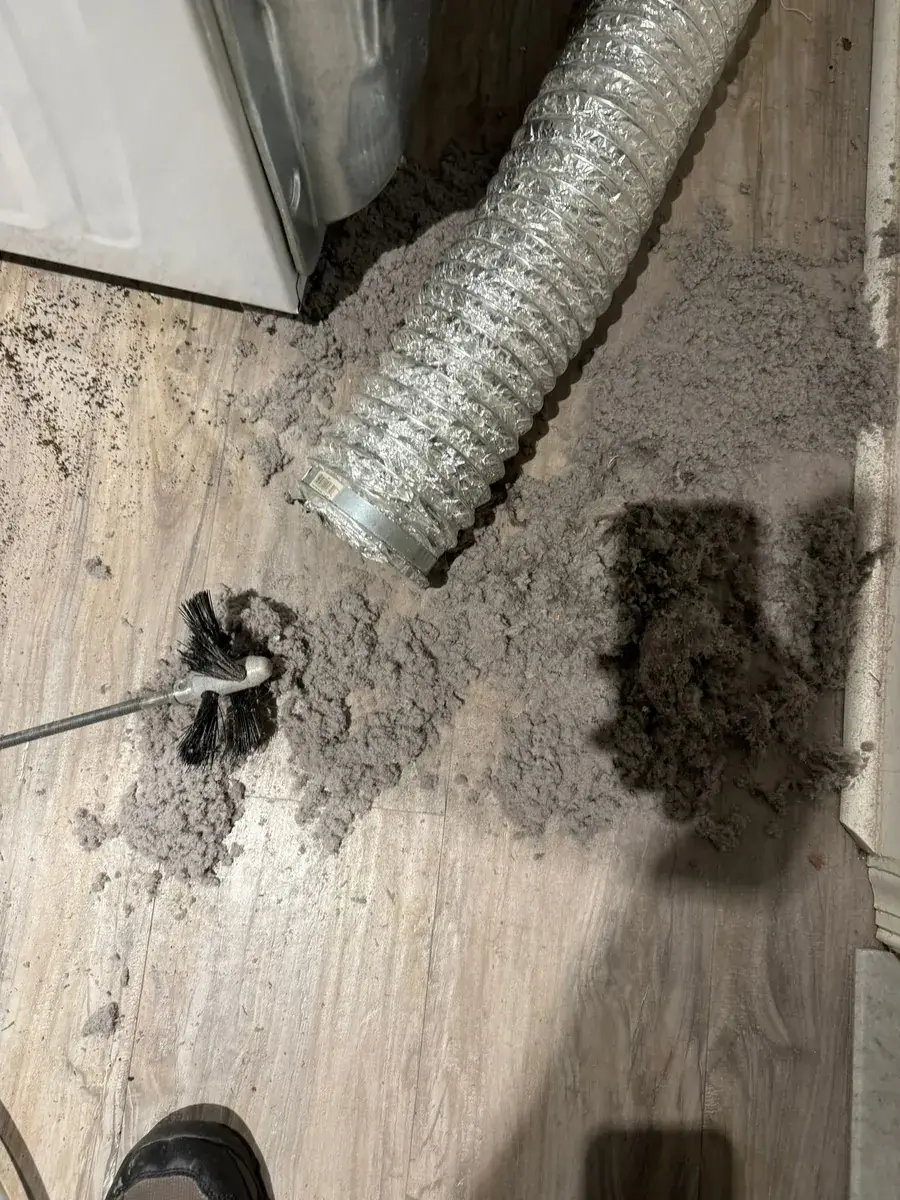
End to end means the entire path: from the connection behind the dryer, through every foot of duct and every elbow, out to the exterior hood or roof cap. We pull the dryer out, detach and inspect the transition hose, then run professional rotary brushes through the full length of the vent while a vacuum captures the lint the brush breaks loose — full-run lint extraction, so the buildup ends up in our equipment instead of blown around your laundry room or across the yard. At the far end we clear the hood or cap, check that the flap or screen actually moves, reconnect everything, and verify strong airflow with the dryer running before we leave.
- Free video inspection of the vent and its termination — we confirm the run, the length, and where it exits before quoting
- A flat written quote covering the exact scope, in your hands before any work begins
- Dryer pulled out and the transition hose behind it detached and inspected
- Rotary brush run through the entire vent with simultaneous vacuum capture — no lint left in the line
- Exterior hood or roof cap cleared, and the flap or screen checked for free movement
- Everything reconnected and airflow verified at the termination with the dryer running
- After-photos of the cleared vent for your records
What a typical visit looks like
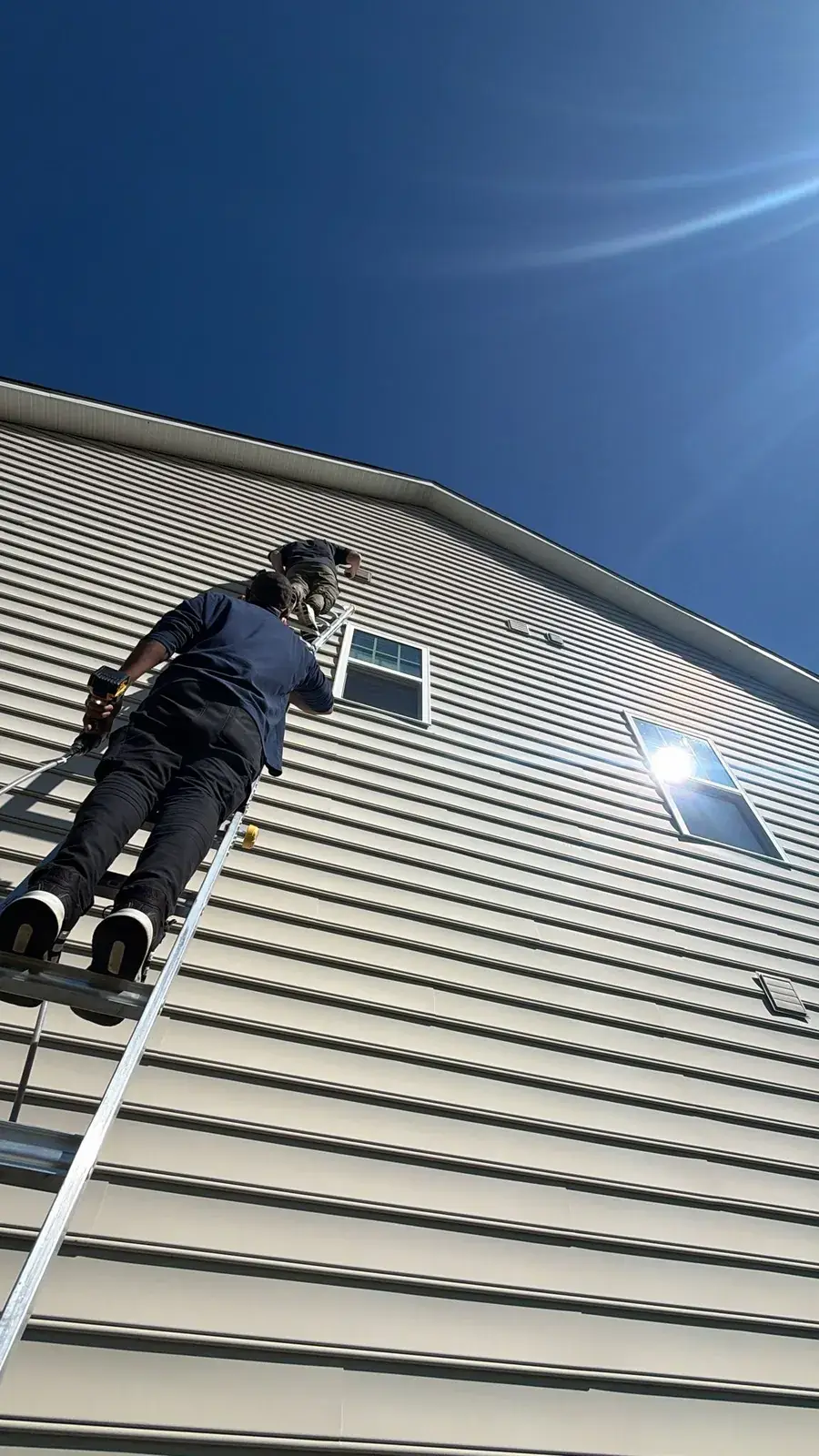
A basement or first-floor hookup is usually under an hour. Upstairs and roof-terminated runs take longer because of the ladder work and the added length. You see the lint that comes out — homeowners are routinely surprised by the volume — and the number on the invoice is the number you approved in writing before we started.
What every cleaning includes — and what we tend to find
Every dryer vent cleaning includes the exterior termination, the transition-hose inspection, and the final airflow check, all spelled out on the flat written quote you approve before we start. Nothing gets added at the door. If the inspection turns up a real problem, we show you photos and explain the options — you decide, and only then does anything change on the quote. There is no per-elbow upcharge invented on the driveway and no surprise line item on the invoice.
A few findings come up often enough in Lower Gwynedd to flag in advance. Plastic or foil accordion-style transition hose behind the dryer sags and traps lint in every ridge, and it is not what current safety guidance calls for — when we see it, we point it out and can swap in semi-rigid metal on the spot. Crushed or disconnected duct hidden in a wall or ceiling chase turns up in renovated homes where the laundry moved upstairs and the vent path was improvised. And on wooded lots, a bird nest behind a low exterior hood is common in spring — it blocks the run completely and shows up as a dryer that suddenly will not dry at all.
Routine or deep — the inspection decides
A vent cleaned within the last year or so needs a straightforward maintenance pass. A long run that has never been serviced, or one packed solid from years of upstairs laundry, needs a deeper clean with more brushing and more lint capture. These are genuinely different jobs, and the free inspection settles which one your vent actually needs — sometimes the honest answer is that it is fine and you should wait.
| Laundry location | Typical vent path | What that means for the job |
|---|---|---|
| Basement or first floor | Short horizontal run to an exterior wall hood | Quick access, faster cleaning and airflow check |
| Second floor or bedroom level | Longer run through wall cavities or up through the roof | More elbows, more ladder work, more cleaning time |
| Carriage home or townhome | Long sidewall run or roof cap on an attached home | Extra length and vertical rise; shared-wall fire concern |
Booking dryer vent cleaning in Lower Gwynedd
Three real commitments stand behind every job. A Price Match Guarantee: bring a competitor's written quote for the same scope of work and we match it. A 6-month workmanship warranty: if a problem traced to our work shows up within six months, we come back and make it right free. And Google Guaranteed status, which adds Google's own money-back protection up to $2,000 on qualifying jobs, administered by Google. We are a licensed PA contractor (PA 187935), insured to $2 million, and the actual documents are viewable on that page.
We schedule 24 hours a day, Sunday through Friday, and we are closed Saturdays. There is no trip fee anywhere in the township — Lower Gwynedd is a short run from our King of Prussia base up US 202 and Sumneytown Pike, and the flat written quote you approve is the whole price. Financing is available through Wisetack when a larger repair comes along with the cleaning. Renters and landlords: dryer vents in rental homes get serviced even less often than owner-occupied ones, so a flat-rate cleaning quoted in writing per unit is inexpensive insurance — this page is an easy one to forward to a property manager.
We clean dryer vents throughout the area with the same free-inspection, written-quote approach: Ambler, North Wales, and Blue Bell, and across the county — see the full list on our Montgomery County page. Many Lower Gwynedd homeowners bundle this visit with air duct cleaning in Lower Gwynedd, since the crew and equipment are already at the house.
How much does dryer vent cleaning cost?
Routine and deep cleaning are different services — the free inspection determines which one your system actually needs. Prices vary house to house; your exact price comes as a flat written quote before any work begins.
| Dryer vent routine — basement / 1st floor | $129.99 |
| Dryer vent routine — 2nd floor & up | $149.99 |
| Dryer vent deep cleaning | $299.99 |
| Nest removal · bird guard installation | from $250 · from $150 |
Three promises. In writing. On every job.
Price Match Guarantee
Bring a competitor's written quote for the same scope of work — we'll match it. You never overpay for doing it right.
6-Month Warranty
Every job carries a 6-month workmanship warranty. If a problem traced to our work shows up, we come back and make it right — free.
Google Guaranteed
Booked through Google Local Services, qualifying jobs carry Google's own money-back protection up to $2,000, administered by Google.
Backed by a real license and $1M/$2M insurance — see the actual documents
Don't put off air you breathe — finance it with Wisetack
Check your options in about a minute with no impact to your credit score, choose terms that fit your budget, and pay over time instead of all at once.
*All financing is subject to credit approval. Your terms may vary. Wisetack loans are issued by Hatch Bank. See additional terms at wisetack.com/faqs.
4.8 stars from 144 Google reviews — and easy to find
E Cleaning Duct & Vent Cleaning is based at 555 S Goddard Blvd, King of Prussia, and serves Lower Gwynedd and all of Montgomery County from right here. Check our Google profile: real jobs, real photos, and a rating our crew protects on every visit.
- Google Guaranteed business — screened, licensed and insured (see the documents)
- Read every review on our Google profile — we don't cherry-pick what you can verify
Dryer Vent Cleaning questions from Lower Gwynedd homeowners
Do you charge a trip fee to come out to Lower Gwynedd?
No. Lower Gwynedd is a short drive from our King of Prussia base up US 202 and Sumneytown Pike, and we do not charge travel or trip fees anywhere we work. The video inspection is free, and the flat written quote you approve before any work begins is the whole price — the same quote every Montgomery County customer gets.
My laundry is on the second floor of a large colonial. Does that make the vent harder to clean?
Yes. Upper-floor laundry means a longer run that drops through wall cavities or exits the roof, with more elbows and vertical rise where lint packs in. That added ladder work and cleaning time is reflected in your flat written quote, which is agreed before we start, so there is nothing to negotiate at the door.
My dryer vent goes out through the roof. Can you clean it?
Yes. Roof-terminated vents are common on Lower Gwynedd's taller colonials and carriage homes, and they are the runs that need cleaning most, because a clogged roof cap is invisible from the ground. We clean the full vertical run, clear the cap, and verify airflow — all scoped in the written quote before we begin.
How often should a dryer vent be cleaned in Lower Gwynedd?
Once a year is the sensible baseline. Move sooner if you have a long upstairs or roof-terminated run, dry many loads a week, or notice longer dry times. Failure to clean is the leading factor in dryer fires, contributing to one-third of them per NFPA data, so the annual clean is cheap insurance for the home.
Do you cover the whole township — Spring House, Penllyn, and Gwynedd Valley?
Yes, all of Lower Gwynedd Township, including every village and the wooded lanes between them. We also clean dryer vents daily in the surrounding towns — Ambler, North Wales, and Blue Bell — and across Montgomery County.
Do you also clean air ducts while you're here?
Yes. Many Lower Gwynedd customers pair the dryer vent with air duct cleaning in Lower Gwynedd in the same visit, since the crew and equipment are already on site. Each service gets its own free inspection and its own line on the flat written quote, so you approve the full scope before any work starts.
Ready for honest dryer vent cleaning in Lower Gwynedd?
Free video inspection, a flat written quote before any work, and real before/after proof — call (484) 367-5944 or book online now.
