
Dryer Vent Cleaning in Lower Pottsgrove, PA
A clogged dryer vent is one of the most preventable fire hazards in a Lower Pottsgrove home — and clearing it usually takes about an hour. E Cleaning cleans dryer vents across the township, from short basement runs in the older homes near Pottstown to the long second-floor runs in the Sanatoga-area colonials and townhomes, always starting with a free inspection and a flat, written quote before any work begins. Family-owned, PA licensed (PA 187935), insured up to $2 million, rated 4.8 stars across 144 Google reviews.
In Lower Pottsgrove, the floor your laundry sits on decides the job
Lower Pottsgrove's homes arrived in waves, and each wave put the laundry somewhere different: the basement in the older and mid-century houses, the main floor in the earlier subdivisions, and dedicated second-floor laundry rooms in the newer Sanatoga colonials. Where the washer and dryer landed determines how long the vent run is, how many elbows it turns, and how quickly it clogs.
The township sits in western Montgomery County, wrapping the eastern side of Pottstown along the Schuylkill River, roughly 30 miles northwest of Philadelphia. Route 422 crosses the south end with the Sanatoga interchange, and the neighborhoods behind that corridor grew steadily through the late twentieth century. Almost every household here does laundry at home rather than at a laundromat, which means nearly every house in the township has a dryer vent that is somebody's responsibility — and in our experience, it is the least-thought-about piece of equipment in the building.
In the older homes near the borough line and the postwar ranches and split-levels, laundry almost always lives in the basement. The vent run is short — out through the rim joist to a sidewall hood — and short runs are the good news. The bad news is age: crushed foil transition hoses behind the dryer, exterior flappers that no longer close, and well-meaning screens added over the hood that trap lint like a filter. A short run that is mostly blocked is still a blocked run, and basement hookups carry a second tell — when the vent leaks or clogs, the moisture stays in the basement, and you start to smell it.
The colonials built from the 1980s through the 2000s around Sanatoga moved laundry upstairs — first to the main floor, then to dedicated second-floor laundry rooms near the bedrooms. Convenient for the family, hard on airflow: the vent now drops through wall cavities and floor systems, turns several elbows, and travels a long path to a sidewall hood high on the house or a roof termination. Every added foot and every elbow gives lint a place to fall out of the airstream, which is why an upstairs laundry room can clog in a fraction of the time a basement hookup takes — and why the homeowner usually cannot see any of the run to check it.
The township's townhome and twin developments add a third pattern: limited exterior wall, longer horizontal runs boxed into ceilings, and homes that share walls — where one household's neglected vent sits a few feet from a neighbor's bedroom. In attached housing like this, an annual vent cleaning is less a maintenance nicety and more basic fire hygiene for the whole row.
The fire math — and the warning signs to catch first
Dryer fires are a lint problem, and lint is removable. The numbers behind that sentence are worth thirty seconds of your attention.
The U.S. Fire Administration (FEMA) separately estimates 2,900 home clothes dryer fires are reported each year. Lint is close to ideal fuel — dry, fine, and packed directly against a heat source — and a restricted vent forces the dryer to run hotter and longer, in exactly the conditions that ignite it.
Winters in this corner of Montgomery County make the vent work hardest just when it is most likely to be compromised. Cold air means longer, hotter cycles; families run heavier loads of coats, blankets, and layers; exterior flappers stick or freeze open; and the vent spends months at maximum duty. Spring brings a different problem — birds hunting for a warm, sheltered cavity find uncapped vent hoods irresistible, and a nest can block a vent completely within days, a common event along the township's open, field-edged streets.
- Towels or jeans need a second cycle to dry
- The dryer top or the laundry room feels hot while running
- A burning or scorched smell during a cycle
- Barely any lint on the screen — it is going into the vent instead
- The exterior flap does not open when the dryer runs, or lint clings to the siding around it
- A damp or mildew smell around a basement laundry area
- You cannot remember the last professional cleaning
Any one of these is reason enough to have the vent inspected — and the inspection costs nothing, so the question never has to stay open. Catching a restricted vent early is the difference between an hour of routine work and a repair, or worse.
How we clean a Lower Pottsgrove dryer vent — the whole run, end to end
A real cleaning covers the entire path lint travels: the transition hose behind the dryer, the full length of in-wall or in-ceiling duct, and the exterior termination — verified with airflow at the end. If a company only vacuums what it can reach from the outside hood, that is not a cleaning.
Free inspection and flat quote
Every visit starts with a free inspection and a flat written quote before we touch anything. You approve the full scope up front, and the number on the quote is the number on the invoice.
Pull the dryer, check the transition
The dryer comes away from the wall and the transition hose gets checked first. A crushed foil accordion hose is the single most common defect we find behind dryers; if yours should be replaced with semi-rigid metal duct, that goes into the quote before the work, not onto the invoice after.
Brush the full run with HEPA capture
A rotary brush is driven through the entire length of the duct while a HEPA-filtered vacuum captures the lint — the same source-removal logic we apply to air ducts, scaled to a four-inch line. Elbows and vertical drops inside the walls get particular attention.
Clear and check the exterior
At the outside hood we clear the termination, remove any nest or debris, and check the flapper so it opens under airflow and closes against weather and pests. Roof terminations, common on the two-story homes here, are routine for us.
Airflow test and after-photos
We confirm the dryer is venting freely, then hand you before-and-after photos of the run. You see the lint that came out and feel the difference in the airflow at the exterior hood.
- Transition hose behind the dryer inspected and cleared
- Full in-wall or in-ceiling duct brushed end to end
- Exterior hood cleared and the flapper checked
- Bird nests and debris removed from the termination
- Airflow verified and after-photos provided
- 6-month workmanship warranty on every job
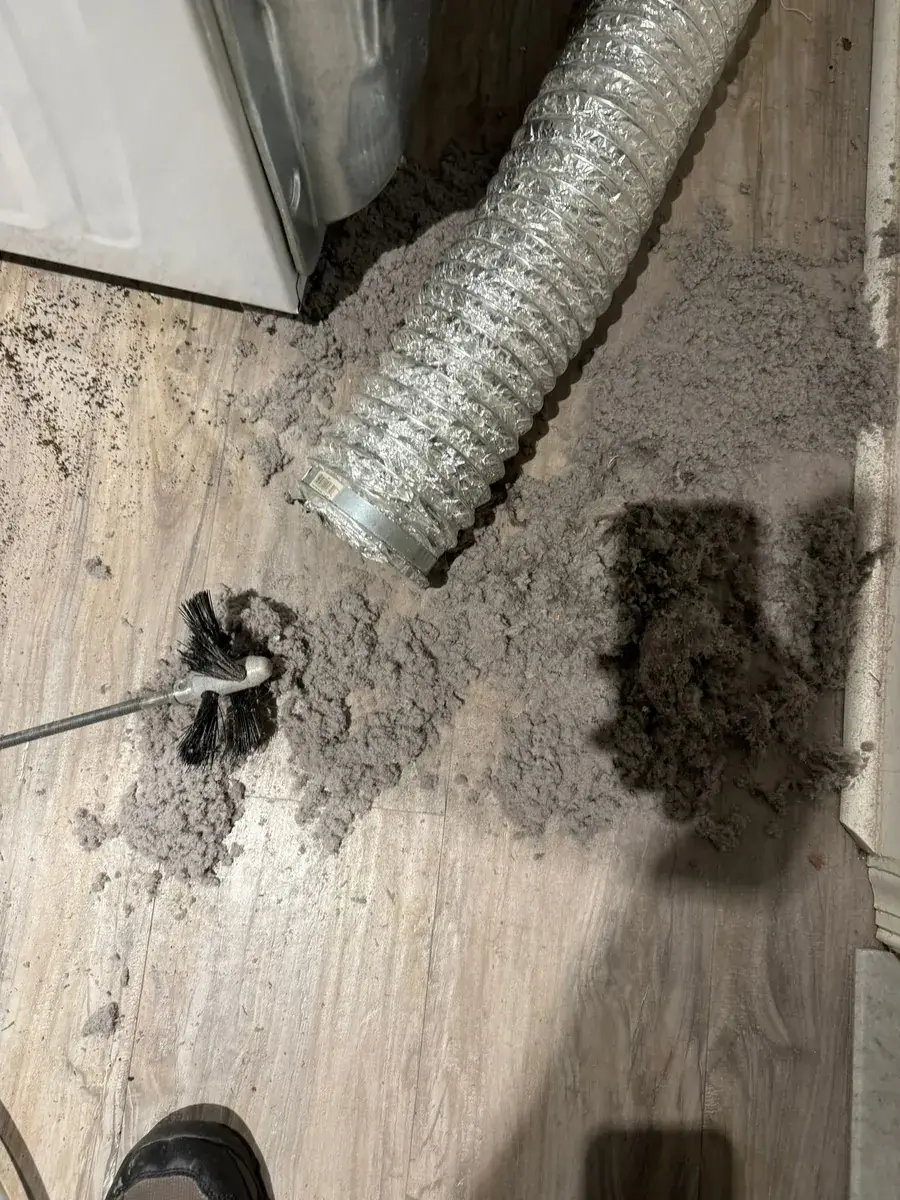
What comes out of a neglected run
This is a typical extraction from a vent that has gone a few years without service — from a long upstairs run, often considerably more. Every ounce of it was sitting between the dryer's heating element and the outside air. Clearing it is what drops your cycle times back down and takes the fire fuel out of the wall.
How often should it be done — and what it costs?
Every dryer vent job in Lower Pottsgrove works the same way: free inspection first, then a flat written quote before any work begins. The number on the quote is the number on the invoice — no teaser pricing, no doorstep upsell, and no trip fee to get here. How often to repeat it depends on your household more than the calendar.
| Your situation | Sensible cleaning interval |
|---|---|
| Basement laundry, short run, one or two people | Every 12 months |
| Family running loads most days | Every 6–9 months |
| Second-floor laundry with a long run or roof termination | Every 6–9 months |
| Shedding pets, or frequent heavy items like comforters and work clothes | Every 6 months |
| Townhome or other attached housing | Every 12 months minimum — treat it as fire safety, not upkeep |
Like air ducts, dryer vents come in two honest tiers of work, and the inspection decides which one you need. A run cleaned within the last year or two is usually a routine maintenance clean — brush the line, clear the hood, verify airflow, done. A run packed solid after years of neglect, a vent choked with a bird nest, or a long second-floor path that has never been serviced is a heavier job that takes more time and sometimes a replacement transition or a repaired termination. Those are genuinely different services, and the written quote names the one your vent calls for before we start — never a maintenance price on the phone that balloons once the dryer is pulled from the wall.
Because the dryer usually sits near the furnace — or shares wall cavities with the same duct chases — most homeowners pair this service with air duct cleaning in Lower Pottsgrove in a single visit: one appointment, one crew, and one written quote covering both scopes. If only one of the two actually needs work, the inspection footage will show it, and we will say so.
Behind every job stands the same set of commitments we offer county-wide: a Price Match Guarantee against a competitor's written quote for the same scope of work, a 6-month workmanship warranty on every job, and Google Guaranteed money-back protection up to $2,000 on qualifying jobs, administered by Google. We are a PA licensed contractor (PA 187935) and insured up to $2 million — the documents are viewable on our license and insurance page. Financing is available through Wisetack, and we work around the clock, Sunday through Friday — we're closed Saturdays, for the times a vent problem cannot wait.
Our crews cover the whole Montgomery County service area from King of Prussia, and the Pottstown-area ring is a regular route — the same technicians handle Upper Pottsgrove, Limerick, and New Hanover.
How much does dryer vent cleaning cost?
Routine and deep cleaning are different services — the free inspection determines which one your system actually needs. Prices vary house to house; your exact price comes as a flat written quote before any work begins.
| Dryer vent routine — basement / 1st floor | $129.99 |
| Dryer vent routine — 2nd floor & up | $149.99 |
| Dryer vent deep cleaning | $299.99 |
| Nest removal · bird guard installation | from $250 · from $150 |
Three promises. In writing. On every job.
Price Match Guarantee
Bring a competitor's written quote for the same scope of work — we'll match it. You never overpay for doing it right.
6-Month Warranty
Every job carries a 6-month workmanship warranty. If a problem traced to our work shows up, we come back and make it right — free.
Google Guaranteed
Booked through Google Local Services, qualifying jobs carry Google's own money-back protection up to $2,000, administered by Google.
Backed by a real license and $1M/$2M insurance — see the actual documents
Don't put off air you breathe — finance it with Wisetack
Check your options in about a minute with no impact to your credit score, choose terms that fit your budget, and pay over time instead of all at once.
*All financing is subject to credit approval. Your terms may vary. Wisetack loans are issued by Hatch Bank. See additional terms at wisetack.com/faqs.
4.8 stars from 144 Google reviews — and easy to find
E Cleaning Duct & Vent Cleaning is based at 555 S Goddard Blvd, King of Prussia, and serves Lower Pottsgrove and all of Montgomery County from right here. Check our Google profile: real jobs, real photos, and a rating our crew protects on every visit.
- Google Guaranteed business — screened, licensed and insured (see the documents)
- Read every review on our Google profile — we don't cherry-pick what you can verify
Dryer Vent Cleaning questions from Lower Pottsgrove homeowners
Do you charge extra to come out to Lower Pottsgrove or Sanatoga?
No. There are no trip fees anywhere in our service area, and the Pottstown-area townships are a regular route for our crews. The free inspection and the flat written quote work exactly the same in Lower Pottsgrove as they do everywhere else we serve — no travel charge, no minimum, and no surprise line items on the invoice.
Our laundry room is on the second floor and the vent exits through the roof. Can you clean it?
Yes. Long vertical runs with roof terminations are common in the Sanatoga-area two-story colonials, and they are routine work for us. The rotary brush cleans the entire length of the run from the inside while the vacuum captures the lint, and the roof hood is cleared and checked at the termination. Long runs like these also clog faster than basement hookups, so they are worth putting on a shorter cleaning cycle.
How often should a busy family here have the vent cleaned?
Once a year is the right baseline for most households. Move to every six to nine months if you run loads most days, dry heavy items like comforters and work clothes regularly, share the house with shedding pets, or have a long second-floor run with several elbows. NFPA data shows failure to clean is the leading factor in dryer fires, contributing to one-third of them — so frequency is most of the game.
A bird built a nest in our dryer vent. What do you do about it?
We remove the nest and any debris, clean the full run behind it, and check the exterior hood. Then we recommend a proper pest-resistant hood with a working flapper — not a mesh screen, which stops birds but traps lint and recreates the clog. Nesting season is a spring problem across the township's open, field-edged streets, and an uncapped hood will get rediscovered year after year until the termination is fixed.
Will you replace the hose behind the dryer if it needs it?
Yes. Crushed or aging foil transition hose is the most common defect we find behind dryers, and the right fix is semi-rigid metal duct. If yours needs replacing, it goes into the flat written quote before any work begins — you approve the full scope up front, and nothing gets added at the invoice.
Can you clean the dryer vent and the air ducts in the same appointment?
Yes — it is the most common way Lower Pottsgrove homeowners book us. One crew handles both in a single visit, and you get one flat written quote covering both scopes after the free inspection. See air duct cleaning in Lower Pottsgrove for how that half of the visit works.
Ready for honest dryer vent cleaning in Lower Pottsgrove?
Free video inspection, a flat written quote before any work, and real before/after proof — call (484) 367-5944 or book online now.
