
Dryer Vent Cleaning in Perkiomenville, PA
If your dryer in Perkiomenville needs two cycles to finish a load, the vent line is the first suspect — and we will show you, on camera, exactly what is choking it before we quote a thing. Every dryer vent job starts with a free video inspection and a flat written quote before any work begins, with no trip fee anywhere in the 18074 area. E Cleaning is family-owned, PA-licensed, insured up to $2 million, and rated 4.8 stars across 144 Google reviews.
Every Perkiomenville laundry setup vents differently — and the run is the job
Dryer vent cleaning comes down to a single question: what path does the exhaust take from the back of your dryer to the outside air? Around Perkiomenville, that path varies enormously, because this is rural, spread-out country in the northwestern corner of Montgomery County. The community straddles Marlborough and Upper Frederick townships along Route 29 (Gravel Pike) in the Perkiomen Creek valley, and almost all of it is detached single-family housing on generous, wooded lots. Detached country homes tend to have longer, more roundabout vent runs than the tight townhouses down-county, and the dryer can sit almost anywhere in the house. Where it lives, and on which floor, effectively decides the shape of the cleaning — which is why we inspect the full run with a camera before quoting anything.
Three setups cover most of the area. In the older farmhouses and mid-century ranches along the back roads, the dryer usually sits in the basement and either vents out through the rim joist or pushes a long horizontal run across the ceiling to reach an outside wall — and every foot of that run, and every elbow in it, is a place where lint slows down and packs in. In homes built or remodeled from the 1980s on, laundry often moved up to a first-floor mudroom or hall closet; the run to daylight gets shorter, but the crimped foil transition hose crushed behind the machine becomes the new choke point. And in the larger colonials raised on former farm parcels through the 1990s and 2000s, second-floor laundry rooms near the bedrooms are common — which means a concealed run climbing through wall cavities and, in many layouts, straight up and out through a roof cap.
Fire safety when the fire company has a long way to drive
A clogged dryer vent is one of the most preventable fire hazards in any home, and prevention counts double out here. Like the rest of this corner of northern Montgomery County, Perkiomenville is protected by volunteer fire companies covering wide, spread-out road networks — help is simply farther away on a wooded back road than it is in a borough — so not needing it is the real strategy. The fire numbers behind that are not scare marketing; they are counted year after year.
Most of Perkiomenville is detached housing, which spares it the wall-to-wall spread you worry about in dense townhome rows — but detachment cuts both ways. A long, concealed run in a big country colonial hides its lint just as well as a shared-wall vent does, and there is no neighbor on the other side to smell trouble first. Toward Green Lane and the older Upper Perkiomen borough cores just up the pike, the picture tightens into twins and closer-set homes, and there a blocked vent becomes your neighbor's problem as much as your own. Either way, the fix is the same, and it is boring on purpose: a once-a-year cleaning that takes the fuel out of the line before it can matter.
Why valley winters and wooded lots are hard on a vent line
Local conditions do real work against dryer vents here. Winter in the upper Perkiomen Valley runs long and cold, and it is also peak laundry season — towels, blankets, snow gear, and heavy work clothes shed far more lint than summer loads, so lint production climbs in exactly the months the dryer works hardest. Long runs passing through unheated attics, crawlspaces, or garages cool the exhaust enough to condense its moisture, turning loose lint into a damp, matted plug that no lint screen ever catches, and exterior flaps stick or freeze partway shut in the cold. Humid valley summers finish the job by keeping lint damp and sticky so it clings to the duct wall instead of blowing clear.
The wooded setting adds a hazard that surprises people: wildlife. Birds and small rodents treat a warm, sheltered vent cap as prime real estate, and a nest packed into the termination blocks airflow just as thoroughly as years of lint. In country this close to fields and trees, clearing a nest out of a vent hood is routine work for us — and once it is clear, a properly designed guard keeps the next tenant out without the fine screening that clogs with lint itself and becomes a hazard of its own. One more local detail: with little natural-gas service on these back roads, dryers here run on electricity or propane, and a propane dryer pushes combustion moisture out through the same duct as the lint, so a restricted vent does not just dry slowly — it drives damp exhaust back toward the laundry room and makes the burner labor against its own backpressure.
We handle dryer vents across the whole valley the same way, including Marlborough Township around us, Green Lane up the pike, and Salford across the creek to the east — see the full Montgomery County service area. No trip fees anywhere on the list.
How do you know it's time — and what does the cleaning involve?
Your dryer tells you when the vent is choking; most people just have not been told what the signals mean. If any of these sound familiar in your Perkiomenville home, the line needs to be looked at:
- Loads need two or more cycles to fully dry
- The top of the dryer or the laundry room feels unusually hot mid-cycle
- A burning or hot-lint smell while the dryer runs
- The exterior flap barely opens, or no steady plume of warm air shows outside on a cold day
- Lint gathers around the door seal, behind the machine, or on the siding near the cap
- It has been more than a year since the line was professionally cleaned — or it never has been
The job itself is visual from start to finish. First comes the free video inspection: a camera goes through the full run — basement rim-joist exit, wall cap, or roof termination — so you see the actual blockage, not a description of one. You get a flat written quote on the spot, and nothing happens until you approve it. Then we clean the line from both ends, using rotary brushes sized to your duct that scrub the walls the full length of the run while HEPA-filtered vacuum extraction pulls the freed lint into our equipment instead of down the line or across your yard. We clear and check the exterior termination and its flap, and we inspect the transition hose behind the dryer — if you have crushable foil back there, we say so, because it is a known lint trap and swapping it for smooth semi-rigid metal is a cheap fix. Before we leave, we verify airflow at the termination with the dryer running and hand you after-photos of the same line you saw on the inspection video.
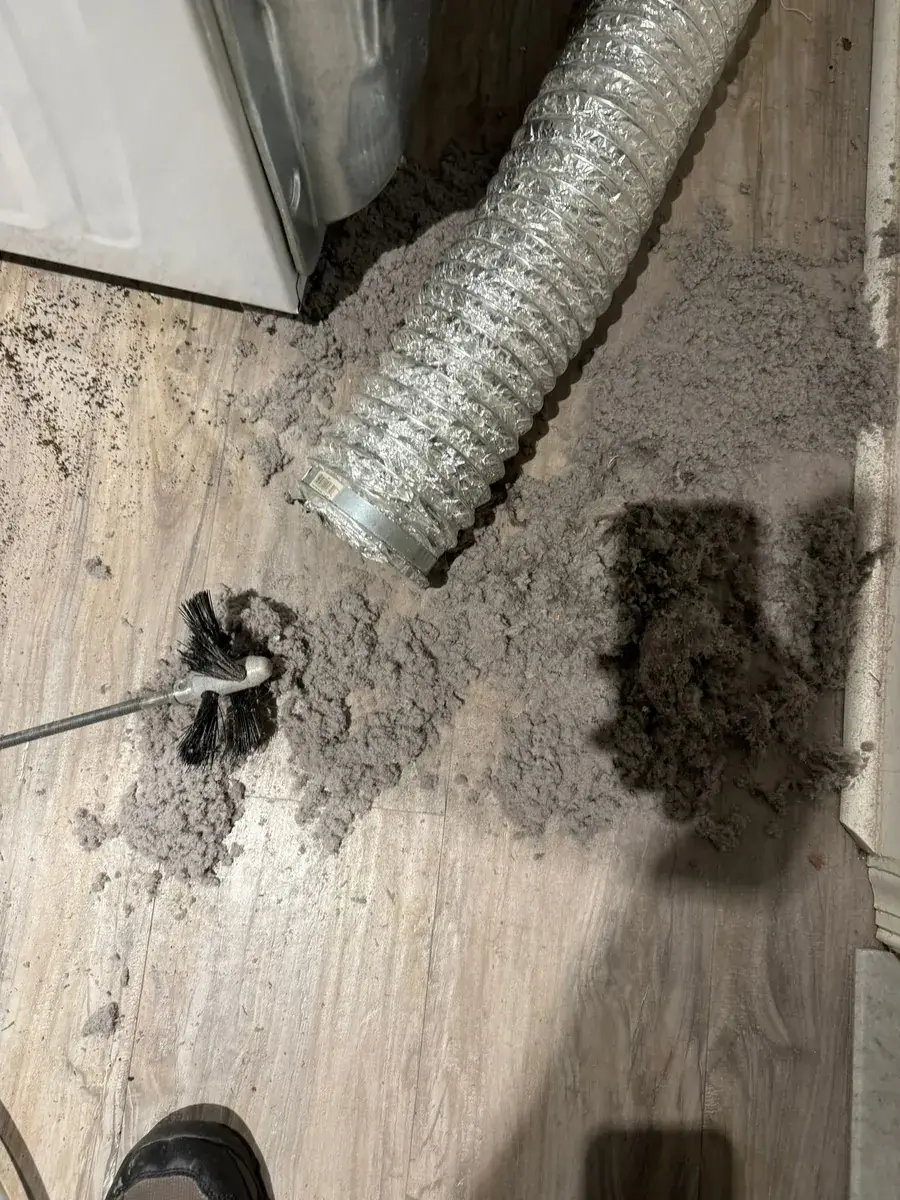
What comes out of a neglected line
A vent that has never been cleaned commonly gives up a startling volume of packed lint — sometimes an armful from a single run. Every ounce of it was sitting between a heating element and your framing. Seeing the pile on the floor is usually the moment homeowners move this from "someday" to "once a year."
How often, what it saves, and what stands behind the work
Routine and deep are different jobs on a dryer vent, too. A run cleaned within the last year or so usually needs a straightforward brush-and-extract and an airflow check at the cap. A run that has gone many years — or has never been opened since the house was built — often hides a compacted core of lint that the brush has to break up in stages, sometimes with a nest or a crushed hose in the mix, and it is scoped and scheduled as the bigger job it honestly is. The free video inspection is what tells the two apart, so you are never guessing and neither are we. For most households once a year is the right cadence, in line with fire-safety guidance; big families running daily loads, homes with shedding pets, and the long or roof-terminated runs so common out here may need it sooner, while a short basement run in good shape sometimes needs it less.
The payoff reaches past safety. A clear vent means shorter dry times, which means fewer hours of runtime a week, less heat-cycling wear on the motor and heating element, and less electricity or propane burned per load — the dryer is among the hungriest appliances in the house, and hungriest of all when it is fighting a blocked exhaust. Homeowners who have been running everything twice to get it dry are usually surprised how much of that was the vent, not a tired machine.
The work carries our full guarantee stack: a Price Match Guarantee if you bring a competitor's written quote for the same scope, and a 6-month workmanship warranty on every job — if a problem traced to our work shows up within six months, we come back and make it right at no charge. Qualifying jobs also carry Google Guaranteed money-back protection up to $2,000, administered by Google. We are a PA-licensed contractor (PA 187935), insured up to $2 million, and you can view our license and insurance documents before we ever knock on your door. Financing is available through Wisetack, and we schedule around the clock, Sunday through Friday, closed Saturdays.
The most efficient way to book us is to have the dryer vent and the HVAC ducts done in the same visit — one appointment, one setup, both systems inspected on camera and each scoped with its own written quote so you can approve one or both. See air duct cleaning in Perkiomenville for how we handle the other side of the job, or just mention both when you call.
How much does dryer vent cleaning cost?
Routine and deep cleaning are different services — the free inspection determines which one your system actually needs. Prices vary house to house; your exact price comes as a flat written quote before any work begins.
| Dryer vent routine — basement / 1st floor | $129.99 |
| Dryer vent routine — 2nd floor & up | $149.99 |
| Dryer vent deep cleaning | $299.99 |
| Nest removal · bird guard installation | from $250 · from $150 |
Three promises. In writing. On every job.
Price Match Guarantee
Bring a competitor's written quote for the same scope of work — we'll match it. You never overpay for doing it right.
6-Month Warranty
Every job carries a 6-month workmanship warranty. If a problem traced to our work shows up, we come back and make it right — free.
Google Guaranteed
Booked through Google Local Services, qualifying jobs carry Google's own money-back protection up to $2,000, administered by Google.
Backed by a real license and $1M/$2M insurance — see the actual documents
Don't put off air you breathe — finance it with Wisetack
Check your options in about a minute with no impact to your credit score, choose terms that fit your budget, and pay over time instead of all at once.
*All financing is subject to credit approval. Your terms may vary. Wisetack loans are issued by Hatch Bank. See additional terms at wisetack.com/faqs.
4.8 stars from 144 Google reviews — and easy to find
E Cleaning Duct & Vent Cleaning is based at 555 S Goddard Blvd, King of Prussia, and serves Perkiomenville and all of Montgomery County from right here. Check our Google profile: real jobs, real photos, and a rating our crew protects on every visit.
- Google Guaranteed business — screened, licensed and insured (see the documents)
- Read every review on our Google profile — we don't cherry-pick what you can verify
Dryer Vent Cleaning questions from Perkiomenville homeowners
Do you charge a trip fee to come to Perkiomenville?
No. We come to Perkiomenville and everywhere else in our Montgomery County service area with no trip or travel fees — about forty minutes up Route 29 from our King of Prussia shop. The visit starts with a free video inspection of your vent run, you get a flat written quote before any work begins, and that quote is the same kind a customer five minutes from our shop would get. What you approve is what you pay.
My laundry room is on the second floor and vents through the roof — can you clean that?
Yes. Roof-terminated runs are common in the larger colonials around Perkiomenville, and they are among the most clogged lines we open because nobody ever sees the termination. We clean the full vertical run with rotary brushes and HEPA-filtered vacuum extraction, clear and inspect the roof cap itself, and verify airflow with the dryer running before we leave. It is scoped honestly as what it is in the written quote, with no surprise add-ons once we are on the roof.
Our farmhouse dryer is in the basement with a very long vent run. Is that a problem?
It is exactly the kind of run that needs professional attention. Long basement runs with multiple elbows collect lint far faster than short straight ones, and no lint screen protects the concealed length. We clean the entire run from both ends with rotary brushes and HEPA-filtered extraction, clear the exterior termination, check the transition hose behind the dryer, and confirm airflow at the cap before we pack up. The free inspection shows you the full run first.
How often should a Perkiomenville home have its dryer vent cleaned?
Once a year for most households. Failure to clean is the leading factor in dryer fires — NFPA data attributes one-third of them to it — and annual service removes that risk on your own schedule. Large families, pet owners, and homes with long or roof-vented runs may need it more often; a short basement run in good condition sometimes less. The free video inspection gives you an honest answer for your specific line rather than a generic interval.
Something is nesting in my exterior dryer vent — do you handle that?
Yes, and in wooded country like Perkiomenville it comes up more than you would think — mice and small rodents in cold weather, birds in spring, all drawn to a warm opening with a broken or missing flap. We remove the nesting material, clean the full line behind it, and recommend a properly designed vent hood or guard so the same tenant does not move back in. A fine hardware-store screen is not the answer; it clogs with lint and becomes its own hazard.
Can you clean my dryer vent and air ducts in the same visit?
Yes — one appointment, one setup, both systems inspected on camera, each scoped with its own written quote so you can approve one or both. It is the most efficient way to book us, especially out here where the truck is already making the drive up the valley. See air duct cleaning in Perkiomenville for what that side of the visit covers in local homes, from farmhouse retrofits to newer flex-duct systems.
Ready for honest dryer vent cleaning in Perkiomenville?
Free video inspection, a flat written quote before any work, and real before/after proof — call (484) 367-5944 or book online now.
