
Dryer Vent Cleaning in Schwenksville, PA
If your dryer in Schwenksville is taking two cycles to dry a load, the vent line is the first suspect — and we will show you, on camera, exactly what is blocking it before we quote anything. Every dryer vent job starts with a free video inspection and a flat written quote before any work begins, with no trip fee anywhere in the 19473 area. E Cleaning is family-owned, PA-licensed, insured up to $2 million, and rated 4.8 stars across 144 Google reviews.
Every Schwenksville laundry setup vents differently — and the vent run is the job
Dryer vent cleaning is really about one question: what path does the vent take from the back of your dryer to the outside air? Around Schwenksville, that path varies enormously with the age and type of the home, which is why we inspect the full run with a camera before quoting anything.
In the older homes of the borough itself, laundry usually lives in the basement. That often means a mercifully short vent run out through the rim joist or foundation wall — but short does not mean safe. These are frequently the oldest terminations in town: rusted flapper hoods that no longer close, crushed foil transition hoses coiled behind the dryer, and decades of lint packed into a line nobody has ever opened. Some borough homes have had the laundry moved up to the first floor over the years, and a relocated dryer far from an exterior wall usually means a long, concealed run through floor cavities — exactly the kind of line that clogs quietly for years.
The newer single-family developments and townhome clusters that grew up around Schwenksville from the 1980s onward flipped the layout: builders put laundry rooms on the second floor, near the bedrooms. Convenient for hampers, demanding for vents. A second-floor laundry room typically vents upward through the attic and out the roof, or takes a long horizontal path through framing to reach a side wall. Long vertical runs work against physics — moist air cools as it climbs, moisture condenses inside the duct, and damp lint mats to the walls instead of blowing free. Roof terminations also clog faster because homeowners never see them, and few people are eager to get on the roof to check. We clean roof-vented runs routinely, and they are consistently the most clogged lines we open in newer construction.
Townhomes along the Route 29 corridor add one more wrinkle: vent runs are routed to suit the floor plan and the shared walls, not the airflow, so they are often longer and more bent than the same-size single home would need. Add the farmhouse conversions and additions in the surrounding countryside — where the dryer may sit in a mudroom the original house never had — and there is no standard Schwenksville dryer vent. There is only your run, and the camera shows us both what it looks like inside before you approve a single dollar of work.
Construction era matters as much as layout, because it decides what the vent line is actually made of. The oldest borough homes were retrofitted for electric or gas dryers long after they were built, so the run behind the machine is often whatever was cheapest at the time — thin ribbed foil or vinyl transition hose that sags, kinks, and catches lint at every fold. Homes built through the 1990s and 2000s usually have rigid or semi-rigid metal duct in the walls, which cleans up well but still leans on that vulnerable flexible hose at the dryer connection. Knowing the vintage of a home tells us roughly what to expect before we arrive, and the camera confirms it in the first minute of the visit.
Why lint is the one house-fire risk you can simply schedule away
The fire numbers on clothes dryers are not scare marketing — they are counted, year after year. U.S. fire departments respond to an estimated 15,970 home fires involving clothes dryers or washing machines each year, and failure to clean is the leading factor, contributing to one-third (33%) of dryer fires, according to NFPA data from 2010–2014. The U.S. Fire Administration (FEMA) puts reported home clothes dryer fires at an estimated 2,900 per year.
Housing density raises the stakes. Schwenksville's borough core includes twins, and the developments around it include attached townhomes — and a dryer fire in attached housing does not politely stay in the unit where it started. If you share a wall with a neighbor, the condition of both dryer vents matters to both households.
Geography sets the baseline. The borough itself is only about half a square mile of closely-set older homes, while the surrounding Perkiomen and Lower Frederick townships spread into larger lots, additions, and converted outbuildings — so a township run tends to be longer and more improvised than a borough one. And because Schwenksville sits low in the Perkiomen Creek valley, basements here run damp. A basement dryer pushing warm, moist air into a cool, humid line is the ideal setup for lint to stop blowing through and start caking to the duct wall, which is why creek-valley basement runs often need attention sooner than their length alone would suggest.
Local rhythm plays a role too. Winter in the upper Perkiomen Valley means heavier laundry — more loads, thicker fabrics, longer cycles — right when the vent is working hardest. Cold months are also when mice and other small animals look for warm openings, and an exterior dryer hood with a broken flap is exactly that; in a semi-rural creek town, nesting material inside dryer vents is something we find regularly, and birds take their turn at unguarded hoods in spring. Humid valley summers finish the job by making lint damp and sticky, so it clings and mats instead of blowing through. None of this requires panic. It requires a once-a-year appointment.
We handle dryer vents across the whole valley, including Spring Mount just across the creek, Collegeville down Route 29, and Harleysville — see the full Montgomery County service area. No trip fees anywhere on the list.
How do you know it's time — and what does the cleaning involve?
Your dryer tells you when the vent is choking; most people just have not been told what the signals mean. If any of these sound familiar in your Schwenksville home, the vent line needs to be looked at:
- Loads need two or more cycles to fully dry
- The top of the dryer or the laundry room feels unusually hot mid-cycle
- A burnt or musty smell while the dryer runs
- The exterior flap barely moves — or does not open at all — during a cycle
- Lint collecting around the dryer door seal or behind the machine
- It has been more than a year since the line was professionally cleaned — or you have never had it done
The job itself is straightforward and visual from start to finish. First, the free video inspection: a camera goes through the full run — basement rim-joist exit, wall termination, or roof — so you see the actual blockage, not a description of one. You get a flat written quote on the spot, and nothing happens until you approve it. Then we clean the line from both ends with rotary brushes that scrub the duct walls while vacuum extraction pulls the lint out, clear and check the exterior hood, and inspect the transition hose behind the dryer — if you have crushable foil back there, we will tell you, because it is a known lint trap and replacing it with semi-rigid duct is a cheap fix. Before we leave, we verify airflow at the termination with the dryer running and hand you after-photos of the same line you saw on the inspection video.
The reason we lead with the camera is simple: a dryer vent hides every one of its problems from the laundry room. On the inspection video you will typically see which of these is throttling your line:
- Packed lint narrowing the duct — how deep the blockage runs and how much is in there
- A crushed, kinked, or disconnected transition hose behind the dryer
- A weather hood or roof cap whose flap is stuck, broken, or screened shut
- Bird or rodent nesting material built up near the termination
- Joints that have separated and are venting into a wall or attic cavity
- Damp, matted lint where a long run lets warm air condense before it exits
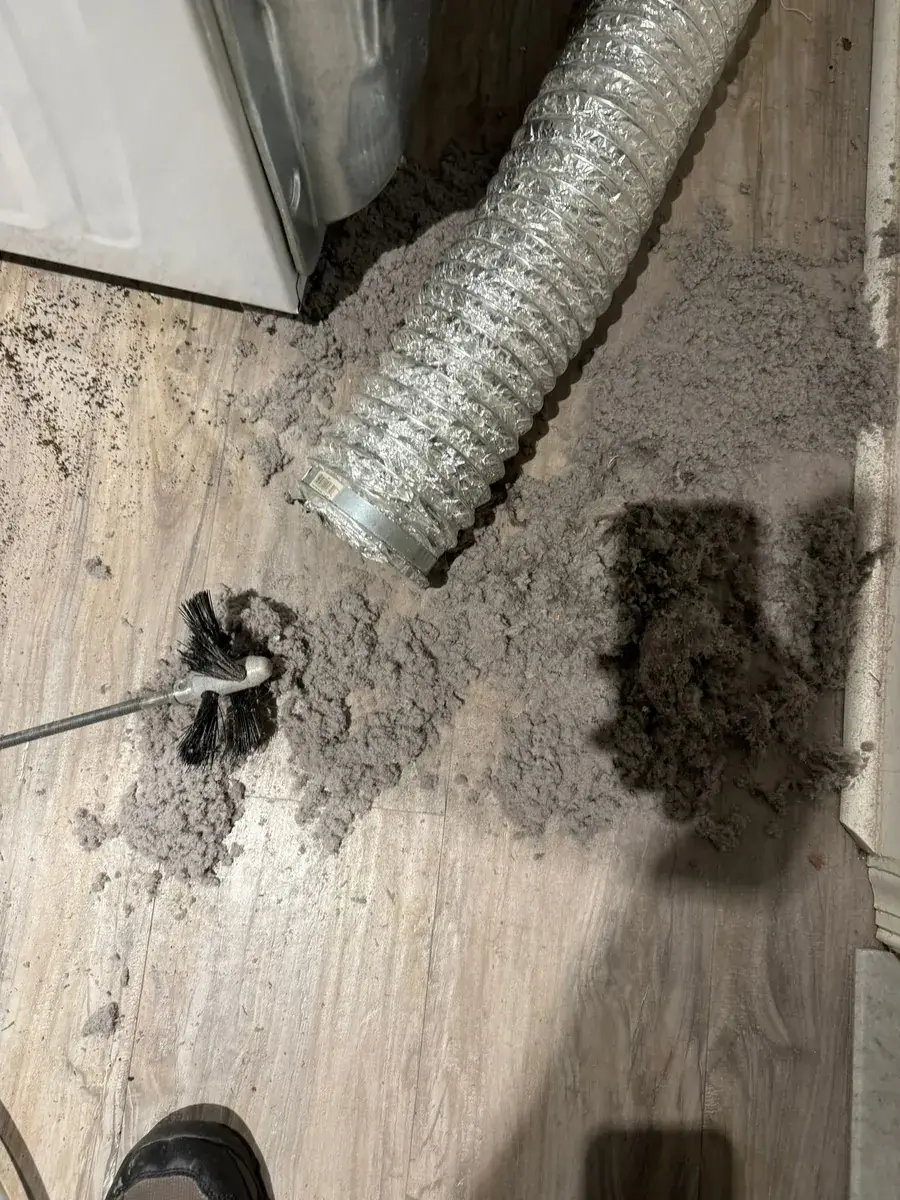
What comes out of a neglected line
A vent that has never been cleaned commonly gives up a startling volume of packed lint — sometimes an armful from a single run. Every ounce of it was sitting between a heating element and your framing. Seeing the pile on the floor is usually the moment homeowners move this from "someday" to "annually."
How often, what it costs to find out, and what stands behind the work
For most households, once a year is the right cadence — and pairing it with a season change makes it easy to remember. Big families running daily loads, pet owners whose laundry carries extra hair, and homes with long or roof-terminated runs may need attention more often; short basement runs in good condition sometimes less. We scope this honestly: a routine annual service and a first-time clean-out of a packed, never-touched line are different jobs, and your written quote will say plainly which one your home needs. Finding out costs nothing — the video inspection is free, there is no trip fee to Schwenksville, and if the line turns out to be clear we will tell you exactly that.
The difference between the two is real, not a sales tier. A routine cleaning maintains a line that has been kept up — brush it, extract the lint, verify airflow, and you are done in a single visit. A deep clean-out is what a line needs when it has never been touched or is years overdue: the lint is compacted, sometimes damp, occasionally hiding a nest, and it takes more time, more passes, and often a transition-hose swap to bring the run back to full flow. The camera tells us which one you are looking at, and the written quote names it before we start — nobody gets talked into the bigger job at the door.
The work carries our full guarantee stack: a Price Match Guarantee if you bring a competitor's written quote for the same scope, a 6-month workmanship warranty on every job — plus Google Guaranteed protection up to $2,000 on qualifying jobs. We are a PA-licensed contractor (PA 187935), insured up to $2 million, and you can view our license and insurance documents before we ever knock on your door. Financing is available through Wisetack, we schedule 24 hours a day, Sunday through Friday, and we respond to emergencies 24-hour.
One practical tip: the single most efficient way to book us is to have the dryer vent and the HVAC ducts done in the same visit — one appointment, one setup, both systems inspected on camera. See air duct cleaning in Schwenksville for how we handle the other side of the job, or just mention both when you call.
How much does dryer vent cleaning cost?
Routine and deep cleaning are different services — the free inspection determines which one your system actually needs. Prices vary house to house; your exact price comes as a flat written quote before any work begins.
| Dryer vent routine — basement / 1st floor | $129.99 |
| Dryer vent routine — 2nd floor & up | $149.99 |
| Dryer vent deep cleaning | $299.99 |
| Nest removal · bird guard installation | from $250 · from $150 |
Three promises. In writing. On every job.
Price Match Guarantee
Bring a competitor's written quote for the same scope of work — we'll match it. You never overpay for doing it right.
6-Month Warranty
Every job carries a 6-month workmanship warranty. If a problem traced to our work shows up, we come back and make it right — free.
Google Guaranteed
Booked through Google Local Services, qualifying jobs carry Google's own money-back protection up to $2,000, administered by Google.
Backed by a real license and $1M/$2M insurance — see the actual documents
Don't put off air you breathe — finance it with Wisetack
Check your options in about a minute with no impact to your credit score, choose terms that fit your budget, and pay over time instead of all at once.
*All financing is subject to credit approval. Your terms may vary. Wisetack loans are issued by Hatch Bank. See additional terms at wisetack.com/faqs.
4.8 stars from 144 Google reviews — and easy to find
E Cleaning Duct & Vent Cleaning is based at 555 S Goddard Blvd, King of Prussia, and serves Schwenksville and all of Montgomery County from right here. Check our Google profile: real jobs, real photos, and a rating our crew protects on every visit.
- Google Guaranteed business — screened, licensed and insured (see the documents)
- Read every review on our Google profile — we don't cherry-pick what you can verify
Dryer Vent Cleaning questions from Schwenksville homeowners
Do you charge a trip fee to come to Schwenksville?
No. We come to Schwenksville, Spring Mount, Zieglerville, and everywhere else in our Montgomery County service area with no trip or travel fees. The visit starts with a free video inspection of your vent run, you get a flat written quote before any work begins, and that quote is the same kind of quote a customer five minutes from our King of Prussia shop would get.
My laundry room is on the second floor and vents through the roof — can you clean that?
Yes. Roof-terminated vent runs are common in the newer developments around Schwenksville, and they are among the most clogged lines we open because nobody ever sees the termination. We clean the full vertical run with rotary brushes and vacuum extraction, clear and inspect the roof cap itself, and verify airflow with the dryer running before we leave.
How often should a Schwenksville home have its dryer vent cleaned?
Once a year for most households. Failure to clean is the leading factor in dryer fires — NFPA data (2010–2014) attributes one-third of them to it — and annual service removes that risk on your schedule. Large families, pet owners, and homes with long or roof-vented runs may need it more often; the free camera inspection gives you an honest answer for your specific line.
Something is nesting in my exterior dryer vent — do you handle that?
Yes, and in a creek-valley town like Schwenksville it comes up more than you would think — mice in cold weather, birds in spring, both drawn to a warm opening with a broken or missing flap. We remove the nesting material, clean the full line behind it, and recommend a proper vent hood or guard so the same tenant does not move back in.
I live in a townhome near Schwenksville — is my vent run different?
Often, yes. Townhome vent runs are routed around shared walls and stacked floor plans, so they tend to be longer and have more bends than a detached home's — which means more places for lint to settle. The free video inspection maps your actual run, and the flat written quote reflects what the camera shows, not a guess. In attached housing, a clean vent also protects the neighbors on the other side of the wall.
Can you clean my dryer vent and air ducts in the same visit?
Yes — one appointment, one setup, both systems inspected on camera, each scoped with its own written quote so you can approve one or both. It is the most efficient way to book us. See air duct cleaning in Schwenksville for what that side of the visit covers in local homes.
Ready for honest dryer vent cleaning in Schwenksville?
Free video inspection, a flat written quote before any work, and real before/after proof — call (484) 367-5944 or book online now.
