
Dryer Vent Cleaning in Spring Mount, PA
E Cleaning cleans dryer vents in Spring Mount, PA end to end — from the connection behind the dryer to the cap on the wall or roof. Every visit starts with a free video inspection of the line and a flat, written quote before any work begins, with no trip fee up the valley. Licensed PA contractor 187935, insured to $2 million, and rated 4.8 stars across 144 Google reviews.
Where does your laundry live — and where does the vent go?
In Spring Mount the answer usually falls into one of two patterns, and each one fails in its own way. In the village core — the older cottages and homes between the Perkiomen Creek and the ski slope, many of them seasonal places later converted to year-round living — laundry mostly sits in the basement or a first-floor corner. Those vent runs are short, but they are also the ones most likely to be improvised: a vinyl or thin-foil hose snaking to a low wall cap, a termination a few feet off the ground where leaves, snow, and nesting birds can block it, and joints assembled decades ago that leak lint into the joist bays. A short run does not protect you when the materials are wrong or the cap has been crushed shut for years.
The townhome and single-family developments built on the higher ground in Lower Frederick Township from the 1980s through the 2000s flipped that layout. Builders moved laundry to the second floor next to the bedrooms — convenient for you, hard on the dryer. An upper-floor laundry closet vents through a long concealed duct that elbows through framing and often exits at the roof. Every added foot and every elbow slows the airflow and drops lint out of the air stream, and a roof cap adds one more clog point you cannot see from the ground. These are exactly the runs that pack solid without warning, because the lint builds in the middle of the run and at the termination, not in the little hose behind the machine where you might notice it.
Attached housing raises the stakes further. Where townhomes share walls, a dryer fire is never only one household's problem, and a blocked run in one unit often has near-identical siblings up and down the row — same builder, same routing, same age. If your neighbors have never had their vents cleaned either, the odds are the whole row is overdue together.
The seasons in a valley town like this do not help. Winter is the heavy season — bulky loads of coats, blankets, and snow gear, including everything that comes home from the ski hill — and it is also when a marginal vent exposes itself, because dry times stretch and the laundry room turns humid while cold outside air makes the duct's moisture condense and glue lint to the walls. Summer along the creek and the Perkiomen Trail brings its own steady rotation of towels and trail clothes, and humid valley air means a weak vent leaves dampness in the drum, in the room, and in the run.
What kind of Spring Mount home do you have — and how does it vent?
Spring Mount homes fall into three broad types — older valley cottages, scattered farmhouses, and newer hillside subdivisions — and each one vents differently. The common thread is the setting. Spring Mount is an unincorporated village in Lower Frederick Township, tucked into the upper Perkiomen Valley in the northwestern part of Montgomery County; Schwenksville borough sits right next door across the Perkiomen Creek, Gravel Pike (Route 29) runs the valley north to south, and the two-lane roads branching off it pass everything from the tight old village core to farmhouses on higher ground. This is a small, semi-rural township, not a grid of identical houses, and that variety is why no two dryer runs here are the same.
The older valley cottages and homes near the village have small footprints, low or basement laundry, and runs often added long after the house was built. The farmhouses and rural homes scattered along the valley roads tend to hide a laundry area carved into a space never meant for one, leaving a long, improvised run threading through old framing. And the 1980s-through-2000s subdivisions on the higher, wooded ground put laundry on the second floor, venting through a concealed duct to a roof or high wall cap. Knowing which of the three you own is the first thing that tells us how hard the run will be to reach and clear.
The valley itself works against all three. Homes on the slope get longer, steeper vent paths; wooded lots put more leaves, seeds, and nesting birds within reach of the termination; and the creek corridor keeps the air damp, so lint left in a run is more likely to hold moisture and cake to the walls instead of blowing clear. We clean dryer vents across all of it — the village cottages, the farmhouses along Gravel Pike, and the newer developments up the hill — and we bring the same camera-first, quote-in-writing approach to every one, because the only way to know which run you actually have is to look inside it.
How dangerous is a clogged dryer vent, really?
Dangerous enough that the numbers are worth quoting exactly. U.S. fire departments respond to an estimated 15,970 home fires involving clothes dryers or washing machines each year, and failure to clean is the leading factor, contributing to one-third (33%) of dryer fires, according to NFPA data from 2010–2014. The U.S. Fire Administration (FEMA) separately estimates 2,900 reported home clothes dryer fires per year. Lint is close to ideal fuel — dry, fine, and packed into a tube that also carries the dryer's heat.
In a town with Spring Mount's share of shared walls and second-floor laundry, the warning signs deserve attention rather than a shrug. Watch for these:
- Loads — especially towels and winter gear — need two cycles to dry
- The top of the dryer or the laundry closet gets noticeably hot mid-cycle
- A burning or scorched-dust smell while the dryer runs
- The outside flap barely moves, or you cannot find where the vent exits at all
- Lint collecting behind or under the machine, or around the closet door
- The moisture sensor ends cycles early while clothes are still damp
Any one of these on its own can have an innocent explanation. Two or more usually mean the run is restricting airflow — and a restricted run is both a fire risk and a slow tax on every load you dry, because the dryer works longer to do the same job.
What happens when we clean a dryer vent in Spring Mount?
The visit runs the same way whether you are in a creekside cottage or a townhome up the hill — and it starts with looking, not selling.
Camera first, quote in writing
We inspect the full line on video — free — from the connection behind the dryer to the wall or roof termination. You see the buildup, any crushed sections or bad materials, and anything living in there. Then you get one flat, written quote before any work begins.
Pull the dryer, clean the transition
We move the machine, clean the short transition duct behind it, and clear the lint trap housing — the stretch most homeowners can partially reach, done properly.
Machine-clean the full run
A rotary brush travels the entire duct while a HEPA-filtered vacuum captures what it frees — every foot and every elbow, including long second-floor runs that snake through framing.
Clear the termination
We finish at the exit point: wall caps near grade that leaves and snow bury, and roof caps on newer construction. Nests and screen blockages come out; a damaged flap gets flagged on the spot.
Verify and photograph
We reconnect everything, confirm strong airflow at the termination, and send after-photos so you can see the difference instead of taking our word for it.
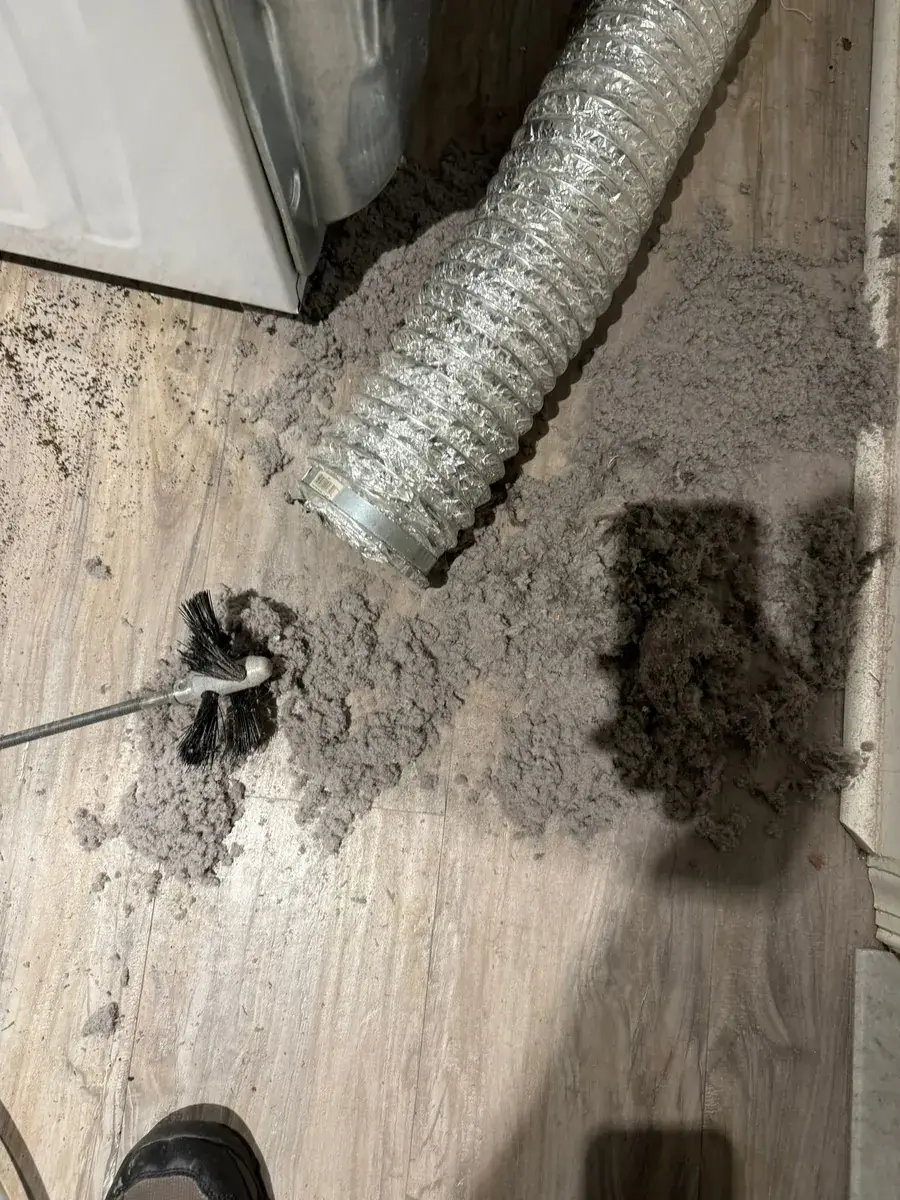
Most visits take under two hours
A straightforward basement run is often done in about 45 minutes to an hour; a packed second-floor-to-roof run takes longer. Either way, you know the scope and the time from the written quote — and the work carries our 6-month workmanship warranty like every job we do.
What does the free video inspection actually show?
The free video inspection does one thing above all: it shows, before you agree to anything, whether your vent needs a routine cleaning or a deep one. Those are two different jobs, and what the camera finds decides which one applies — not a guess made at your door.
We feed the camera the length of the line and you watch the screen with us. Some of what it turns up is obvious once you see it; some of it you would never catch on your own:
- A light, even film of lint in a run that has been kept up — or lint caked and moisture-hardened to the walls
- Elbows and the termination packed solid, which is where blockages almost always begin
- A section crushed behind a finished wall, or a joint pulled apart in the attic and venting into the structure
- A bird nest or screen blockage at the cap you cannot see from the ground
- Vinyl or thin-foil hose sagging behind the dryer, or an exterior flap that no longer opens
A routine cleaning is for a vent that has been maintained — cleaned within roughly the last year, carrying a normal seasonal lint load. We run a rotary brush the full length of the duct and pull everything it frees back through a HEPA-filtered negative-pressure vacuum. A deep cleaning is for a run that has never been done, or not in years: the lint is hardened to the duct walls, the elbows are packed, and there is often nesting debris to clear first. It takes more agitation and more time, and it is honestly a different service — which is why we show you the inside of the line before quoting, instead of quoting blind and hoping. The camera makes that call in front of you, so you are never paying for a deep clean a routine one would have handled.
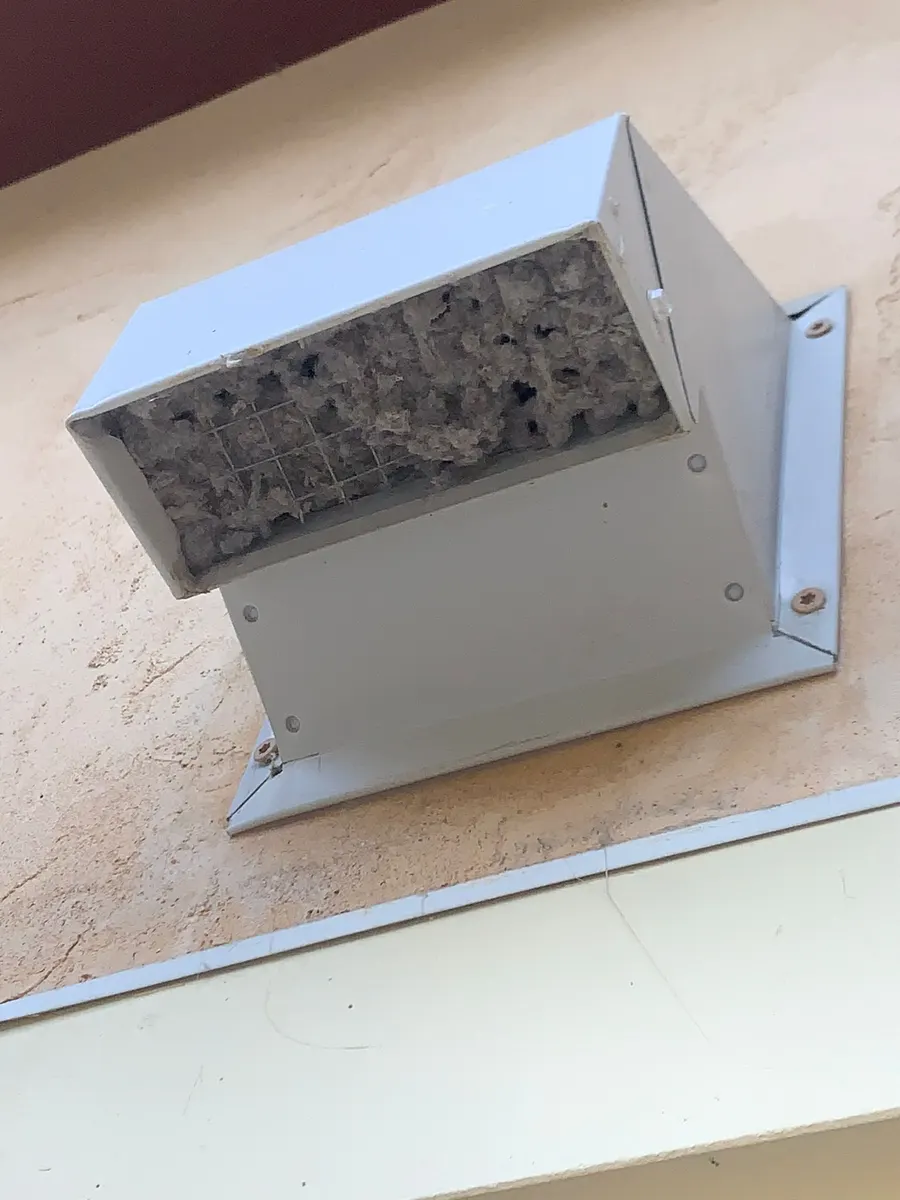
The termination tells the truth
A run can look clear behind the dryer and still be blocked solid at the cap. Our method is source removal, not a shop-vac held at the opening — professional Nikro machines pulling negative pressure while the brush flexes through every elbow, so the lint leaves the run instead of resettling inside it. We finish by confirming strong airflow where the vent actually exits, then send after-photos.
If you are going to book, the smart time is before heating season and the winter laundry pile-up — coats, blankets, and everything that comes off the ski hill — when a marginal vent has the least margin to spare and long, back-to-back loads lean on it hardest.
Cleaning is one job — fixing a bad vent is another, and we say which is which
Some Spring Mount vents just need the lint removed. Others need work: a vinyl or thin-foil transition that should be semi-rigid or rigid metal, a crushed section behind a finished wall, a termination with no functioning flap, or a cap that needs a proper pest guard after a nest removal. We scope those honestly as separate items on the same written quote — you see the cleaning and any recommended repair as their own lines, decided by what the camera showed, never invented at your door. If the vent only needs cleaning, that is what the quote says.
There is no trip fee to Spring Mount or anywhere else we work, the quote is flat and written before any work, and the job is backed by our Price Match Guarantee, and Google Guaranteed protection on qualifying jobs. We are a licensed PA contractor (PA 187935), insured to $2 million, and we have been doing this as a family business since 2016.
Because the same visit can cover both systems, many homeowners pair the vent with ductwork — see air duct cleaning in Spring Mount. We also handle dryer vents throughout the area: Schwenksville next door, Skippack down Route 73, and Harleysville to the east, plus the rest of Montgomery County.
How much does dryer vent cleaning cost?
Routine and deep cleaning are different services — the free inspection determines which one your system actually needs. Prices vary house to house; your exact price comes as a flat written quote before any work begins.
| Dryer vent routine — basement / 1st floor | $129.99 |
| Dryer vent routine — 2nd floor & up | $149.99 |
| Dryer vent deep cleaning | $299.99 |
| Nest removal · bird guard installation | from $250 · from $150 |
Three promises. In writing. On every job.
Price Match Guarantee
Bring a competitor's written quote for the same scope of work — we'll match it. You never overpay for doing it right.
6-Month Warranty
Every job carries a 6-month workmanship warranty. If a problem traced to our work shows up, we come back and make it right — free.
Google Guaranteed
Booked through Google Local Services, qualifying jobs carry Google's own money-back protection up to $2,000, administered by Google.
Backed by a real license and $1M/$2M insurance — see the actual documents
Don't put off air you breathe — finance it with Wisetack
Check your options in about a minute with no impact to your credit score, choose terms that fit your budget, and pay over time instead of all at once.
*All financing is subject to credit approval. Your terms may vary. Wisetack loans are issued by Hatch Bank. See additional terms at wisetack.com/faqs.
4.8 stars from 144 Google reviews — and easy to find
E Cleaning Duct & Vent Cleaning is based at 555 S Goddard Blvd, King of Prussia, and serves Spring Mount and all of Montgomery County from right here. Check our Google profile: real jobs, real photos, and a rating our crew protects on every visit.
- Google Guaranteed business — screened, licensed and insured (see the documents)
- Read every review on our Google profile — we don't cherry-pick what you can verify
Dryer Vent Cleaning questions from Spring Mount homeowners
Do you charge extra to come out to Spring Mount?
No. There is no trip fee to Spring Mount or anywhere else in Montgomery County. The video inspection of your vent line is free, and the flat written quote you get before any work is the number you pay — same terms in a creekside cottage as anywhere else we go.
How often should a Spring Mount home have its dryer vent cleaned?
Once a year is the right rhythm for most households. Go more often — roughly every six months — if you have a long second-floor-to-roof run, a big family doing daily loads, pets whose hair ends up in the laundry, or heavy winter-gear season use. Older short runs with proper metal duct can sometimes stretch longer, but only if the termination stays clear.
My townhome's dryer vents through the roof. Can you clean that?
Yes. Roof terminations are common in the 1980s–2000s construction around Spring Mount, and we clean the full run from the laundry closet to the roof cap, including nest and screen blockages at the top. Roof-exit runs are the ones we most often find packed, because nobody ever sees the cap.
Birds nested in my dryer vent. Is that something you handle?
Yes. Nest removal is routine — low wall caps near grade and unguarded roof caps both attract birds in spring. We remove the material, clean the run behind it, and can quote a proper pest-guard cap as a separate written line item so it does not happen again.
Should the flexible hose behind my dryer be replaced?
If it is vinyl or thin foil, usually yes — those materials sag, trap lint, and are the weak link in otherwise decent runs, especially in older converted homes. We recommend semi-rigid or rigid metal, and if yours needs replacing it appears as its own line on the written quote before any work, never as a surprise afterward.
Can you do several townhomes in a row on the same visit?
Yes. Attached homes in the same row usually share the same builder routing and the same age of lint, so it makes sense to coordinate. Neighbors can book the same day, and each home still gets its own free video inspection and its own flat written quote.
Ready for honest dryer vent cleaning in Spring Mount?
Free video inspection, a flat written quote before any work, and real before/after proof — call (484) 367-5944 or book online now.
