
Dryer Vent Cleaning in West Marlborough, PA
E Cleaning provides professional dryer vent cleaning throughout West Marlborough Township — from farmhouse basements outside Doe Run to second-floor laundry rooms in newer estate homes. We clean the full vent run, from the dryer connection to the exterior termination, after a free inspection and a flat written quote. Family-owned since 2016, licensed, insured, and rated 4.8 stars across 144 Google reviews.
Laundry Rooms of West Marlborough: Where the Vent Run Begins
West Marlborough is a rural township in southern Chester County — horse farms, conserved fields, and two small villages, Doe Run and Springdell, strung along Routes 82, 926, and 841. Its neighbors are the same kind of country: Highland to the west, Londonderry and London Grove to the south, East Marlborough to the east, and Newlin and East Fallowfield to the north. There are no rowhome blocks here and almost no attached housing — which means dryer vents in this township have a very different shape than the short, stacked runs of a borough streetscape. They tend to be long, they wander, and they were often improvised into buildings that never planned for a dryer.
In the township's old stone farmhouses, laundry usually lives in the basement, and the vent has to escape through a foundation wall that can be two feet of stone. Those runs frequently jog around joists and old masonry before finding daylight, and every bend is a place lint slows down and settles. Renovated farm properties often move laundry up to a first-floor mudroom — the practical choice for a household that generates barn clothes and muddy boots daily — and that relocation usually means a longer horizontal run to reach an outside wall. The township's newer estate homes go the other direction: second-floor laundry rooms near the bedrooms, with vent runs that travel through walls and attic space and sometimes terminate at the roof rather than a gable wall.
Every one of those layouts ends the same way if it is never serviced: a duct lined and then packed with lint. E Cleaning is based in King of Prussia and works Chester County every week; Route 82 and Route 926 bring us to every corner of West Marlborough with no trip fee. The visit starts with a free inspection of your actual vent run — then a flat written quote before any work begins.
Why Dryer Vent Fires Are a Rural-Township Problem
The fire numbers are worth stating plainly. U.S. fire departments respond to an estimated 15,970 home fires involving clothes dryers or washing machines each year, and failure to clean is the leading factor, contributing to one-third (33%) of dryer fires, according to NFPA data from 2010–2014. The U.S. Fire Administration (FEMA) separately estimates 2,900 home clothes dryer fires reported each year. Lint is close to ideal tinder — dry, fine, and packed directly in the path of a high-temperature appliance.
Geography raises the stakes in a township like West Marlborough. Homes here sit far apart, down long gravel drives, in a part of the county served — like most rural Pennsylvania townships — by volunteer fire companies covering large territories. None of that is a criticism of the crews; it is simple arithmetic about distance and drive time. In a dense borough, help is often minutes away. Out here, prevention has to do more of the work, and a clean, unobstructed dryer vent is one of the cheapest, most direct pieces of fire prevention a household can buy.
Older homes in the township add two specific risks. First, the transition duct — the short connector behind the dryer — in an older setup is often flexible vinyl or thin foil accordion hose, materials that trap lint in their ridges and were never meant for today's dryers. We check it on every visit and tell you honestly if it should be replaced. Second, exterior terminations on old stone walls and outbuildings are favorite spots for birds and mice; a nest sitting in a vent hood blocks airflow as thoroughly as a decade of lint. If our inspection finds a nest, we tell you what removal involves and put it in writing before touching anything — and a bird guard can keep the problem from coming back.
Horse-Country Laundry Is Heavy Laundry
Dryer vents clog on a schedule set by how much a household dries — and West Marlborough households dry more than most. This is a township of barns, kennels, and working outdoor life. Horse blankets, saddle pads, stable towels, dog bedding, insulated coveralls, and daily loads of mud-caked work clothes all shed heavy fiber, and heavy fabrics shed far more lint per load than office wear. A farm household running the dryer twice a day is loading its vent at several times the rate of a typical two-person home, which means the "clean it once a year" rule of thumb can be genuinely too slow here.
The seasons pile on. Winter brings the bulkiest loads — blankets, fleeces, layered barn gear — exactly when the dryer runs most. Spring mud season keeps the washer and dryer cycling constantly. By the time summer arrives, a season's worth of lint has compacted at every elbow in the run. Long rural runs make it worse: a vent that travels twenty or thirty feet from a basement or mudroom to the far side of the house gives lint that much more distance in which to settle, and each 90-degree bend acts like a trap.
The warning signs are consistent, and worth knowing. Towels that need two cycles to dry. A laundry room that gets noticeably hot and humid mid-cycle. Clothing that comes out hotter than it used to. A faint burnt or scorched smell while the dryer runs. Little or no lint appearing on the exterior flap — because it is stuck inside instead. Any one of these says the vent is restricting airflow; the dryer is working harder, running longer, wearing out sooner, and operating closer to ignition conditions with every load. A free inspection answers the question definitively.
Full-Run Lint Extraction, End to End
Our dryer vent service cleans the entire run — not a quick brush of the first few feet, but everything from the connection behind the dryer to the termination on your wall or roof. The visit opens with a free inspection: we look at the layout, the transition duct, the termination, and the airflow the system is actually moving. What we find determines the honest scope. A vent on a regular maintenance schedule is a routine cleaning. A vent that has never been serviced, is packed solid, or has a nest in the termination is a deep cleaning — a longer job with more extraction work, and genuinely a different service. Either way, you get a flat quote in writing before we start, and that number does not change at the doorstep. No trip fee, no surprise line items, no upsell theater.
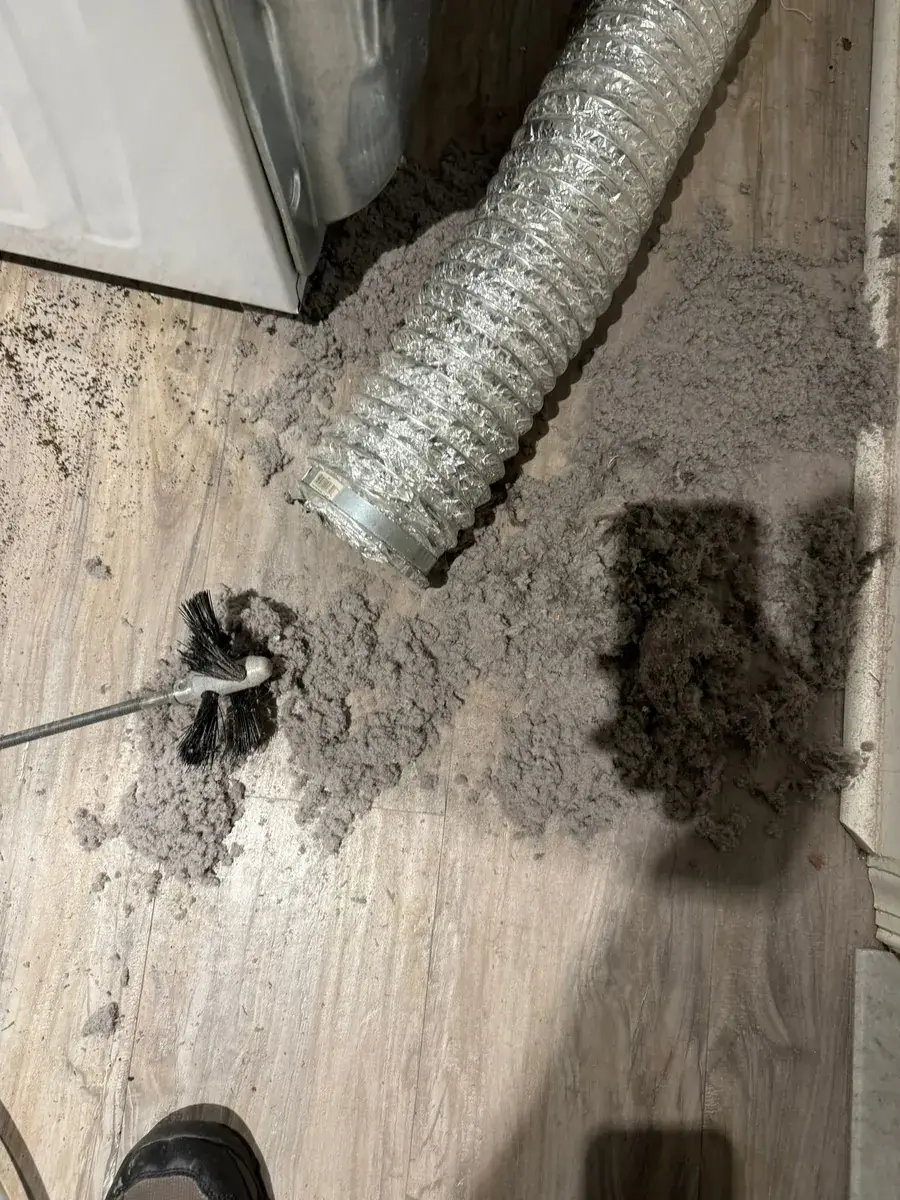
The cleaning itself works from both ends of the run. We pull the dryer, disconnect and clean the transition duct, then drive a rotary brush through the full length of the vent while a high-powered vacuum captures what the brush breaks loose — the same source-removal logic we apply to air ducts, scaled to a four-inch line. Compacted lint, construction debris, and the occasional abandoned nest all come out. At the exterior, we clear the termination hood and confirm the flap opens and closes freely; if birds have been a problem, we can install a bird guard that keeps them out without choking airflow. Before we leave, we reconnect everything, run the dryer, and verify strong airflow at the termination — then show you after-photos of what came out and what the run looks like now.
The full-run approach is the whole point. Plenty of cheap operators clean the last few feet of a vent from the outside, declare victory, and leave the compacted lint at the mid-run elbows untouched — which is why the dryer runs no better a week later. Airflow is the honest referee here: we check it before the cleaning and again after, at the termination, so the improvement is something you can feel with your hand rather than take on faith. A properly cleared vent shows immediate, obvious results — the flap snaps open when the dryer starts, cycles shorten, and the machine stops fighting its own exhaust.
What a Dryer Vent Visit Includes in West Marlborough
Every visit follows the same sequence:
- Free inspection. Layout, transition duct, termination, and current airflow — assessed before anything is quoted.
- Flat written quote. Routine or deep, scoped honestly, on paper before work starts.
- Dryer pulled and protected. We move the machine and cover the work area.
- Transition duct cleaned. The connector behind the dryer — and a straight answer if it should be replaced.
- Full-run extraction. Rotary brush plus vacuum through every foot and every elbow of the vent.
- Termination cleared. Hood cleaned, flap checked, nests removed if the scope calls for it.
- Airflow verified. Dryer reconnected and run; we confirm strong flow at the exit.
- After-photos. You see the cleared run and the pile of lint that came out of it.
A straightforward basement or first-floor run is usually done within about an hour. Long runs, second-floor laundry rooms, and roof terminations take longer — our technicians carry ladders and work rooftop terminations routinely, so an estate home's attic run is a normal job, not a reason to be turned away. Many households bundle this with air duct cleaning in West Marlborough in the same appointment: one visit, both systems inspected on camera, one written quote covering everything.
Preparation on your end takes two minutes: clear a path to pull the dryer out a few feet, and if you know where the vent exits the house, point it out — on old farm properties the termination is not always where you would guess, and finding it fast keeps the visit short. Beyond the fire-safety case, the payoff shows up in daily use. A dryer breathing through a clear vent finishes loads in one cycle instead of two, runs cooler, and lasts longer — heavy-use households feel the difference the same week. We also clean the lint trap housing and check the transition connection for kinks and crushed spots, the small defects that quietly restrict airflow even in a freshly cleaned run.
Licensed, Insured, and Accountable in West Marlborough
E Cleaning is a Pennsylvania licensed contractor (PA 187935), insured up to $2 million — both documents are viewable on that page. Customers rate the company 4.8 stars across 144 Google reviews, and every job here runs on the same promise: free inspection first, flat written quote before work, no trip fee anywhere in the township.
Three commitments back the work. The Price Match Guarantee — bring a competitor's written quote for the same scope and we match it. The 6-month workmanship warranty — if a problem traced to our work shows up within six months, we return and make it right free. And Google Guaranteed status, which includes Google's money-back protection of up to $2,000 on qualifying jobs, a program run and administered by Google. Wisetack financing is available. We operate 24 hours a day, Sunday through Friday — closed Saturdays — so a farm schedule that only frees up after evening chores still fits ours.
Browse the full county coverage on the Chester County service hub, and if you are just over the township line we handle the neighbors too: Highland, Londonderry, and Newlin.
How much does dryer vent cleaning cost?
Routine and deep cleaning are different services — the free inspection determines which one your system actually needs. Prices vary house to house; your exact price comes as a flat written quote before any work begins.
| Dryer vent routine — basement / 1st floor | $129.99 |
| Dryer vent routine — 2nd floor & up | $149.99 |
| Dryer vent deep cleaning | $299.99 |
| Nest removal · bird guard installation | from $250 · from $150 |
Three promises. In writing. On every job.
Price Match Guarantee
Bring a competitor's written quote for the same scope of work — we'll match it. You never overpay for doing it right.
6-Month Warranty
Every job carries a 6-month workmanship warranty. If a problem traced to our work shows up, we come back and make it right — free.
Google Guaranteed
Booked through Google Local Services, qualifying jobs carry Google's own money-back protection up to $2,000, administered by Google.
Backed by a real license and $1M/$2M insurance — see the actual documents
Don't put off air you breathe — finance it with Wisetack
Check your options in about a minute with no impact to your credit score, choose terms that fit your budget, and pay over time instead of all at once.
*All financing is subject to credit approval. Your terms may vary. Wisetack loans are issued by Hatch Bank. See additional terms at wisetack.com/faqs.
4.8 stars from 144 Google reviews — and easy to find
E Cleaning Duct & Vent Cleaning is based at 555 S Goddard Blvd, King of Prussia, and serves West Marlborough and all of Chester County from right here. Check our Google profile: real jobs, real photos, and a rating our crew protects on every visit.
- Google Guaranteed business — screened, licensed and insured (see the documents)
- Read every review on our Google profile — we don't cherry-pick what you can verify
Dryer Vent Cleaning questions from West Marlborough homeowners
How often should a dryer vent be cleaned in West Marlborough?
Once a year is the standard baseline, but many West Marlborough households should go more often. Farm and horse properties drying blankets, saddle pads, dog bedding, and daily work clothes generate several times the lint of a typical home, and long runs from basement or mudroom laundry areas trap it faster. If towels take two cycles or the laundry room runs hot, do not wait for the calendar — the free inspection will tell you exactly where the vent stands.
Can you clean a vent that terminates on the roof?
Yes. Second-floor laundry rooms in the township's newer estate homes often vent through attic space to a roof termination, and we work those routinely — our technicians carry ladders and clean the run from both ends, including the rooftop hood. Roof jobs take somewhat longer than a basement wall exit, and the written quote reflects the full scope before we start, so the price never changes mid-job.
There is a bird nest in my dryer vent. Can you remove it?
Yes. Exterior terminations on stone walls and quiet farm properties are prime nesting spots, and a nest blocks airflow as completely as years of lint. We confirm the blockage during the free inspection, explain what removal involves, and put the scope in writing before any work. Afterward we can install a bird guard on the termination so the vent stays clear without restricting exhaust flow.
How do I know my dryer vent actually needs cleaning?
The signs are consistent: clothes needing a second cycle, a hot and humid laundry room mid-run, laundry that comes out hotter than it used to, a scorched smell while drying, or little lint visible at the outside flap. Any of these means restricted airflow — the dryer is running longer, wearing faster, and operating closer to ignition conditions. NFPA data ties one-third of dryer fires to failure to clean, so the symptoms are worth taking seriously. The inspection is free and settles it.
Do you charge a trip fee to reach rural parts of the township?
No. Long gravel drives outside Doe Run, farm lanes off Route 926, houses set far back from Route 82 — none of it adds a penny. West Marlborough sits inside our regular Chester County loop, and the flat written quote you receive after the free inspection is the complete price. We serve the neighboring townships the same way, from Highland to Newlin to Londonderry.
My dryer still works fine. Is cleaning really worth it?
A dryer usually works right up until the vent is nearly closed — restriction builds gradually, so "working fine" mostly means "working harder than it should." A clogged vent makes every load run longer, shortens the machine's life, and raises fire risk: the U.S. Fire Administration estimates 2,900 home clothes dryer fires are reported each year. Cleaning restores full airflow, and our before-and-after airflow check plus photos show you the difference rather than asking you to take it on faith.
Ready for honest dryer vent cleaning in West Marlborough?
Free video inspection, a flat written quote before any work, and real before/after proof — call (484) 367-5944 or book online now.
