
Dryer Vent Cleaning in Whitpain, PA
E Cleaning cleans dryer vents throughout Whitpain Township — from basement hookups in the older colonials to second-floor laundry rooms and roof-vented townhomes around Blue Bell. A free inspection comes first, you get a flat written quote before any work begins, and we clean the full run from the dryer connection to the exterior hood. Licensed, insured to $2 million, and rated 4.8 stars across 144 Google reviews.
Where Your Laundry Room Sits Decides How Fast Your Vent Clogs
Whitpain Township sits in the central band of Montgomery County, built up around the old crossroads at Center Square where DeKalb Pike (US 202) meets Skippack Pike (PA 73), with the Wissahickon Creek running through its lower ground and Blue Bell anchoring its residential heart. It is a township of layers — old stone farmhouses along the original pikes, mid-century subdivisions, and newer developments from the 1980s on — and each layer vents its laundry a different way, which is what decides the work.
The single biggest factor in how quickly a dryer vent fills with lint — and how dangerous that lint becomes — is where the laundry room sits and how far the vent has to travel to reach outside air. In Whitpain, that answer depends almost entirely on when your home was built.
In the township's postwar ranches, split-levels, and 1960s–70s colonials, the washer and dryer usually live in the basement, and the vent makes a relatively short run through the rim joist to a hood on the side of the house. Short runs clog more slowly — but in these homes the venting is often original equipment: forty-year-old duct, a crushed foil transition hose folded behind the dryer, and an exterior flapper that has been painted over or has lost its spring. A short run that can't move air is just as dangerous as a long one.
The newer side of Whitpain tells the opposite story. From the late 1980s onward, builders moved laundry upstairs near the bedrooms, and the developments that filled in around the Blue Bell corridor are full of second-floor laundry rooms. A second-floor laundry means the vent either climbs through an interior wall to the roof or snakes horizontally through floor joists to a distant sidewall. Every added foot of duct and every elbow cuts airflow and gives lint a cool, quiet place to settle — and lint settles fastest exactly where you can least see it.
Whitpain's oldest stone farmhouses are a category of their own. A dryer there often has to push its exhaust through a foot of masonry, along a transition retrofitted long after the house was built and routed wherever the joists allowed — runs longer and more contorted than they look, sometimes with a rigid-pipe joint pulled apart inside a wall cavity, the kind of fault you never find until an inspection camera goes in.
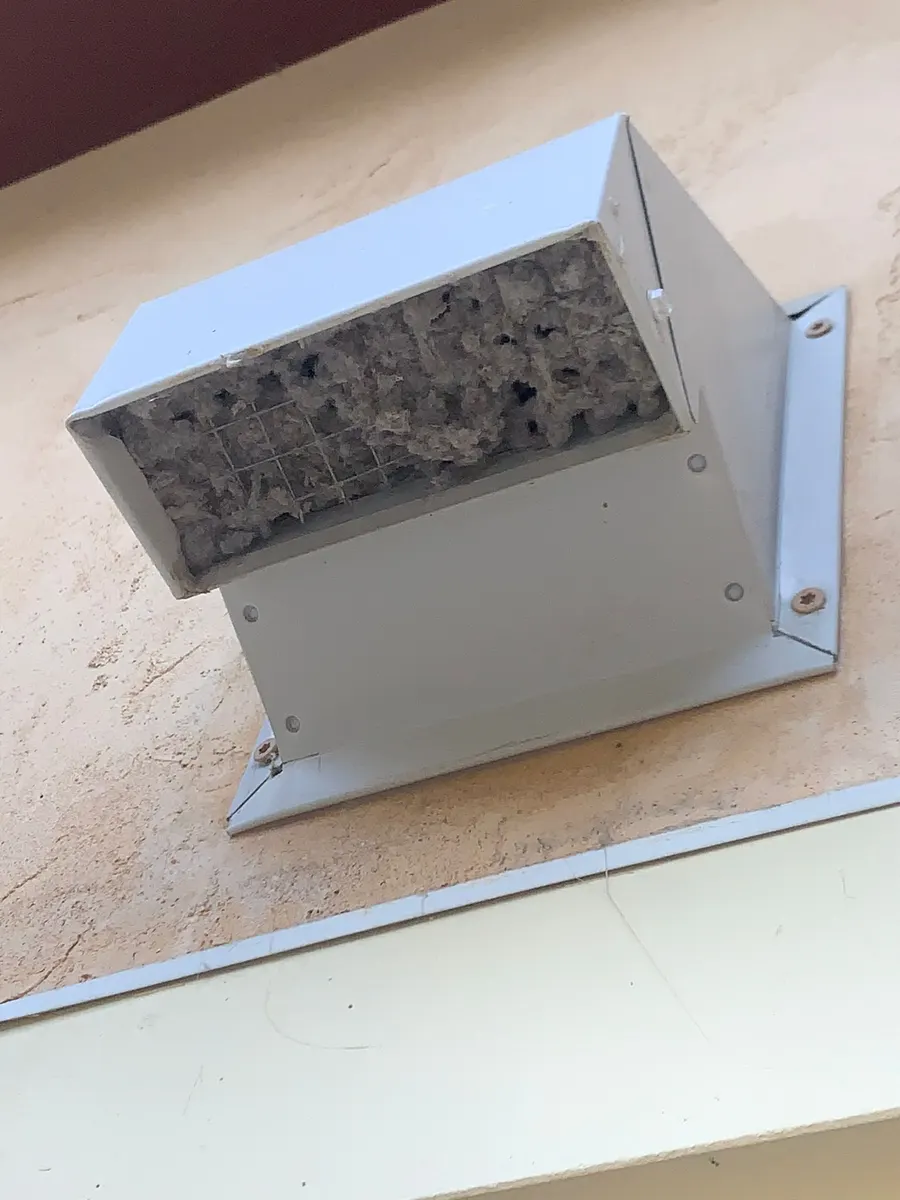
Lint is not just a clog — it is kindling packed around a heat source. As it builds up, it insulates the duct, traps moist exhaust air that condenses in cooler attic and wall sections, and mats into dense layers that a hot dryer element can ignite. Cleaning the vent removes the fuel; that is the whole point of the service.
Attached Homes Around Blue Bell Share More Than Walls
The developments built along Whitpain's US 202 corridor from the 1980s onward include a large share of townhomes and condos, and attached housing raises the stakes on dryer maintenance: a vent fire in one unit is never only that unit's problem. If you share a wall, your neighbor's dryer habits are partly your fire risk — and yours are theirs.
Attached and newer construction also leans heavily on roof-terminated vents, which are the ones homeowners can never check. With a sidewall hood you can at least watch the flap move while the dryer runs; a roof termination is out of sight until it is fully blocked, and clogged roof caps also invite nesting birds in spring. We work on roof terminations as part of the job — this is not a service where we clean what's easy to reach and hope the rest is fine.
Interior units bring their own geometry: vent runs routed through long chases or across garage ceilings to reach an outside wall, sometimes with a booster fan spliced into the line to keep air moving. Booster fans collect lint on their blades and need cleaning too — a lint-caked booster can make airflow worse than having none at all.
Ownership adds a blind spot of its own. In many Whitpain condo buildings the exterior belongs to the association while everything from the dryer to the wall belongs to the owner — a split that leaves the vent run itself in nobody's routine. The association repaints the hood; no one cleans the duct behind it. If you own a condo or townhome here and have never arranged a vent cleaning yourself, it almost certainly has not been done.
Whatever your setup, the warning signs are the same:
- Towels or jeans need a second cycle to dry
- The dryer top or the laundry room feels hot and humid mid-cycle
- A faint burning smell while the dryer runs
- Little or no lint on the screen — it is going into the vent instead
- No visible flap movement at the exterior hood while the dryer is on
- Clothes come out smelling musty instead of fresh
Season matters here too. Whitpain winters push every load through the dryer with no line-drying relief, and holiday guests mean extra bedding and towels — which is why vents that limped through summer tend to fail between November and February, exactly when the dryer is working hardest.
What the Free Video Inspection Shows — and How We Scope the Work
Before we quote anything, we look. The free inspection is a real diagnostic, not a formality: we check the transition hose behind the dryer, follow the duct route as far as it can be seen, and examine the exterior hood or roof cap with the dryer running so we can read the actual airflow at the end of the line. What we find sets the scope, and the scope sets the price — you see the evidence before anyone talks about work.
Two jobs wear the same name but are not the same work. A routine cleaning clears a vent that still moves air but has built up a normal season or two of lint. A deep cleaning is for a run that is heavily compacted, has never been cleaned, holds a bird nest, or has a crushed or disconnected section that has to be dealt with before the duct will pass air at all. Quoting every homeowner the heavier job would be easy and dishonest; we tell you which one your vent actually needs and put that in writing.
Here is what the camera and airflow check commonly turn up in Whitpain homes:
- A foil or vinyl transition hose — a fire-code problem, not just a clog — where rigid or semi-rigid metal belongs
- A transition crushed flat behind a dryer shoved tight to the wall
- Compacted lint stacked at every elbow where the run changes direction
- A bird or rodent nest packed against an unguarded exterior hood
- A flapper painted shut or missing its spring, so it never opens or seals
- A booster fan caked with lint on a long second-floor or interior run
- A rigid-pipe joint separated inside a wall, venting hot damp air into the cavity
The transition hose is where a surprising number of Whitpain problems begin. The ribbed foil and plastic hoses sold for decades sag, tear, and trap lint in every ridge, exactly the material modern practice steers homeowners away from in favor of smooth rigid or semi-rigid metal. If yours is the old kind, we show you and note the fix as its own line on the quote; cleaning a bad transition only treats the symptom.
How We Clean a Dryer Vent — Start to Finish
We clean the entire run — from the connection behind the dryer, through every foot of duct, to the exterior termination — and we verify the result with an airflow check, not a guess. Here is how a visit goes:
Free inspection
We walk the full vent path and read airflow at the exterior termination, so the quote reflects what is actually in your duct — not a guess.
Flat written quote
One number, in writing, before work begins — no surprise invoice and no doorstep upsell once we are on site. You approve the scope set by the inspection before anyone starts.
Full-run cleaning
A rotary brush works through the entire duct while HEPA-filtered vacuum extraction pulls the loosened lint out of the line. We clean the dryer-to-wall transition, the duct run itself, and the exterior hood — roof terminations included.
Verify and document
We re-check airflow at the termination, confirm the flapper moves freely, and take after-photos so you can see the difference — the same documentation habit we bring to every duct job.

The method is source removal, the same approach we bring to ductwork: a rotating brush breaks the lint loose while professional Nikro negative-pressure equipment with HEPA filtration carries it out of the line rather than driving it deeper. Lint pulled from the vent leaves the house — it is not pushed toward the exterior hood to re-pack on your next heavy load.
There is no trip fee to Whitpain — we are based in King of Prussia, a short drive up US 202, and the price on your written quote is the price you pay whether you are in Center Square, Blue Bell, or anywhere else in the township.
How Often Should Whitpain Homes Have This Done?
Once a year is the right baseline for most households. Larger families, homes with shedding pets, and — especially relevant in Whitpain's newer neighborhoods — second-floor laundry rooms with long or roof-terminated runs should consider every six to twelve months, because those runs load up faster and hide it longer. If you have never had the vent cleaned and can't remember the last time it was, that is the answer right there.
What a clean vent gives back is straightforward: loads dry in one cycle instead of two, the dryer runs cooler and lasts longer, you stop paying to run the machine twice, and the leading contributing factor in dryer fires — failure to clean, per NFPA — is off the table for another year. We keep the claims measured, but this is one service where the mechanism is simple: lint out, air moves, risk drops.
Every visit is backed by our guarantee stack: a 6-month workmanship warranty on every job, a Price Match Guarantee against any competitor's written quote for the same scope, and Google Guaranteed money-back protection up to $2,000 on qualifying jobs. We are a PA licensed contractor (PA 187935) insured up to $2 million — the documents are viewable here. Financing is available through Wisetack, and we work 24 hours a day, Sunday through Friday (we're closed Saturdays).
Many Whitpain homeowners pair this with air duct cleaning in Whitpain in a single visit — one appointment covers both of the air pathways in your house. We also serve the surrounding towns: see Plymouth Meeting, Lower Gwynedd, and Ambler, or the full Montgomery County service area.
How much does dryer vent cleaning cost?
Routine and deep cleaning are different services — the free inspection determines which one your system actually needs. Prices vary house to house; your exact price comes as a flat written quote before any work begins.
| Dryer vent routine — basement / 1st floor | $129.99 |
| Dryer vent routine — 2nd floor & up | $149.99 |
| Dryer vent deep cleaning | $299.99 |
| Nest removal · bird guard installation | from $250 · from $150 |
Three promises. In writing. On every job.
Price Match Guarantee
Bring a competitor's written quote for the same scope of work — we'll match it. You never overpay for doing it right.
6-Month Warranty
Every job carries a 6-month workmanship warranty. If a problem traced to our work shows up, we come back and make it right — free.
Google Guaranteed
Booked through Google Local Services, qualifying jobs carry Google's own money-back protection up to $2,000, administered by Google.
Backed by a real license and $1M/$2M insurance — see the actual documents
Don't put off air you breathe — finance it with Wisetack
Check your options in about a minute with no impact to your credit score, choose terms that fit your budget, and pay over time instead of all at once.
*All financing is subject to credit approval. Your terms may vary. Wisetack loans are issued by Hatch Bank. See additional terms at wisetack.com/faqs.
4.8 stars from 144 Google reviews — and easy to find
E Cleaning Duct & Vent Cleaning is based at 555 S Goddard Blvd, King of Prussia, and serves Whitpain and all of Montgomery County from right here. Check our Google profile: real jobs, real photos, and a rating our crew protects on every visit.
- Google Guaranteed business — screened, licensed and insured (see the documents)
- Read every review on our Google profile — we don't cherry-pick what you can verify
Dryer Vent Cleaning questions from Whitpain homeowners
Do you charge extra to come out to Whitpain?
No. We never charge trip or travel fees, and Whitpain is minutes from our King of Prussia base via US 202. The inspection is free, the quote is flat and in writing before any work starts, and it is the same everywhere we serve in Montgomery County.
My townhome's dryer vents through the roof — can you clean that?
Yes. Roof-terminated vents are common in the attached homes around the Blue Bell corridor, and we clean the full run including the roof cap. Roof terminations are actually the ones that most need professional attention, because you can't see the termination from the ground and blockages build unnoticed until dry times double.
How long does dryer vent cleaning take?
Most Whitpain jobs run under an hour to about ninety minutes. A short basement-to-sidewall run in an older colonial is on the quick end; a long second-floor-to-roof run, a nest removal, or a booster fan cleaning takes longer. The free inspection tells us the run length and condition, so the written quote comes with an honest time estimate.
We have a second-floor laundry room — how often should the vent be cleaned?
Every six to twelve months is a sensible rhythm for long or vertical runs, versus roughly annually for short basement runs. Second-floor laundry means more duct, more elbows, and cooler sections where moist exhaust condenses and lint mats — the run loads up faster and shows fewer visible warning signs until airflow is badly restricted.
There's a bird nest in my exterior dryer vent — do you handle that?
Yes. Nest and debris removal is a routine part of our dryer vent work, especially in spring when open hoods invite nesting. We remove the nest material, clean the full run behind it, verify airflow, and can install a proper guard on the termination so it doesn't happen again. It is scoped honestly in the written quote as its own line of work — never a surprise charge after the fact.
Will you tell me if my vent needs repair or replacement instead of just cleaning?
Yes, and this comes up often in Whitpain's older homes: crushed foil transition hoses, disconnected joints inside walls, or flappers that no longer open aren't fixed by cleaning alone. The inspection identifies it, we show you, and the written quote separates cleaning from any repair work so you can decide with the facts in front of you. If a problem traced to our work appears within six months, our workmanship warranty covers the return visit free.
Ready for honest dryer vent cleaning in Whitpain?
Free video inspection, a flat written quote before any work, and real before/after proof — call (484) 367-5944 or book online now.
