
Dryer Vent Cleaning in Zieglerville, PA
Dryer vent cleaning in Zieglerville, PA clears your entire vent run to prevent the number-one preventable fire risk in most homes. E Cleaning inspects first and quotes flat and in writing before any work — a licensed (PA187935), insured, Google Guaranteed crew rated 4.8 stars across 144 Google reviews, serving the upper Perkiomen Valley since 2016.
Country lots, longer runs, and vents worth watching
Zieglerville is an unincorporated community in Lower Frederick Township, part of the upper Perkiomen Valley in Montgomery County, PA. It sits on the west side of the Perkiomen Creek just north of Schwenksville, at the roundabout where PA Route 29 (Gravel Pike) and PA Route 73 (Big Road) split — the kind of country crossroads where the county's suburbs give way to open farmland and wooded hills.
Zieglerville was Lower Frederick's old commercial center — a stagecoach stop known as “Zieglersville” until 1887 — so the village core carries genuinely old housing, and the surrounding township is a mix of eras. Eighteenth- and nineteenth-century stone farmhouses sit near mid-century ranches and split-levels on wide lots, with newer single-family homes filling in where old farm parcels were subdivided. What most of these houses share is space: generous footprints, deep setbacks, full basements, and detached or walk-out layouts.
Generous footprints usually mean one thing for laundry — a longer dryer vent run to reach an exterior wall. Longer runs are exactly where lint packs fastest, because every added foot and every elbow slows the airflow and gives the lint somewhere to settle. That is the quiet reason so many homes around Zieglerville and Lower Frederick Township are overdue for a proper vent cleaning without anyone realizing it.
We come out to Zieglerville from our King of Prussia base as routing allows, with no trip fee or travel charge anywhere in our service area — call and we’ll confirm scheduling honestly.
How Lower Frederick housing stock shapes your vent run
The age and style of a Zieglerville home usually predicts where the laundry lives and how the vent is routed — and that determines how hard the vent is to clean and how often it needs it. Three broad eras cover most of the township.
Older farmhouses and stone homes. In the valley’s oldest houses, laundry was almost always retrofitted into a basement or a back utility room long after the house was built. That means a horizontal run across the basement ceiling to the foundation wall, often with extra elbows to dodge joists, beams, and old plumbing. Thick masonry walls make the through-wall termination longer, too. These runs collect lint steadily and are close to impossible to reach with a consumer brush from the laundry side.
Mid-century ranches and split-levels. Post-war homes on Lower Frederick’s larger lots typically put the laundry on the main level or in the basement. Ranches spread out horizontally, so the dryer can sit a long way from any exterior wall — again, a long run with several turns. Split-levels add vertical offsets between half-floors, and lint loves to settle right at those transitions where the duct changes direction.
Newer construction and subdivisions. Homes built in recent decades often move the laundry upstairs, near the bedrooms, for convenience. That is easier on laundry day but harder on the vent: an upper-floor dryer usually vents up and out through the roof, a vertical run where gravity pulls settling lint back down toward the dryer and where the roof cap sits exposed to weather and wildlife. Second-floor and roof-terminated runs are among the most neglected simply because nobody can see the exit.
Rural properties here also tend to run on their own well and septic, with detached garages and outbuildings. None of that touches the dryer vent directly, but it is a reminder that these are self-maintained homes — there is no municipal crew quietly checking anything. The vent is one more system that lives entirely on the homeowner’s to-do list, and it is the one most people forget until the dryer stops drying.
Long runs, country wildlife, and heavy-use seasons
Three things make dryer vents in the Zieglerville area worth watching more closely than a typical townhouse vent: the length of the runs, the rural setting, and the way families here use their dryers.
The runs are long. As noted above, larger homes on larger lots push the dryer farther from the exterior wall. Airflow is the whole game with a dryer vent — the more feet and elbows between the dryer and the outdoors, the more the airstream slows and drops its lint load along the way. A 25-foot run with three elbows behaves very differently from a short straight shot, and much of the valley’s housing is closer to the former than the latter.
It is the country. Exterior vent hoods on rural and semi-rural properties are magnets for birds building spring nests and for small rodents looking for a warm, sheltered cavity. A nest packed into the termination is both a fire risk and a complete airflow blocker, and it is one of the most common things we clear on Lower Frederick calls. A working damper — and, where it makes sense, a bird guard — keeps wildlife out without choking the airflow.
Seasons drive the load. Laundry volume climbs in the cold months — heavier bedding, layers, and towels, plus the dryer working against cold, dense outside air that is harder to push lint through. A vent that coped all summer can pack up over a single Pennsylvania winter. Households with kids, pets, or a work-from-home routine push far more loads through the same run and reach the danger zone sooner than a two-person household would.
We serve Zieglerville and the surrounding Lower Frederick Township addresses, plus the neighboring upper-valley communities, and we treat every home the same way: inspect first, explain what we find, and never touch a thing before you have approved a written price.
Dryer fires are a lint problem — and lint is a vent problem
Lint is highly flammable, and a restricted vent traps the very heat that ignites it. According to NFPA data (2010–2014), U.S. fire departments respond to an estimated 15,970 home fires involving clothes dryers or washing machines each year, and failure to clean is the leading contributing factor — one-third (33%) of dryer fires. The U.S. Fire Administration (FEMA) separately estimates about 2,900 home clothes dryer fires are reported each year. These are not freak events; they are the predictable end of a vent nobody cleared.
The failure builds slowly, which is why it is so easy to miss. Each load leaves a little more lint on the duct wall; the narrower passage runs hotter; the heat and restriction speed up the next round of buildup. By the time drying takes two cycles, the vent is already well down that road. Watch for these warning signs:
- Clothes need two or more cycles to dry fully
- The dryer, the laundry room, or the clothes feel unusually hot at the end of a cycle
- A burning or musty smell while the dryer runs
- Little or no airflow at the outside vent hood when the dryer is on
- Lint collecting around or behind the dryer, or a damp, humid laundry room
- The dryer shuts itself off early mid-cycle — a sign it is overheating
If you recognize two or more of these, the vent is overdue. None of it requires guessing — a quick inspection shows exactly how packed the run is.
How we clean a Zieglerville dryer vent
We clean the whole path — from the connection behind the dryer, through every foot of duct and every elbow, to the exterior hood or roof cap. Cleaning only the few feet a brush can reach from the laundry room leaves the packed section untouched; the entire point of a professional cleaning is the part you cannot get to yourself.
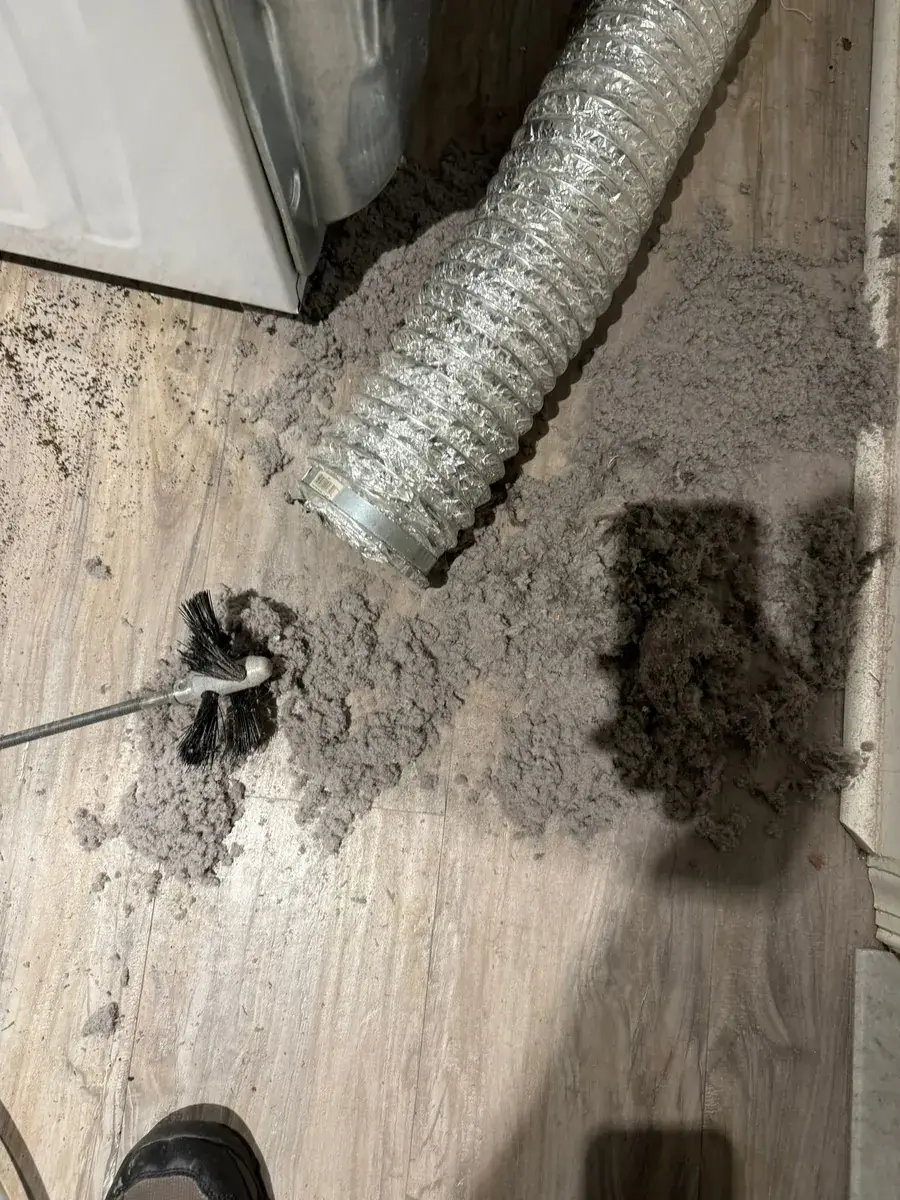
It starts with a free inspection. Before any work and before any price, we pull the dryer out, look over the transition hose, and send a camera into the vent so we can both see the actual lint load, the length and turns of the run, and whether the termination is blocked. You see what we see on the screen. That inspection is what tells us — honestly — whether your vent needs a routine cleaning or a deep one.
Routine vs. deep — scoped honestly
A routine cleaning is for a vent that has been maintained and carries a normal season or two of lint — a straightforward full-run brush-and-vacuum. A deep cleaning is a different, more involved job: a vent that has never been done, is packed hard, or is blocked by a bird nest or a collapsed section. They are genuinely different services, and the inspection — not a guess over the phone — decides which one your home needs. Either way, you get the flat written price for the correct scope before we start.
Here is the full-run process we follow every time:
- Pull the dryer and inspect the transition hose for crushing, kinks, or lint packing
- Camera-inspect the run to measure the buildup and locate any blockage
- Run rotary brushes the full length while a HEPA-filtered vacuum captures the lint at the source
- Clear the exterior hood or roof cap and confirm the damper opens and closes freely
- Reconnect the dryer and verify strong, warm airflow at the termination with it running
- Show you the extracted lint and leave after-photos for your records
If we find a crushed duct, a nest in the termination, or a joint that has pulled apart, we stop and show you photos before scoping any additional work. Nothing gets added to the job without your say-so, and there is never a doorstep upsell.
Flat written quotes, real guarantees, and how to book
The written quote before work is the core of how we operate. Be wary of the “$49–$99 whole-house special” you will see advertised around the region — that teaser is built to get a truck in your driveway, and the number climbs once they are inside and “find” extra work. We do not do that. You get a flat price in writing after the free inspection, and that is the number you pay: no surprise invoice, no pressure, no trip fee.
Every job is backed by commitments that actually mean something:
- Price Match Guarantee — bring a competitor’s written quote for the same scope of work and we will match it
- 6-month workmanship warranty — if a problem traced to our work turns up within six months, we come back and make it right at no charge
- Google Guaranteed — money-back protection up to $2,000 on qualifying jobs, backed and administered by Google
- Fully licensed (PA187935) and insured to $2M, with financing available through Wisetack
We schedule 24 hours a day, Sunday through Friday, and we are closed Saturdays. Call (484) 367-5944 or book online — tell us which floor the laundry is on and roughly how far the dryer sits from an exterior wall, and you will have a clear picture before we arrive. Many Zieglerville homeowners bundle this with air duct cleaning in Zieglerville while the crew is already at the house. We serve the neighboring communities on the same terms — Schwenksville and Collegeville — and every town in Montgomery County.
How much does dryer vent cleaning cost?
Routine and deep cleaning are different services — the free inspection determines which one your system actually needs. Prices vary house to house; your exact price comes as a flat written quote before any work begins.
| Dryer vent routine — basement / 1st floor | $129.99 |
| Dryer vent routine — 2nd floor & up | $149.99 |
| Dryer vent deep cleaning | $299.99 |
| Nest removal · bird guard installation | from $250 · from $150 |
Three promises. In writing. On every job.
Price Match Guarantee
Bring a competitor's written quote for the same scope of work — we'll match it. You never overpay for doing it right.
6-Month Warranty
Every job carries a 6-month workmanship warranty. If a problem traced to our work shows up, we come back and make it right — free.
Google Guaranteed
Booked through Google Local Services, qualifying jobs carry Google's own money-back protection up to $2,000, administered by Google.
Backed by a real license and $1M/$2M insurance — see the actual documents
Don't put off air you breathe — finance it with Wisetack
Check your options in about a minute with no impact to your credit score, choose terms that fit your budget, and pay over time instead of all at once.
*All financing is subject to credit approval. Your terms may vary. Wisetack loans are issued by Hatch Bank. See additional terms at wisetack.com/faqs.
4.8 stars from 144 Google reviews — and easy to find
E Cleaning Duct & Vent Cleaning is based at 555 S Goddard Blvd, King of Prussia, and serves Zieglerville and all of Montgomery County from right here. Check our Google profile: real jobs, real photos, and a rating our crew protects on every visit.
- Google Guaranteed business — screened, licensed and insured (see the documents)
- Read every review on our Google profile — we don't cherry-pick what you can verify
Dryer Vent Cleaning questions from Zieglerville homeowners
How often should a Zieglerville dryer vent be cleaned?
Once a year is the sensible baseline, and sooner for larger homes with long runs, upper-floor or roof-terminated vents, or households that do heavy laundry. Failure to clean is the leading contributing factor in home dryer fires, per NFPA data, so an annual clearing is simple, worthwhile protection against something that builds up invisibly.
What does dryer vent cleaning cost in Zieglerville?
We quote it flat and in writing after a quick, free inspection, because run length, layout, and whether it needs a routine or a deep cleaning all affect the scope. You get the written price before any work begins, and it is the exact number you pay — no trip fee and no surprise add-ons.
Do you really come out to Zieglerville?
Yes. We route to Lower Frederick Township and the upper Perkiomen Valley from our King of Prussia base — call (484) 367-5944 and we will confirm scheduling honestly. There is no travel charge or trip fee anywhere in our service area, including the rural addresses off the country roads.
My exterior vent had a bird nest last spring. Can you handle that?
Yes. Nests and heavy blockages in the termination are common on country lots, and clearing them is part of a full-run cleaning — a deep one if the run is packed as well. We show you what we find on camera before we scope the work, and we can talk through a bird guard to keep it from happening again.
Do you clean upper-floor and roof-vented dryers?
Yes. Many newer Zieglerville-area homes put the laundry upstairs and vent up through the roof, a vertical run that traps settling lint and is easy to neglect because the exit is out of sight. We clean the full vertical path, clear the roof cap, and verify airflow with the dryer running before we leave.
Is it worth cleaning the vent if the dryer still seems to work?
Usually, yes. A vent packs up gradually, so a dryer can be pushing through a badly restricted run — hotter and less efficiently — well before it stops drying entirely. Longer dry times, a hot laundry room, or extra lint behind the dryer are the early signs. A free inspection tells you exactly where your run stands, with no obligation.
Ready for honest dryer vent cleaning in Zieglerville?
Free video inspection, a flat written quote before any work, and real before/after proof — call (484) 367-5944 or book online now.
